Last updated June 2026
The Basics
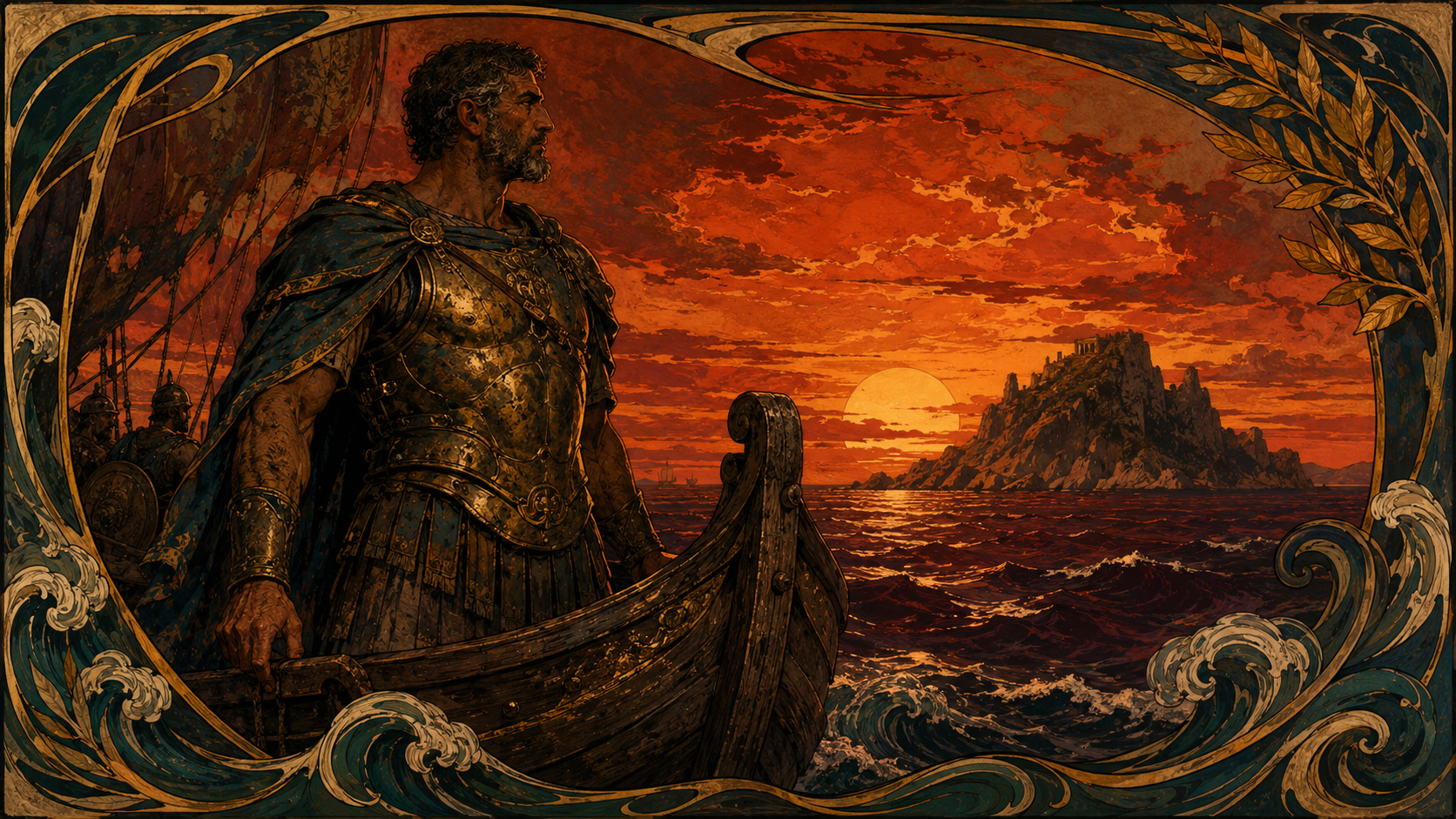
Odysseus is the King of Ithaca, a small island off the western coast of Greece. His father is Laertes, his mother Anticlea, his wife Penelope, and his son Telemachus. In some traditions his grandfather is Autolycus, a legendary thief, which might explain a few things about Odysseus's relationship with the truth. Homer calls him polytropos in the very first line of the Odyssey, a word that translates roughly as "the man of many turns" or "the man of many ways." It means he can adapt to anything, talk to anyone, and become whoever he needs to be. It also means he is slippery, and that is not always a compliment.
Before the Odyssey even begins, Odysseus has already had a full career. He was one of Helen's original suitors and the one who devised the oath that bound all of them to defend whoever she chose, which is how the entire Greek army ended up sailing to Troy when Paris ran off with her. He tried to dodge the draft by pretending to be insane, plowing his fields with salt, until someone placed his infant son Telemachus in front of the plow and Odysseus swerved. He spent ten years at Troy, where he proved himself not just as a fighter but as the Greeks' most valuable strategist. He is the one who came up with the Trojan Horse. That is the man who then turns around and spends another ten years just trying to get home.
His Defining Trait: Cunning Intelligence
The Greek word for what makes Odysseus special is metis, and it does not have a clean English equivalent. It is cunning, cleverness, practical wisdom, and the ability to read a situation and exploit it, all rolled into one. While Achilles is the strongest and Ajax is the toughest, Odysseus is the smartest, and in Homer's world that turns out to matter more than muscle.
Watch him work. Trapped in the Cyclops's cave with a giant eating his men two at a time, Odysseus does not charge in with a sword. He waits, gets Polyphemus drunk on wine, tells him his name is "Nobody," and then drives a sharpened olive stake into the monster's eye while he sleeps. When the other Cyclopes come running and ask who hurt him, Polyphemus screams "Nobody is hurting me!" and they walk away. That is metis in action: patience, deception, and a plan that turns your enemy's own strength against him.
He uses disguise the way other heroes use weapons. He sneaks into Troy dressed as a beggar during the war. He returns to his own palace as a ragged old man and sits among the suitors for days without being recognized. He tests people by telling them lies about who he is and watching how they react. Lying is so natural to him that Athena, his patron goddess, laughs about it to his face. Even among the gods, she says, you would be hard to beat at deception.
His Flaws: Pride, Curiosity, and the Cost of Being Clever
Homer never lets you forget that Odysseus's strengths and his flaws are the same thing. His curiosity is what drives him into the Cyclops's cave in the first place. His men want to grab the cheese and leave. Odysseus insists on staying to meet the cave's owner. Six men die because of that decision.
And then there is the moment that nearly costs him everything. After blinding the Cyclops and escaping on the underside of the sheep, Odysseus is safely on his ship, pulling away from the island. He has won. He should keep sailing. Instead he turns around and screams his real name across the water: "It was Odysseus who blinded you! Odysseus, sacker of cities, son of Laertes, from Ithaca!" Polyphemus grabs a boulder and heaves it toward the voice. But worse than the boulder is the prayer: the Cyclops calls on his father Poseidon to make sure Odysseus never reaches home, or if he does, to make the journey long and bitter. Poseidon hears. Ten years of suffering follow. All because Odysseus could not resist the need to be known.
That tension, between the anonymous survivor and the man who craves recognition, runs through the entire poem. Odysseus is brilliant at being nobody. He is also incapable of staying nobody for long. It is the most human contradiction Homer ever wrote: the desire to be safe fighting against the desire to be seen.
Recommended Reading
As an Amazon Associate, we earn from qualifying purchases.
Odysseus and Penelope
The marriage at the center of the Odyssey is one of the great love stories in all of literature, and Homer builds it almost entirely on absence. Odysseus and Penelope are apart for twenty years. They share only a handful of scenes in the entire poem. And yet everything both of them do is oriented toward each other.
Calypso offers Odysseus immortality if he stays with her. He says no. He says Penelope is not as beautiful as Calypso (he is honest about it), but she is his wife, and he wants to go home to her. That is not a romantic speech. It is something more stubborn and more real: a man choosing a mortal woman and a mortal life over paradise because the mortal life is his.
Penelope, for her part, has held the kingdom together for twenty years through pure intelligence. She invented the weaving trick to stall the suitors. She manages a household under occupation. When Odysseus finally reveals himself, she does not throw herself into his arms. She tests him. She tells a servant to move their marriage bed, knowing that Odysseus is the only person alive who knows the bed cannot be moved because he built it around a living olive tree. When he erupts at the idea of someone cutting that tree, she knows it is him. They are perfectly matched: two people who think before they trust, who test before they believe, who recognize each other not through appearance but through shared knowledge that nobody else has.
Odysseus and Telemachus
Odysseus left for Troy when Telemachus was a baby. He comes back to a young man he has never known. The Odyssey is not just a homecoming story; it is a story about a father and son finding each other for the first time.
When Athena lifts the disguise and Odysseus stands revealed in Eumaeus's hut, Telemachus backs away and says he must be a god. "I am no god," Odysseus tells him. "I am your father." Homer compares their weeping to sea-eagles whose chicks have been stolen from the nest. It is one of the rawest moments in the poem, and it earns its rawness because we have watched Telemachus grow up across the first four books, moving from a passive boy surrounded by enemies to a young man who crosses the sea looking for answers. He was searching for his father. And his father, it turns out, was fighting his way back to him.
What follows is striking. They do not have a long emotional reunion. They dry their eyes, sit down, and start planning. They are outnumbered a hundred to two, and they need a strategy. Odysseus turns his son into a co-conspirator, and Telemachus rises to it. The father-son relationship in the Odyssey is defined not by sentiment but by shared purpose: two people who have been apart for twenty years choosing to trust each other and fight together.
Odysseus and Athena
If Penelope is Odysseus's match in marriage, Athena is his match among the gods. She is the goddess of wisdom, strategy, and craft, and Odysseus is her favorite mortal because he thinks the way she does. Their relationship is one of the warmest in all of Greek mythology, which is saying something for a tradition where gods usually treat humans as toys.
Athena argues for Odysseus in front of Zeus. She guides Telemachus. She stands beside Odysseus in disguise after disguise, and when he finally reaches Ithaca she appears to him and they sit together like old friends, both of them grinning, both of them spinning stories. "We are both clever," she tells him, and it sounds like affection. She does not make the journey easy for him; she lets him suffer through it. But she is always there at the edges, making sure the story comes out right.
Recommended Reading
As an Amazon Associate, we earn from qualifying purchases.
The Journey and What It Cost
Odysseus left Troy with twelve ships and hundreds of men. He arrived home alone. The full timeline of his journey traces every loss along the way. Every single one of his companions died along the way: eaten by the Cyclops, drowned by Poseidon's storms, turned into pigs by Circe (though she changed them back), swallowed by the whirlpool Charybdis, struck down by Zeus for eating the sacred cattle of the sun god Helios. Odysseus survived. They did not.
Homer does not let you feel too comfortable about that. Odysseus makes some genuinely terrible decisions that get his men killed. His curiosity in the Cyclops's cave. His failure to stay awake when his men opened the bag of winds. His inability to prevent them from eating the cattle of the Sun. He is a survivor, but he is not always a good leader, and the Odyssey is honest about the difference.
When Odysseus visits the underworld in Book 11, he meets the ghost of his crewman Elpenor, who fell off Circe's roof and died so unremarkably that Odysseus did not even notice. He meets his own mother, Anticlea, who died of grief while he was away. He meets Achilles, who tells him that being dead is so miserable he would rather be a living slave than the king of all the dead. The underworld scene strips away all the glory and adventure and shows what the journey actually cost: not just the men who died, but the life Odysseus missed. His mother died without him. His son grew up without him. His wife waited twenty years. He got home, but the twenty years he lost are gone forever.
Why He Still Matters
Odysseus invented a type of hero that did not exist before Homer wrote him: the thinker, the survivor, the man who wins not by being the strongest but by being the smartest. Achilles fights and dies gloriously. Odysseus endures and lives. In a world that valued physical courage above everything, Homer created a character whose greatest weapon was his mind, and then spent an entire epic proving that the mind was enough.
But what keeps Odysseus alive in people's imaginations is not his cleverness. It is his stubbornness. He wants to go home. That is it. That is the entire plot of the Odyssey: a man who will not stop trying to get back to the people he loves. He turns down paradise. He swims for two days through a storm. He walks into his own palace as a beggar and sits there being abused by men eating his food, and he does not break cover. He does all of this because he loves his wife, his son, and his rocky little island, and nothing in the world, not even immortality, is worth trading them away.
Three thousand years of readers have recognized that stubbornness. The word "odyssey" entered the language as a word for any long, difficult journey, and it did so because Homer created a character whose journey felt so real that it became the template for everyone else's. Odysseus is not a perfect hero. He is a human one. That is why he lasted.
Read About Odysseus
As an Amazon Associate, we earn from qualifying purchases.
Related Pages
Hear Odysseus Tell His Own Story
All 24 books of the Odyssey, read aloud with a full cast of distinct voices. Hear Odysseus in his own words as he faces the Cyclops, resists the Sirens, and fights his way home. Every word highlights as it is spoken.
Listen NowWear the Hero
Odysseus merch across five product types. T-shirts, posters, mugs, canvas prints, and tote bags.
Shop This DesignMORE ODYSSEY DESIGNS
Hear this character's story in Homer's own words
Go Deeper Into the Odyssey Film
Get the free Odyssey Companion Guide: character map, timeline, family tree, and the essential scenes from Homer's poem and the film.
No spam. Unsubscribe anytime.