What Nostos Meant to the Ancient Greeks
In ancient Greek culture, a person's identity was not something that existed in isolation. You were not simply yourself. You were a son or daughter, a citizen of a specific city, a member of a household, a name in a lineage that stretched back generations. To be separated from that web of relationships was to lose something essential, not just comfort or familiarity, but the very structure that made you who you were.
This is why nostos mattered so intensely. The Trojan War pulled thousands of Greek men away from their homes for ten years. When the war ended, the question of nostos, whether and how those men would return, became the most urgent question in their world. The Odyssey is the greatest nostos story in Greek literature, but it was not the only one. Ancient audiences knew of a whole cycle of nostos poems, now mostly lost, that told the homecoming stories of other heroes. Agamemnon came home and was murdered. Menelaus wandered for eight years before reaching Sparta. Diomedes returned to find his wife had taken a lover. Ajax the Lesser was drowned by Poseidon. Each story posed the same question: what happens when the war is over and you try to go back to the life you left?
The Odyssey gives the most complete answer. It takes twenty years, the destruction of every ship and every companion, the intervention of gods, the endurance of suffering that would break most people, and a final bloody reckoning in his own hall. But Odysseus gets home. And in the logic of the Greek world, that homecoming is worth more than all the glory of Troy.
The Etymology of Nostalgia: Pain Made Into a Word
In 1688, a Swiss medical student named Johannes Hofer was studying a peculiar illness afflicting Swiss mercenaries serving in foreign armies. The soldiers were dying, not from wounds or disease, but from what appeared to be an unbearable longing for home. They stopped eating. They could not sleep. They lost the will to do anything. Hofer needed a name for this condition, so he reached back into Greek and combined two words: nostos, meaning "homecoming," and algos, meaning "pain" or "ache."
He called it nostalgia. The pain of homecoming. Or, more precisely, the pain of wanting to come home and being unable to.
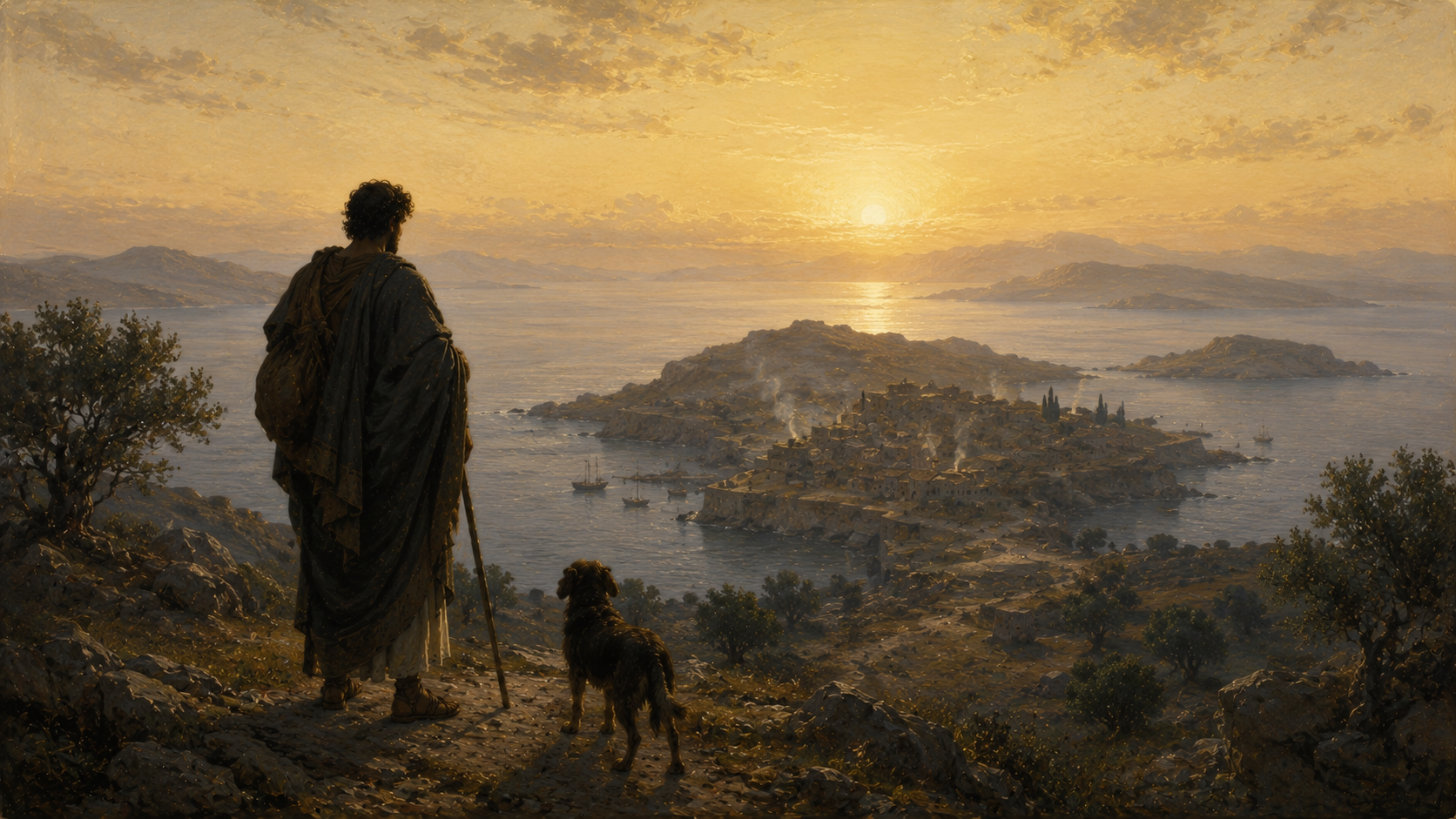
The word caught on because the feeling it described was universal. But what Hofer had done, perhaps without fully realizing it, was name an emotion that Homer had already described with devastating precision nearly three thousand years earlier. When Homer shows us Odysseus sitting on the shore of Calypso's island, weeping as he stares across the water toward a home he cannot reach, he is painting the exact portrait of nostalgia. The ache is not merely emotional. It is physical. Odysseus does not just feel sad. He feels broken. He feels incomplete. Some essential part of him is located in Ithaca, and until he can get there, he is less than himself.
"But he, straining for the sight of even the smoke rising from his own land, longs to die." Homer, The Odyssey, Book 1 (Samuel Butler translation)
Even the smoke. Not the house, not the hearth, not Penelope's face. Just the smoke rising from his own land. It is one of the most restrained and most devastating lines in the poem, because it tells you that nostos is not about luxury or comfort. It is about belonging. The smoke of home means more than all the paradise of Ogygia.
.png)
The ache for home that defines the longest journey in literature
Why Odysseus Keeps Choosing Home
The poem tests Odysseus's commitment to nostos again and again, and each test is designed to make the choice harder. The Lotus-Eaters offer a drug that erases the desire for home entirely. Circe offers a year of comfort and pleasure on her island. Calypso offers immortality itself, an eternity of ease on the most beautiful island in the world. Each offer is genuinely appealing. Each is presented not as a trap but as a reasonable alternative to the pain of continuing the journey.
Odysseus resists them all. Not because he is immune to temptation, but because the pull of nostos is stronger than any alternative. He weeps on Calypso's shore. He spends a year with Circe before his crew reminds him to move on. He is not a stoic who feels nothing. He is a man who feels everything and still chooses the harder path because the destination is the only one that matters.
What makes these tests so effective is that they escalate. The Lotus-Eaters threaten to erase the memory of home. Circe threatens to make another place feel like home. Calypso threatens to make home irrelevant by removing the fundamental condition, mortality, that gives homecoming its urgency. If you live forever, you can always go back later. What is the rush? Odysseus's answer, though he never articulates it this way, is that the rush is the point. Human life is short, and the people you love will not wait forever, and neither will you. Home matters precisely because you can lose it.
The Failed Nostos: Agamemnon's Warning
The Odyssey does not let you forget that nostos can go wrong. The ghost of Agamemnon appears to Odysseus in the underworld and tells his story: he came home from Troy victorious, walked through the doors of his own palace, and was murdered at the feast table by his wife Clytemnestra and her lover Aegisthus. His homecoming was a death trap. The home he longed for had become a place that wanted him dead.
Agamemnon's failed nostos haunts the Odyssey like a shadow version of Odysseus's story. At every level, it serves as a warning. Be careful what you assume about home. The house may look the same, but the people inside it may have changed. Loyalty cannot be taken for granted. The door you walked through when you left may not be the same door when you return.
This is why Odysseus arrives in Ithaca in disguise. He does not walk up to the front door and announce himself. He comes as a beggar, tests the loyalty of his servants, observes the suitors, and plans his strike with the careful patience of a man who has heard Agamemnon's story and taken it to heart. Odysseus's nostos succeeds precisely because he treats homecoming as something that must be earned and fought for, not simply claimed.
The contrast between Odysseus and Agamemnon also extends to their wives. Penelope is faithful, but she is also shrewd. She tests Odysseus just as he tests her. The bed, the olive tree, the shared secret: these are the proofs that their bond survived twenty years of separation. Agamemnon had no such bond. His nostos failed because the home he thought he was returning to no longer existed. Odysseus's nostos succeeds because he and Penelope rebuilt their connection in the very act of proving it.
Telemachus: A Nostos of a Different Kind
Odysseus is not the only character in the poem who achieves a nostos. Telemachus has one too, though his is quieter and easier to overlook. At the beginning of the poem, Telemachus is a young man who has never left Ithaca, who has never known his father, and who lacks the confidence to confront the suitors who are devouring his inheritance. He is, in a sense, already at home. But he is not at home in himself.
Athena sends Telemachus on a journey to Pylos and Sparta, ostensibly to seek news of his father, but really to discover who he is. He meets Nestor, the wise old king who tells him stories of Troy. He meets Menelaus and Helen, who have achieved their own complicated nostos. He hears his father spoken of with respect and admiration by men who knew him. By the time Telemachus returns to Ithaca, he has not found his father, but he has found something just as important: a sense of himself as his father's son, as a person capable of action and leadership.
Telemachus's nostos is a homecoming to identity. He leaves Ithaca as a boy overwhelmed by circumstances he cannot control. He returns as a young man ready to stand beside his father in the fight that is coming. His journey mirrors his father's in miniature: both leave home, both are changed by what they encounter, both return stronger than when they left. The difference is that Odysseus's nostos is about reclaiming a life he already lived. Telemachus's is about stepping into a life he has not yet begun.
The Crew: Those Who Never Come Home
Odysseus's companions are the poem's collective tragedy. They leave Troy alongside their captain, and not one of them makes it back to Ithaca. They are eaten by the Cyclops, drowned in storms, turned into pigs by Circe, pulled down by Scylla, and finally destroyed by Zeus's thunderbolt after eating the cattle of the Sun. Their nostos fails completely.
Homer does not treat the crew's deaths as meaningless. He gives them names, personalities, moments of courage and folly. Eurylochus, who argues with Odysseus and leads the mutiny over the Sun god's cattle, is not a villain. He is a frightened man who is tired of following orders that keep getting his companions killed. Elpenor, who falls off Circe's roof and breaks his neck, is not a fool. He is a young man who drank too much and slept in the wrong place. These are ordinary people caught up in an extraordinary journey, and the poem mourns their loss even as it acknowledges that some of their deaths were consequences of their own choices.
The crew's failed nostos serves a structural purpose in the poem. It makes Odysseus's homecoming feel earned rather than inevitable. If everyone made it home, the journey would feel like a tour. Because the crew does not survive, every mile Odysseus crosses carries the weight of the men who crossed it with him and did not make it to the other side. His nostos is built on their absence.
What "Home" Means After Twenty Years
Perhaps the most difficult question the Odyssey asks about nostos is this: can you truly come home after twenty years away? The Ithaca Odysseus left was a young kingdom with a young king, a baby son, and a new bride. The Ithaca he returns to is a household overrun by parasites, a wife besieged by suitors, a son he does not recognize, and a father so broken by grief that he has retreated to a farm to sleep among servants.
Odysseus himself has changed. He left as a confident young king. He returns as a scarred, weathered survivor who has seen the land of the dead, been offered immortality and refused it, lost every man under his command, and spent seven years weeping on a goddess's island. He is not the man who left. And Penelope, who has spent twenty years managing a household under siege while raising a child alone, is not the woman he left behind.
The recognition scene between Odysseus and Penelope is the poem's most profound meditation on this problem. They do not simply fall into each other's arms. They approach each other cautiously, testing, doubting, needing proof. Penelope's test of the bed is not mistrust. It is wisdom. She knows that twenty years can change a person beyond recognition, and she needs to know that the man in front of her is not just someone who looks like her husband, but someone who carries the memories that only her husband could carry.
When Odysseus passes the test, when he describes the bed he built around the olive tree with an urgency that only the real Odysseus could feel, the nostos is complete. But it is not a return to the past. It is a reunion between two people who have both been changed by the years and who choose each other again, not out of obligation or habit, but out of recognition. They see each other clearly, scars and all, and they choose this. That is what nostos really means. Not going back to what was. Going forward to what still is.
Nostos Beyond the Odyssey: Why the Ache Endures
The reason the Odyssey still moves people after nearly three thousand years is that nostos is not a Greek concept. It is a human one. The longing for home, for belonging, for the place where you are known and recognized, is so fundamental to human experience that it surfaces in every culture and every era. Soldiers returning from war, immigrants who left their countries decades ago, even people who simply moved to a new city and find themselves aching for the sound of a familiar street: they all know what Odysseus felt on that shoreline.
The Odyssey does not promise that nostos will be easy or that home will be unchanged when you arrive. It does not promise that you will be unchanged either. What it promises is that the longing itself is meaningful. That wanting to go home, even when home may be nothing like what you remember, is not weakness or sentimentality. It is the deepest assertion of who you are. You are the person who belongs in a particular place, among particular people, and no amount of wandering, no island paradise, no offer of immortality, can substitute for that belonging.
Homer understood this. He placed the ache for home at the center of the greatest adventure story ever told and made a radical claim: the adventure is not the point. The point is what you are trying to get back to. All the monsters and goddesses and storms and wonders are obstacles on the way to a kitchen table, a marriage bed built around a living tree, and the sound of someone who knows your name speaking it in the dark.
Hear the Longing in Odysseus's Voice
Our full-cast narration brings the ache of nostos to life in a way that reading alone cannot. Hear Odysseus weep on Calypso's shore. Hear him tell the Phaeacians that nothing is sweeter than the land where you were born. Hear the trembling moment when Eurycleia recognizes the scar on his leg and nearly calls his name aloud. Hear Penelope test the stranger with the secret of the olive tree, and hear Odysseus's voice break as he proves who he is. This is what the poem sounds like when it comes home. Every word highlighted as it is spoken.
Related Pages
Hear the Journey Home
Full-cast narration with 60+ character voices. Every word highlighted as it is spoken. Book I is free. Unlock all 24 books for $6.99.
Start Listening FreeContinue the Journey
Hear the complete Odyssey read aloud with 60+ character voices. Every word highlights as it is spoken.
Book I is completely free. No signup required.
Go Deeper Into the Odyssey Film
Get the free Odyssey Companion Guide: character map, timeline, family tree, and the essential scenes from Homer's poem and the film.
No spam. Unsubscribe anytime.