What Kleos Means
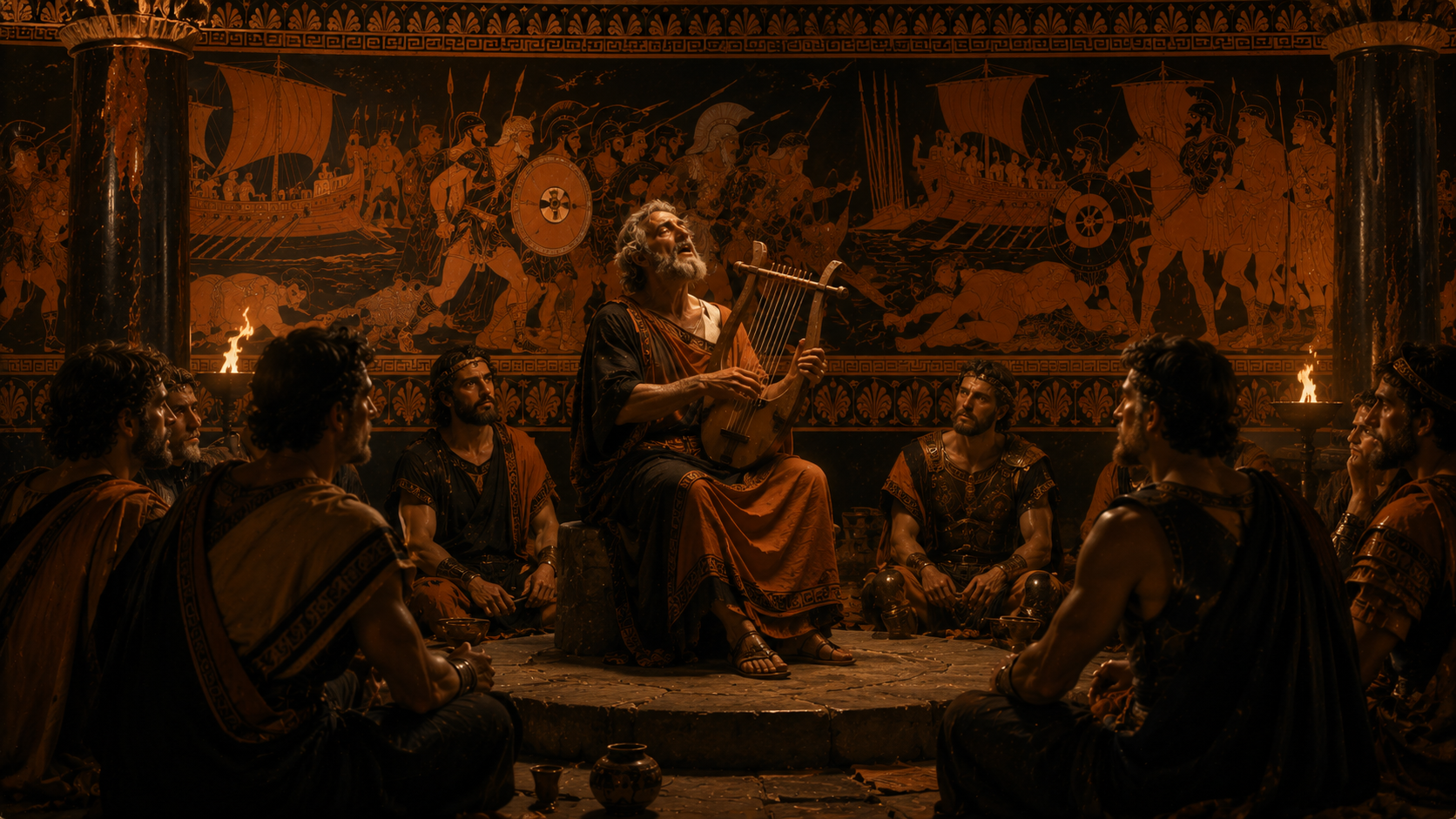
Kleos comes from the Greek verb kluein, meaning "to hear." Your kleos is, quite literally, what people hear about you. It is your reputation carried forward by the voices of others: the song a poet sings about your deeds, the story a father tells his son about the warrior who once stood against impossible odds. In a culture without scripture, without a written tradition in its earliest centuries, kleos was everything. It was the only guarantee that your life meant something beyond its own brief span.
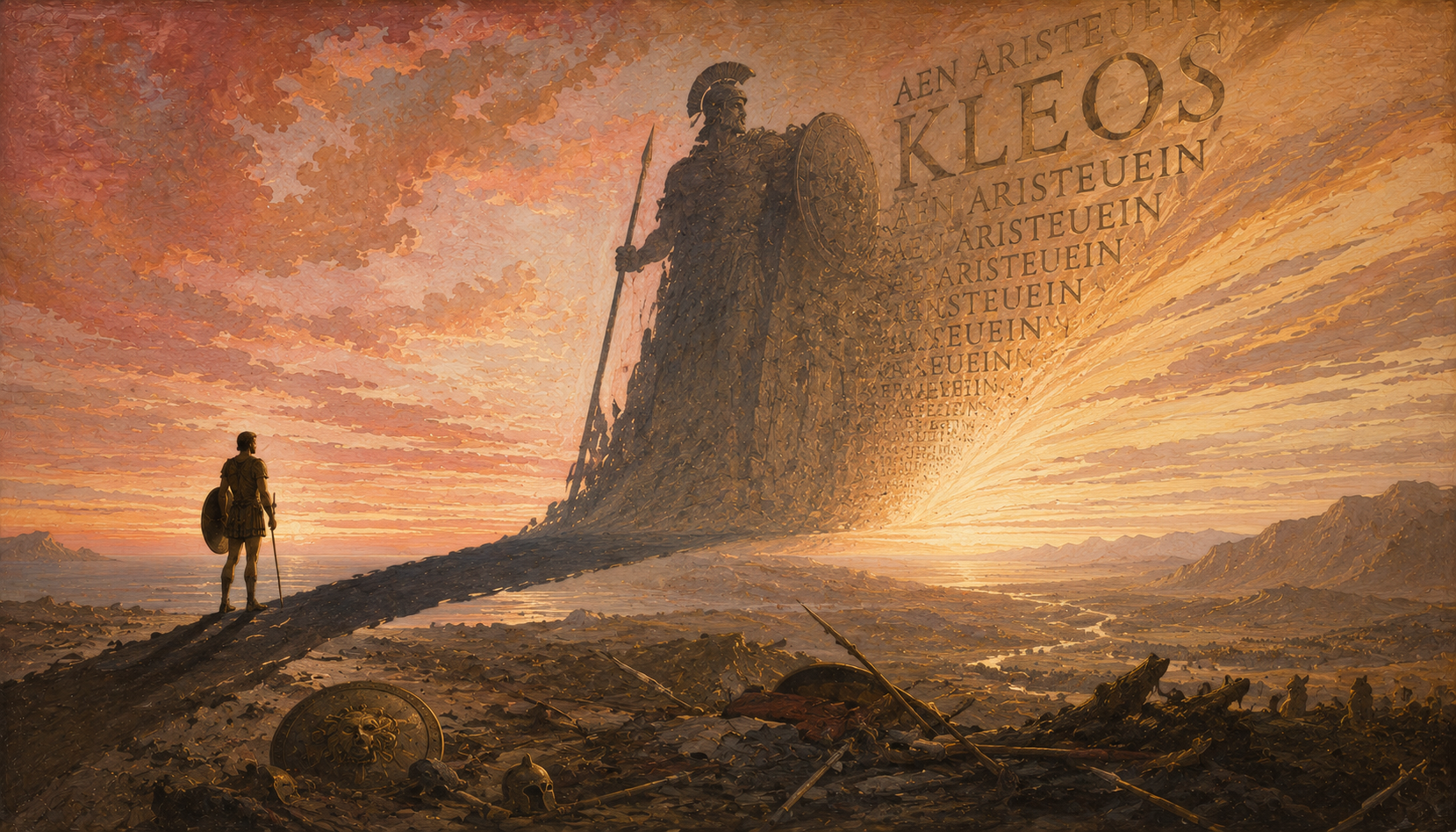
The fullest expression of the idea appears in the phrase kleos aphthiton, "imperishable glory." The word aphthiton means "unwithering," like a flower that never fades. It is a promise that your name will outlast your bones, that the story of what you did will be told and retold long after your body has returned to earth. For the heroes of Greek epic, this was the highest aspiration and the deepest consolation. You cannot live forever, but your story can.
This is not vanity, or at least it is not merely vanity. In the Greek heroic world, kleos is bound up with identity, purpose, and moral seriousness. A man without kleos is a man without a legacy. He lived, and then he died, and nothing remains. The pursuit of kleos is the pursuit of meaning itself, the refusal to accept that death is the final word on who you were.
Kleos: the glory that echoes through eternity
The Iliad's Bargain: Die Young, Shine Forever
The Iliad presents the clearest, most uncompromising version of the kleos bargain. Achilles, the greatest warrior alive, knows from his mother Thetis that he has two possible fates. He can stay at Troy, fight, die young, and win imperishable glory. Or he can go home to Phthia, live a long and quiet life, and be forgotten. There is no middle path. Glory or longevity. Fame or obscurity.
Achilles chooses glory, and the Iliad celebrates that choice even as it mourns the cost. The poem's final image is a funeral, Hector's, and its subject from beginning to end is the wrath and grief that glory requires. To pursue kleos in the Iliad is to accept that you will suffer, that the people you love will suffer, and that the only compensation is a name that echoes through the centuries. Achilles gets his imperishable glory. He also gets the death of Patroclus, his dearest companion, and an early grave on a foreign shore.
For generations of Greek warriors, this was the model. You proved your worth on the battlefield. You fought conspicuously, gloriously, in full view of your peers. You either won honor through victory or honor through a beautiful death. The poetry remembered you, and that memory was your immortality. It is a gorgeous and terrifying bargain, and the Iliad never pretends it is anything less than heartbreaking.
The Odyssey's Counter-Offer: Survive, Endure, Come Home
The Odyssey looks at the Iliad's bargain and asks: what if there is another way? What if glory does not require an early death? What if you can win kleos not by falling on the plains of Troy but by surviving the journey home?
Odysseus is the living refutation of the Iliad's binary. He fought at Troy. He was there for the full ten years. His cunning, the stratagem of the wooden horse, is what finally won the war. And then, instead of dying gloriously, he turned his ship toward Ithaca and spent another ten years trying to get there. His kleos comes not from how he died but from how he lived: from the monsters he outwitted, the temptations he resisted, the suffering he endured, and the home he refused to forget.
This is a radical proposition. In a culture that equated heroism with combat and glory with death, the Odyssey argues that there is heroism in patience, in cleverness, in the stubborn refusal to give up. Odysseus faces the Cyclops, the Sirens, Scylla and Charybdis, the wrath of Poseidon, Circe's magic, and Calypso's offer of immortality. He survives them all, not through brute strength but through intelligence, resilience, and an unbreakable connection to his wife, his son, and his home. And his story, the poem we are still reading nearly three thousand years later, is his kleos.
Recommended Reading
As an Amazon Associate, we earn from qualifying purchases.
Achilles in the Underworld: Glory Reconsidered
The most devastating moment in the Odyssey's treatment of kleos comes in Book 11, when Odysseus descends to the Underworld and meets the shade of Achilles. Odysseus greets the dead hero with admiration, telling him that no man has ever been more fortunate: honored like a god while alive, and now a king among the dead. It is the kind of praise the Iliad would endorse without reservation.
Achilles' response shatters it completely.
"I would rather serve as a hired hand to a landless farmer, a man with nothing, than be king over all the breathless dead." Homer, The Odyssey, Book 11 (Samuel Butler translation, 1900)
This is one of the most extraordinary lines in all of Western literature. The man who chose glory over life, the man whose entire existence was a wager that fame was worth dying for, now says he would trade it all to be alive. Not to be a king alive, not to be a hero alive, but to be a servant, the lowest of the low, if only it meant feeling the sun on his face and the dirt under his feet.
Homer is not contradicting the Iliad. He is completing it. The Iliad shows the beauty of the choice. The Odyssey shows the cost. Achilles made his bargain with full knowledge and absolute commitment, and in the Underworld, he has discovered that no amount of glory can compensate for the loss of life itself. His kleos is imperishable. His happiness is not. And standing before him is Odysseus, the man who chose the other path, who chose life and home and mortality, still breathing, still striving, still on his way home. The contrast could not be sharper.
Odysseus at the Court of the Phaeacians: Earning Kleos Through Story
If Achilles' kleos comes from the battlefield, Odysseus's comes from the banquet hall. Books 9 through 12 of the Odyssey, the great flashback in which Odysseus narrates his wanderings to the Phaeacians, represent a different kind of glory entirely. Odysseus is not fighting. He is talking. He is telling the story of his own suffering, and by telling it, he is creating his own kleos in real time.
This is a profound structural choice. Homer could have narrated Odysseus's adventures in the third person, the way the Iliad narrates its battles. Instead, he puts the story in Odysseus's own mouth. The hero becomes his own poet. He shapes the tale, chooses what to emphasize, decides how to present his triumphs and his failures. When the Phaeacians sit in stunned silence at the end of his narration, they are not just entertained. They are witnesses. They have heard his story, and they will carry it forward. His kleos is not won through dying. It is won through telling.
This idea, that storytelling itself is a form of heroism, runs through the entire Odyssey. The poem is full of singers and stories. Demodocus, the blind bard at the Phaeacian court, sings of the Trojan War while Odysseus weeps behind his cloak. Phemius, the bard in Ithaca, is spared during the slaughter of the suitors because, as he tells Odysseus, a poet is sacred. The poem knows that it is a poem, that it is itself the instrument through which Odysseus's kleos will survive. Homer, whoever he was, understood that the singer and the hero need each other. Without the hero, the singer has nothing to sing. Without the singer, the hero is forgotten.
Penelope's Kleos: Glory Beyond the Battlefield
One of the Odyssey's most radical gestures is to grant kleos to Penelope. In the poem's final book, the shade of Agamemnon in the Underworld speaks about her, and his words are extraordinary. He declares that because of her faithfulness and intelligence, the gods themselves will ensure that poets sing of her virtue for all time. Her kleos, he says, will never die.
Agamemnon knows what he is talking about, because his own wife, Clytemnestra, is the counter-example. When Agamemnon returned from Troy, Clytemnestra murdered him. Her kleos is eternal too, but it is a kleos of shame, a hateful song that will cling to all women in its shadow. Penelope's fame will be the opposite: a song of praise, of endurance, of a loyalty that held when everything around it crumbled.
This is a stunning expansion of the concept of kleos. In the Iliad, kleos belongs to warriors. It is won on the battlefield with sword and spear. The Odyssey says: no. Kleos can also be won through the long, quiet heroism of waiting, through the intelligence of the weaving trick, through the emotional courage of the bed test. Penelope never lifts a weapon. She never sets foot on a battlefield. And yet the poem declares that her fame will last forever, that she has achieved the same imperishable glory as any warrior in the Iliad. It is Homer's way of saying that there is more than one kind of greatness, and more than one way to leave a mark on the world.
Telemachus and the Inheritance of Kleos
Telemachus begins the Odyssey in the shadow of his father's kleos and terrified that he will never measure up. He has grown up hearing stories of the great Odysseus, the sacker of cities, the man of many turns. He lives in a house overrun by men who treat him as a boy, and he has no deeds of his own to point to, no story anyone would want to sing.
The Telemachy, the opening four books of the poem, is the story of a young man learning how to pursue his own kleos. He travels to Pylos and Sparta, where Nestor and Menelaus tell him stories of his father, and something important happens in those conversations. Telemachus begins to understand that kleos is not simply inherited. You do not get glory because your father had it. You earn it through your own actions, your own courage, your own willingness to step into the world and risk something.
By the time Telemachus stands beside his father in the great hall and fights the suitors, he has earned his first measure of kleos. It is not the same as his father's. It does not need to be. The Odyssey suggests that each generation must find its own path to glory, its own story worth telling. Telemachus is not Odysseus, and he does not need to be. He is the son who grew up, crossed the sea, came home, and fought. That is enough for a beginning.
Recommended Reading
As an Amazon Associate, we earn from qualifying purchases.
The Poem Itself as an Act of Kleos
There is a final dimension to kleos in the Odyssey that is easy to overlook because it is so vast: the poem itself is Odysseus's kleos made real. Every time someone reads or hears the Odyssey, Odysseus's glory is renewed. His story has outlasted the civilization that produced it, the language in which it was first sung, and the oral tradition that carried it before writing fixed it in place. Nearly three thousand years after its composition, the Odyssey is still being read, translated, adapted, and performed. That is kleos aphthiton. That is imperishable glory, not as a metaphor, but as a literal fact.
Homer seems to have understood this. The Odyssey is full of moments where characters pause to reflect on the power of story, where bards sing and audiences weep, where the line between living an adventure and narrating one dissolves. When Odysseus weeps at Demodocus's song about the Trojan War, he is weeping at his own kleos being performed in front of him. He is experiencing what it means to have your life turned into art, and the experience is overwhelming.
This self-awareness gives the Odyssey a dimension that few works of literature can match. The poem does not just describe kleos. It enacts kleos. It is the thing it is talking about. Every voice that has ever spoken its lines, every student who has puzzled over its Greek, every listener who has been moved by the sound of the words, is participating in the process of glory that the poem celebrates. To read the Odyssey is to keep Odysseus alive. To listen to it is to be the voice that carries his name forward into the next generation.
Hear the Song That Keeps Them Alive
Our full cast of voices carries the Odyssey forward in the oldest tradition there is: the human voice speaking words into the air. Every line highlighted as it is spoken, every character given a distinct voice, every moment of glory and grief rendered in the medium Homer intended. This is kleos in action: a story being told again, for a new audience, in a new age. Book I is free. The full poem, all twenty-four books, unlocks for $6.99.
Explore Kleos
As an Amazon Associate, we earn from qualifying purchases.
Continue Reading
Hear the Story That Has Lasted Three Thousand Years
Full-cast narration with every word highlighted as it is spoken. Start free with Book I, then unlock all twenty-four books for $6.99.
Start Listening FreeContinue the Journey
Hear the complete Odyssey read aloud with 60+ character voices. Every word highlights as it is spoken.
Book I is completely free. No signup required.
Go Deeper Into the Odyssey Film
Get the free Odyssey Companion Guide: character map, timeline, family tree, and the essential scenes from Homer's poem and the film.
No spam. Unsubscribe anytime.