Why the Odyssey Is Told Out of Order
The technical term for starting a story in the middle of the action is in medias res, which is Latin for "in the middle of things." Homer did not just use this technique. He invented it. The Odyssey does not begin with Troy falling or Odysseus setting sail. It begins in the twentieth year of his absence, with his son growing up fatherless, his wife besieged by suitors, and the gods on Olympus finally deciding to intervene. The famous adventures, from the Cyclops to the Sirens, do not show up until Books 9 through 12, and even then they are told as a flashback: Odysseus sits at a feast among the Phaeacians and narrates his own story.
This is a deliberate choice. Homer wants you to feel the weight of Odysseus's absence before you see what caused it. He wants you to care about Ithaca before you watch Odysseus fight his way back to it. And he wants the flashback to work like memory itself: compressed, emotional, shaped by the teller's perspective. Odysseus is a famous liar, after all. When he tells his own story, you are hearing it through the filter of a man who has survived everything and wants to impress his audience.
The timeline below puts every event in straight chronological order. Use it as a reference, a study aid, or a way to see the whole shape of the story at a glance. Each event links to the book where Homer tells it.
The Complete Chronological Timeline
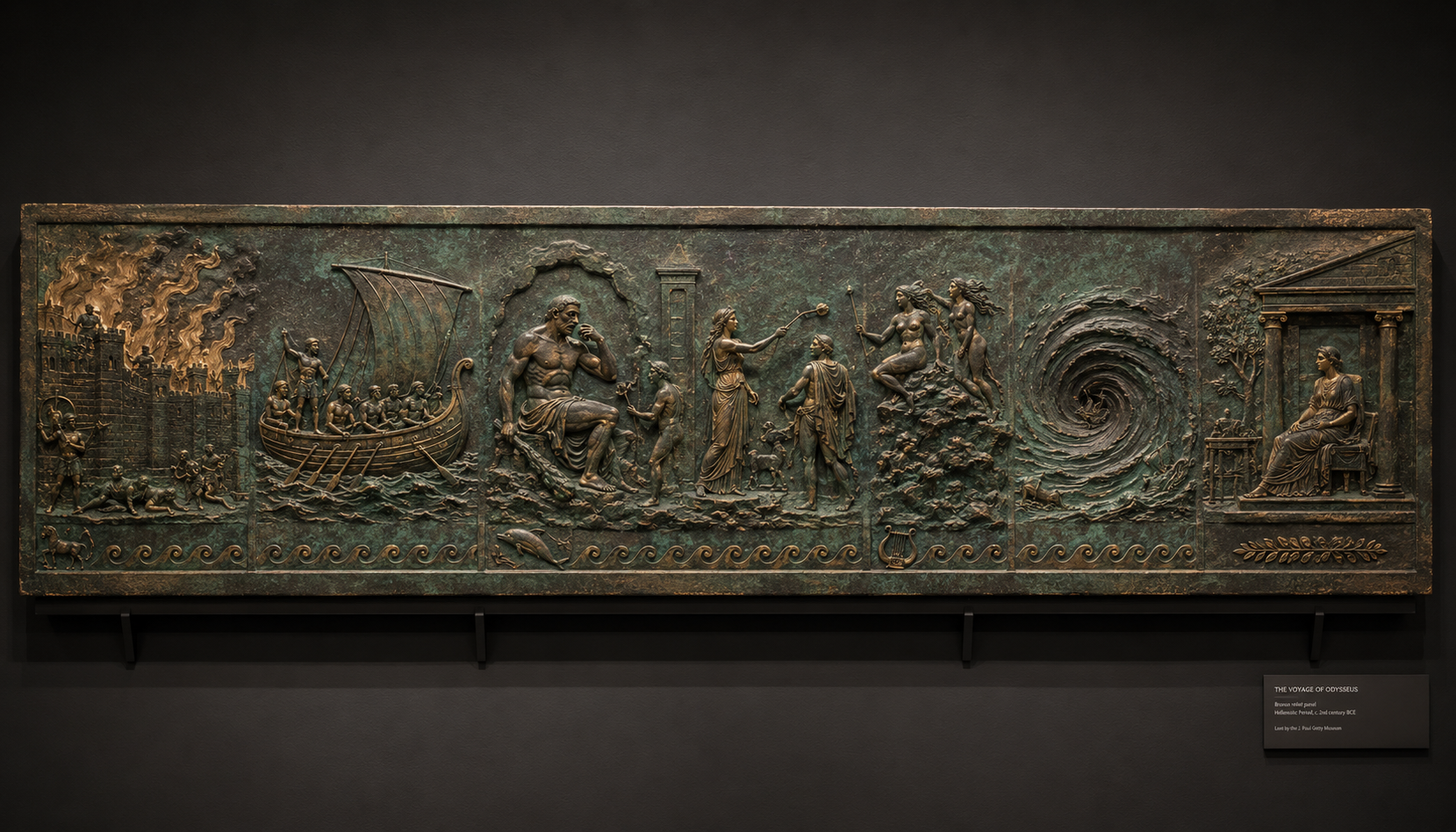
Told in Book IX (flashback) and referenced throughout
The Fall of Troy and Departure
After ten years of siege, the Greeks sack Troy using the wooden horse, a stratagem devised by Odysseus himself. The Greek fleet scatters as the victors sail for home. Odysseus leaves Troy with twelve ships and his Ithakan crew, heading west across the Aegean. He does not know it will take him another ten years to reach his own shore.
Listen to Book IX →
Told in Book IX (flashback)
The Raid on the Cicones
The first stop is Ismarus, city of the Cicones, allies of Troy. Odysseus's men sack the city and divide the plunder. He orders them to leave quickly, but they refuse, choosing to stay on the beach drinking wine and slaughtering cattle. The Cicones regroup, call their inland neighbors, and counterattack at dawn. Six men from each of Odysseus's twelve ships are killed. It is the first lesson of the journey: disobedience costs lives.
Listen to Book IX →
Told in Book IX (flashback)
The Land of the Lotus-Eaters
A storm blows the fleet south for nine days. They land among the Lotus-Eaters, a peaceful people who eat a flower that makes anyone who tastes it forget their home and lose all desire to leave. Some of Odysseus's scouts eat the lotus and have to be dragged back to the ships weeping, strapped to the rowing benches. Odysseus orders an immediate departure. The danger here is not violence. It is forgetting.
Listen to Book IX →
Told in Book IX (flashback)
The Cyclops Polyphemus
The fleet reaches the land of the Cyclopes. Odysseus takes one ship to explore and enters a cave filled with cheese and penned sheep. His men want to steal the food and leave. Odysseus insists on waiting to meet the cave's owner. Polyphemus, a one-eyed giant and son of Poseidon, returns, seals the cave with a boulder, and eats two of Odysseus's men. Over the next two days, Odysseus gets the Cyclops drunk on wine, tells him his name is "Nobody," drives a sharpened olive stake into his eye, and escapes by clinging to the underside of the sheep. But as the ships pull away, Odysseus cannot resist shouting his real name. Polyphemus prays to his father Poseidon: make sure Odysseus never gets home. Poseidon hears. The curse shapes the entire journey.
Listen to Book IX →
Told in Book X (flashback)
The Island of Aeolus and the Bag of Winds
Aeolus, keeper of the winds, entertains Odysseus for a month and gives him an extraordinary gift: a leather bag containing all the winds that could blow him off course. With only the gentle west wind free to push them home, the fleet sails within sight of Ithaca. Odysseus can see the smoke rising from his own hearth. Then he falls asleep. His men, suspicious that the bag holds treasure he is keeping from them, open it. The winds explode out, and a storm blows the fleet all the way back to Aeolus's island. The wind god refuses to help again. You are cursed by the gods, he says. Get out.
Listen to Book X →
Told in Book X (flashback)
The Laestrygonians
The fleet sails to the land of the Laestrygonians, a race of man-eating giants. Eleven of the twelve ships anchor inside a narrow harbor. Odysseus, cautious, moors his own ship outside the harbor entrance. The Laestrygonians hurl boulders down from the cliffs, smashing the ships to splinters and spearing the crews like fish. Only Odysseus's ship escapes. In a matter of minutes, he loses eleven ships and most of his men. He sails on with a single vessel.
Listen to Book X →
Told in Book X (flashback)
Circe's Island: The Enchantress
The surviving ship reaches the island of Aeaea, home of Circe. A scouting party goes to her palace, and she feeds them a drugged feast that turns them into pigs. Only Eurylochus escapes to warn Odysseus. On his way to rescue his men, Odysseus meets the god Hermes, who gives him a plant called moly that protects him from Circe's magic. He resists her spell, draws his sword, and forces her to swear she will do no more harm. She changes the men back. Then something unexpected happens: Odysseus stays on the island for an entire year, feasting and sharing Circe's bed, until his men finally beg him to remember home. Circe tells him he must visit the land of the dead before he can leave.
Listen to Book X →
Told in Book XI (flashback)
The Journey to the Underworld
Odysseus sails to the edge of the world and performs a blood sacrifice to summon the dead. The shades crowd around him. He speaks with the prophet Tiresias, who warns him not to touch the cattle of the sun god and tells him that even after reaching home, his trials will not be finished. He meets his mother Anticlea and learns she died of grief waiting for him to return. He sees Agamemnon's ghost, who tells the bitter story of his murder at his own wife's hands. He meets Achilles, who says he would rather be a living slave than king of all the dead. The underworld scene is the emotional center of the poem: a man standing among ghosts, confronting everything he has lost.
Listen to Book XI →
Told in Book XII (flashback)
The Sirens
Back from the underworld, Odysseus returns briefly to Circe for final instructions. She warns him of three dangers ahead. The first is the Sirens, whose singing lures sailors to crash on the rocks. Odysseus plugs his crew's ears with beeswax but has himself lashed to the mast so he can hear the song. The Sirens sing of knowledge, glory, and everything he has ever wanted. He screams to be untied. His men row harder. They pass through.
Listen to Book XII →
Told in Book XII (flashback)
Scylla and Charybdis
The next danger is a narrow strait between two monsters. Charybdis is a whirlpool that swallows the sea three times a day and could take the whole ship. Scylla is a six-headed creature perched on a cliff who snatches sailors from passing decks. Circe told Odysseus the truth: there is no way through without loss. He chooses to pass closer to Scylla, sacrificing six men to save the ship. He watches the monster snatch them one by one, screaming his name as they are carried up the cliff. It is the moment in the poem where Odysseus's role as a leader costs him the most.
Listen to Book XII →
Told in Book XII (flashback)
The Cattle of the Sun God
The ship reaches Thrinacia, the island of the sun god Helios, where sacred cattle graze on the hillsides. Odysseus, remembering Tiresias's warning, tells his men not to touch the animals. But unfavorable winds strand them on the island for a month. Their provisions run out. Odysseus goes inland to pray. While he is gone, Eurylochus convinces the starving crew to slaughter the cattle. When Odysseus returns and sees the meat on the spits, he knows they are all dead. Zeus waits until they sail, then hurls a thunderbolt that shatters the ship. Every man drowns. Odysseus alone survives, clinging to wreckage. The current carries him backward, past Charybdis (which he narrowly escapes by grabbing an overhanging fig tree), and out to sea.
Listen to Book XII →
Told in Book V and referenced in Books I and VII
Seven Years on Calypso's Island
The sea carries Odysseus to Ogygia, the remote island of the nymph Calypso. She falls in love with him and keeps him there for seven years. She offers him immortality and eternal youth if he will stay. He refuses. Every day he sits on the shore staring at the sea and weeping. When the poem opens in Book 1, this is where Odysseus is: trapped in paradise, dying inside because it is not home. In Book 5, Zeus sends Hermes to order Calypso to let him go. She obeys, grudgingly. Odysseus builds a raft and sails east.
Listen to Book V →
Told in Book V
The Raft, the Storm, and the Swim
Odysseus sails for seventeen days on his raft. Then Poseidon spots him. The god sends a storm that smashes the raft to pieces. Odysseus spends two days and nights swimming through open ocean, kept afloat by a magical veil from the sea nymph Ino. He finally reaches the coast of Scheria, island of the Phaeacians. Battered and naked, he crawls into a thicket of olive bushes, covers himself with leaves, and sleeps.
Listen to Book V →
Told in Books VI through VIII
The Phaeacians: Nausicaa, Alcinous, and the Feast
The princess Nausicaa finds the shipwrecked stranger on the beach and brings him to her father King Alcinous. The Phaeacians are legendary seafarers and generous hosts. They feast Odysseus, entertain him with games and songs, and promise to take him home by ship. During the feast, the bard Demodocus sings about the Trojan War, and Odysseus, hearing his own story told back to him, breaks down and weeps. Alcinous notices and asks the question: who are you? This is the moment Odysseus reveals his identity and begins telling his story, the flashback that fills Books 9 through 12.
Listen to Book VI →
Meanwhile on Ithaca (Books 1 through 4)
While the events above are happening to Odysseus, Homer also shows us what has been happening at home. These events run parallel to Odysseus's time on Calypso's island and his journey to the Phaeacians. Athena descends to Ithaca and inspires Telemachus to stand up to the suitors and search for news of his father. Telemachus sails to Pylos (where old King Nestor gives him stories but no news) and then to Sparta (where Menelaus tells him Odysseus is alive on Calypso's island). While Telemachus is away, the suitors plot to ambush and kill him on his return voyage.
Told in Book XIII
Arrival on Ithaca
The Phaeacians sail Odysseus home while he sleeps. They lay him on the beach of Ithaca with all his gifts. Poseidon, furious, turns the Phaeacian ship to stone as it enters their harbor. Odysseus wakes and does not recognize his own island until Athena appears and tells him where he is. She disguises him as an old beggar so he can enter his palace unrecognized and learn who is loyal and who is not. Twenty years after he left, Odysseus is home. But the hardest part of the journey is not over yet.
Listen to Book XIII →
Told in Books XIV and XV
The Hut of Eumaeus and Telemachus's Return
Disguised as a beggar, Odysseus goes to the hut of Eumaeus, his loyal swineherd, who does not recognize his master but welcomes the stranger with food and a place to sleep. Meanwhile, Athena goes to Sparta and tells Telemachus it is time to come home. She warns him about the suitors' ambush, and he takes a different route, landing safely. Athena directs him to Eumaeus's hut. Father and son are about to meet.
Listen to Book XIV →
Told in Book XVI
Father and Son Reunited
Athena lifts the disguise and Odysseus stands revealed before Telemachus. "I am no god. I am your father." They weep in each other's arms. Then they plan. Odysseus will enter the palace as a beggar. Telemachus will remove the weapons from the great hall. When the signal comes, they will fight together.
Listen to Book XVI →
Told in Book XVII
Return to the Palace and the Death of Argos
Odysseus, disguised again, walks to his own palace. Outside the gate, his old hunting dog Argos lies on a dungheap, too weak to stand. The dog recognizes his master after twenty years, wags his tail, and dies. Inside, Odysseus begs among the suitors and is struck by Antinous, who throws a footstool at him. Penelope hears about the stranger and wants to speak with him.
Listen to Book XVII →
Told in Books XVIII and XIX
Testing Loyalties and the Scar
Odysseus fights the beggar Irus and wins with a single punch. Penelope comes downstairs and shames the suitors into bringing her gifts. That night, Penelope sits with the disguised Odysseus by the fire. He tells her a false story about meeting her husband, describing Odysseus's brooch and cloak in detail that only a witness would know. She weeps. Old Eurycleia washes the stranger's feet and finds the boar-hunt scar on his thigh. She recognizes him instantly. Odysseus grabs her mouth before she can cry out. Penelope announces the contest of the bow.
Listen to Book XIX →
Told in Books XX and XXI
The Last Feast and the Contest of the Bow
The suitors eat their final meal. The prophet Theoclymenus sees a vision of blood on the walls and ghosts filing toward the underworld. They laugh at him. Then Penelope brings out the great bow and announces: whoever can string it and shoot through twelve axe-heads wins her hand. Every suitor tries and fails. The disguised Odysseus asks for a turn. He strings the bow without effort, like a musician tuning a lyre, and sends an arrow cleanly through all twelve axe-heads. Eumaeus and the cowherd bar the doors. Telemachus reaches for his sword.
Listen to Book XXI →
Told in Book XXII
The Slaughter of the Suitors
Odysseus drops his disguise and puts an arrow through Antinous's throat. The suitors scramble for weapons and find the walls bare. Odysseus, Telemachus, Eumaeus, and the cowherd Philoetius fight the entire crowd. Athena appears, and the rout becomes total. Every suitor dies in the hall. The disloyal maids are forced to clean the blood from the flagstones and are then hanged in the courtyard. The palace is purified with fire and sulfur.
Listen to Book XXII →
Told in Book XXIII
The Reunion with Penelope
Eurycleia runs upstairs to tell Penelope that Odysseus has returned and the suitors are dead. Penelope comes downstairs and sits across from her husband, studying him in silence. She is cautious. She has been deceived before. She tests him: she tells a servant to move their marriage bed. Odysseus erupts. He built that bed himself around a living olive tree rooted in the ground. Nobody could move it. That is the secret only the two of them share. Penelope's knees give way, and she throws her arms around him and weeps. They are together again. Homer says the dawn would have found them still talking if Athena had not held back the night.
Listen to Book XXIII →
Told in Book XXIV
Peace Restored
Hermes leads the ghosts of the dead suitors to the underworld. Odysseus travels to the country estate of his aged father Laertes, reveals himself (after yet another test), and embraces the old man. The families of the slain suitors march on the estate seeking revenge. A brief battle breaks out. Then Athena, on Zeus's orders, steps between the two sides and demands peace. Both sides put down their weapons. Oaths are sworn. The Odyssey ends not with a battle cry but with a covenant: order restored, a kingdom whole again, and Odysseus finally, irrevocably home.
Listen to Book XXIV →
The Whole Journey at a Glance
Twenty years. Ten at war, ten getting home. Twelve ships lost. Every companion dead. A wife who waited. A son who searched. A dog who held on just long enough. And a man whose greatest weapon was not his strength or his sword but his refusal to stop. That is the Odyssey, start to finish.
Homer could have told it in order. He chose not to. He started in the middle because the middle is where the pain is, and the past only matters when you feel its weight in the present. Now that you have the timeline, go back and read the poem the way Homer arranged it. Our book-by-book guide follows Homer's own order. You will see why he made the choices he did.
Explore the Odyssey
As an Amazon Associate, we earn from qualifying purchases.
Follow the Journey in Homer's Own Order
All 24 books of the Odyssey, read aloud with a full cast of distinct voices. Every word highlights as it is spoken. Start from Book 1 or jump to any adventure on the timeline.
Listen Now
Continue the Journey
Hear the complete Odyssey read aloud with 60+ character voices. Every word highlights as it is spoken.
Book I is completely free. No signup required.
Go Deeper Into the Odyssey Film
Get the free Odyssey Companion Guide: character map, timeline, family tree, and the essential scenes from Homer's poem and the film.
No spam. Unsubscribe anytime.