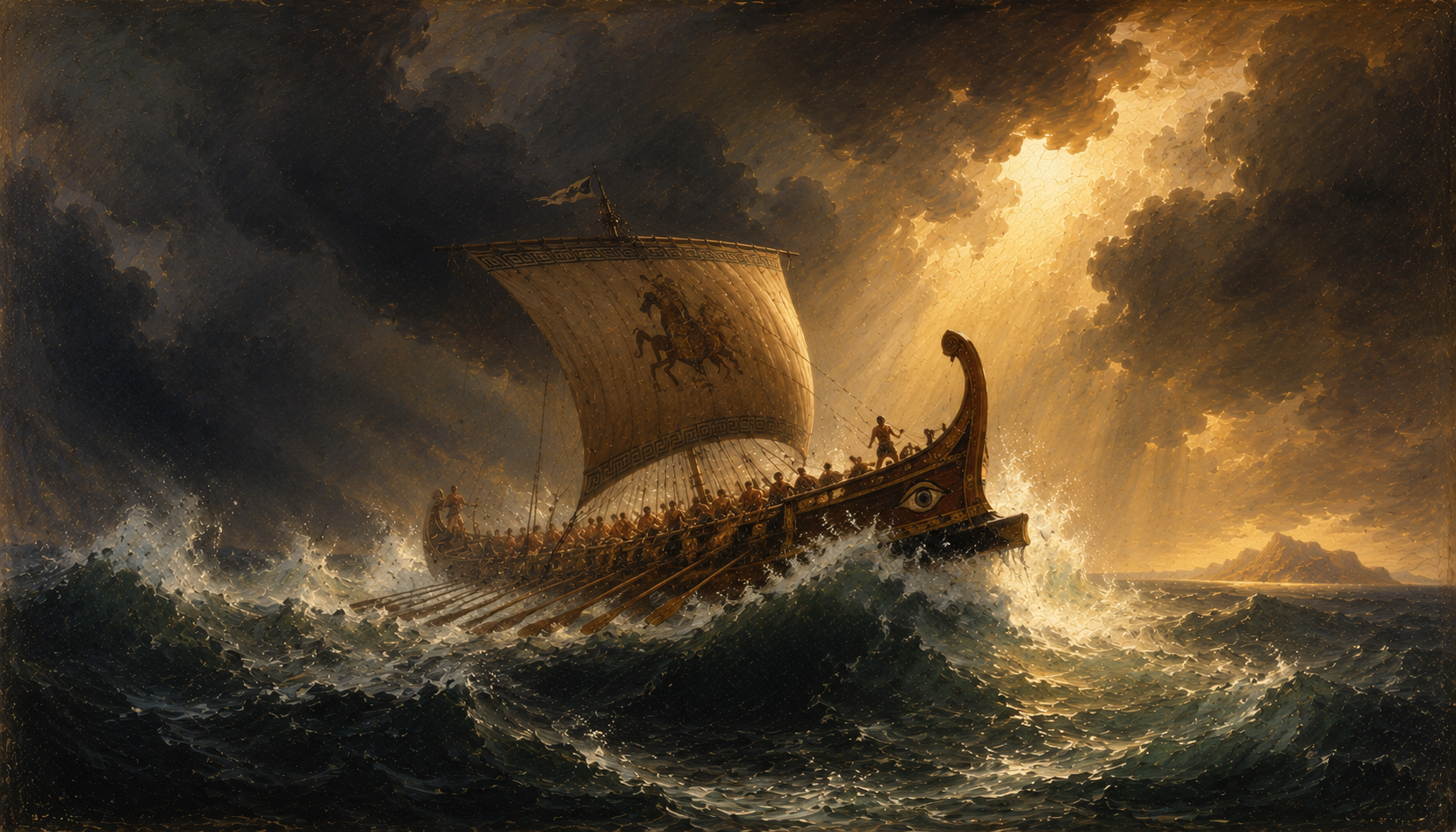
What We Know About the Film
Christopher Nolan announced The Odyssey as his next project following the extraordinary success of Oppenheimer, which won seven Academy Awards including Best Picture and Best Director. The film was produced by Universal Pictures and released worldwide on July 17, 2026. Tickets are available now on Fandango.
Nolan has described the project as a mythic action epic, shot using IMAX film technology. This is consistent with his established approach of using large-format film to capture images of extraordinary scale and detail. Given the Odyssey's settings, including open ocean, volcanic islands, vast palaces, and the underworld itself, the IMAX format is a natural fit for a story that operates at the boundary between the human and the mythological.
Matt Damon leads the cast, which also includes Anne Hathaway, Tom Holland, Zendaya, Lupita Nyong'o, Robert Pattinson, and Charlize Theron, among others. Specific character assignments have not been comprehensively detailed by the production, though Damon's role as Odysseus has been widely reported.
Beyond these confirmed details, the production was characteristically tight-lipped in the lead-up to release. What we can say with confidence is that the film draws from Homer's poem and that it was made at the highest level of cinematic ambition.
What Is the Odyssey, Exactly?
The Odyssey is an epic poem attributed to Homer, composed around the 8th century BCE, roughly 2,800 years ago. It is one of the two foundational works of Western literature (the other being Homer's Iliad). The poem consists of 24 books and approximately 12,110 lines of dactylic hexameter verse. It was originally performed orally, likely over the course of several evenings, by professional bards who recited it from memory.
The story follows Odysseus, king of Ithaca, on his ten-year journey home after the Trojan War. The war itself lasted ten years, so by the time Odysseus reaches his front door, he has been gone for twenty years. Along the way, he encounters the Cyclops Polyphemus, the sorceress Circe, the goddess Calypso, the Sirens, the monster Scylla, the whirlpool Charybdis, and the dead themselves. Meanwhile, back in Ithaca, his wife Penelope holds off over a hundred suitors who want to marry her and claim the throne, and his son Telemachus grows from a boy into a man capable of standing beside his father.
The poem is not told in chronological order. Homer begins in the middle of the story, with Odysseus trapped on Calypso's island and Telemachus setting out to find news of his father. The flashback structure, where Odysseus narrates his own earlier adventures to an audience within the poem, is one of the Odyssey's most influential narrative innovations. Nearly every nonlinear story told since owes something to Homer's technique.
Why Read the Poem With the Film
You do not need to read the Odyssey to enjoy a well-made movie. Nolan is one of the most skilled filmmakers alive, and he makes the story accessible on its own terms. But knowing the source material transforms the experience of any adaptation, from passive viewing into active engagement.
First, the Odyssey is built on dramatic irony. Homer constantly lets the audience know more than the characters do. When Odysseus arrives in Ithaca disguised as a beggar, we know who he is. The suitors do not. Every insult they throw at him, every cup they hurl, every plan they whisper about killing Telemachus, is charged with the knowledge of what is coming. If the film preserves this structure, and it would be strange not to, a viewer who knows the poem will feel the tension in every scene.
Second, the poem's themes are layered and reward familiarity. The Odyssey is about homecoming, about hospitality, about loyalty, about the difference between appearance and truth. These themes do not announce themselves with title cards. They emerge through patterns, repetitions, and echoes that a reader who knows the poem will recognize instantly.
Third, knowing the poem lets you appreciate what Nolan chooses to change. Every adaptation makes choices: what to include, what to cut, what to rearrange, what to reinterpret. These choices are invisible to someone who does not know the original. To someone who does, they are the most interesting part of the experience. Watching an adaptation with the source in mind turns the film into a conversation between two artists, Homer and Nolan, separated by millennia but working with the same raw material.
Recommended Reading
As an Amazon Associate, we earn from qualifying purchases.
The Scenes Most Likely to Appear
No adaptation can include all 24 books of the Odyssey. The poem is too dense, too episodic, and too long. Every filmmaker who has approached this material has had to choose. Without knowing the script, we can look at which episodes have proven most essential across centuries of Odyssey adaptations and which are the most visually and dramatically powerful.
The Cyclops cave is almost certain to appear. It is the most famous episode in the poem, the scene most people picture when they think of the Odyssey. Odysseus trapped in a cave with a one-eyed giant, devising the Nobody trick, blinding Polyphemus with a sharpened stake, escaping under the bellies of sheep. It is pure cinema: confined space, escalating danger, a brilliant escape plan, and a fatal moment of pride when Odysseus shouts his real name as he sails away.
The Sirens are similarly iconic. Odysseus tied to the mast, his crew's ears plugged with beeswax, the ship gliding past voices that promise knowledge of all things. The image is so powerful that it has become a permanent part of Western visual culture. For IMAX, the possibilities are extraordinary.
The descent to the underworld, where Odysseus speaks with the dead, including his own mother and the ghost of Achilles, is one of the most emotionally resonant sections of the poem. It is also visually unlike anything else in the story, a journey into a landscape of shadow and grief that would give a filmmaker like Nolan enormous creative range.
The homecoming itself, Odysseus's return to Ithaca in disguise, the test of the bow, and the slaughter of the suitors, is the dramatic climax of the entire poem. It is the moment everything has been building toward for twenty years of story time. Any adaptation worth its salt will build to this scene, and it is here that the emotional weight of the poem lands hardest.
How Past Adaptations Have Handled Homer
The Odyssey has been adapted many times, though rarely as a straightforward retelling. The most successful adaptations have tended to use Homer's structure, themes, or characters as a framework for something new rather than attempting a literal translation from poem to screen.
Joel and Ethan Coen's O Brother, Where Art Thou? (2000) transplanted the Odyssey to Depression-era Mississippi, with George Clooney as a fast-talking escaped convict making his way home to his wife. The film kept the Cyclops (as a one-eyed Bible salesman), the Sirens (as women washing clothes by a river), and the structure of episodic encounters on a long road home. It worked because it understood that the Odyssey's deep structure, a man trying to get home, encountering wonders and dangers along the way, is portable across time and place.
The 1997 television miniseries The Odyssey, starring Armand Assante, attempted a more faithful retelling and remains one of the most complete screen versions of the poem. It was ambitious for its time and budget, and it captured many of the key episodes, though the special effects have inevitably aged.
Troy (2004) dealt with the Iliad rather than the Odyssey, but its approach is instructive. The film stripped out the gods almost entirely, grounding the story in human motivations and historical warfare. Whether Nolan takes a similar approach or embraces the supernatural elements of Homer's world is one of the most interesting things to watch for in the theater.
Uberto Pasolini's The Return (2024), starring Ralph Fiennes, focused specifically on the homecoming portion of the story, Odysseus's arrival in Ithaca, his disguise as a beggar, and his reunion with Penelope. It proved that even a single thread of the Odyssey contains enough material for a complete and moving film.
Nolan and the Problem of Scale
One of the great challenges of adapting the Odyssey is that it operates on two very different registers. Half the poem is a fantastical adventure: monsters, magic, divine interventions, journeys to the land of the dead. The other half is an intimate domestic drama: a wife holding her household together, a son growing up, a husband in disguise in his own home, testing who has been faithful and who has not.
Most adaptations have leaned one way or the other. The adventure films focus on the monsters and the spectacle. The quieter films focus on the homecoming and the human relationships. Very few have managed both.
Nolan is one of the few filmmakers who might pull it off. His career has been defined by films that combine massive spectacle with deeply personal stories. Interstellar sent a man across the galaxy and anchored the entire film in a father's love for his daughter. Dunkirk staged one of the largest military evacuations in history and kept the emotional scale painfully intimate. Oppenheimer balanced the physics of the atomic bomb with the psychology of the man who built it. The Odyssey demands exactly this combination: a film that can show you Scylla snatching men from a ship and then, an hour later, make you weep at a husband and wife recognizing each other after twenty years apart.
Recommended Reading
As an Amazon Associate, we earn from qualifying purchases.
The Original Is Always Worth Experiencing
Films come and go. The Odyssey has been here for nearly three thousand years. However extraordinary the film, it is one interpretation of a poem that has already inspired thousands of interpretations and will inspire thousands more. The source is inexhaustible.
The poem itself is not difficult. It was composed for a general audience, performed at festivals and feasts, designed to be heard by people who ranged from kings to farmers. The language, especially in modern translations by scholars like Emily Wilson, Richmond Lattimore, or Samuel Butler, is clear, vivid, and immediate. You do not need a classics degree to read the Odyssey. You just need a few evenings.
"Sing to me of the man, Muse, the man of twists and turns, driven time and again off course, once he had plundered the hallowed heights of Troy." Homer, The Odyssey, Book 1 (Samuel Butler translation, 1900)
Or, if you prefer to listen, you can hear the entire poem performed with a full cast of 60+ character voices, every word highlighted as it is spoken, in the Homer's Odyssey: Read Aloud app. Book I is free. The complete poem, all 24 books, is $6.99. You can hear the original before your next viewing. And when the lights go down in the theater, every scene carries the weight of the original behind it.
A Note on What We Do Not Know
It is worth being honest about the limits of what anyone outside the production can say. We do not know how closely the film follows Homer's plot. We do not know whether the gods appear as characters or are handled through other means. We do not know which episodes are included and which are left out. We do not know whether the film uses Homer's nonlinear structure or tells the story chronologically. We do not know the runtime, the score, the visual style, or the tone.
What we know is that Nolan has chosen one of the greatest stories ever told, and he had the resources, the cast, and the format to do it at a scale never attempted before. The rest is now on screen. The source is waiting whenever you are.
In the meantime, the best preparation is the simplest: go to the source. Read the poem. Or better yet, hear it.
Read the Poem, See the Film
As an Amazon Associate, we earn from qualifying purchases.
Continue Reading
See It on the Big Screen
The Odyssey is now playing in theaters and IMAX nationwide.
Get Tickets on FandangoHear the Poem Behind the Film
Full-cast narration with 60+ character voices. Every word highlighted as it is spoken. Book I is free. All 24 books for $6.99. Hear it before your next viewing.
Start Listening FreeContinue the Journey
Hear the complete Odyssey read aloud with 60+ character voices. Every word highlights as it is spoken.
Book I is completely free. No signup required.
The Odyssey Film Guide
Get the free Odyssey Film Guide: character map, timeline, family tree, and the essential scenes from the film.
No spam. Unsubscribe anytime.
The Odyssey Collection
Wear the characters from the film. T-shirts, posters, mugs, canvas prints, and tote bags.
Browse All ProductsFEATURED DESIGNS
SCENES & THEMES