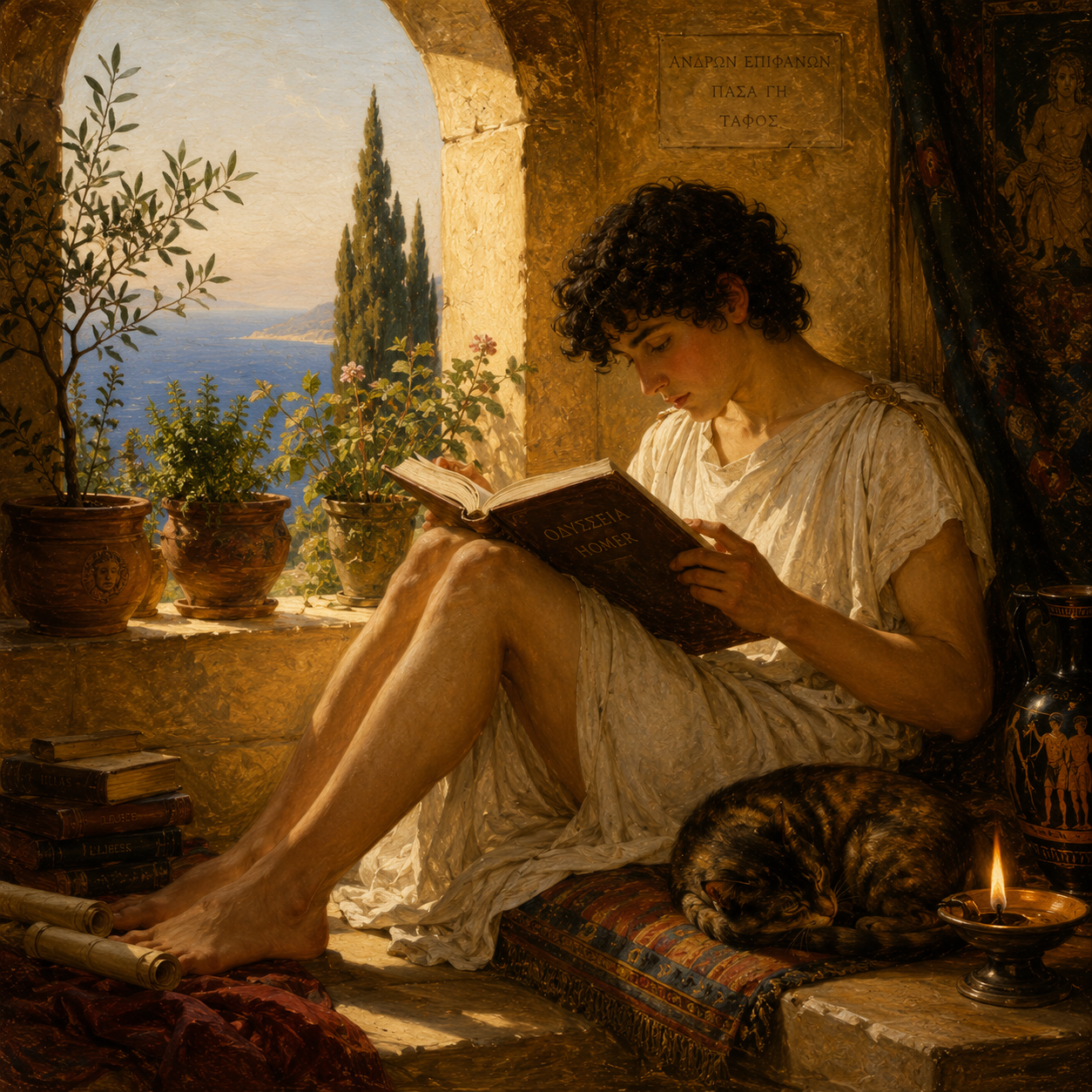
What Is This Book, Exactly?
The Odyssey is an epic poem composed by Homer, a Greek poet who lived around the 8th century BCE. That makes it roughly 2,800 years old, which sounds like it should feel dusty and impossible to read. It does not. The Odyssey is an adventure story about a man named Odysseus trying to get home after fighting in the Trojan War. His journey takes ten years because the god of the sea is angry at him, and along the way he faces one-eyed giants, enchantresses who turn men into pigs, six-headed sea monsters, and the temptation of never dying. Back home, his wife Penelope is fending off a house full of men who want to marry her and take the throne, and his son Telemachus is growing up without a father.
The poem has 24 books (think of them as chapters). It was originally performed out loud by traveling poets who chanted it from memory at feasts and festivals. Nobody wrote it down for generations. That matters because the Odyssey was designed to be heard. The rhythms, the repeated phrases ("rosy-fingered dawn," "the wine-dark sea"), the way the story builds through repetition and surprise: all of it works better when you hear it than when you read it silently off a page. That is worth remembering when you feel stuck.
Why Schools Teach It
Schools do not assign the Odyssey because it is old. They assign it because it does things that no other book does as well. It invented the flashback. It invented the idea of starting a story in the middle and working backward. It created the template for the hero's journey that every adventure story since has followed, from Star Wars to The Lord of the Rings. If you have ever watched a movie where the hero goes on a quest, faces trials, nearly dies, and comes home changed, you are watching a story that the Odyssey told first.
It also teaches you how to read complicated narratives. The Odyssey has multiple storylines running at the same time. It shifts between points of view. It has an unreliable narrator (Odysseus tells his own adventure stories, and he is a famous liar). It plays with time, jumping between past and present. Learning to follow all of that trains your brain for the kind of complex reading you will do for the rest of your life.
And then there are the themes. The Odyssey is about identity, loyalty, temptation, revenge, justice, the relationship between parents and children, and what home actually means. Our study guide digs into all of these, and our themes of the Odyssey page explores each one in depth. Every one of those themes is relevant to a teenager figuring out who they are, and that is not an accident. Teachers have been watching students connect with this poem for generations.
How to Read It Without Getting Lost
The biggest challenge for first-time readers is the names. There are a lot of them, and they are Greek, which means they do not sound like names you are used to. Telemachus, Polyphemus, Eumaeus, Eurycleia, Antinous. Do not try to memorize them all at once. Focus on the main cast: Odysseus (the hero), Penelope (his wife), Telemachus (his son), Athena (the goddess who helps him), and Poseidon (the god who hates him). Everyone else will sort themselves out as you go. Our glossary of Odyssey terms has every name, place, and concept with pronunciation hints.
The second challenge is the structure. The Odyssey does not start at the beginning of the story. It starts ten years after the Trojan War, with Odysseus trapped on an island and his family in crisis at home. The early books follow Telemachus, not Odysseus. The famous adventures (the Cyclops, the Sirens, Circe) do not show up until Books 9 through 12, and they are told as a flashback. This is confusing if you expect a straight timeline, but it was a deliberate choice. Homer wanted you to understand what Odysseus lost before showing you what he went through.
Here is a practical tip: before you start each book, read a one-paragraph summary of what happens. Our book-by-book guide gives you exactly that. Knowing what is coming lets you focus on how Homer tells the story instead of scrambling to follow the plot. This is not cheating. Homer's original audiences already knew the story. They came for the telling.
Recommended Reading
As an Amazon Associate, we earn from qualifying purchases.
Tips for Students
Read it out loud. Even just a few paragraphs at a time. The Odyssey was built for the ear, not the eye. You will be amazed at how much easier it is to follow when you hear the rhythms. Better yet, listen to an audio version while following along with the text. The combination of seeing and hearing locks the story into your memory in a way that silent reading alone does not.
Do not skip the "boring" parts. The books about Telemachus visiting old kings (Books 3 and 4) feel slow compared to the Cyclops or the Sirens, but they are doing something important. They are showing you a young man growing up and learning what it means to be his father's son. When Telemachus and Odysseus finally meet in Book 16, it only hits as hard as it does because you watched both of them get there.
Keep a character list. Write down each new name with a one-line description. "Eumaeus: the loyal pig farmer. Antinous: the worst suitor. Eurycleia: the old nurse who recognizes Odysseus by his scar." You will not need it after the first few books, but it keeps you from getting tangled early on.
Pay attention to disguises and recognition. Almost the entire second half of the Odyssey is about who recognizes Odysseus and when. His dog Argos knows him. His nurse Eurycleia knows him by a scar on his leg. Penelope tests him with a secret about their bed. These recognition scenes are the emotional heart of the poem, and Homer spaces them out beautifully. Watch for them.
Tips for Teachers
Start with the monsters. If you are introducing the Odyssey to a class that has never read Homer, start with Book 9 (the Cyclops). It is the most immediately gripping section, it works as a standalone episode, and it hooks students on Odysseus's character before they have to deal with the more complex structural elements. You can always circle back to Books 1 through 4 once they are invested.
Use audio. The Odyssey was oral poetry first. Having students listen to sections read aloud, with different voices for different characters, makes the experience feel closer to what Homer intended. It also helps struggling readers access the text without giving up. Our reader highlights each word as it is spoken, which makes it easy to follow along and stay oriented in the text.
Lean into the debates. Is Odysseus a good leader? Is Penelope smarter than he is? Are the suitors villains or just a product of their culture? Was Odysseus right to kill all of them? Students light up when they realize this poem does not hand them easy answers. Our collection of key quotes provides excellent starting points for classroom discussion. Use that. Set up formal debates. Let students take sides. The Odyssey rewards argument because Homer built moral ambiguity into every major scene.
Connect it to things they already know. The Odyssey is the ancestor of every quest narrative your students have ever consumed. Percy Jackson borrows from it directly. The Lord of the Rings follows its structure. Even video game quest lines use the same pattern of trials, temptations, and homecoming. Making those connections explicit gives students a framework for understanding why this old poem still matters.
Tips for Parents
If your kid just got assigned the Odyssey and is staring at it with dread, the single best thing you can do is make it a shared experience. Read it together, even casually. Or listen to the audiobook version in the car. (Not sure which translation to pick? We compare the top four.) You do not need to be a scholar. You just need to be curious alongside them.
The Odyssey does contain violence: men get eaten by a Cyclops, a battle scene at the end is bloody and brutal, and the suitors are killed in their seats. It also has references to sexual relationships (Odysseus spends time with the enchantress Circe and the nymph Calypso). None of it is gratuitous, but it is there. For most middle and high school students, this content is well within what they encounter in movies and games. If you have a younger or more sensitive reader, skimming ahead or reading a summary of the rougher scenes lets you decide what to discuss.
At its core, the Odyssey is a story about a father trying to get back to his family and a son searching for the father he never knew. Those are themes that open up real conversations about what family means, what loyalty looks like, and why some things are worth fighting for. If your kid asks a question about the poem over dinner, lean into it. That is the Odyssey working exactly the way Homer intended.
Recommended Reading
As an Amazon Associate, we earn from qualifying purchases.
Why Listening Changes Everything
Here is a fact that often gets lost: the Odyssey was never meant to be read. It was meant to be performed. For hundreds of years before anyone wrote it down, bards chanted this poem from memory at feasts, weddings, and festivals. The audience did not sit quietly with a book. They listened, leaning in, the way you lean into a campfire story. The poem was built for that experience, and when you hear it performed well, you feel the difference instantly.
Students who struggle with the text on a page often find that listening unlocks it. The unfamiliar names suddenly have a pronunciation. The long sentences have a rhythm that guides you through them. The dialogue comes alive when different characters have different voices. And the scenes that feel flat in print, like the reunion between Odysseus and Telemachus, become genuinely moving when you hear the emotion in the words.
Our audiobook reader is designed with exactly this in mind. Each word highlights as it is spoken, so you never lose your place. Each character has a distinct voice, so you always know who is talking. You can follow along with the text, or just close your eyes and listen. Either way, you are experiencing the Odyssey the way Homer's audiences did: through sound, through voice, through the oldest form of storytelling there is.
Student Resources
As an Amazon Associate, we earn from qualifying purchases.
Related Pages
Hear Homer the Way He Was Meant to Be Heard
All 24 books of the Odyssey, read aloud with a full cast of distinct voices, every word highlighting as it is spoken. Pick any book, press play, and let the story do the rest.
Listen NowTAKE YOUR STUDY FURTHER
Downloadable guides, essay prompts, and classroom-ready materials for the Odyssey.
Continue the Journey
Hear the complete Odyssey read aloud with 60+ character voices. Every word highlights as it is spoken.
Book I is completely free. No signup required.
Go Deeper Into the Odyssey Film
Get the free Odyssey Companion Guide: character map, timeline, family tree, and the essential scenes from Homer's poem and the film.
No spam. Unsubscribe anytime.