Last updated June 2026
Book 21: The Contest of the Bow
Penelope has spent twenty years waiting for Odysseus. Now, with Athena's quiet nudging, she goes upstairs, retrieves Odysseus's great bow from the storeroom, and carries it down to the hall full of suitors. The bow itself has a history. It was a gift from Iphitus, a friend Odysseus met in Messene years ago, and Odysseus valued it too much to take it to Troy. It has been hanging on a peg in the storeroom for two decades.
Penelope announces her terms: whoever can string the bow and shoot an arrow through twelve axe heads will win her hand. She is offering herself as the prize, but there is something deeply layered about this moment. Is she giving up on Odysseus? Or does she somehow sense that the ragged stranger sitting in the corner is her husband? Homer leaves it ambiguous. What is clear is that the contest is rigged. Nobody but Odysseus has ever been able to string that bow.
One by one, the suitors try and fail. They warm the bow by the fire. They grease it with lard. They strain with everything they have. The bow does not bend. Antinous, the ringleader, suggests they postpone the contest. Meanwhile, Odysseus slips outside and reveals himself to two loyal servants, the swineherd Eumaeus and the cowherd Philoetius, showing them his scar as proof. He tells them to lock the doors of the hall when the moment comes.
Then Odysseus, still in his beggar's rags, asks to try the bow. The suitors are furious at the idea, but Telemachus insists. Penelope supports the stranger's request and is sent upstairs by Telemachus. Odysseus takes the bow, examines it, and strings it as easily as a musician stringing a lyre. He plucks the string, and it sings. Then he sends an arrow cleanly through all twelve axe heads.
The hall goes silent.
Book 22: The Slaughter of the Suitors
This is the bloodiest passage in the Odyssey, and Homer does not flinch from any of it. Odysseus tears off his rags, scatters arrows at his feet, and speaks for the first time as himself:
"The mighty contest is at an end. I will now see whether Apollo will vouchsafe it to me to hit another mark which no man has yet hit."
His first arrow hits Antinous in the throat while the suitor is lifting a golden cup to drink. The cup drops. Blood gushes from his nostrils. He kicks the table over and falls dead. The suitors do not understand what is happening at first. They think it was an accident. They threaten the stranger: "You shall pay for shooting people in this way."
Then Odysseus identifies himself, and his speech is terrifying:
"Dogs, did you think that I should not come back from Troy? You have wasted my substance, have forced my women servants to lie with you, and have wooed my wife while I was still living. You have feared neither God nor man, and now you shall die."
Eurymachus tries to negotiate, offering to pay for everything the suitors have consumed. Odysseus refuses. Eurymachus draws his sword and charges. Odysseus puts an arrow through his chest. From this point, it is a sustained battle. Telemachus fights alongside his father with a spear. Eumaeus and Philoetius join in. Athena appears in the form of Mentor to encourage them, though she lets Odysseus earn his victory rather than simply handing it to him.
Every suitor dies. The hall is soaked with blood. Homer compares the dead bodies to a haul of fish pulled from the sea and left gasping on the shore. After the killing, Odysseus has the disloyal maidservants, the ones who slept with the suitors, clean the hall and remove the bodies. Then they too are executed. The hall is fumigated with sulphur. The killing is over.
This is not a comfortable scene. Homer does not present it as uncomplicated heroism. The scale of the violence, the execution of the maidservants, the refusal to accept any negotiation or surrender, these are troubling elements that readers and scholars have wrestled with for centuries. It is justice in an ancient, unforgiving sense. Whether it is justice in any modern sense is a question Homer leaves for the reader.
Book 23: Penelope's Test and the Reunion
This is the emotional heart of the ending, and many scholars believe it is the true climax of the entire Odyssey. The old nurse Eurycleia runs upstairs to tell Penelope that her husband has come home and killed the suitors. Penelope does not believe her. She thinks a god must have done the killing, and that Odysseus is dead. When Eurycleia insists, pointing to the scar she recognized when she washed the stranger's feet, Penelope goes downstairs but keeps her distance.
She sits across from Odysseus by the fire and studies him. Sometimes she thinks she recognizes him. Sometimes she does not. Telemachus scolds her for her coldness: "No other woman could bear to keep away from her husband when he had come back to her after twenty years of absence." Penelope's answer is careful: "I am so lost in astonishment that I can find no words."
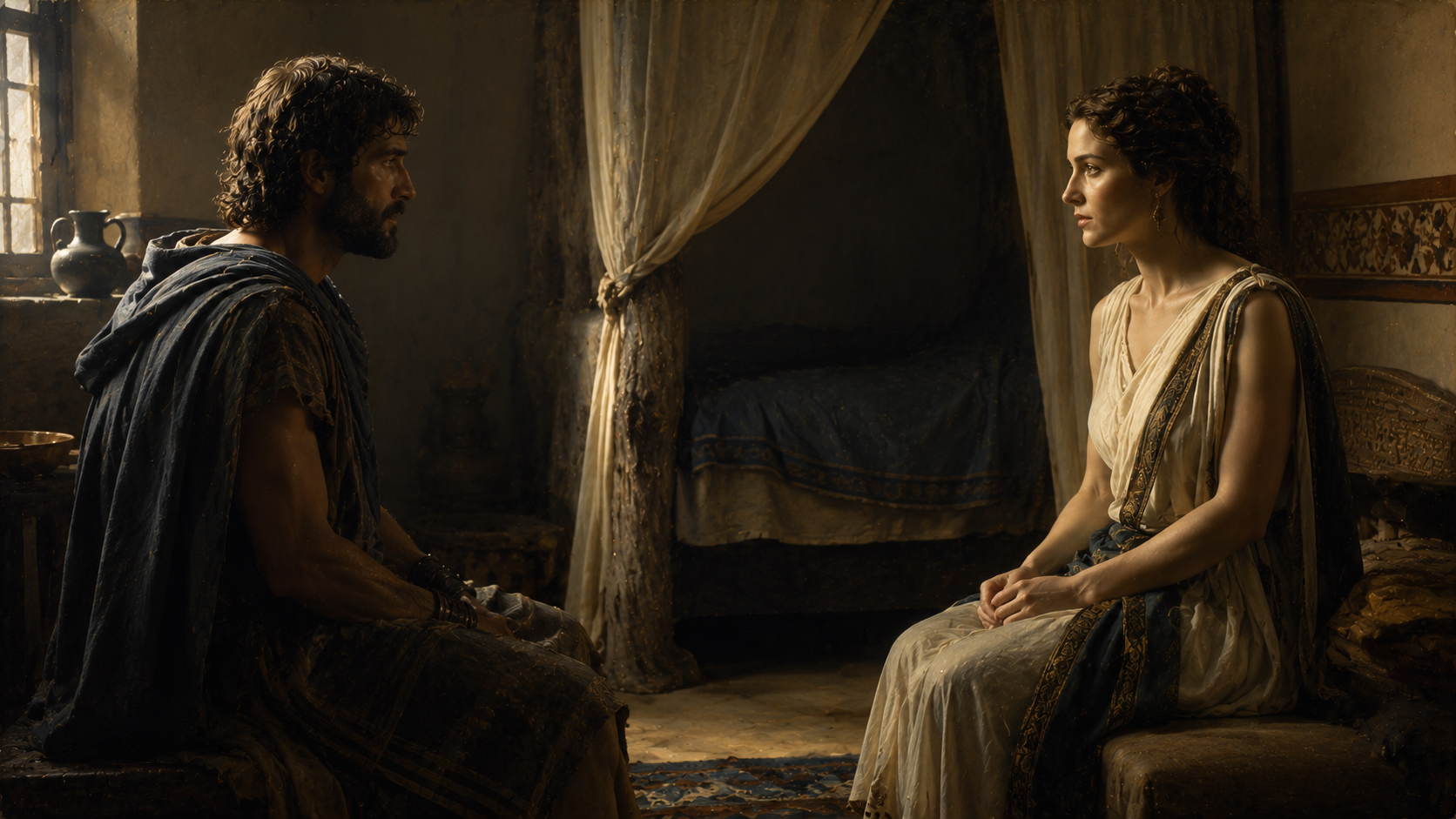
Then she sets her trap. She tells Eurycleia to move the marriage bed out of the bedroom so this stranger can sleep in it. Odysseus erupts:
"Wife, I am much displeased at what you have just been saying. Who has been taking my bed from the place in which I left it?"
He explains that the bed cannot be moved because he built it himself around a living olive tree. The trunk of the tree is one of the bedposts. He describes the entire construction in detail: how he cut the top off the olive tree, dressed the stump, bored a hole through it, inlaid it with gold and silver, and stretched crimson leather across the frame. Only Odysseus, Penelope, and one maidservant have ever seen that bed. No one else alive knows how it was built.
When Penelope hears this, she breaks down completely:
"Do not be angry with me Ulysses. We have suffered, both of us. Heaven has denied us the happiness of spending our youth, and of growing old, together; do not then be aggrieved or take it amiss that I did not embrace you thus as soon as I saw you."
She flies to him, throws her arms around his neck, and kisses him. Homer gives us one of his most beautiful similes to describe the moment. Penelope's relief at seeing Odysseus is compared to the joy of shipwrecked sailors who finally reach the shore: "covered with brine, are thankful when they find themselves on firm ground and out of danger." The comparison is perfect. Penelope has been drowning too, in her own way, for twenty years.
Athena holds back the dawn to give them more time together. They go to bed, make love, and tell each other everything that has happened during the twenty years apart. Homer summarizes Odysseus's entire story in a single paragraph, as though it is Penelope, not the reader, who most needed to hear it.
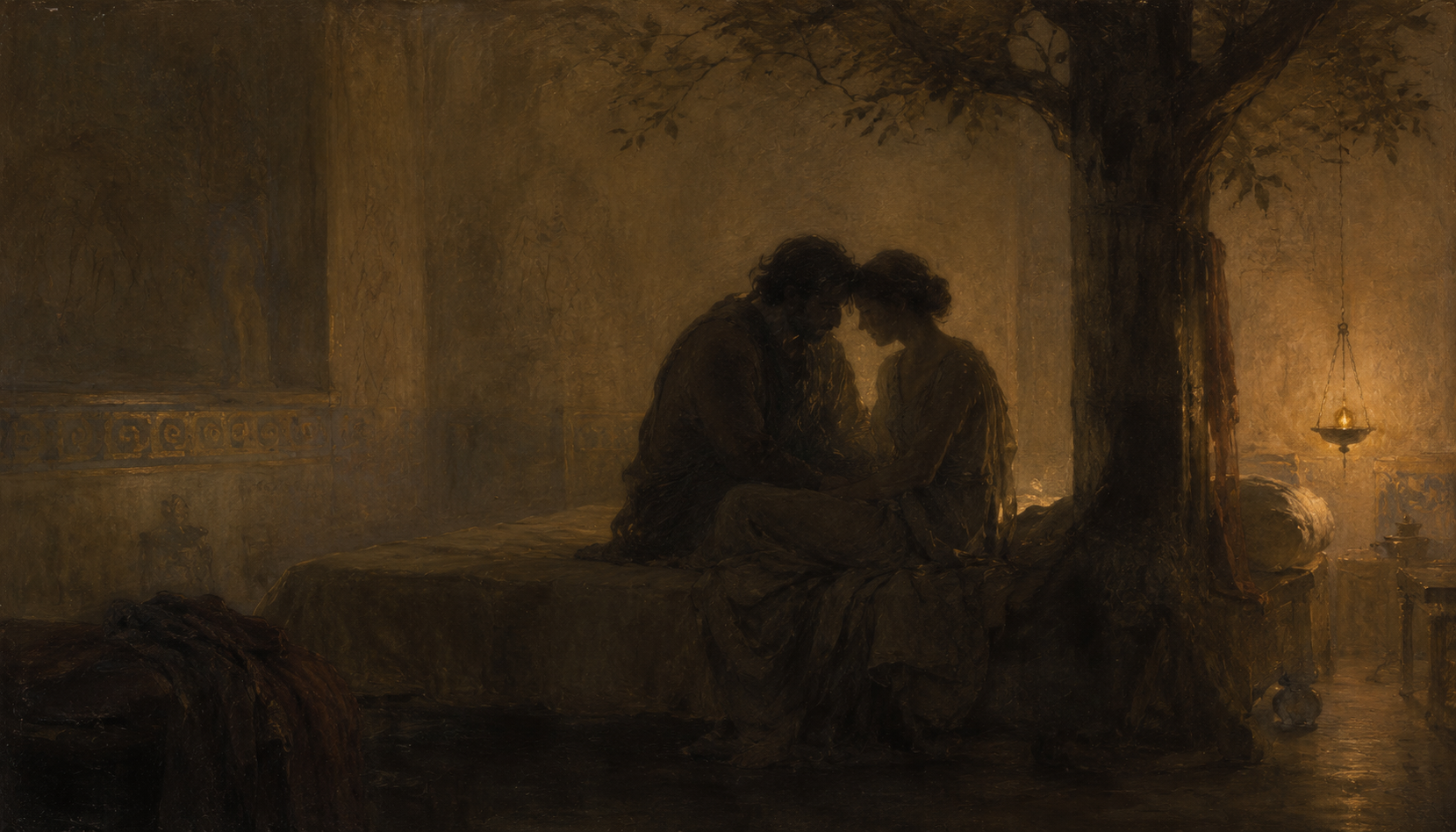
The long-awaited reunion of Odysseus and Penelope
Recommended Reading
As an Amazon Associate, we earn from qualifying purchases.
Book 24: Laertes, the Dead, and Athena's Peace
Book 24 opens in the Underworld. Hermes leads the ghosts of the newly killed suitors down to Hades, where they meet the shades of Achilles and Agamemnon. Agamemnon's ghost, murdered by his own wife Clytemnestra when he returned from Troy, hears how Odysseus came home and how faithful Penelope was. He pronounces a verdict that resonates through the whole poem:
"Happy Ulysses, son of Laertes, you are indeed blessed in the possession of a wife endowed with such rare excellence of understanding, and so faithful to her wedded lord as Penelope the daughter of Icarius."
Meanwhile, in the world above, Odysseus walks out to his father Laertes's farm. The old man has been living in squalor, wearing filthy clothes, sleeping among the servants, barely holding on. Odysseus tests him with a false story, just as he has tested everyone else, before revealing himself. When Laertes asks for proof, Odysseus shows him his scar and then names every tree in the orchard that Laertes gave him as a boy: thirteen pear trees, ten apple trees, and forty fig trees. Laertes collapses into his arms.
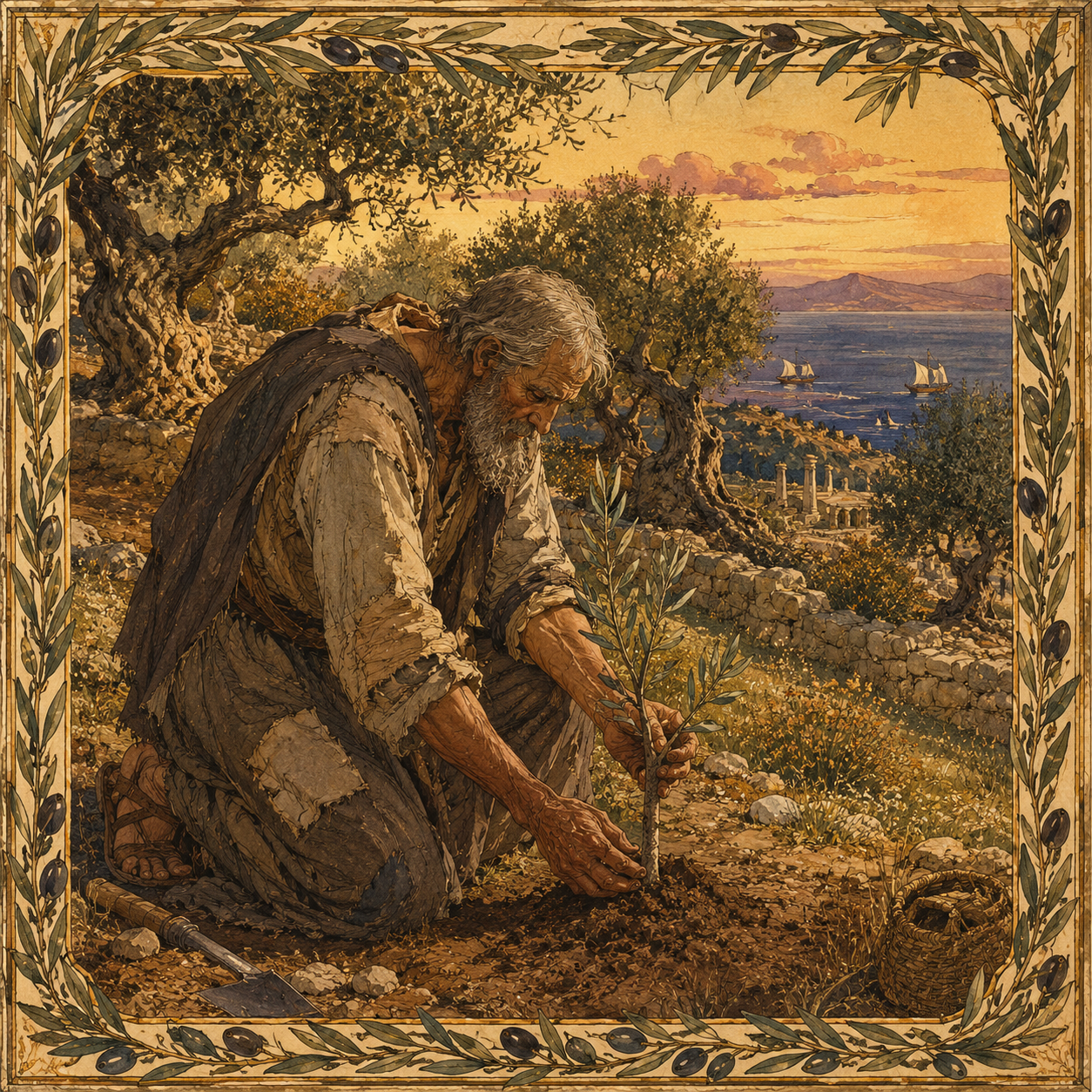
Odysseus reveals himself to his aged father Laertes
But the story is not quite over. The families of the dead suitors gather in the city, and Eupeithes, the father of Antinous, rallies them to attack Odysseus. They arm themselves and march on Laertes's farm. It looks like the cycle of violence will continue forever: killing leading to revenge, revenge leading to more killing.
Athena intervenes. She asks Zeus what he wants, and Zeus tells her to make peace. Athena goes down to the battlefield. Old Laertes, rejuvenated by Athena, hurls a spear and kills Eupeithes. A full battle nearly erupts. But then Athena raises her voice: "Men of Ithaca, cease this dreadful war, and settle the matter at once without further bloodshed." A thunderbolt crashes in front of her. The weapons drop from men's hands. They flee.
Odysseus wants to chase them, but Athena stops him: "Ulysses, noble son of Laertes, stop this warful strife, or Jove will be angry with you." He obeys. Athena, taking the form of Mentor, brokers a covenant of peace between the two sides. And that is how the poem ends.
The Controversy: Where Does the Odyssey Really End?
Ancient scholars Aristophanes of Byzantium and Aristarchus of Samothrace, two of the most important editors of Homer's text in the ancient world, reportedly identified a specific line in Book 23 as the "end" or "limit" of the Odyssey. The line comes after Odysseus and Penelope go to bed together, at the point where Homer says they "came joyfully to the rites of their own old bed." After this, these scholars believed, the poem was originally over.
Their argument has persuaded many modern scholars. The reunion of Odysseus and Penelope does feel like a natural ending. The hero has come home, reclaimed his house, passed his wife's test, and been recognized. The story that began with a man trying to get home has reached its destination. Everything after that, the argument goes, is addition, perhaps by a later poet working in Homer's style.
Several features of Book 24 support this view. The scene in the Underworld has a different tone. The episode with Laertes involves yet another recognition scene (the third in a row, after Eurycleia's recognition in Book 19 and Penelope's in Book 23), and by this point the pattern is starting to feel repetitive. The battle with the suitors' families is resolved so abruptly, with a single divine intervention, that it reads more like a summary than a developed narrative.
On the other hand, plenty of scholars defend Book 24. Without it, the families of the dead suitors are left with no resolution. There are over a hundred dead men in the hall, and their relatives are going to want answers. A poem that ends without addressing this would feel incomplete. The Laertes scene is also important thematically: Odysseus has been recognized by his dog, his nurse, his son, and his wife. His father is the last and most emotional link in the chain. And the Underworld scene, where Agamemnon's ghost praises Penelope's faithfulness, ties together one of the poem's longest-running threads.
There is no consensus. The honest answer is that we do not know where Homer intended the poem to end, or whether "Homer" was one person or several. What we have is the poem as it has been transmitted for roughly 2,700 years, and in that poem, the story ends with Athena making peace.
Why This Ending Matters
The ending of the Odyssey accomplishes something that very few stories manage. It does not just resolve the plot. It resolves the emotional and moral questions that the poem has been asking since its opening lines.
The contest of the bow answers the question of identity. Only Odysseus can string that bow. His strength, his skill, and his rightful ownership of the weapon are inseparable. The slaughter answers the question of justice, or at least of ancient Greek justice: the suitors violated the sacred code of hospitality, abused a man's household, plotted to murder his son, and forced his wife into a position no woman should have been put in. In Homer's world, this demands blood.
Penelope's test of the bed answers the deepest question of all: whether Odysseus and Penelope can still know each other after twenty years apart. The bed built around the olive tree is the perfect test because it is something only the two of them share, a secret so intimate that it cannot be faked. When Odysseus describes how he built it, he is not just proving his identity. He is proving that the private world they built together still exists.
And Athena's final peace answers the question that hangs over the entire slaughter: what happens next? In a world governed by blood revenge, the killing of over a hundred men would trigger an endless cycle of retaliation. Athena breaks that cycle by divine command. Whether you find that satisfying depends on your tolerance for divine intervention as a storytelling tool. But it does what it needs to do: it stops the killing and lets the poem end.
Recommended Reading
As an Amazon Associate, we earn from qualifying purchases.
Hearing the Ending
The last four books of the Odyssey were composed for performance, and they reward listening. The shift in pace from the slow tension of Book 21, where suitor after suitor fails with the bow, to the explosive violence of Book 22, to the quiet intimacy of Book 23, to the cosmic resolution of Book 24, is a masterpiece of rhythm. You can feel Homer controlling the audience's emotions like a musician.
In our audiobook, every word of Books 21 through 24 is spoken aloud with synchronized text highlighting. You hear the bowstring sing when Odysseus plucks it. You hear him call the suitors "dogs" in a voice that has been hiding in plain sight for ten books. You hear Penelope's voice break when she finally believes. These are scenes that were always meant to live in sound.
Explore the Odyssey
As an Amazon Associate, we earn from qualifying purchases.
Related Pages
Hear How the Story Ends
All 24 books of the Odyssey, read aloud with a full cast of distinct voices. Every word highlights as it is spoken. Start at Book 21 and listen straight through to the final peace.
Listen NowContinue the Journey
Hear the complete Odyssey read aloud with 60+ character voices. Every word highlights as it is spoken.
Book I is completely free. No signup required.
Go Deeper Into the Odyssey Film
Get the free Odyssey Companion Guide: character map, timeline, family tree, and the essential scenes from Homer's poem and the film.
No spam. Unsubscribe anytime.
The Final Triumph
Test of the Bow and homecoming merch. T-shirts, posters, mugs, canvas prints, and tote bags.
Browse All ProductsFEATURED DESIGNS