Where the Episode Falls in the Story
The Lotus-Eaters appear early in Odysseus's account of his wanderings. He is telling his story to the Phaeacians at the court of King Alcinous, and he begins with the aftermath of Troy. After leaving the ruined city, his fleet sails to the land of the Cicons, where a quick raid turns into a disaster. The Cicons fight back, and Odysseus loses six men from each of his twelve ships before the survivors escape.
Then Zeus sends a terrible storm. For nine days the fleet is battered by gales, driven south across open water with no control over their direction. On the tenth day they reach an unfamiliar coast. This is the land of the Lotus-Eaters.
Notice the pacing. Homer places the Lotus-Eaters right after the first military loss and the storm. Odysseus and his men are exhausted, beaten down, and disoriented. They do not know where they are. They need food and rest. They are exactly the kind of people who would be vulnerable to what the lotus offers.
What Happens: The Briefest Encounter with the Longest Shadow
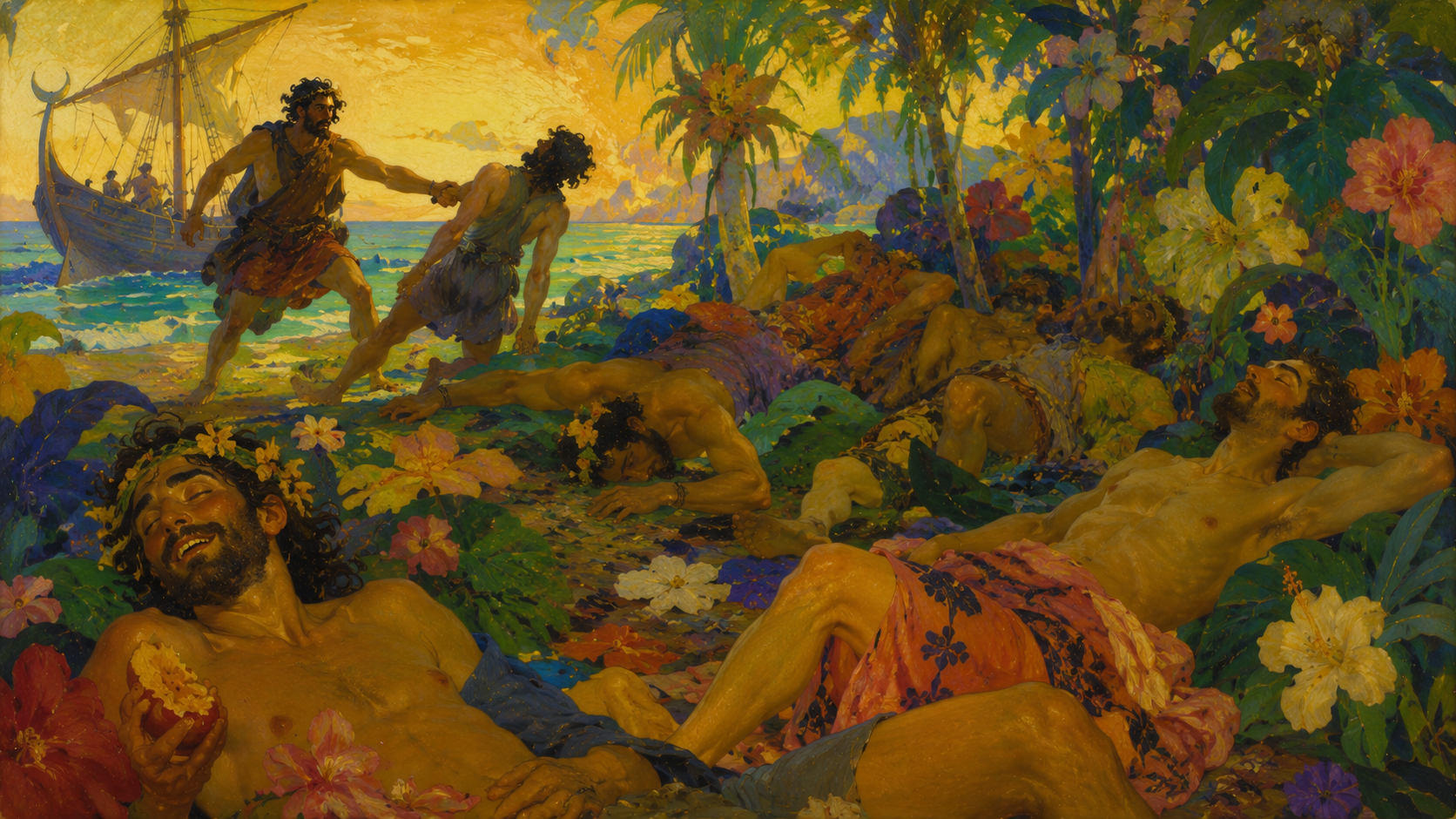
Odysseus sends three scouts ashore to find out who lives on this coast. The Lotus-Eaters are not hostile. They do not attack the scouts or threaten them. They simply share their food: the lotus fruit. And the effect is immediate.
"I sent two of my company to see what manner of men the people of the land might be, and they had a third man with them. They started at once, and went about among the Lotus-Eaters, who did them no hurt, but gave them to eat of the lotus, which was so delicious that those who ate of it left off caring about home, and did not even want to go back and say what had happened to them, but were for staying and munching lotus with the Lotus-Eaters without thinking further of their return." Homer, The Odyssey, Book 9 (Samuel Butler translation)
That is almost the entire episode, right there. The scouts eat the lotus. They forget home. They stop caring. Odysseus has to physically drag them back to the ships, weeping and struggling, and tie them under the rowing benches. Then he orders an immediate departure before anyone else tastes the fruit.
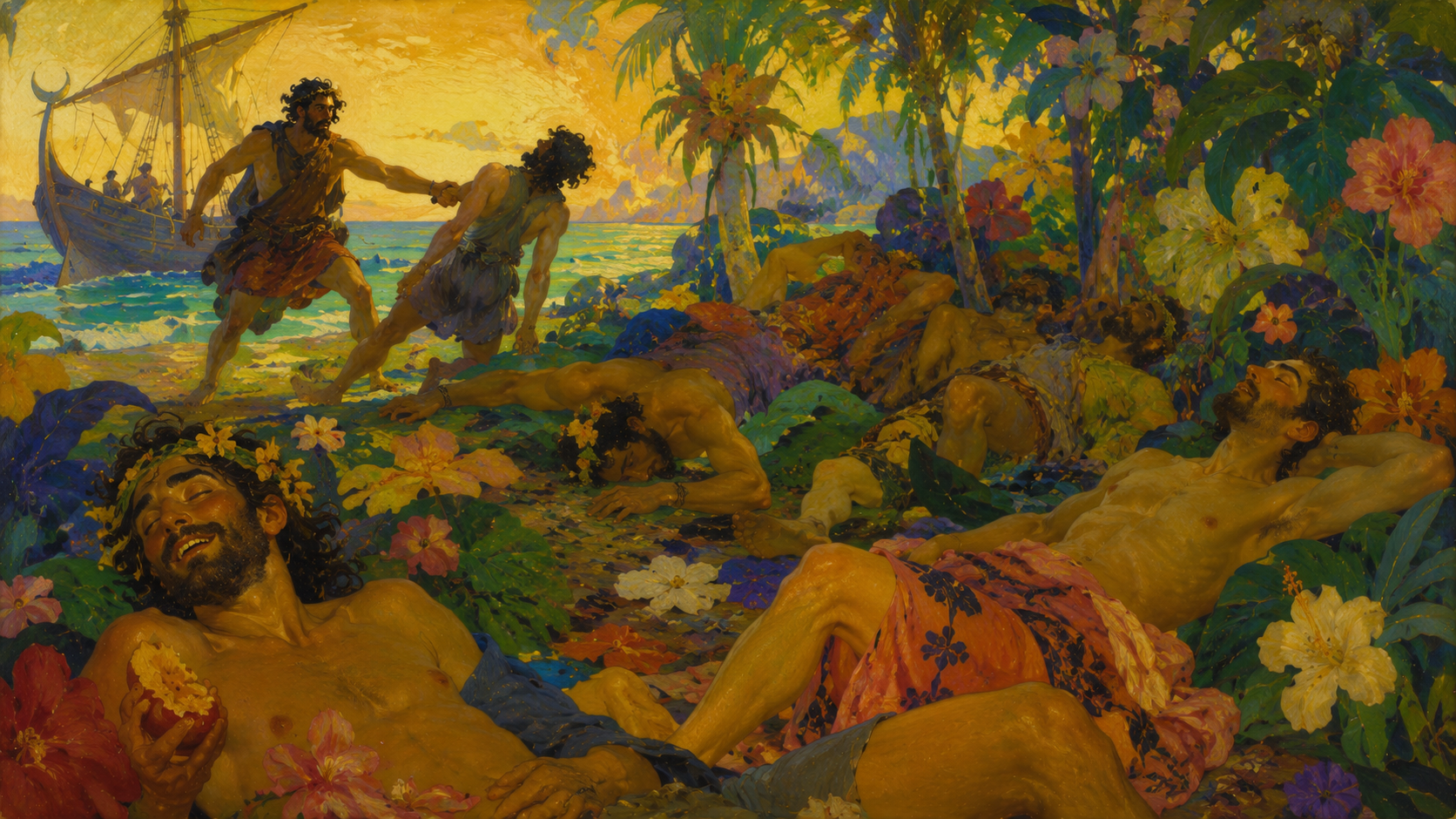
No dramatic confrontation. No clever escape. Just a leader recognizing a danger his men cannot see and making the hard call to remove them from it by force.
What the Lotus Actually Does
The lotus does not poison the body. It does not cause hallucinations or madness. What it does is far more subtle and far more terrifying: it removes desire. Specifically, it removes the desire to go home.
Think about what that means in the context of the Odyssey. The entire poem is powered by Odysseus's refusal to give up on reaching Ithaca. He turns down immortality from Calypso. He resists Circe's enchantments. He endures shipwreck after shipwreck. He spends twenty years away from his wife and son. All of that endurance depends on one thing: wanting to go home badly enough to suffer for it.
The lotus takes that away. It does not make you hurt. It does not make you afraid. It makes you content. And contentment, in the world of the Odyssey, is the most dangerous thing there is. Because if you stop wanting, you stop moving. And if you stop moving, you never get home.
Homer does not describe what the lotus tastes like. He does not describe the Lotus-Eaters' appearance or their houses or their customs. They are barely characterized at all. That vagueness is the point. They are not villains. They are not even obstacles in the traditional sense. They are simply people who have found something pleasant and want to share it. The danger is that the pleasant thing happens to erase the one motivation that keeps Odysseus's crew alive as a functional unit.
Recommended Reading
As an Amazon Associate, we earn from qualifying purchases.
The First Test of Odysseus as a Leader
The Lotus-Eaters episode is not really about the lotus. It is about leadership. And specifically, it is about the kind of leadership that the Odyssey values: the ability to make decisions that your people will hate you for, because you can see what they cannot.
Odysseus's scouts are not in pain. They are not calling for help. They are weeping when he drags them away, not because they are suffering, but because they do not want to leave. From their perspective, Odysseus is the villain. He is the one forcing them back onto the ships, back into the storm, back onto the dangerous sea. They have found peace, and he is taking it from them.
But Odysseus understands something the lotus has made them forget: that comfort without purpose is a trap. Those men have families. They have homes. They have lives waiting for them in Ithaca. The lotus has not destroyed those things. It has just made the men stop caring about them. And Odysseus will not let that stand.
Compare this to how he handles the Cyclops episode that follows immediately after. In the cave of Polyphemus, Odysseus shows his famous cunning. But with the Lotus-Eaters, he shows something arguably more important: judgment. He recognizes the danger, acts quickly, and accepts that his men will resent him for it. That is what a captain does.
It also sets up a pattern that repeats throughout the poem. Again and again, Odysseus will face situations where his men want to take the easy path and he has to overrule them. Sometimes he succeeds (the Lotus-Eaters, the Sirens). Sometimes he fails (the cattle of the Sun, where his crew slaughters the sacred animals while he sleeps). The tension between the leader who sees farther and the crew who want relief is one of the Odyssey's most persistent themes.
The Lotus as a Metaphor: Then and Now
Every generation reads the Lotus-Eaters and sees its own temptations reflected back. The Victorians saw opium. The twentieth century saw television. The twenty-first century sees social media, streaming services, and the infinite scroll. The metaphor is durable because the underlying pattern never changes: there is always something pleasant, accessible, and numbing that will make you forget what you are supposed to be doing with your life.
But Homer's version is more nuanced than a simple anti-pleasure parable. The lotus is not bad because pleasure is bad. The lotus is dangerous because it replaces purpose with contentment. In the Odyssey, the good life is not the comfortable life. It is the meaningful life, even when meaning comes with pain. Odysseus will suffer enormously on his way home. But the suffering has direction. It is pointed toward something: his wife, his son, his kingdom, his identity. The lotus removes the direction and leaves only the feeling. And that, Homer tells us, is a kind of death.
This connects directly to the poem's deepest themes. The Odyssey is about what it costs to remain yourself. Calypso offers Odysseus a paradise island and eternal youth, but it comes at the price of his identity as a husband, father, and king. Circe turns his men into animals, literally stripping away their humanity. The Sirens offer irresistible knowledge, but you have to die to hear it. In every case, the temptation is the same: give up who you are in exchange for something easier. The Lotus-Eaters are the first and simplest version of this bargain.
Why Homer Keeps It Short
The brevity of the Lotus-Eaters episode is part of its power. Homer spends dozens of lines on the Cyclops, on Circe, on the underworld. He gives the Lotus-Eaters fewer than thirty. Why?
Because the lotus works instantly, and Odysseus responds instantly. There is no negotiation, no extended temptation, no internal debate. Odysseus sees what the fruit has done to his scouts, understands the danger, and acts. He does not taste it himself. He does not try to reason with the affected men. He does not ask the Lotus-Eaters to stop sharing it. He drags his men to the ships and leaves.
The speed of his response tells us something about Odysseus's character. He is a man who understands temptation precisely because he takes it seriously. He does not linger in dangerous places. He does not assume he is immune. He sees the trap, pulls his people out, and sails away. If he had brought this same decisiveness to the Cyclops episode (where his crew begged him to leave the cave before Polyphemus returned), six men would still be alive.
Homer also keeps it short because the Lotus-Eaters are not a test of cunning. They are a test of will. There is no clever trick to discover, no riddle to solve, no monster to outsmart. The only question is: do you remember why you are here? Odysseus does. His men do not. End of episode.
Recommended Reading
As an Amazon Associate, we earn from qualifying purchases.
The Lotus-Eaters in Later Literature
Homer's brief episode became one of the most revisited scenes in Western literature. Alfred, Lord Tennyson wrote "The Lotos-Eaters" in 1832, a long poem imagining what it would feel like to stay in that drowsy land. Tennyson's sailors argue that the effort of getting home is not worth the pain, that rest is its own reward:
"Why should we only toil, the roof and crown of things?" Tennyson, "The Lotos-Eaters"
Tennyson's version is seductive because he lets the argument play out. His sailors make a genuine case for giving up. In Homer, there is no argument. The lotus simply removes the capacity for argument. You eat it and you stop wanting. Tennyson adds the philosophical dimension that Homer deliberately withholds.
The episode also echoes through modern storytelling. The Matrix's blue pill (choose comfortable ignorance over harsh truth) is a Lotus-Eater scenario. So is the pleasure planet in countless science fiction stories. So is any narrative where a character has to choose between an easy lie and a hard truth. Homer did not invent the idea, but he gave it its most compact, most enduring form.
Hear the Episode Read Aloud
The Lotus-Eaters appear early in Book 9, right before the Cyclops sequence. Our full-cast narration brings the whole book to life with every word highlighted as it is spoken. Listen to how quickly the encounter happens, how decisively Odysseus responds, and how the tone shifts as the fleet sails on to the cave of Polyphemus. The contrast between the gentle Lotus-Eaters and the violent Cyclops, back to back in the same book, is one of Homer's most effective structural moves.
Explore the Odyssey
As an Amazon Associate, we earn from qualifying purchases.
Related Pages
Listen to the Lotus-Eaters Episode
Full-cast narration. Every word highlighted as it is spoken. Open Book 9 and hear the encounter that sets the stage for everything.
Open Book 9Continue the Journey
Hear the complete Odyssey read aloud with 60+ character voices. Every word highlights as it is spoken.
Book I is completely free. No signup required.
Go Deeper Into the Odyssey Film
Get the free Odyssey Companion Guide: character map, timeline, family tree, and the essential scenes from Homer's poem and the film.
No spam. Unsubscribe anytime.
The Odyssey Collection
Journey scenes across five product types. T-shirts, posters, mugs, canvas prints, and tote bags.
Browse All ProductsFEATURED DESIGNS