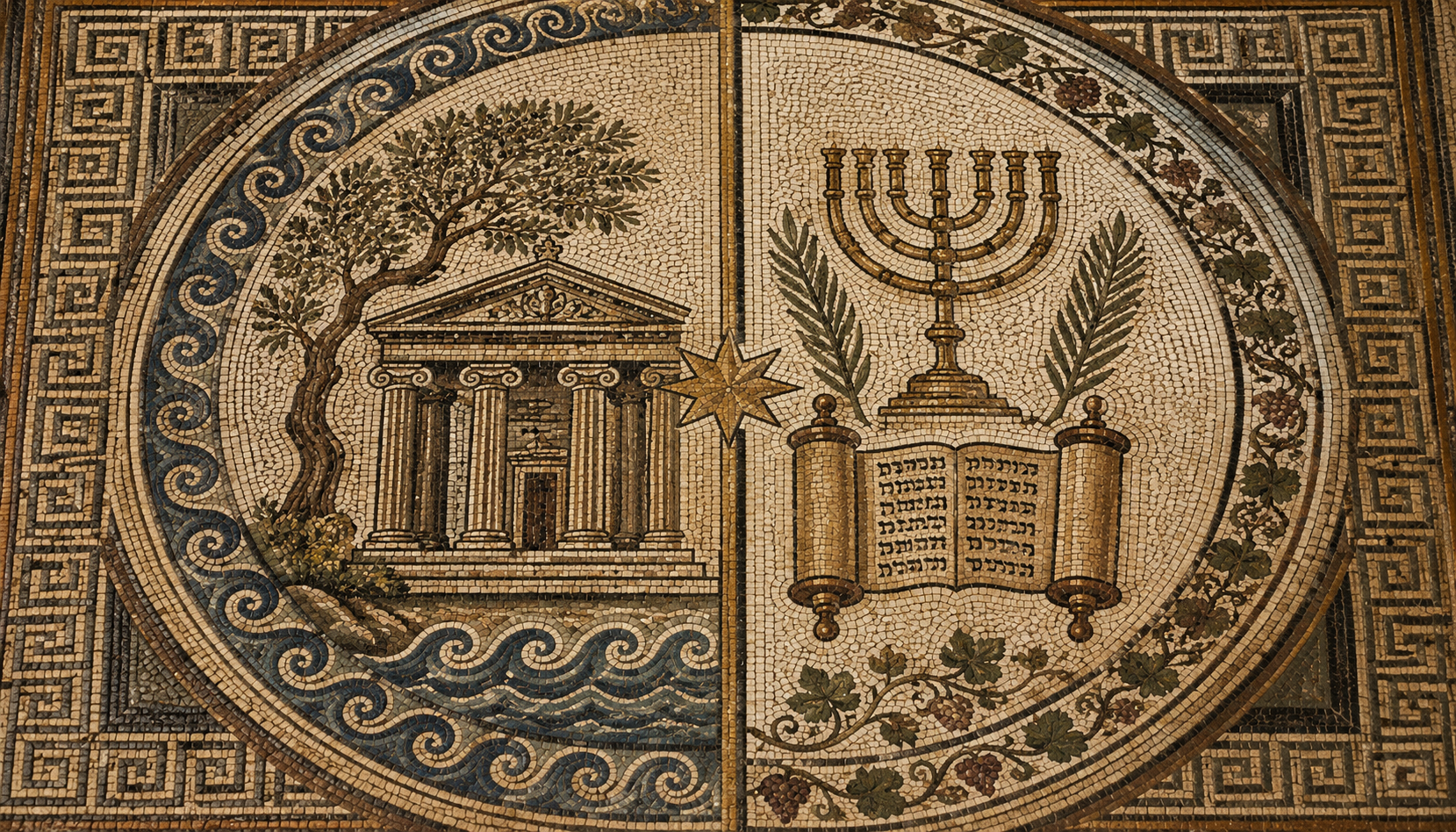
Two Texts, Two Traditions
The Odyssey was composed in the Greek-speaking Aegean world, probably in the 8th century BCE, in the tradition of oral poetry that had been developing for centuries. It was performed by professional bards at festivals and aristocratic gatherings, sung or chanted to the accompaniment of a lyre. It tells the story of one man, Odysseus, trying to get home after a war. It is a poem about a human life lived under the gaze of many gods.
The Bible is not a single composition but a library: dozens of books written across roughly a thousand years, in Hebrew, Aramaic, and Greek, by authors from the ancient Near East and the early Mediterranean world. It includes law codes, history, poetry, prophecy, wisdom literature, letters, and apocalyptic visions. Its central concern is the relationship between one God and the people, and later peoples, bound to that God by covenant.
Comparing the two is not comparing like with like. The Odyssey is a single narrative poem with a beginning, middle, and end. The Bible is an entire civilization's literary output, spanning genres and centuries. But the comparison is valuable precisely because both texts became foundational. Western literature, philosophy, law, art, and moral thought grew from the root system these two traditions planted together. Understanding where they agree and where they diverge is understanding the double inheritance of Western culture.
The Divine: Many Gods, One God
The most obvious difference is the nature of the divine itself. The Odyssey's gods are plural, embodied, and vividly imperfect. Zeus presides over Olympus, but he does not claim omniscience or moral perfection. He maintains order more through power than through righteousness. Athena plays favorites, championing Odysseus because she likes him, because his cleverness delights her. Poseidon hates Odysseus for blinding his son and pursues him with storms across the Mediterranean. The gods bicker, seduce, deceive, and occasionally destroy mortals for offenses as minor as eating the wrong cattle.
The God of the Bible is singular, invisible, and presented as the ultimate moral authority. In the Hebrew Bible, God creates the universe, establishes law, punishes disobedience, and rewards faithfulness. The relationship between God and humanity is covenantal: God makes promises and demands obedience in return. This God can be wrathful, jealous, and terrifying, but the wrath is presented as righteous, the jealousy as justified by the exclusivity of the covenant. There is no assembly of competing deities. There is one will, one standard, one source of meaning.
Homer's gods are participants in the story. They take sides, intervene physically, and sometimes lose. The God of the Bible is the author of the story. He does not compete with other gods for control of events; he is the ground of all events. This difference shapes everything else in both texts. In the Odyssey, the cosmos is contested territory where mortals navigate between competing divine interests. In the Bible, the cosmos is a moral order with a single architect, and the central question is whether humanity will align itself with that order or rebel against it.
Morality: Honor and Law
The Odyssey's moral world is built on honor, reciprocity, and social obligation. Xenia, the sacred code of hospitality, is the closest thing the poem has to a moral absolute. Be generous to strangers. Respect your host. Do not consume what belongs to another. The suitors die not because they have broken a commandment but because they have violated the reciprocal obligations that hold society together. Homer does not preach. He shows the consequences of behavior and trusts the audience to draw the lesson.
The Bible's moral world is built on divine law, delivered explicitly. The Ten Commandments are not suggestions or social customs. They are orders from the creator of the universe, and violating them has consequences that extend beyond social disapproval into the realm of sin, guilt, atonement, and divine judgment. The Bible is comfortable with direct moral instruction in a way that Homer is not. Proverbs teaches wisdom through maxims. Deuteronomy lays out the law in exhaustive detail. The prophets thunder against injustice, naming it and condemning it.
There is a meaningful overlap. Both texts value justice, hospitality, and the protection of the vulnerable. Both punish arrogance and excess. Both believe that how you treat strangers reveals your character. But the Odyssey locates morality in human relationships and social norms, while the Bible locates it in a vertical relationship with a divine lawgiver. In Homer, you should be hospitable because that is what civilized people do. In the Bible, you should be hospitable because God commands it. For a deeper look at the shared themes running through the Odyssey, including hospitality, justice, and loyalty, see our themes guide.
Recommended Reading
As an Amazon Associate, we earn from qualifying purchases.
Suffering: Testing and Meaning
Both texts take suffering seriously, but they interpret it differently. In the Odyssey, suffering is the price of being human in a dangerous world. Odysseus suffers because Poseidon is angry, because the sea is vast, because his men are foolish, because getting home is simply hard. His suffering does not carry a lesson from the gods. It is not a test of his faith or a punishment for sin. It is simply what happens to a mortal who is far from home and surrounded by forces larger than himself.
The Bible, particularly in the story of Job and in the prophetic tradition, wrestles with the meaning of suffering in a universe governed by a just God. If God is good and all-powerful, why do the righteous suffer? Job's friends insist that his suffering must be punishment for some hidden sin. Job refuses to accept this. God's eventual answer, delivered from the whirlwind, does not explain suffering but reframes the question: the divine order is too vast for human comprehension, and demanding an explanation is itself a form of presumption.
The Odyssey does not ask why suffering exists. It accepts suffering as a condition of life and focuses on how to endure it. Odysseus's defining quality is not strength or piety but endurance, the ability to hold on, to keep going, to survive long enough to reach the shore. The Bible asks the harder question, why does God allow suffering, and arrives at answers that range from punishment to purification to mystery. Both responses are profound. One says: the world is hard; survive it. The other says: the world is hard; trust that it has meaning even when you cannot see it.
Homecoming: Ithaca and the Promised Land
Both texts are, at their deepest levels, stories about homecoming. The Odyssey is the story of one man returning to one island. The Hebrew Bible is the story of an entire people seeking, losing, and seeking again a promised homeland. The parallels are striking, even though the scales are different.
Odysseus longs for Ithaca with a longing that borders on physical pain. He sits on Calypso's shore and weeps, staring at the sea, aching for a rocky island that even the gods acknowledge is not much to look at. His nostos is personal, specific, rooted in memory: the bed he built from a living olive tree, the wife who waited, the son who grew up without him. Home is not an idea. It is a place with a smell and a texture and a history.
The Israelites' journey to the Promised Land, narrated across Exodus, Numbers, and Deuteronomy, is collective and covenantal. They wander for forty years in the desert, tested and sustained by God. The land they seek is not just a piece of geography. It is the fulfillment of a promise made to Abraham generations earlier. Arriving in Canaan is not simply reaching a destination; it is completing a divine contract. Home, in the biblical sense, is where covenant and geography meet.
Both stories understand that homecoming is not the end of the struggle. Odysseus arrives in Ithaca and finds his house occupied by enemies. The Israelites arrive in Canaan and find it occupied by other peoples. In both cases, claiming the home requires another fight. The journey does not end at the border. It ends when you have fully reclaimed what was promised.
Justice: Vengeance and Righteousness
Justice in the Odyssey is personal, violent, and immediate. Odysseus kills the suitors himself, with a bow and arrows and then a sword, in his own hall, with blood pooling on the floor. The slaughter is sanctioned by the gods; Athena herself is present. But it is Odysseus who does the killing. Justice is not delegated to an institution or a court. It is enacted by the wronged party, in person, with his own hands.
Biblical justice operates on multiple levels. There is personal justice, as when David avenges insults or when the judges of Israel fight against oppressors. But there is also a larger, systemic vision of justice: the Torah's extensive legal codes, the prophets' demands for social equity, the concept of a divine judge who will set all things right at the end of history. Biblical justice is forward-looking in a way that Homeric justice is not. The prophets imagine a future in which justice will be complete and universal, a vision that has no real equivalent in the Odyssey.
The Odyssey's vision of justice has a darkness that the poem does not shy away from. After the suitors are dead, Odysseus hangs the twelve maidservants who had been disloyal. The poem describes the scene without comment, letting the reader absorb its weight. There is no appeal. There is no mercy. The ending requires divine intervention, Athena stopping the cycle of revenge by decree, to prevent the violence from continuing indefinitely. Homer sees justice as necessary and brutal, and he is honest about the fact that one act of justice can easily generate the next act of vengeance.
The Afterlife: Shadows and Promises
The Odyssey's underworld is bleak. When Odysseus descends to the land of the dead in Book 11, he finds shades, pale and insubstantial, who have no strength and no joy. The ghost of Achilles, the greatest hero of the Greek world, tells Odysseus that he would rather be a living servant to a poor farmer than king of all the dead. This is not punishment. It is simply what happens after death in Homer's world. The afterlife is diminished existence, a shadow of the life that mattered, which was the life lived under the sun.
"No winning words about death to me, shining Odysseus! By god, I'd rather slave on earth for another man, some dirt-poor tenant farmer who scrapes to keep alive, than rule down here over all the breathless dead." Homer, The Odyssey, Book 11 (Samuel Butler translation, 1900)
The Bible's vision of the afterlife developed over time, from the early concept of Sheol (a shadowy place not unlike Homer's Hades) to the later visions of resurrection, judgment, and eternal life that appear in Daniel, in the Psalms, and fully developed in the New Testament. By the time of early Christianity, the afterlife had become the central promise: death is not the end, and the righteous will be raised to eternal communion with God.
This difference has enormous consequences for how each text values life on earth. In the Odyssey, this life is all there is. That is why Odysseus fights so hard to get home, why he rejects Calypso's offer of immortality, why every moment of warmth and recognition carries such emotional weight. In the biblical tradition, this life is a prelude. Its suffering is temporary, its pleasures fleeting, and its ultimate meaning is determined by what comes after. Both perspectives are internally coherent. One says: live fully, because this is all you get. The other says: live rightly, because this is not all there is.
Recommended Reading
As an Amazon Associate, we earn from qualifying purchases.
The Hero: Cunning and Obedience
Odysseus is the Odyssey's ideal. He is clever, adaptable, patient, and deceptive when deception is needed. He lies to almost everyone he meets, including Athena, and she admires him for it. His greatest quality is metis, practical intelligence, the ability to read a situation and respond with exactly the right stratagem. He is not morally perfect. He is effective. He survives. And the poem celebrates him for surviving.
The Bible's heroes are measured by a different standard. Abraham's greatness lies in his obedience to God, even to the point of being willing to sacrifice his son Isaac. Moses's greatness lies in his role as mediator between God and the people, delivering the law and leading the exodus. David, the most human of the biblical heroes, is great because of his relationship with God, his psalms, his repentance, his capacity to sin and then turn back. The biblical hero is not the person who outwits his enemies most cleverly but the person who aligns himself most fully with the divine will.
Both traditions understand that heroes are flawed. Odysseus's pride costs him years of suffering; his shout to the Cyclops, revealing his real name, brings Poseidon's wrath down on his head. David's adultery with Bathsheba and his murder of Uriah are recorded without excuse. But the nature of the flaw is different. Odysseus fails when he lets his ego override his intelligence. David fails when he lets his desire override his covenant with God. One tradition judges by effectiveness. The other judges by faithfulness.
Women: Agency and Archetype
The Odyssey gives its women remarkable presence, even within the constraints of a patriarchal world. Penelope is one of the great literary characters: intelligent, resourceful, emotionally complex, and more patient than the poem fully credits. Circe is dangerous and then generous. Calypso is powerful and lonely. Nausicaa is poised and kind. Athena, the most powerful character in the poem aside from Zeus, is female. Women in the Odyssey are not ornamental. They are essential, and the poem would collapse without them.
The Bible's portrayal of women is similarly complex and similarly constrained by its cultural moment. Ruth's loyalty to Naomi is one of the most celebrated devotions in all of scripture. Deborah judges Israel and leads armies. Esther saves her people through courage and political intelligence. The Song of Solomon gives voice to female desire with an openness that surprised many later readers. At the same time, large portions of biblical law treat women as property, limit their testimony, and subordinate them to fathers and husbands.
Both texts reflect the patriarchal cultures that produced them, and both contain individual portrayals of women that transcend those cultures. Penelope's scene of recognition with Odysseus, when she tests him with the secret of their bed, is one of the most equal and intimate exchanges between a man and a woman in all of ancient literature. Ruth's declaration to Naomi carries a depth of love and commitment that resists any reduction to social role. These moments stand out precisely because they push against the limits of their time.
The Good Life: Glory and Covenant
What makes a life worth living? The Odyssey and the Bible give different answers, and those answers have shaped Western thought in different directions for thousands of years.
For Homer, the good life is a life fully lived in the world: a home, a family, a reputation, a name that will be remembered in song. Kleos, glory, is the closest thing the Odyssey offers to immortality. Your body dies. Your shade goes to the underworld. But if the poets sing your name, some part of you endures. Odysseus complicates this by choosing a mortal life with Penelope over immortal life with Calypso. He values the specific, the human, the finite. The good life is not the longest life or the most famous life. It is the life lived in the right place, with the right people, on your own terms.
For the Bible, the good life is a life lived in covenant with God. It is not measured by fame or adventure but by faithfulness, justice, mercy, and humility. The book of Micah distills it: "What does the Lord require of you? To act justly, to love mercy, and to walk humbly with your God." The good life is not about what you achieve but about the orientation of your soul toward the divine. In the New Testament, this idea reaches its fullest expression in the promise that a life lived in faith will continue beyond death into eternity.
Both visions have shaped the Western imagination. The Homeric ideal gave us the restless, striving, achievement-oriented culture of the classical world and its many revivals. The biblical ideal gave us the moral seriousness, the concern with justice, and the inward focus on conscience and faith that runs through Judaism, Christianity, and Islam. Most of us, whether we know it or not, carry both traditions inside us. We want to achieve, and we want to be good. We want to be remembered, and we want to be righteous. The tension between those desires is one of the defining features of Western civilization. Many of the Odyssey's most memorable passages touch on exactly this tension between glory and goodness.
How Both Texts Shaped Western Literature
It is impossible to understand Western literature without both the Odyssey and the Bible. Dante's Divine Comedy fuses Homeric and biblical traditions into a single journey through the afterlife, guided by the Roman poet Virgil (himself a student of Homer) and then by Beatrice (a figure of divine grace). Milton's Paradise Lost uses Homeric epic structure to tell a biblical story. Joyce's Ulysses maps the Odyssey onto a single day in Dublin, while its moral and psychological depth owes as much to the biblical tradition of inwardness and conscience as to Homer's narrative art.
The two traditions have been in conversation for over two thousand years. Early Christian writers, including Clement of Alexandria and Augustine, read Homer alongside scripture and debated what each had to teach. Renaissance humanists revived the classical texts and tried to harmonize them with Christian teaching. The Enlightenment pitted the two traditions against each other; Romanticism tried to reconcile them again. The conversation has never ended, and the fact that both texts are still widely read, taught, argued about, and adapted, the Odyssey in the 2026 IMAX film, the Bible in countless forms, proves that neither tradition has exhausted what it has to say.
Hear the Odyssey's World Come Alive
The Odyssey is a poem that was meant to be heard, not read silently. For three thousand years, its natural home was in the human voice: bards performing in torchlit halls, audiences leaning in to hear what happened next. Our full-cast narration with 60+ character voices restores the poem to its spoken roots. Every word highlighted as it is spoken. Book I is free. The complete poem, all 24 books, is $6.99.
Explore Both Traditions
As an Amazon Associate, we earn from qualifying purchases.
Continue Reading
Hear the Oldest Voice in Western Literature
Full-cast narration with 60+ character voices. Every word highlighted as it is spoken. Book I is free. All 24 books for $6.99.
Start Listening FreeContinue the Journey
Hear the complete Odyssey read aloud with 60+ character voices. Every word highlights as it is spoken.
Book I is completely free. No signup required.
Go Deeper Into the Odyssey Film
Get the free Odyssey Companion Guide: character map, timeline, family tree, and the essential scenes from Homer's poem and the film.
No spam. Unsubscribe anytime.
The Odyssey Collection
Wear the epic. T-shirts, posters, mugs, canvas prints, and tote bags.
Browse All ProductsFEATURED DESIGNS
SCENES & THEMES