Two Poems, One War, Very Different Questions
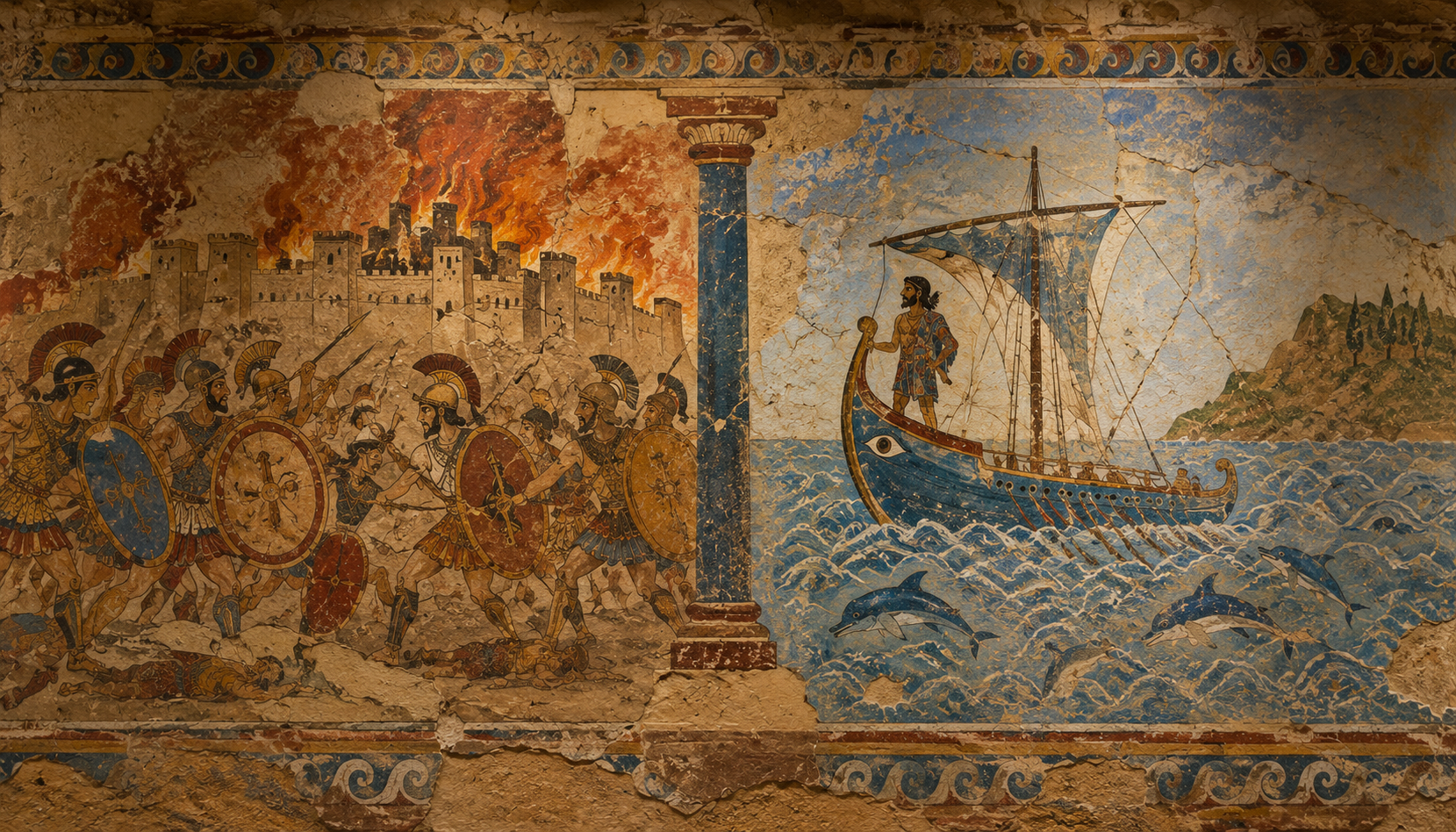
The simplest way to put it: the Iliad asks what it means to fight, and the Odyssey asks what it means to come home. Both poems grow out of the Trojan War, a ten-year siege launched because Paris of Troy ran off with Helen, the wife of the Greek king Menelaus. The entire Greek world gathered an army, sailed across the Aegean, and spent a decade trying to break down the walls of Troy. The Iliad drops us into the final year of that siege. The Odyssey picks up ten years after Troy has already fallen and follows one man trying to get back to his island.
Homer probably composed the Iliad first, sometime in the 8th century BCE, and the Odyssey shortly after. Both poems were performed orally before they were ever written down, chanted by bards at feasts and festivals across the Greek-speaking world. They were the stories everyone knew. If you wanted to talk about courage, grief, loyalty, revenge, or what it costs to be human, you talked about these two poems. People still do.
The Plot: Battlefield vs. Journey Home
The Iliad covers roughly fifty days during the final year of the Trojan War. It opens with a quarrel between Achilles, the greatest Greek warrior, and Agamemnon, the commander of the Greek forces. Agamemnon takes a war-prize from Achilles, and Achilles, furious, refuses to fight. Without him, the Greeks start losing badly. Achilles' closest companion, Patroclus, borrows Achilles' armor and goes into battle in his place. Hector, the best Trojan fighter, kills Patroclus. Achilles, shattered by grief, returns to the war, hunts Hector down, and kills him. The poem ends not with the fall of Troy but with Hector's funeral, a moment of fragile, temporary peace.
The Odyssey covers ten years of travel (and twenty years of absence) compressed into about forty days of real-time storytelling. Odysseus has been stuck on the island of the nymph Calypso for seven years. Back home on Ithaca, his wife Penelope is besieged by over a hundred suitors who want to marry her and take the throne. Their son Telemachus is barely an adult and has never known his father. The poem follows three storylines that braid together: Telemachus searching for news of Odysseus, Odysseus escaping Calypso and telling his tale of monsters and magic to the Phaeacians, and finally Odysseus returning to Ithaca in disguise to reclaim his home. The Iliad is a war story. The Odyssey is a homecoming story, an adventure story, and a family story all wrapped into one.
Main Characters: Rage vs. Cunning
The hero of the Iliad is Achilles, and he is defined by one thing: rage. He is the fastest, strongest, most lethal fighter alive, and when his pride is wounded, he lets his own people die rather than swallow the insult. His story is about what happens when the greatest warrior in the world is also the most emotionally volatile. He is terrifying and heartbreaking in equal measure.
The hero of the Odyssey is Odysseus, and his defining trait is the opposite: cunning. He is "the man of many turns," the trickster who can talk his way out of anything, disguise himself as anyone, and outthink enemies who are bigger, stronger, and more powerful than he is. Where Achilles solves problems with force, Odysseus solves them with brains, patience, and lies. He is also deeply flawed in his own way. His curiosity gets his men killed. His pride nearly costs him everything when he shouts his real name at the Cyclops. But he survives, which is the thing Achilles cannot do.
The supporting casts also feel very different. The Iliad is packed with warriors on both sides: Hector, Ajax, Diomedes, Paris, Patroclus, Priam. It is a poem full of men fighting and dying. The Odyssey has a much wider range. Penelope is one of the most complex characters in all of ancient literature, a woman holding a kingdom together with her intelligence alone. Telemachus goes through a real coming-of-age arc. The nymph Calypso, the witch Circe, the princess Nausicaa, the loyal swineherd Eumaeus, and the old nurse Eurycleia all get memorable scenes. The Odyssey is interested in everyone, not just the fighters.
Recommended Reading
As an Amazon Associate, we earn from qualifying purchases.
Themes: Glory vs. Homecoming
The central theme of the Iliad is kleos, glory. In the world of that poem, the worst thing that can happen to you is to be forgotten. Warriors fight knowing they will die, and they accept it because dying well means your name lives forever. Achilles is given an explicit choice: a long, quiet life at home, or a short, brilliant one at Troy. He picks Troy. The Iliad is obsessed with mortality, with the beauty and waste of young men killing each other, with what it takes to be remembered.
The central theme of the Odyssey is nostos, homecoming. Where the Iliad asks "what is worth dying for?", the Odyssey asks "what is worth living for?" Odysseus has the glory. He won the war. He is famous across the entire Greek world. But all he wants is his own hearth, his own bed, his own wife, and his own son. He turns down immortality from Calypso because none of it matters without home. The Odyssey is about identity, recognition, endurance, and the idea that the hardest journey is the one that brings you back to where you started.
The Iliad treats the gods as powerful and capricious, playing favorites among the warriors and dragging mortals into their grudges. The Odyssey treats the gods differently. Athena genuinely cares about Odysseus. She mentors Telemachus. She argues for Odysseus in front of Zeus. The relationship between mortals and gods in the Odyssey has more warmth and more personal investment than anything in the Iliad.
Tone and Style: Tragic vs. Adventurous
Read a few pages of the Iliad and the weight hits you immediately. It is a heavy poem. Homer lingers on death. He gives you the backstory of soldiers right before they are killed: where they came from, who loved them, what their lives held before the war swallowed them. It is a deliberate technique, and it hurts every time. The battle scenes are graphic and unflinching. The emotional peaks, like Priam kissing the hands of Achilles and begging for his son's body, are almost unbearably intense.
The Odyssey has dark moments (the Cyclops eating men alive, the slaughter of the suitors), but the overall tone is lighter, more varied, and more playful. There are comedy scenes. There are suspenseful scenes. There are domestic scenes that feel genuinely tender. The poem moves between registers in a way the Iliad does not. You get monsters and magic in one book, then a quiet conversation between a husband and wife in the next. The Odyssey invented the adventure story, and it reads like one.
Structurally, the Iliad is mostly linear. Events happen in sequence over those fifty days. The Odyssey is famously nonlinear. It starts in the middle of the story (a technique called in medias res that Homer essentially invented), bounces between storylines, and includes a four-book flashback told in Odysseus's own voice. It is a more complex piece of storytelling, and it set the template for how novels would be built for the next three millennia.
Length and Structure
Both poems contain 24 books (think of them as chapters). The Iliad is the longer one, running about 15,693 lines of Greek verse compared to the Odyssey's roughly 12,110 lines. In English prose translation, the Iliad usually lands around 500 pages and the Odyssey around 400 pages, though this varies by translator.
The Iliad's 24 books follow the rhythm of battle: days of fighting, nights of council, moments of truce. The Odyssey's 24 books break into three clean sections. Our book-by-book guide walks through each one. Books 1 through 4 follow Telemachus (scholars call this section the "Telemachy"). Books 5 through 12 follow Odysseus, including his famous flashback of adventures. Books 13 through 24 cover the return to Ithaca, the disguise, and the reckoning with the suitors.
Recommended Reading
As an Amazon Associate, we earn from qualifying purchases.
Which Should You Read First?
Honestly, either one works. If you want to follow the chronological order of events, start with the Iliad: it covers the war that comes before the Odyssey's journey home. If you want the more accessible, faster-moving story, start with the Odyssey. Its adventure plot, its variety of settings, and its single hero make it an easier entry point. Most school curricula assign the Odyssey first for exactly this reason.
There is something to be said for reading the Iliad first. When you meet Achilles' ghost in Book 11 of the Odyssey, standing in the underworld and regretting everything, it hits differently if you watched him make the choice that put him there. When Agamemnon's shade tells Odysseus how he was murdered by his own wife, it carries more weight if you remember the general who led the Greeks. But these are added layers, not requirements. Homer built the Odyssey to stand on its own.
If you are new to Homer and not sure where to begin, start with the Odyssey. It is the poem that has launched more readers into ancient literature than any other, and there is a reason for that. It grabs you, it moves, and it never lets go.
Why They Both Still Matter
The Iliad and the Odyssey are not just old books that scholars assign because they are important. They are the foundation of the storytelling tradition that produced everything from Virgil's Aeneid to Tolkien's Lord of the Rings to the latest superhero movie. The Iliad invented the war story. The Odyssey invented the quest story. Between them, they gave us most of the narrative structures we still use.
But the reason they survive is not structural. It is emotional. The Iliad makes you feel the cost of violence. The Odyssey makes you feel the pull of home. Three thousand years of readers have picked up these poems and recognized themselves, and that has not stopped yet.
Read Both Epics
As an Amazon Associate, we earn from qualifying purchases.
Related Pages
Hear the Odyssey Come Alive
All 24 books of the Odyssey, read aloud with a full cast of distinct voices. Every word highlights as it is spoken. Pick any book, press play, and listen to three thousand years of storytelling.
Listen NowContinue the Journey
Hear the complete Odyssey read aloud with 60+ character voices. Every word highlights as it is spoken.
Book I is completely free. No signup required.
Go Deeper Into the Odyssey Film
Get the free Odyssey Companion Guide: character map, timeline, family tree, and the essential scenes from Homer's poem and the film.
No spam. Unsubscribe anytime.
The Odyssey Collection
Both epics, one collection. T-shirts, posters, mugs, canvas prints, and tote bags.
Browse All ProductsFEATURED DESIGNS