1. Perseverance and the Long Road Home
The most fundamental moral of the Odyssey is that perseverance matters more than strength. Odysseus is not the strongest Greek warrior; that title belongs to Ajax and, before him, Achilles. He is not the wealthiest or the most politically powerful. What sets him apart is that he simply does not stop. Ten years of war at Troy, then ten more years of shipwrecks, monsters, divine curses, and every conceivable obstacle between him and Ithaca, and he keeps going. Not gracefully. Not without despair. Homer shows us Odysseus weeping on Calypso's beach, staring at the sea, longing for a home he fears he may never reach. But he does not give up.
This is the moral lesson the Greeks called nostos, the homecoming. It was not simply a matter of arriving at a physical location. A true nostos meant returning to your place in the world, reclaiming your identity, and being recognized by the people who matter to you. Odysseus could have stayed with Calypso, who offered him immortality and eternal youth. He could have remained with Circe, who offered him comfort and pleasure. He chose home instead, because the poem's deepest conviction is that nothing, not even eternal life, is worth more than belonging to the people and the place that are yours.
The lesson extends to every character in the poem. Penelope perseveres against the suitors for twenty years without any certainty that her husband is alive. Telemachus perseveres through a fatherless youth to become the young man who stands beside his father in battle. Even Argos, the old dog lying on a dung heap, perseveres long enough to see his master one final time. Perseverance in the Odyssey is not heroic bravado. It is the quiet, daily refusal to let go of what matters.
.png)
2. The Cost of Pride and Hubris
If perseverance is the Odyssey's greatest virtue, pride is its greatest vice. The Greek word for it is hubris: the arrogance of believing you are above the rules that govern everyone else. And the poem's single most devastating illustration of hubris comes in Book 9, in the cave of the Cyclops Polyphemus.
The setup is brilliant. Odysseus and his men are trapped in the cave of a man-eating giant. Using his famous cunning, Odysseus devises a plan: he tells Polyphemus his name is "Nobody," gets the Cyclops drunk on wine, and blinds him with a sharpened stake. When Polyphemus cries out to the other Cyclopes for help, he screams that "Nobody" is hurting him, and they leave him alone. It is a perfect plan, and it works. Odysseus and his surviving men escape under the bellies of the giant's sheep. They reach their ships. They begin to row away.
And then Odysseus makes the worst decision in the entire poem.
He cannot resist taunting the blinded giant. He shouts back his real name: "I am Odysseus, son of Laertes, from Ithaca." It is a moment of pure, reckless pride. He has won. He is safe. And he throws that safety away because he needs the Cyclops to know who beat him. Polyphemus, now armed with his enemy's true name, prays to his father Poseidon, god of the sea, to curse Odysseus. Poseidon hears. And a journey that should have taken weeks stretches into a decade of suffering that kills every single member of Odysseus's crew.
"Hear me, Poseidon, if I am indeed your son. Grant that Odysseus may never reach his home alive; or if he must, let him come late, in bad plight, with the loss of all his men." Homer, The Odyssey, Book 9 (Samuel Butler translation, 1900)
Homer's lesson is precise: cleverness without humility is self-destructive. Odysseus had the intelligence to escape, but he lacked the discipline to stay silent. The poem does not punish him for being clever. It punishes him for being proud of being clever at exactly the wrong moment. It is a moral lesson about the gap between ability and wisdom, and it remains as relevant now as it was in the eighth century BCE.
3. Loyalty and Faithfulness
The Odyssey is, at its heart, a story about what happens to a household when its leader is gone for twenty years. And the poem's moral verdict on that question is unflinching: loyalty is the virtue that holds everything together, and betrayal is the sin that tears everything apart.
Penelope is the poem's great emblem of loyalty. For twenty years, she resists the pressure of over a hundred suitors occupying her home and demanding she remarry. Her most famous tactic is the weaving trick: she tells the suitors she will choose a husband once she finishes a funeral shroud for her father-in-law Laertes, then unravels her work each night, buying three years of delay through sheer cunning. Even after the trick is discovered, she invents new obstacles. Her loyalty is not passive waiting. It is active, intelligent resistance, and Homer presents it as the moral counterpart to Odysseus's physical endurance on the sea.
The poem also honors loyalty in humbler forms. Eumaeus the swineherd tends his absent master's pigs with such devotion that Homer addresses him directly in the second person, an almost unique honor in ancient epic. Philoetius the cowherd weeps at the state of the household. Argos the dog waits twenty years on a pile of refuse and dies the moment he sees Odysseus again. These are not powerful characters. They cannot change the outcome alone. But their faithfulness earns them a place in the homecoming.
Against them stand the faithless: the goatherd Melanthius, who sides with the suitors and arms them during the final battle; the serving women who sleep with the suitors and mock the disguised Odysseus; and the suitors themselves, who consume another man's wealth without shame. Homer's treatment of these characters is severe. After the battle, every one of them is killed. The moral line is bright and hard: you are either with the household or against it, and the poem remembers which side you chose.
4. The Sacred Duty of Hospitality
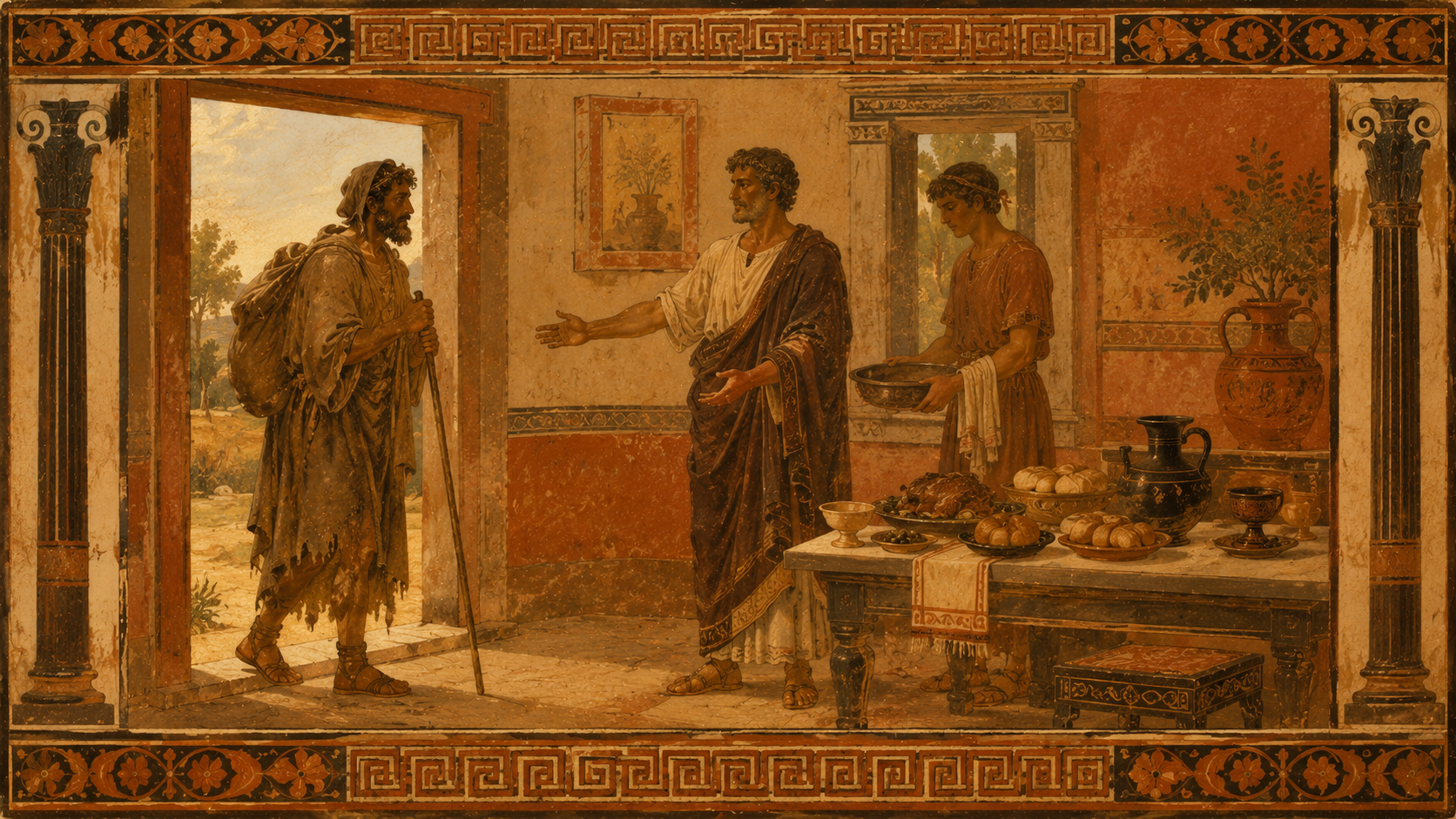
Modern readers sometimes miss how seriously the Odyssey takes hospitality, because we no longer live in a world where travelers depend on strangers for survival. But in Homer's world, there were no hotels, no restaurants, no public infrastructure for travelers. If a stranger arrived at your door hungry and exhausted, the expectation, enforced by Zeus himself, was that you would feed them, shelter them, and send them on their way with gifts. The Greeks called this xenia, and it was not a social nicety. It was a sacred obligation.
The Odyssey uses xenia as a moral measuring stick for nearly every character and community Odysseus encounters. The Phaeacians are the poem's model hosts: they welcome the shipwrecked Odysseus, bathe him, feast him, listen to his story, load him with gifts, and sail him home on a magic ship. They do all of this before they even know his name. This is xenia at its finest, and the poem rewards them by making their generosity one of the most beautiful sequences in all of literature.
Polyphemus is the opposite. When Odysseus invokes the law of xenia and asks the Cyclops for hospitality, Polyphemus replies that he does not care about Zeus or the gods, and then he eats two of Odysseus's men. This is not just bad manners. In the poem's moral framework, it is an abomination, and the blinding of the Cyclops is presented as a just response to a monstrous violation of the most basic human duty.
The suitors commit the same crime in a different form. They are guests in Odysseus's house, but they have inverted the relationship entirely: instead of receiving hospitality with gratitude and respect, they consume it with greed and contempt. They slaughter his cattle, drink his wine, harass his wife, and plot to murder his son. Their slaughter at the poem's end is Homer's moral verdict on what happens when xenia is violated so thoroughly and for so long that only violence can restore the balance.
5. Glory vs. Family: What Really Matters
The Iliad is a poem about glory. The Odyssey is a poem about what glory costs and whether it is worth the price. This tension between public achievement and private love runs through every major decision Odysseus faces, and it represents one of Homer's most sophisticated moral arguments.
In the underworld, Odysseus meets the shade of Achilles, the greatest warrior of the Trojan War, the man who chose a short, glorious life over a long, obscure one. And Achilles delivers a verdict that overturns everything the Iliad seemed to teach. He tells Odysseus that he would rather be a living farmhand, serving the poorest master on earth, than king of all the dead. The glory he fought and died for has turned to ashes. He wants to know about his son and his father. He wants to know about the living.
"Say not a word in death's favour; I would rather be a paid servant in a poor man's house and be above ground than king of kings among the dead." Homer, The Odyssey, Book 11 (Samuel Butler translation, 1900)
This scene is the moral hinge of the poem. Odysseus, who could have died gloriously at Troy and earned eternal fame, chose instead to go home. And now the greatest warrior who ever lived is telling him he chose correctly. Glory, the poem argues, is the thing you pursue when you do not yet understand what matters. Family, home, the people who know your name and care whether you live or die: these are the things that matter. The Odyssey does not reject glory entirely, but it ranks it firmly below the quieter, harder, more enduring achievement of simply making it home to the people who love you.
6. The Consequences of Temptation
Odysseus's journey is structured as a series of temptations, and the moral lesson embedded in each one is the same: giving in to immediate pleasure or curiosity destroys your chance of reaching what matters most. Every island, every encounter, every offer of comfort is a test of whether Odysseus can keep his focus on the thing that counts, which is getting home.
The Lotus Eaters offer a fruit that makes anyone who tastes it forget their homeland and their purpose. Several of Odysseus's men eat it and have to be dragged back to the ships by force. Circe turns men into pigs and keeps Odysseus on her island for a year of feasting and pleasure. Calypso offers him the ultimate temptation: immortality itself, the chance to live forever in paradise with a goddess. The Sirens offer knowledge, promising to tell Odysseus everything that has happened and will happen in the world, if only he will steer his ship toward their shore and the rocks beneath it.
Each temptation appeals to something real: the desire to forget pain, the desire for pleasure, the desire for knowledge, the desire to escape death. Homer does not treat these desires as foolish. He treats them as genuinely appealing, which is what makes them dangerous. The moral lesson is not that desire is wrong, but that indulging it at the expense of your purpose will cost you everything. Odysseus's crew, who eat the cattle of the sun god despite being warned that doing so means death, learn this lesson in the harshest possible way. Only Odysseus, who resists, survives.
The tension between fate and choice is important here. The gods set the stage, but the mortals make the decisions. Zeus himself says at the beginning of the poem that mortals suffer beyond what fate decrees because of their own recklessness. Temptation is the mechanism through which recklessness operates. Every death in the poem is, at some level, a consequence of someone choosing the wrong thing when a better option was available.
7. Justice, Revenge, and Restoring the Balance
The final moral lesson of the Odyssey is also its most complicated. The slaughter of the suitors in the great hall of Ithaca is the poem's climactic act of justice, but it is also, inescapably, an act of extraordinary violence. Over a hundred men are killed in a single afternoon. The disloyal servants are hanged. Melanthius the goatherd is mutilated. The question the poem forces you to confront is whether this is justice or vengeance, and whether there is a difference.
Homer's answer is carefully constructed. The suitors are not innocent victims. They have been warned, repeatedly, by omens, by the seer Halitherses, by Telemachus, by Odysseus himself in disguise, and they have refused every chance to leave. They have consumed another man's wealth, plotted to murder his son, and pressured his wife into a marriage she does not want. In the poem's moral framework, they have violated xenia so profoundly and for so long that the only possible remedy is force. Athena, goddess of wisdom and justice, stands with Odysseus during the battle. Zeus sends omens confirming that the slaughter is divinely sanctioned. The poem wants you to understand that this is not a man losing control. This is order being restored.
But the poem does not end with the bloodshed. It ends with reconciliation. In the final book, the families of the dead suitors march on Odysseus's household seeking revenge for their sons. Athena intervenes, and Zeus sends a thunderbolt, and peace is imposed from above. The cycle of violence is broken, not by more violence, but by divine command. Homer's last moral lesson may be his wisest: justice requires action, but left unchecked, justice becomes an endless cycle of retaliation. At some point, someone, or some force, must say "enough."
The ending asks readers to sit with the tension between justice and mercy, between punishment and forgiveness, between the satisfaction of seeing wrongs made right and the discomfort of how that righting was accomplished. Nearly three thousand years later, we have not resolved that tension. Homer did not resolve it either. He simply held it up to the light and let it be complicated. That honesty is its own kind of moral lesson.
Why These Lessons Still Matter
The Odyssey has survived for nearly three millennia not because it is a good adventure story, though it is that, but because its moral lessons speak to experiences that have not changed. People still struggle to get home, literally and figuratively. People still let pride destroy what their intelligence builds. People still face the choice between immediate gratification and long-term purpose. People still argue about whether justice and revenge are the same thing.
What Homer understood, and what the poem continues to teach, is that moral life is not a set of abstract rules. It is a series of specific situations in which you must decide what kind of person you are going to be. Will you shout your name at the Cyclops, or will you stay silent and survive? Will you eat the sacred cattle, or will you endure hunger and keep your oath? Will you wait twenty years for someone who may never come back, or will you give in and move on?
The themes of the Odyssey are not lessons you learn once. They are lessons you encounter again and again, in different forms, at different stages of life. That is why the poem rewards rereading, and why each reading reveals something the last one missed. Homer is not lecturing. He is showing you the consequences of choices, and trusting you to draw your own conclusions. That trust is the final gift of the poem, and the reason its moral lessons still feel alive.
Continue Reading
Hear Every Moral Lesson Come Alive
Full-cast narration with every word highlighted as it is spoken. Start free with Book I, then unlock all twenty-four books for $6.99.
Start Listening FreeContinue the Journey
Hear the complete Odyssey read aloud with 60+ character voices. Every word highlights as it is spoken.
Book I is completely free. No signup required.
Go Deeper Into the Odyssey Film
Get the free Odyssey Companion Guide: character map, timeline, family tree, and the essential scenes from Homer's poem and the film.
No spam. Unsubscribe anytime.