Zeus Sets the Terms: The Speech That Opens the Poem
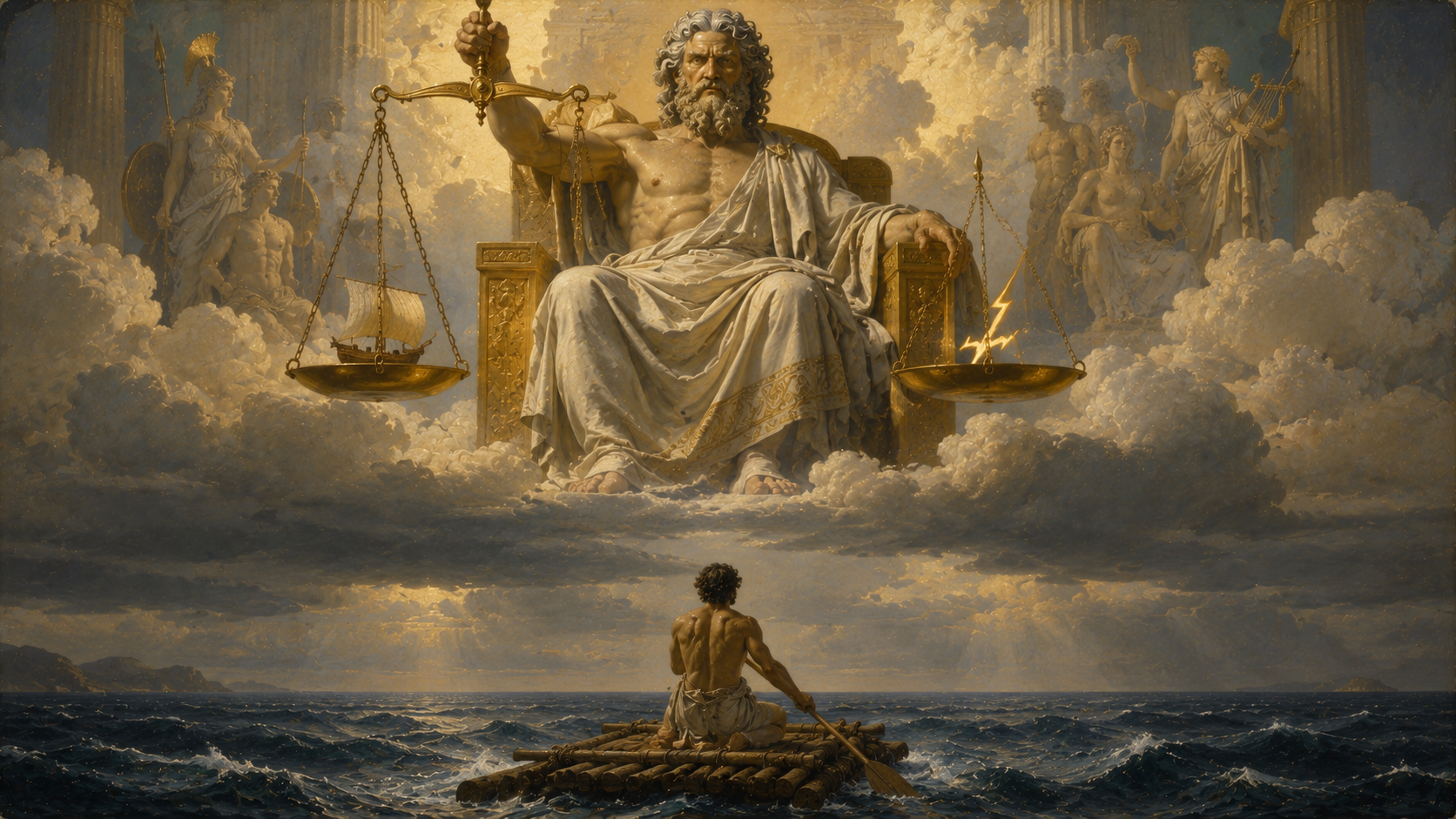
Before Odysseus appears, before Telemachus speaks, before Athena descends from Olympus, Zeus delivers a short speech on the nature of human suffering. He is talking about Aegisthus, the man who seduced Clytemnestra and murdered Agamemnon when the king of Mycenae returned from Troy. The gods warned Aegisthus. They sent Hermes to tell him plainly: do not do this. Aegisthus did it anyway and paid the price when Orestes, Agamemnon's son, came back and killed him.
Zeus uses this as proof that mortals suffer beyond what fate decrees because of their own foolishness. The Greek word Homer uses is atasthalia, which means something close to "blind recklessness," the kind of willful stupidity that makes a person ignore a warning they have clearly received. Zeus is not denying that the gods influence mortal lives. He is saying that mortals make things worse than they need to be.
This distinction is subtle but crucial. Fate, in the Odyssey, establishes the broad strokes: Odysseus will return to Ithaca. That is decreed. But the path he takes, the years he loses, the men who die along the way, these are shaped by human choices. Fate says where you end up. Free will determines how much you suffer getting there.
Poseidon's Grudge: When the Gods Make It Personal
The clearest example of divine interference in the Odyssey is Poseidon's relentless persecution of Odysseus. The god of the sea hates Odysseus because Odysseus blinded Poseidon's son, the Cyclops Polyphemus. Every storm, every shipwreck, every delay on the wine-dark sea is Poseidon's doing. He is not enforcing fate. He is settling a personal score.
But here is where the question of free will becomes unavoidable. How did Poseidon come to hate Odysseus in the first place? Because Odysseus made a choice. After escaping the Cyclops's cave through an ingenious plan (hiding his men under the bellies of rams, giving his name as "Nobody"), Odysseus could have sailed away in silence and safety. Instead, he stood on the deck of his ship and shouted his real name back at the blinded giant, telling Polyphemus exactly who had done this to him.
It was pride. Pure, reckless, unnecessary pride. And it is the single most consequential decision in the entire poem. Because once Polyphemus knows the name of the man who blinded him, he can pray to his father Poseidon by name: "Grant that Odysseus may never reach home." Every year of suffering that follows traces back to this moment. Not to fate. Not to the gods. To a man who could not resist the urge to make sure his enemy knew who had beaten him.
"So, Cyclops, no weak coward it was whose men you devoured in the hollow cave. And your evil deeds were to catch up with you." Homer, The Odyssey, Book 9 (Samuel Butler translation)
Zeus's opening speech suddenly looks less like philosophical abstraction and more like a precise description of what Odysseus does in Book 9. The gods warned you, and you did it anyway. Now live with the consequences.
Athena's Hand: Help That Complicates Freedom
If Poseidon represents the punishing side of divine intervention, Athena represents the enabling side. She is Odysseus's champion. She argues for his release on Olympus, guides Telemachus on his journey, meets Odysseus on the shore of Ithaca, disguises him as a beggar, stands beside him in battle, and engineers the peace that closes the poem. Without Athena, the homecoming would not happen.
But Athena's help raises an uncomfortable question: if a goddess is orchestrating your success, can you really claim credit for it? When Odysseus outwits the suitors, is that his cunning or Athena's design? When Telemachus grows from a passive boy into a decisive young man, is that personal development or divine manipulation?
Homer's answer is characteristically both. Athena does not act like a puppet master. She acts like a mentor. She creates situations in which Odysseus and Telemachus can succeed, but they still have to do the work. She disguises Odysseus, but he decides how to play the beggar. She inspires Telemachus, but the boy has to find the courage to confront the suitors on his own. The best analogy might be a brilliant teacher who sees potential in a student and creates opportunities for that potential to emerge. The student still has to walk through the door.
There is also the matter of why Athena helps Odysseus in the first place. She tells him plainly: she favors him because he thinks the way she does. They are both schemers, strategists, people who prefer intelligence to brute force. Athena's aid is not random. It is a response to qualities that Odysseus possesses independently of her. She does not create his cunning. She recognizes it and rewards it. The line between divine favor and earned merit blurs, and Homer seems perfectly content to leave it blurred.
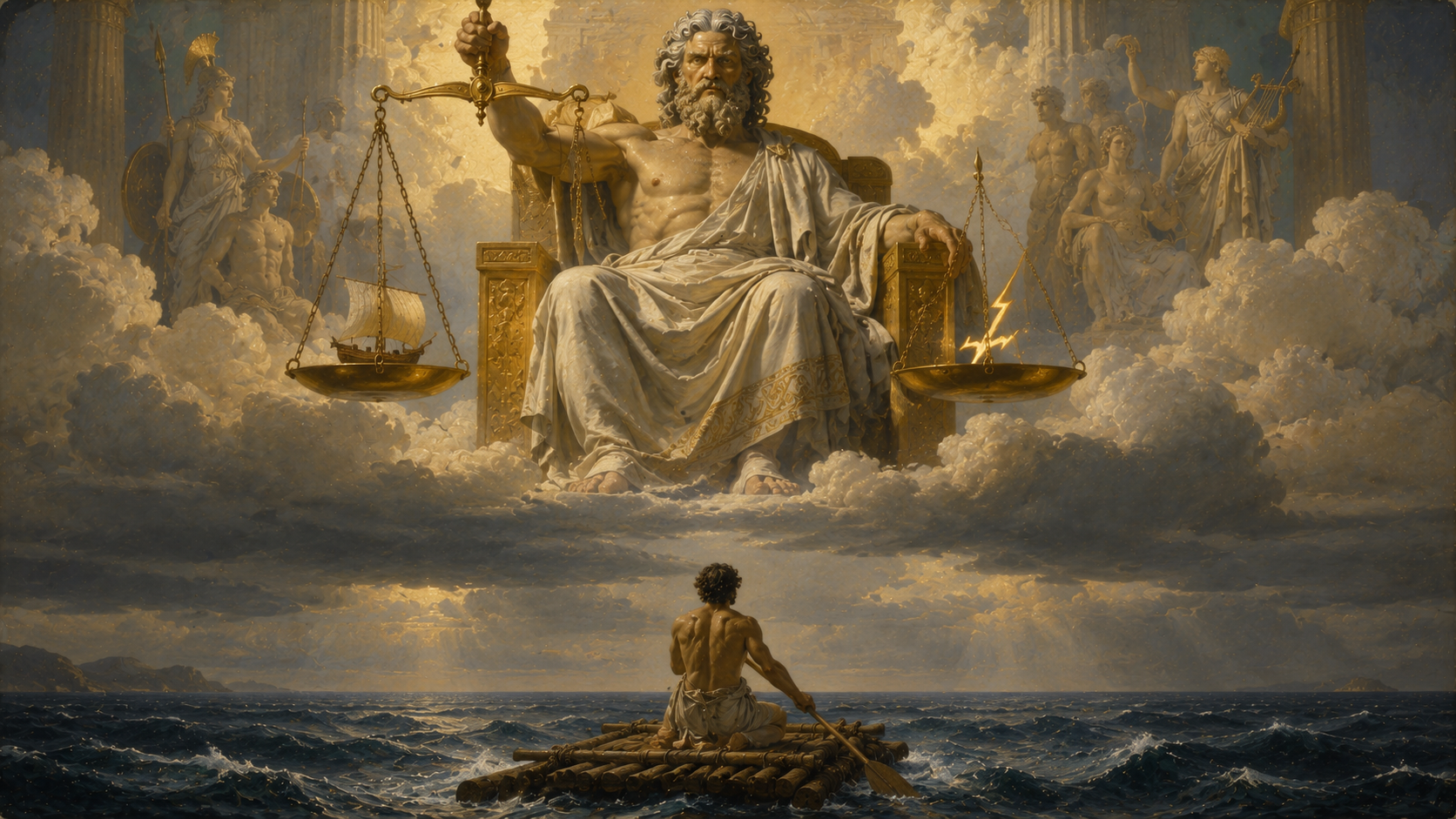
The gods watch from above, but mortals still choose their path
The Cattle of the Sun: A Case Study in Choice
If you want to see the Odyssey's treatment of fate and free will compressed into a single episode, look at Book 12 and the cattle of the Sun god Helios. The setup is extraordinary in its clarity. Odysseus has been warned by everyone. Circe warned him. The prophet Tiresias warned him in the land of the dead. The instruction could not be simpler: do not eat the cattle of the Sun. If you eat them, your ship will be destroyed and your men will die.
Odysseus tells his crew. He makes them swear an oath. They know exactly what will happen if they disobey. And then, when Odysseus falls asleep after days of watching over them, the crew slaughters the cattle and eats the meat. They are hungry. They are tired. They have been stranded on the island for a month because Zeus sent unfavorable winds. And so they make the choice that kills them, knowing full well what the consequence will be.
This is Zeus's atasthalia in action. The men were warned. They understood the warning. They chose to ignore it because their immediate suffering felt more pressing than a future punishment. It is, in miniature, the human condition as Homer understands it: we know what we should do, and we do something else, and then we blame the gods for the outcome.
What makes this episode even more complex is the role of Zeus himself. After the crew eats the cattle, Helios threatens to take his light down to the underworld and shine among the dead if Zeus does not punish them. Zeus, essentially pressured by another god, destroys Odysseus's ship with a thunderbolt. So even the punishment is not purely a consequence of mortal choice. It is also the result of divine politics, one god pressuring another into action. The boundaries between human responsibility and divine caprice become almost impossible to trace.
Odysseus's Cunning: When Human Will Bends Fate
For all the power of the gods, the Odyssey consistently shows Odysseus shaping his own outcomes through intelligence and will. In the Cyclops's cave, no god saves him. He comes up with the plan himself: the name "Nobody," the sharpened stake, the escape beneath the rams. Against the Sirens, he devises the solution of wax and ropes. Against Scylla and Charybdis, he makes the terrible but correct tactical choice to sail closer to Scylla, losing six men rather than the entire ship. Back in Ithaca, he endures insult after insult from the suitors, biding his time with a patience that is entirely his own.
These moments suggest that the Odyssey does not treat fate as absolute determinism. Fate sets the destination, but human intelligence determines the route. Odysseus is fated to get home, yes, but he is not fated to survive every individual encounter along the way. He survives because he is clever, disciplined, and, when necessary, ruthless. Other men in the poem, men who are less shrewd or less patient, do not survive. The crew dies. The suitors die. Odysseus endures because of qualities that belong to him, not to the gods.
Homer seems to admire this. The word that describes Odysseus most often, polytropos ("of many turns" or "much-traveled" or "crafty"), is a word about human capability. It does not mean "beloved by the gods." It means "capable of finding his way through anything." The Odyssey is, at its core, a poem that celebrates human resourcefulness even within a world ruled by divine power.
The Suitors: Men Who Chose Their Own Destruction
The suitors of Penelope are the poem's clearest example of Zeus's opening thesis. They are warned, repeatedly, that what they are doing will end badly. Telemachus warns them. The prophet Theoclymenus warns them so explicitly that he describes visions of blood and death. They are offered chances to leave. They ignore every warning because they do not believe consequences apply to them.
When Odysseus finally kills them, the poem frames it as justice, not fate. The suitors had a choice. They chose to occupy another man's house, consume his wealth, harass his wife, and plot to murder his son. They did this for years, with no external compulsion, no divine mandate, no prophetic obligation. They did it because they wanted to, and because they assumed there would be no reckoning. The reckoning arrives in the form of Odysseus with a bow, and their surprise at being held accountable is itself a kind of moral failure.
Homer draws a direct line from the Aegisthus story in Zeus's opening speech to the suitors' destruction at the poem's end. Both are stories of men who were warned, who chose to act against the warning, and who suffered for it. The gods did not make them do it. The gods told them not to do it. They did it anyway. In the Odyssey's moral universe, that is the essential human tragedy: not that we lack freedom, but that we use our freedom poorly.
Calypso and the Limits of Divine Will
Calypso's seven-year detention of Odysseus on Ogygia introduces yet another dimension to the fate-and-free-will question. Calypso is a goddess. She wants Odysseus to stay. She offers him immortality. And for seven years, he stays, not because he wants to, but because he cannot leave. A god has decided his fate for him, and his free will counts for nothing.
This changes only when a higher god intervenes. Zeus sends Hermes to order Calypso to release Odysseus. One divine will overrules another, and suddenly Odysseus's desire to go home aligns with Olympian decree. His freedom is restored not because he earned it or fought for it, but because the gods changed their minds. It is a humbling reminder that in the Odyssey's world, human autonomy operates within boundaries set by forces no mortal can control.
And yet, even here, choice matters. Calypso offers Odysseus immortality, and he refuses. No god forced that refusal. No prophecy required it. Odysseus chose mortality, chose Penelope, chose the difficult journey home over eternal comfort. It is perhaps the purest act of free will in the entire poem, a decision made without any divine pressure in either direction. The gods can keep him on an island. They can wreck his ships. They can delay his journey for a decade. But they cannot choose his values for him. That remains his and his alone.
Homer's Both-And: Why the Tension Is the Point
Modern readers often want Homer to resolve the tension between fate and free will, to come down clearly on one side or the other. He does not. And that refusal to resolve is not a failure of the poem. It is the poem's deepest insight.
Homer understood something that later Greek philosophers would spend centuries debating: that the question "Is my life determined by forces beyond my control, or do I shape my own destiny?" does not have a clean answer. Both are true, simultaneously. You are born into circumstances you did not choose. You encounter obstacles placed by forces you cannot see. And within those constraints, you make decisions that matter enormously, decisions that determine whether you arrive home battered but intact, or not at all.
The Odyssey is not a poem about predestination. Odysseus does not simply ride a conveyor belt back to Ithaca. He fights, schemes, endures, and chooses his way home. But the Odyssey is also not a poem about pure self-determination. Poseidon's storms are real. Athena's help is real. The gods are real presences whose decisions shape the world in ways mortals cannot override.
The genius of the poem is that it holds both of these truths in tension without collapsing one into the other. Human beings are free enough to be responsible for their choices, and constrained enough that those choices play out on a stage they did not build. That is not a contradiction. That is what it feels like to be alive.
Hear the Gods Debate on Olympus
Our full-cast narration brings the divine councils to life with distinct voices for Zeus, Athena, Poseidon, and Hermes. Hear Zeus's opening complaint about mortal recklessness. Hear Athena's passionate case for Odysseus's return. Hear Calypso's furious protest when Hermes arrives with orders she did not ask for. The theological arguments of the Odyssey are not abstract. They are dramatic, personal, and charged with the same emotional intensity as any confrontation between mortals. Every word highlighted as it is spoken.
Related Pages
Hear the Gods and Mortals Collide
Full-cast narration with 60+ character voices. Every word highlighted as it is spoken. Book I is free. Unlock all 24 books for $6.99.
Start Listening FreeContinue the Journey
Hear the complete Odyssey read aloud with 60+ character voices. Every word highlights as it is spoken.
Book I is completely free. No signup required.
Go Deeper Into the Odyssey Film
Get the free Odyssey Companion Guide: character map, timeline, family tree, and the essential scenes from Homer's poem and the film.
No spam. Unsubscribe anytime.