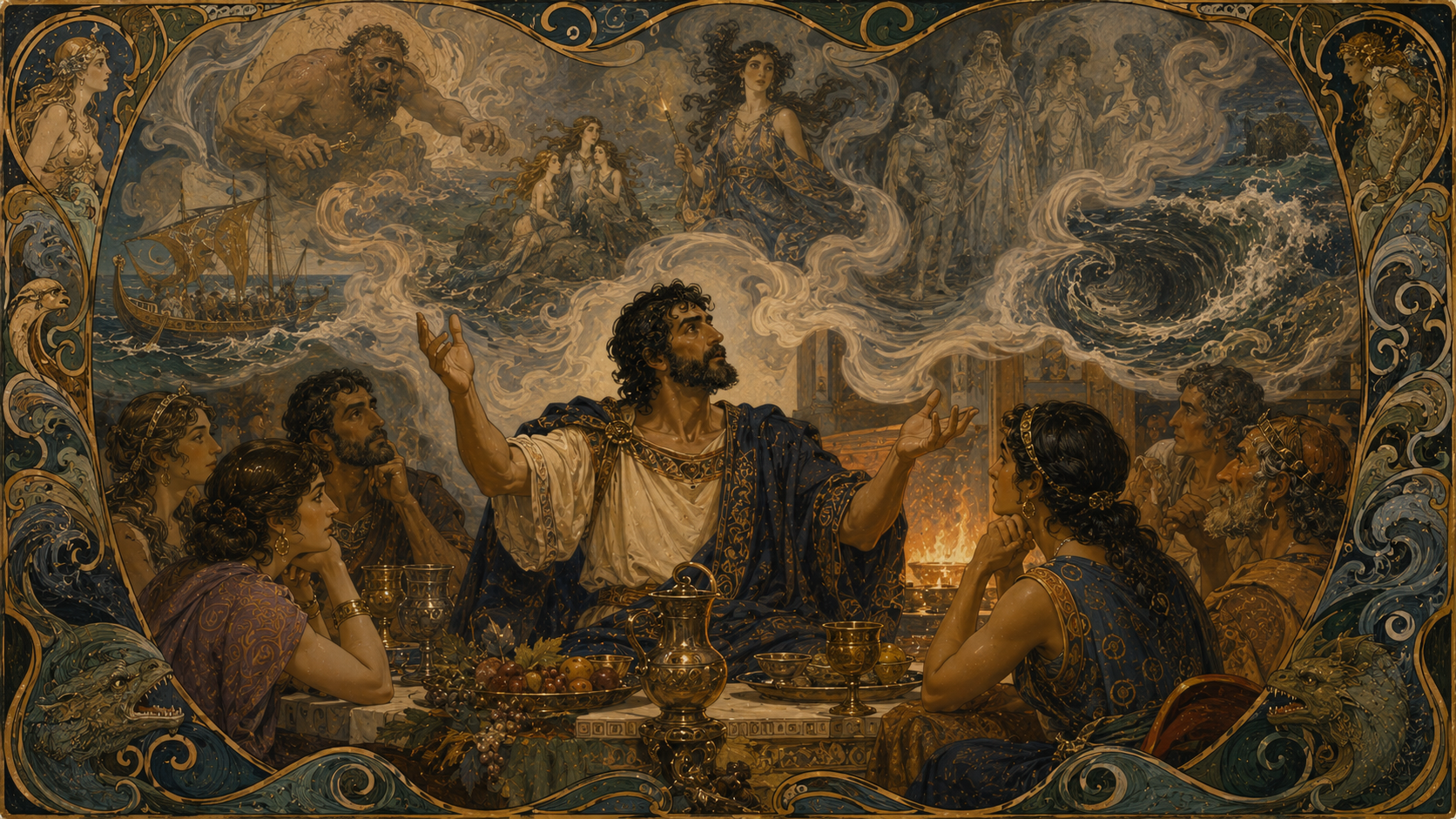
Beginning in the Middle: The In Medias Res Revolution
The Odyssey does not start at the beginning. It does not open with the fall of Troy, or with Odysseus setting sail for home, or with any of the famous adventures that most people associate with the poem. Instead, it begins in the tenth year of Odysseus's absence, at the moment when the gods on Olympus decide he has suffered long enough. Odysseus is stuck on Calypso's island. His son Telemachus is overwhelmed by suitors in Ithaca. The situation is already a crisis before the first line is spoken.
This technique, which later critics would call in medias res (Latin for "in the middle of things"), is so familiar now that it is easy to forget how radical it was. Every thriller that opens with a chase in progress, every film that begins with a mystery already unfolding, every novel that drops you into a world and trusts you to catch up, owes something to this decision by Homer. The Iliad begins close to the end of the Trojan War, but the Odyssey goes further: it scatters its chronology across the entire poem, so that the audience must assemble the timeline from fragments told by different speakers at different moments.
The effect is suspense of a particular kind. We know Odysseus is alive. We know he wants to come home. But we do not know what happened to him, and we do not learn the full story until Books 9 through 12, when Odysseus himself decides to tell it. Homer withholds the adventures, the Cyclops, the Sirens, the descent to the underworld, for nearly a third of the poem. By the time Odysseus opens his mouth at the Phaeacian court, we are desperate to hear it.
The Telemachy: A Son Collecting Stories
Before we hear from Odysseus, we hear about him. Books 1 through 4, known as the Telemachy, follow Telemachus as he travels to Pylos and Sparta looking for news of his father. What he finds are stories. Nestor, the old king of Pylos, tells him about the disastrous returns of the Greek heroes after Troy. Menelaus, back in Sparta with Helen, tells him about his own wanderings, including a strange encounter with the shape-shifting sea god Proteus on the shores of Egypt.
These are not digressions. They are the poem teaching us how to listen. Each story Telemachus hears contains a lesson about homecoming: some heroes returned safely, some were murdered, some wandered for years. Agamemnon came home and was killed by his wife and her lover. Menelaus came home but only after years of being lost. Ajax never came home at all. The question hanging over every conversation is simple. What happened to Odysseus? And the answer, every time, is: we do not know.
By structuring the opening this way, Homer accomplishes something subtle. He makes us experience what Telemachus experiences. We sit in great halls and listen to old men talk about the past, hoping for one useful detail, one clue about whether Odysseus is alive. The Telemachy is often the part of the Odyssey that first-time readers find slowest, but it is doing essential work. It establishes that in this poem, information is power, and stories are the primary medium through which information travels.
Demodocus and the Bard's Authority
When Odysseus finally arrives at the Phaeacian court in Books 6 through 8, he encounters Demodocus, the blind bard who sings at King Alcinous's feasts. Demodocus sings three songs over the course of Books 8, and each one matters.
His first song is about a quarrel between Odysseus and Achilles at Troy. Odysseus, hearing his own past sung by a stranger, covers his face and weeps. His second song is a comic tale about Ares and Aphrodite caught in an adulterous affair by Aphrodite's husband Hephaestus. This is a lighter moment, but it raises questions about deception and exposure that echo throughout the poem. His third song, requested by Odysseus himself, is the story of the Trojan Horse, the stratagem that won the war. Odysseus weeps again, so violently that Alcinous notices and asks who he really is.
The Demodocus scenes establish several things at once. They show the power of song to move even the person whose story is being told. They demonstrate that stories about real events circulate independently of the people who lived them. And they set up a contrast that will become crucial: Demodocus sings the truth (the Muse inspires him, as Homer tells us), but he sings it from the outside, without having been there. When Odysseus takes over as narrator in Book 9, he will tell his story from the inside, as someone who lived it. The question the poem raises is whether living through something makes you a better teller of it, or a worse one.
"Sing to me of the man, O Muse, the man of twists and turns, driven time and again off course." Homer, The Odyssey, Book 1 (Opening Invocation)
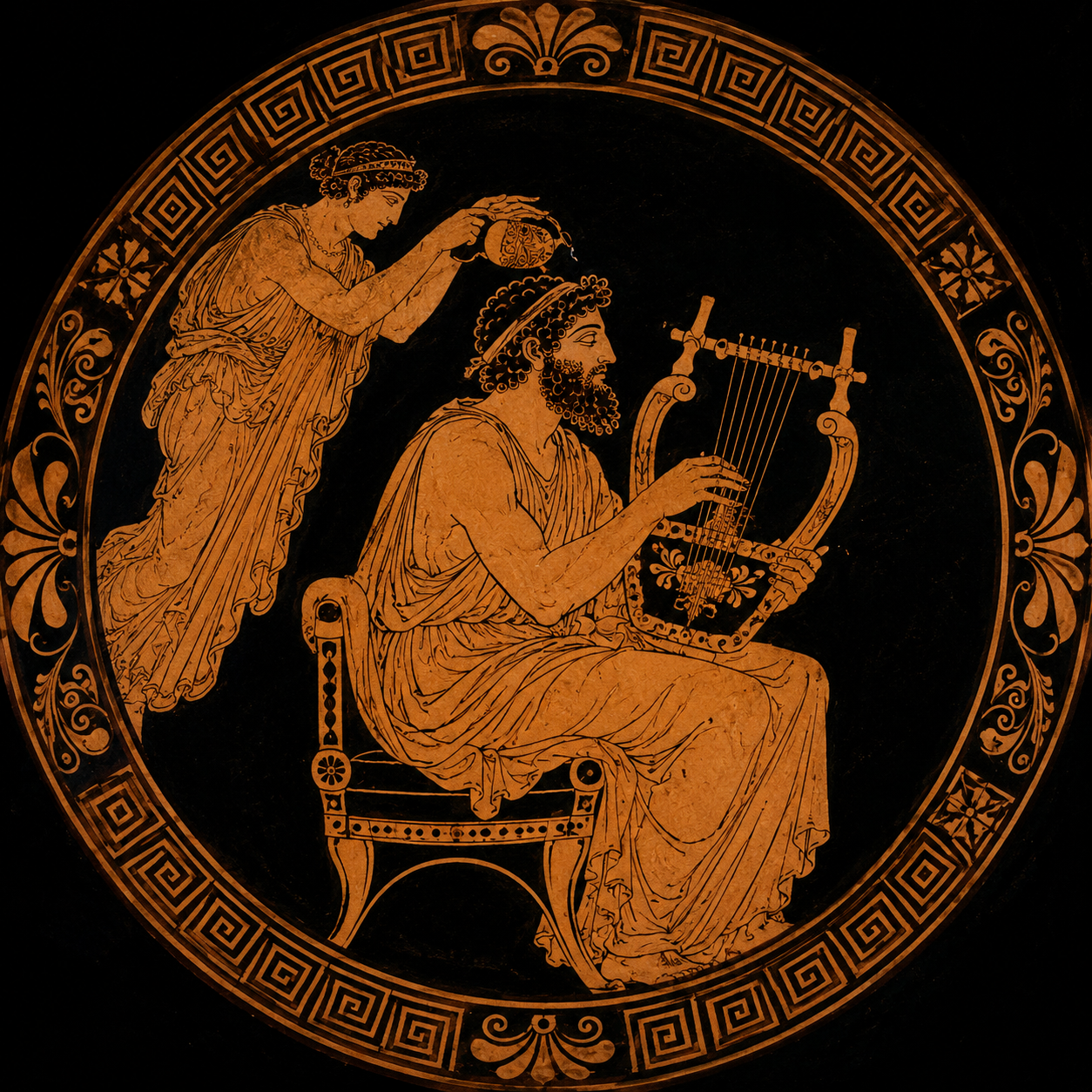
The blind bard Demodocus moves Odysseus to tears with his song
Recommended Reading
As an Amazon Associate, we earn from qualifying purchases.
Books 9 Through 12: Odysseus Takes the Stage
When Alcinous asks Odysseus to reveal himself and tell his story, something remarkable happens. The poem shifts narrators. For four consecutive books, nearly two thousand lines of verse, the voice we hear is not Homer's but Odysseus's. He tells the Phaeacians everything: the raid on the Cicones, the Lotus-Eaters, the Cyclops, Aeolus and the bag of winds, the Laestrygonians, Circe, the journey to the land of the dead, the Sirens, Scylla and Charybdis, the cattle of the Sun, and his years on Calypso's island.
This is the heart of the Odyssey as most people know it, the section with all the monsters and marvels. But it is worth pausing on the framing. Odysseus is not talking to us. He is talking to the Phaeacians, and he wants something from them: a ship to take him home. He is performing. He is working an audience. And he is very, very good at it. Homer tells us that when Odysseus finishes a section of his story, the Phaeacians sit in silence, spellbound. They shower him with gifts. They promise him safe passage. His storytelling literally earns him his ticket home.
This raises a question that scholars have debated for centuries. How much of what Odysseus tells the Phaeacians is true? Homer has already shown us, repeatedly, that Odysseus is a liar. The epithet "polytropos," the very first adjective applied to him in the poem, means something like "of many turns" or "of many wiles." Later in the poem, after he reaches Ithaca, he will invent at least four elaborate false identities, complete with invented backstories delivered with total conviction. Athena herself tells him he is the greatest liar among mortals, and she means it as a compliment.
So when Odysseus tells the Phaeacians about one-eyed giants and singing monsters and a descent into the underworld, are we meant to believe every word? Or is Homer inviting us to wonder whether the greatest storyteller in literature is also, perhaps, embellishing for his audience? The poem does not answer this question directly. It simply lets it hang in the air, like the Sirens' song, impossible to ignore once you have heard it.
Stories Within Stories: The Nested Architecture
The Odyssey is layered like a set of nesting boxes. Homer tells a story. Inside that story, characters tell their own stories. Inside those stories, still other voices speak. The effect is a poem that constantly reflects on the act of narration, that keeps asking who is speaking, to whom, and why.
Consider the structure. Homer narrates the frame. Nestor tells Telemachus about the Greek returns from Troy. Menelaus tells Telemachus about encountering Proteus, and within that story, Proteus tells Menelaus about the fates of other heroes. Demodocus sings three songs at the Phaeacian court. Odysseus narrates Books 9 through 12, and within his narration, the ghost of Teiresias speaks, the ghost of his mother speaks, the ghosts of dead warriors speak. Eumaeus tells his own life story in Book 15. Penelope tells the suitors about her weaving trick. Even Odysseus's old nurse Eurycleia recognizes him by a scar, and the poem pauses to tell us the full story of how he got it.
No ancient poem before the Odyssey attempted anything this complex. Homer created a narrative architecture in which the act of telling a story is always also part of the story being told. Every narrator has motives. Every audience reacts. Every tale has consequences for both the teller and the listener.
Penelope's Loom: The Story That Buys Time
Perhaps the most elegant story within the Odyssey is Penelope's famous trick with the loom. She tells the suitors that she cannot remarry until she finishes weaving a funeral shroud for Odysseus's father, Laertes. Each day she weaves, and each night she unravels what she has done. For three years, this deception holds. She is, in her way, as crafty as Odysseus, and her tool is the same: narrative. She tells the suitors a story about weaving, and the story keeps them at bay.
The weaving metaphor runs deep. In ancient Greek, the word for the craft of storytelling and the word for the craft of weaving are closely related. To weave a tale is not merely a modern cliche; it is a connection embedded in the language Homer spoke. Penelope at her loom is a mirror of Homer at his poem: constructing something intricate, deliberate, and designed to hold an audience in place.
When the trick is finally discovered (a servant betrays her), the suitors are furious. They have been manipulated by a story. They have been defeated, for three years, not by a warrior or a god, but by a woman with a narrative. The Odyssey treats this as one of the most impressive feats in the entire poem. Penelope's weaving and unweaving is placed alongside Odysseus's tales at the Phaeacian court as evidence that in this family, intelligence and storytelling are inseparable.
Recommended Reading
As an Amazon Associate, we earn from qualifying purchases.
The Lies of Odysseus: Storytelling as Survival
After Odysseus arrives in Ithaca, disguised as a beggar by Athena, he tells a series of elaborate false stories about who he is. To Eumaeus the swineherd, he invents a tale about being a Cretan warrior who fought at Troy and then fell on hard times. To Penelope, he tells a slightly different version. To Antinous, the chief suitor, he tells yet another. Each lie is tailored to the audience, designed to elicit the response Odysseus needs: sympathy, hospitality, information.
These are not casual deceptions. Homer gives them the full treatment, letting Odysseus spin out long, detailed narratives with specific places, names, and events. They are as vivid and compelling as any passage in the poem, and they work. Eumaeus weeps. Penelope is moved. The suitors are fooled. Odysseus survives in his own house, surrounded by enemies, entirely on the strength of his storytelling.
The irony is exquisite. The man who told the Phaeacians about monsters and magic now tells commoners about trade routes and storms. The grandest storyteller in Greek literature is also the most practical one. He understands that a story does not need to be true to be effective. It needs to do what the situation demands. Sometimes that means inspiring awe. Sometimes it means inspiring pity. The skill is the same.
"He made the many falsehoods of his tale seem like the truth." Homer, The Odyssey, Book 19
Why the Odyssey Cares About Storytelling
At its deepest level, the Odyssey is a poem about the relationship between experience and narration. Odysseus has lived through extraordinary things, but those experiences only become meaningful when he puts them into words. The monsters he fought, the men he lost, the years he spent adrift, none of it counts until it is told. And the telling does not merely record the experience. It transforms it. Odysseus at the Phaeacian court is not simply remembering. He is shaping his past into a form that serves his present needs.
This is why the Odyssey, more than the Iliad or any other ancient epic, feels startlingly modern. It understands that identity is a story we tell about ourselves. It understands that memory is selective, that narrators have agendas, that audiences are not passive. Three thousand years before the unreliable narrator became a staple of literary fiction, Homer was already playing with the idea that the man telling you his story might be leaving things out, rearranging the order, improving his own role, or simply inventing what he needs.
The poem also understands that stories create community. The Phaeacians listen to Odysseus and are changed by what they hear. They commit their ships and their treasure to helping a stranger because his story moved them. Telemachus listens to Nestor and Menelaus and begins to understand who his father is and, by extension, who he himself might become. Even the suitors are destroyed, in part, because they refused to listen. They ignored the stories, the warnings, the signs. In the Odyssey, the people who listen survive. The people who do not, perish.

The tools of the ancient storyteller's craft
The Odyssey Read Aloud: Hearing What Homer Intended
Homer composed for the ear, not the eye. The Odyssey was sung or chanted at public gatherings, performed by bards who held their audiences with the rhythm and music of the Greek hexameter line. When you read the Odyssey silently on a page, you get the story. When you hear it spoken aloud, you get something closer to what Homer designed: a performance, a voice in a room, a narrator working an audience just as Odysseus works the Phaeacians.
Our full-cast narration of the Odyssey restores that spoken dimension. Every character has a distinct voice. Every shift in narrator, from Homer to Odysseus to Nestor to the ghosts of the dead, is marked by a change in tone and presence. You hear the difference between the poem's outer frame and the inner stories. You catch the rhythms that a silent reader misses. And you experience what audiences have experienced for three millennia: the simple, ancient pleasure of being told a good story by someone who knows how to tell it.
Explore Homer's Craft
As an Amazon Associate, we earn from qualifying purchases.
Continue Reading
Hear the Stories Come Alive
Full-cast narration with 60+ character voices. Book I is free. Unlock the complete Odyssey, all 24 books, for $6.99.
Start Listening FreeContinue the Journey
Hear the complete Odyssey read aloud with 60+ character voices. Every word highlights as it is spoken.
Book I is completely free. No signup required.
Go Deeper Into the Odyssey Film
Get the free Odyssey Companion Guide: character map, timeline, family tree, and the essential scenes from Homer's poem and the film.
No spam. Unsubscribe anytime.
Sing to Me, O Muse
The immortal invocation and more. T-shirts, posters, mugs, canvas prints, and tote bags.
Browse All ProductsFEATURED DESIGNS