A Poem Before Writing
For most of Western literary history, scholars assumed Homer worked the way any great poet works: alone, with time, revising and polishing. The Odyssey was treated as a written masterpiece that happened to be very old. Then, in the 1930s, a young American classicist named Milman Parry traveled to the remote mountains of Yugoslavia and discovered something extraordinary. There were still living oral poets there, men who could perform epic poems of thousands of lines entirely from memory, composing new verses on the spot while maintaining a strict metrical pattern. Parry and his student Albert Lord recorded these performances and studied their techniques. What they found revolutionized our understanding of Homer.
The Yugoslav bards did not memorize their poems word for word. They memorized a system: a set of stock phrases, narrative patterns, and rhythmic building blocks that could be assembled in different combinations for each performance. No two performances were exactly alike, yet every performance sounded like the same poem. The bards were not reciting. They were composing, in real time, using inherited materials. Parry recognized the same system at work in Homer. The Odyssey's famous repetitions, its recurring phrases and descriptive tags, were not signs of a poet too lazy to find new words. They were the tools of a poet who had to build 12,110 lines of metrically perfect verse without the ability to pause, reread, or revise.
The Music of Formulas: How Epithets Work
Open any page of the Odyssey and you will find them: "rosy-fingered Dawn," "swift-footed Achilles," "much-enduring, brilliant Odysseus," "the wine-dark sea." These are not metaphors chosen for a particular moment. They are formulas, metrically shaped phrases that fill a specific rhythmic slot in the dactylic hexameter line. Each formula is like a prefabricated beam in a building. The bard knows exactly how many syllables it contains, exactly where it fits in the line, and exactly how it connects to the phrases before and after it. When he needs to mention Dawn, "rosy-fingered" is ready. When the sea appears, "wine-dark" is waiting. The formula does the rhythmic work so the poet's mind can race ahead to the next thought.
This is why Homer almost never uses two different epithets for the same character in the same metrical position. Athena is "grey-eyed" or "bright-eyed" depending on the translation, but in the Greek, her epithet is chosen based on where in the line her name falls. It is not about what she is doing in the scene. It is about what fits the meter. Modern readers sometimes find this puzzling. Why is the sea "wine-dark" even in broad daylight? Why is Dawn "rosy-fingered" even when nothing about the scene calls for a description of the sky? Because the epithet is not a description. It is a musical phrase, a rhythmic anchor, a piece of the machinery that keeps the poem moving forward at performance speed.
The beauty of this system is that it works on two levels at once. Practically, it gives the bard breathing room. While his mouth is producing "much-enduring, brilliant Odysseus," his mind is already constructing the rest of the sentence. But aesthetically, the formulas also create a kind of grandeur, a sense of the poem's world as stable and eternal. Every time Dawn is rosy-fingered, every time the sea is wine-dark, the audience is reminded that they are inside a tradition, a way of speaking about the world that stretches back beyond any single poet's memory.
Type Scenes: The Blueprints of Story
Formulas operate at the level of the phrase. But oral poets also work with larger building blocks called type scenes, which are essentially narrative templates for recurring situations. There is a type scene for a hero arming for battle. There is one for a guest arriving at a palace. There is one for a feast, for a sacrifice, for a ship setting sail. Each type scene has a standard sequence of elements, and the poet can expand, compress, or vary those elements depending on the needs of the moment, but the basic pattern remains recognizable.
The Odyssey is built from type scenes in a way that becomes visible once you know what to look for. Consider the hospitality scenes. Every time Odysseus (or Telemachus) arrives at a new place, a familiar pattern unfolds: the traveler approaches, someone notices the stranger, the host offers a seat and food before asking any questions, a meal is served, and only after the guest has eaten does the host ask who the visitor is and where he comes from. This happens at the palace of Nestor, at the court of Menelaus, on the island of the Cyclops (where the pattern is deliberately violated), at the hut of the swineherd, and at the palace of Ithaca. Each version of the scene is different in its details, but the underlying structure is the same.
For the performing bard, type scenes serve the same purpose as formulas: they reduce the cognitive load of composition. The poet does not have to invent a hospitality scene from scratch every time someone knocks on a door. He has the template in his memory, and he can pour new content into its familiar shape. For the audience, type scenes create expectation and suspense. When the pattern is followed, there is comfort and satisfaction. When it is broken, as with the Cyclops who eats his guests instead of feeding them, the violation is shocking precisely because the audience knows how the scene is supposed to go.
Recommended Reading
As an Amazon Associate, we earn from qualifying purchases.
The Bard in Greek Society
Homer was not a modern author. He was something closer to a musician, a priest, and a historian rolled into one. The bard, or aoidos in Greek, held a position of genuine honor in ancient Greek society. He was the keeper of the culture's memory, the man who could summon the great deeds of heroes and gods and make them live again in the present moment. In a world without books, without written records, without schools as we understand them, the bard was the living library.
Homer tells us about his own profession through the bards who appear inside the Odyssey itself. There are two: Phemius, who sings for the suitors in Odysseus's palace on Ithaca, and Demodocus, who performs at the court of the Phaeacians. Both are treated with deep respect. Demodocus is blind (a detail that ancient tradition also attributed to Homer himself), and the Phaeacians seat him in a place of honor and bring him the finest cuts of meat. When he sings the story of the Trojan Horse, Odysseus weeps, overwhelmed by the memory of his own experience being retold as song. It is a breathtaking moment of self-awareness. Homer, a bard, is describing the power of a bard's song to move a hero to tears, and he is doing so in a performance that was itself meant to move its audience.
Phemius, the bard on Ithaca, gives us the other side of the profession. He sings for the suitors under duress, forced to perform for men who are destroying his patron's household. When Odysseus finally kills the suitors, Phemius throws himself at the hero's feet and begs for his life, arguing that a bard is sacred, that killing a singer would be an offense against the gods. Odysseus spares him. The scene reveals something important about how the Greeks understood the bard's role: he was not merely an entertainer. He was under divine protection, a channel for the Muses, and his art was considered genuinely holy.
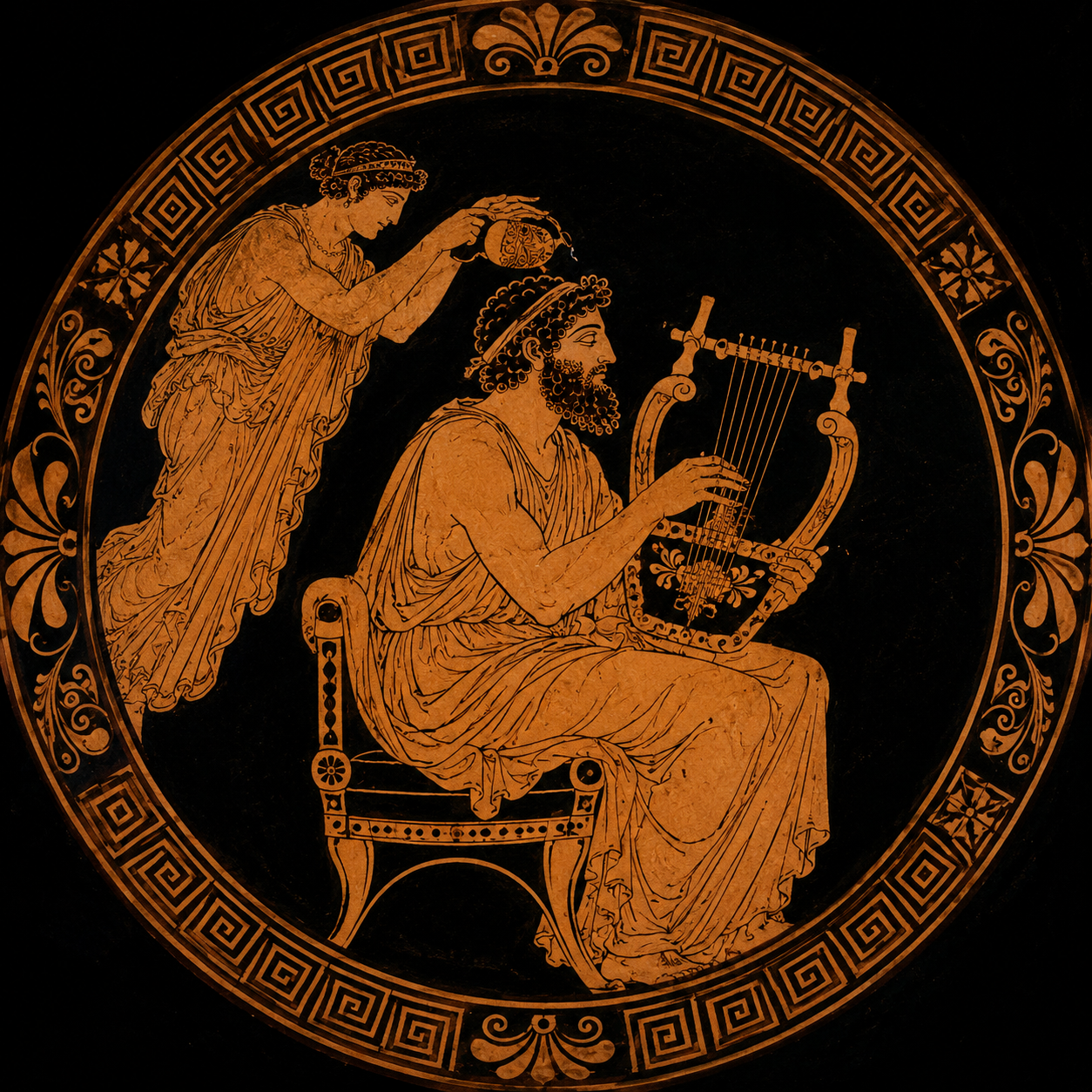
Demodocus embodies the living tradition of oral poetry
Oral vs. Written: Why It Sounds Different
If you have ever felt that the Odyssey reads differently from a modern novel, that it repeats itself too much, that its descriptions are strangely formulaic, that its characters seem to introduce themselves the same way every time, you are not wrong. You are simply encountering the fingerprints of oral composition on a poem that has been frozen into written text. The Odyssey was designed for listeners, not readers. It was built to be heard once, in sequence, without the ability to flip back to an earlier page. Every technique that seems odd on the printed page makes perfect sense when you imagine it being performed aloud.
Repetition, for instance, is not a flaw in oral poetry. It is a feature. When a written reader encounters the same phrase twice, it feels redundant. When a listener hears it, it feels anchoring. The repeated epithets and type scenes serve as landmarks in a vast narrative landscape, reminding the audience where they are, who is speaking, and what kind of scene is unfolding. They are the chorus of a song, the refrain that holds everything together.
The same is true of the poem's pacing. Written narratives can afford to be dense, because the reader controls the speed. Oral narratives cannot. The bard has to manage his audience's attention in real time, which means alternating between moments of high drama and stretches of familiar, comfortable narration - a technique explored further in our guide to storytelling in the Odyssey. The long catalogues of ships, the detailed descriptions of meals, the extended similes comparing a hero to a lion or a farmer or a wave, all of these give the audience time to process what has happened and prepare for what comes next. They are the breathing spaces of a poem that was meant to be experienced over many hours, possibly over multiple evenings.
"Sing to me of the man, Muse, the man of twists and turns, driven time and again off course, once he had plundered the hallowed heights of Troy." Homer, The Odyssey, Book 1 (Samuel Butler translation, 1900)
Even the famous opening line is an oral formula. "Sing to me" is not a literary flourish. It is a literal invocation. The bard is asking the Muse, the goddess of memory and inspiration, to sing through him. He is declaring that what follows is not his own invention but something received, channeled, drawn from a source older and deeper than any individual poet. For a culture that believed the Muses genuinely inspired artistic creation, this was not a metaphor. It was a statement of how the poem actually came into being.
The Wine-Dark Sea: A Mystery in Three Words
No Homeric epithet has generated more debate than "wine-dark sea." The phrase appears dozens of times across the Odyssey and the Iliad, and it has puzzled readers for centuries. The sea is not the color of wine. Not in the Aegean, not in the Mediterranean, not anywhere. So what does it mean?
One famous theory, advanced by the British politician William Gladstone in the nineteenth century, holds that the ancient Greeks perceived color differently than we do. Gladstone noticed that Homer uses color words in ways that seem strange by modern standards: honey is "green," iron is "violet," sheep are "wine-colored." He proposed that the Greeks had an underdeveloped sense of color, particularly for blue. Later scholars have debated this endlessly, with some arguing that different languages carve up the color spectrum in genuinely different ways, and others insisting that Greek eyes worked the same as ours and the words simply had different ranges of meaning.
Another explanation focuses on context. The sea really does look wine-dark at certain moments: at sunset, when the water turns a deep reddish-purple, or during a storm, when the waves take on a nearly black opacity. Perhaps "wine-dark" is not a generic description of all seas at all times but a specific image captured in the formula and then applied broadly, the way we might describe the sky as "blue" even at dawn or dusk when it is really pink or gold.
But the most compelling reading may be the simplest. "Wine-dark" is a formula. It fills a metrical space. It sounds beautiful. And it carries a resonance, a sense of depth and danger and intoxication, that no literal color word could match. The sea in the Odyssey is not just a body of water. It is the force that separates Odysseus from home, that swallows his companions, that tests him at every turn. Calling it "wine-dark" links it to another powerful substance, one that can bring joy or destruction depending on how it is used. The epithet works not because it is visually accurate but because it is emotionally true.
From voice to scroll: the evolution of epic storytelling
Recommended Reading
As an Amazon Associate, we earn from qualifying purchases.
Hearing Homer Again
For nearly three thousand years, the Odyssey has been a text. Something you read on a page, in silence, with your eyes. But for the first centuries of its existence, perhaps the most important centuries, it was something else entirely. It was a performance. A living, breathing event that happened between a singer and an audience, shaped by the room, the occasion, the mood of the crowd, and the skill of the bard. Every formula, every epithet, every type scene was a tool designed for that moment of living contact between voice and ear.
When you hear the Odyssey read aloud, with a full cast of voices bringing each character to life, something changes. The repetitions stop feeling like repetitions and start feeling like music. The epithets stop feeling like padding and start feeling like refrains. The pacing, which can seem slow on the page, reveals itself as deliberate and masterful, giving you time to absorb the weight of what is happening before the next wave of story crashes over you.
This is not a coincidence. It is the poem working the way it was designed to work. Homer composed for the ear. Every choice he made, from the smallest formula to the largest structural decision, was shaped by the fact that his audience would hear his words once, in real time, and that those words had to land on the first pass. Reading the Odyssey silently is like looking at a musical score instead of hearing the symphony. You can understand it, intellectually. But you are missing the thing it was made to do.
Explore the Tradition
As an Amazon Associate, we earn from qualifying purchases.
Continue Reading
Hear the Odyssey the Way Homer Meant It
A full cast of over 60 voices. Every word highlighted as it is spoken. The poem performed aloud, the way it was born. Book 1 is free.
Start Listening FreeContinue the Journey
Hear the complete Odyssey read aloud with 60+ character voices. Every word highlights as it is spoken.
Book I is completely free. No signup required.
Go Deeper Into the Odyssey Film
Get the free Odyssey Companion Guide: character map, timeline, family tree, and the essential scenes from Homer's poem and the film.
No spam. Unsubscribe anytime.
Sing to Me, O Muse
The storytelling tradition, wearable. T-shirts, posters, mugs, canvas prints, and tote bags.
Browse All ProductsFEATURED DESIGNS
MORE DESIGNS