Last updated June 2026
Penelope's Decision: Why Now?
Penelope has been delaying for years. Her most famous trick was the shroud of Laertes: she told the suitors she would choose a husband after she finished weaving a burial shroud for Odysseus's elderly father. Every day she wove. Every night she unraveled what she had done. It worked for three years, until one of her own serving women betrayed the secret. After that, she had no more stratagems.
So why does she choose this moment to set the contest? Homer does not spell it out, and scholars have debated it for centuries. Some believe Penelope has simply run out of options and is ready to accept her fate. Others believe she suspects (or knows) that the beggar in the hall is Odysseus, and she is creating the conditions for his reveal. The poem supports both readings and commits to neither.
What is clear is the nature of the test she chooses. The bow is not just any weapon. It is Odysseus's bow, a gift from the hero Iphitus, so powerful that Odysseus never took it to Troy, keeping it at home as a prized possession. No one in Ithaca has strung it in twenty years. By making it the test, Penelope is not just looking for a strong man. She is looking for a man who can fill Odysseus's place. And she may already know that only Odysseus himself can do it.
The Bow Comes Down
Homer gives the scene of Penelope fetching the bow a deliberate weight. She goes to the storeroom where Odysseus's treasures are kept, a room she does not visit often. She takes the key, a beautiful bronze key with an ivory handle, and unlocks the door. The bow is hanging on a peg, still in its case.
When she takes it down, she sits and weeps, holding the bow across her knees. This is her husband's weapon. She has not touched it in twenty years. Every detail Homer includes here, the key, the storeroom, the tears, slows the narrative down, building anticipation. The audience knows what is coming. Penelope does not, or does she? That ambiguity is part of what makes the scene so compelling.
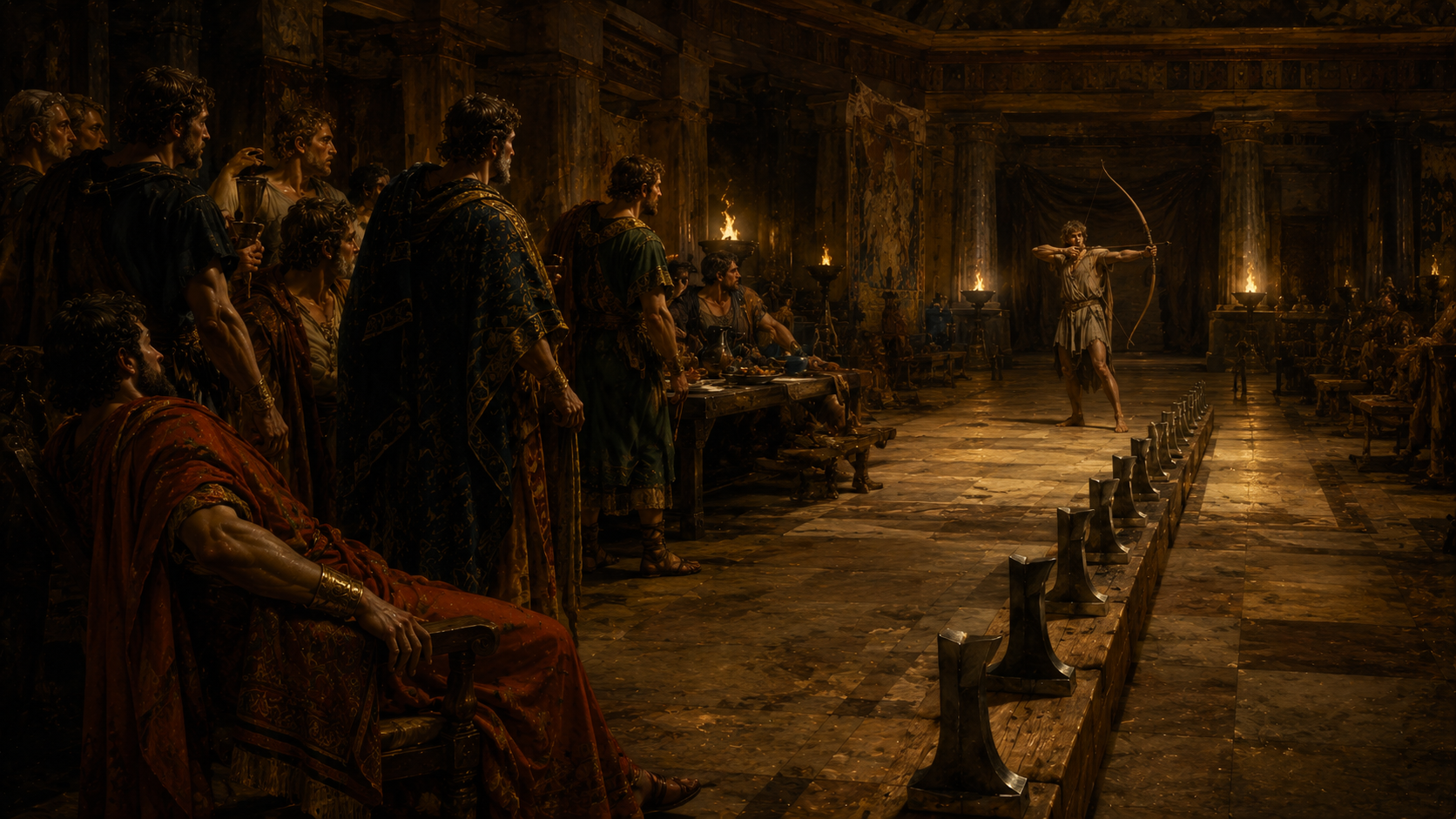
She carries the bow and a quiver of arrows down to the great hall where the suitors are feasting. She announces the contest. Her voice is steady. She is committing to something enormous: the end of her marriage to Odysseus, or so it seems. She sets the bow on a table and lays out the terms. Telemachus sets up the twelve axe heads in a long trench dug in the floor of the hall, aligning them perfectly so the socket-holes form a tunnel. Then the contest begins.
Telemachus Tries First
Before any suitor touches the bow, Telemachus steps up. He says that if he can string his father's bow, then his mother will not have to leave the house, and none of this will be necessary. It is a brave and slightly desperate gesture: the son trying to solve the problem himself, trying to make the contest unnecessary.
He tries three times. On the fourth attempt, he begins to bend the bow far enough, and Homer tells us he would have succeeded. But Odysseus, sitting across the room in his beggar disguise, catches his son's eye and shakes his head. Stop.
Telemachus puts the bow down and says, with carefully performed disappointment, that he is too young and weak. The moment is loaded. Telemachus is strong enough. He nearly did it. But the plan requires that Odysseus be the one who strings the bow, not his son. So Telemachus stands aside, showing the discipline and self-control that the poem has been building in him since Book 1.
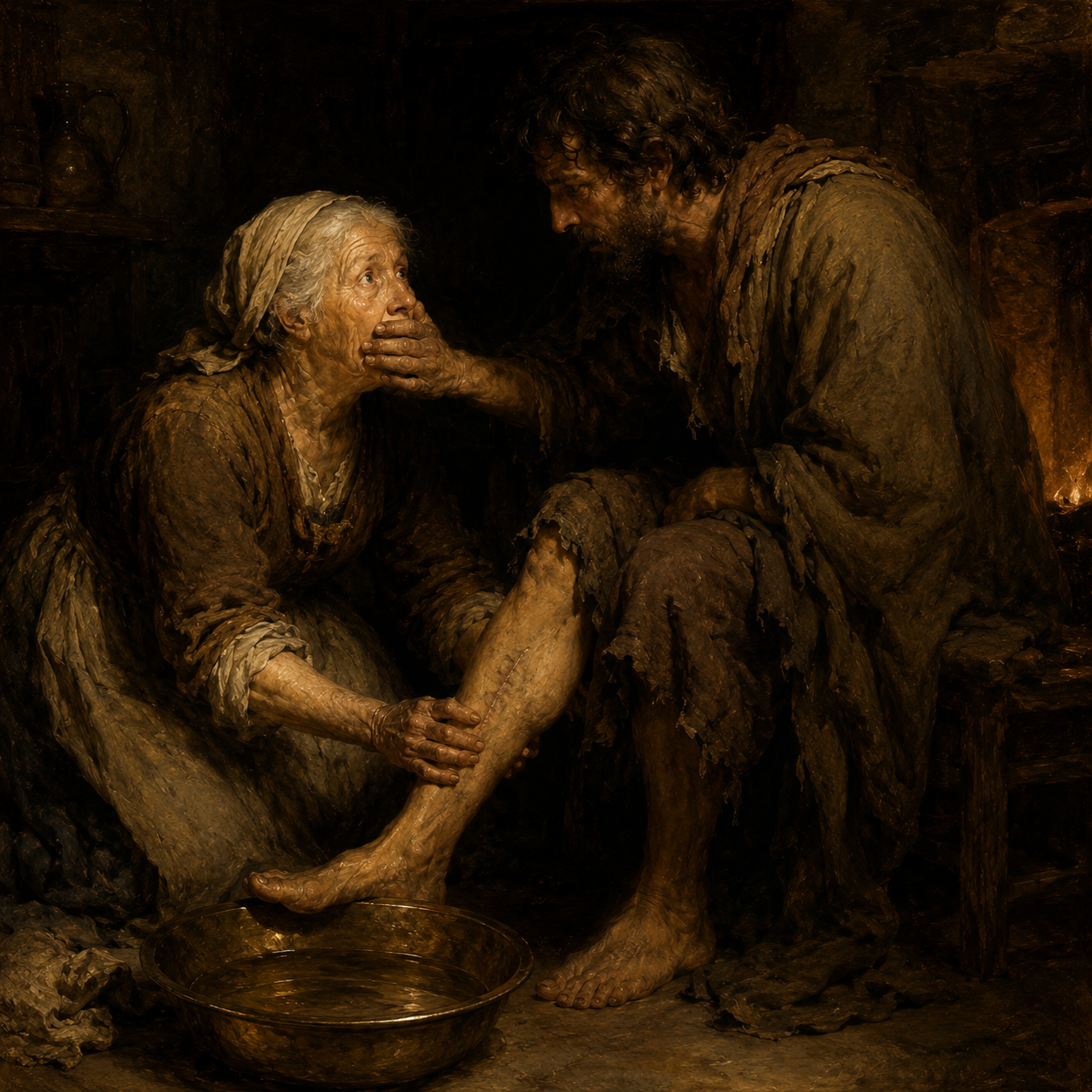
The faithful nurse Eurycleia discovers her master's true identity
Recommended Reading
As an Amazon Associate, we earn from qualifying purchases.
The Suitors Fail
Now the suitors take their turns. They go in order, starting from the seat nearest the wine server and working around the hall. Homer does not describe every attempt, but he gives us the important ones.
Leodes, the suitors' priest, tries first. He is not a strong man, and the bow defeats him easily. He declares that the bow will break the hearts and spirits of many men in the hall and suggests they give up.
Antinous, the ringleader of the suitors, refuses to try yet. He suggests they warm the bow with grease and heat to make it more flexible. This is the response of a man who suspects he might fail and is looking for ways to improve his odds before attempting it. The suitors melt tallow and warm the bow over a fire. It does not help.
Eurymachus, the suitors' smoothest talker, tries and fails. He is mortified. His concern is not that he cannot win Penelope. It is that he cannot match Odysseus. The bow has become a measure of manhood, and every suitor who fails it is publicly demonstrated to be less than the absent king. The humiliation is precise and devastating.
Antinous proposes that they stop for the day and try again tomorrow, after making sacrifices to Apollo, the god of archery. It is a face-saving delay. He knows they are losing.
The Beggar Asks for the Bow
This is the moment. Odysseus, still in his beggar disguise, speaks up. He says, quietly, respectfully, that he would like to try the bow. Not for the prize. He does not want to marry Penelope. He just wants to test his old hands, to see if the strength he had in his youth is still there.
The suitors react with fury. Antinous threatens him. The idea that a beggar, a homeless old man, would dare to put his hands on the contest bow is an insult to their dignity. If he strings it, they say, they will ship him off the island. Their anger is out of proportion, which tells you something. They are afraid. Not of the beggar specifically, but of what it would mean if he succeeded. If a ragged vagabond can string the bow that defeated them, their shame is complete.
Penelope intervenes. She says the stranger should be allowed to try. He is a guest in the house, and hospitality requires it. She also says, practically, that she is not going to marry a beggar, so what are they worried about? Telemachus, taking control of the moment, tells his mother to go upstairs. The bow is men's business now. This is not rudeness. It is strategy. Telemachus is clearing Penelope from the hall before what comes next.
The swineherd Eumaeus brings the bow to Odysseus. The suitors shout at him to stop. Telemachus overrides them. The bow reaches Odysseus's hands.
The Stringing: Like a Man Who Knows a Lyre
Homer slows everything down for this moment. He has been building toward it for twenty books. And he delivers it with one of the most perfect similes in the poem.
Odysseus turns the bow over in his hands, examining it. He checks for damage, for worm-holes, for warping. The suitors watch, some of them sneering that the old man is admiring it like a connoisseur. They do not realize that he is checking whether his weapon is still sound after twenty years.
Then he strings it. Homer says he does it the way a skilled musician strings a lyre: effortlessly, with practiced hands, bending the great bow and slipping the string into its notch without strain. He plucks the string and it sings out, clear and sharp, like the cry of a swallow.
"As a man skilled in the lyre and in song easily stretches the string around a new peg, making the twisted sheep-gut fast at either end, so without effort did Odysseus string the great bow." Homer, The Odyssey, Book 21
The simile is genius. It reframes the contest entirely. The suitors treated the bow as a test of brute force. Odysseus treats it as a musical instrument. He does not overpower it. He plays it. The distinction captures everything the poem has been saying about Odysseus: he is not the strongest man in the room. He is the most skilled, the most experienced, the one who knows how things work. The bow is not a challenge for him. It is an old friend.
At the sound of the string, Zeus sends a thunderclap. The sign is unmistakable. The gods are watching. The gods approve. Odysseus smiles.
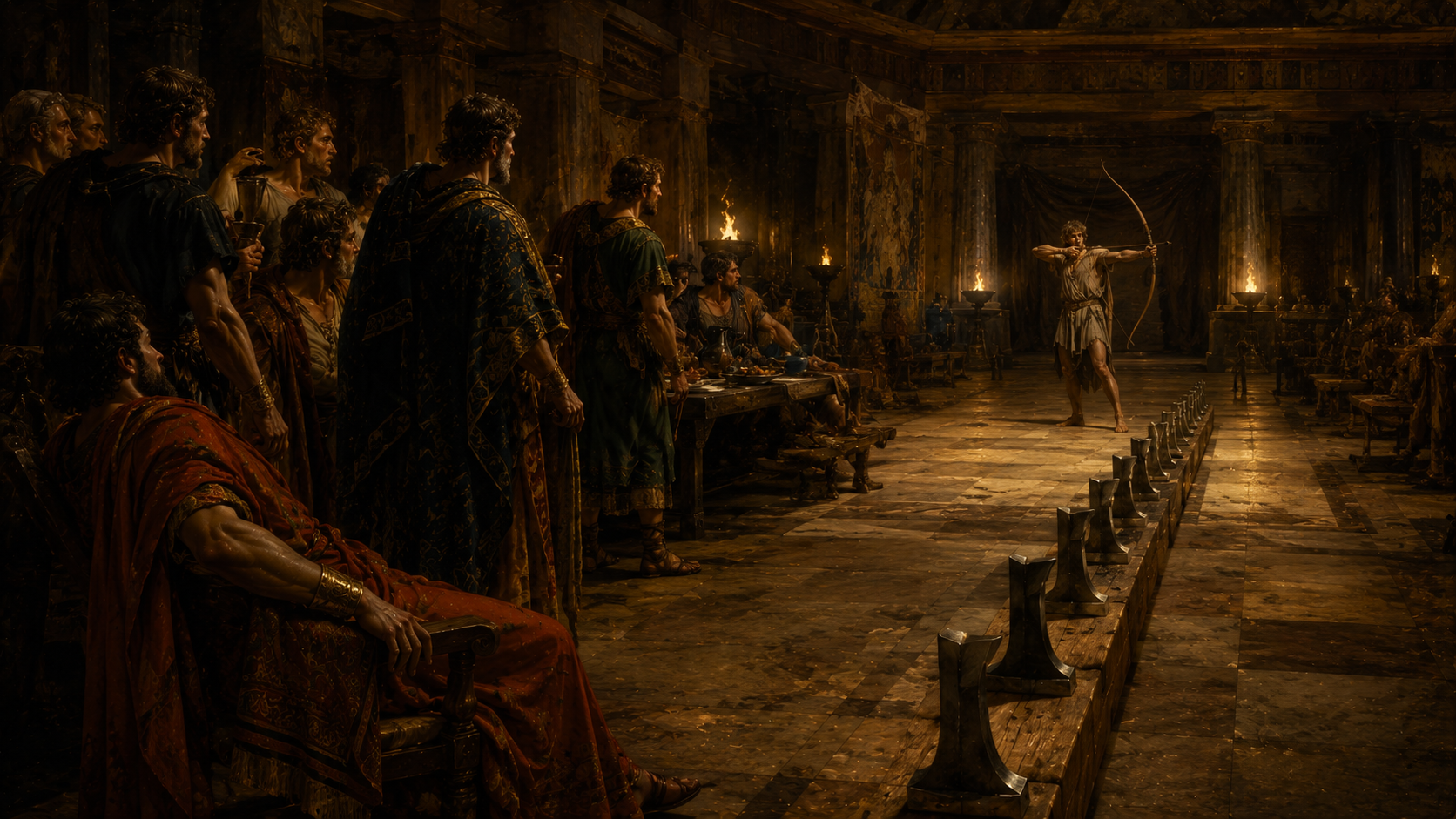
Only Odysseus can string the mighty bow
The Shot Through the Axes
Odysseus picks up an arrow. He does not stand. He is still sitting on his stool, still in his beggar's rags. He nocks the arrow, draws the string to his chest, aims, and lets fly.
The arrow passes cleanly through all twelve axe heads.
Homer does not dwell on the shot itself. He does not need to. The buildup has been so long and so careful that the actual moment of release needs only a few lines. The arrow flies. It misses nothing. It comes out the other side. The feat is impossible for anyone except the man who practiced it for years.
Then Odysseus turns to Telemachus. He speaks calmly. He says something like: your guest has not disgraced you. His strength has not failed. The suitors were wrong to mock him.
And then he nods. Telemachus buckles on his sword, picks up his spear, and takes his place beside his father. The contest is over. The battle is about to begin.
Recommended Reading
As an Amazon Associate, we earn from qualifying purchases.
What the Contest Means
The bow contest is not just a plot device. It is the poem's final statement about identity, competence, and what it means to be the rightful king.
The suitors have been sitting in Odysseus's hall, eating his food, drinking his wine, and claiming they deserve to replace him. They believe that kingship is about status, about wealth, about being in the right place at the right time. The bow contest strips all of that away. It asks a simple question: can you do what Odysseus can do? And the answer, for every single suitor, is no.
The bow is a test of legitimacy. In a world without DNA tests or identity documents, how do you prove you are who you say you are? You prove it by doing the things only that person can do. Odysseus proves his identity not by removing a mask but by performing a feat that no one else can match. The bow knows him. The string sings for him. The arrow obeys him. That is proof more convincing than any words.
The contest also marks the end of Odysseus's patience. For days, he has sat in his own hall in disguise, enduring insults, having things thrown at him, watching the suitors abuse his household. The stringing of the bow is the end of endurance and the beginning of action. He has gathered his intelligence, positioned his allies, and waited for the perfect moment. Now the bow is in his hands, and the revenge that follows is the consequence.
Hear the Bowstring Sing
Our full-cast narration brings every moment of Book 21 alive: Penelope's tears as she carries the bow down, the suitors straining and failing, the beggar's quiet request, and the sound of the bowstring ringing like a swallow's cry. Every word highlighted as it is spoken. This is the Odyssey at its most suspenseful. You can feel the tension in the room. And then the string sings, and everything changes.
Explore the Odyssey
As an Amazon Associate, we earn from qualifying purchases.
Related Pages
Hear the Bow Sing
Full-cast narration. Every word highlighted as it is spoken. Open Book 21 and feel the tension build to breaking.
Open Book 21Continue the Journey
Hear the complete Odyssey read aloud with 60+ character voices. Every word highlights as it is spoken.
Book I is completely free. No signup required.
Go Deeper Into the Odyssey Film
Get the free Odyssey Companion Guide: character map, timeline, family tree, and the essential scenes from Homer's poem and the film.
No spam. Unsubscribe anytime.
Wear the Contest
Test of the Bow merch across five product types. T-shirts, posters, mugs, canvas prints, and tote bags.
Shop This Design