What the Ancients Thought They Knew
The ancient Greeks had no doubt that Homer existed. He was the poet, the greatest who had ever lived, the man whose works formed the foundation of Greek education, identity, and spiritual life. Children memorized his verses. Generals quoted him before battle. Philosophers argued with him. Alexander the Great slept with a copy of the Iliad under his pillow.
But even in antiquity, the details were contested. Seven cities claimed to be Homer's birthplace: Smyrna, Chios, Colophon, Salamis, Rhodes, Argos, and Athens. The competing claims became so famous that an ancient epigram mocked them: seven cities fought over Homer dead, though none had sheltered him alive. Most scholars, ancient and modern, favor the Ionian coast of Asia Minor (modern Turkey) or one of the nearby islands, particularly Chios. The dialect of Homer's Greek is predominantly Ionic, which supports an eastern Aegean origin.
As for when he lived, the best guesses cluster around the eighth century BCE, roughly 750 to 700. This places him in the period when the Greeks were just beginning to adopt the Phoenician alphabet and adapt it for their own language. It is possible, even likely, that Homer composed at the hinge point between oral and literate culture, that he worked in a tradition of unwritten poetry but lived to see (or hear about) the first experiments in Greek writing. Whether the poems were first written down during his lifetime, shortly after, or much later remains unknown.
The Blind Bard: Fact or Symbol?
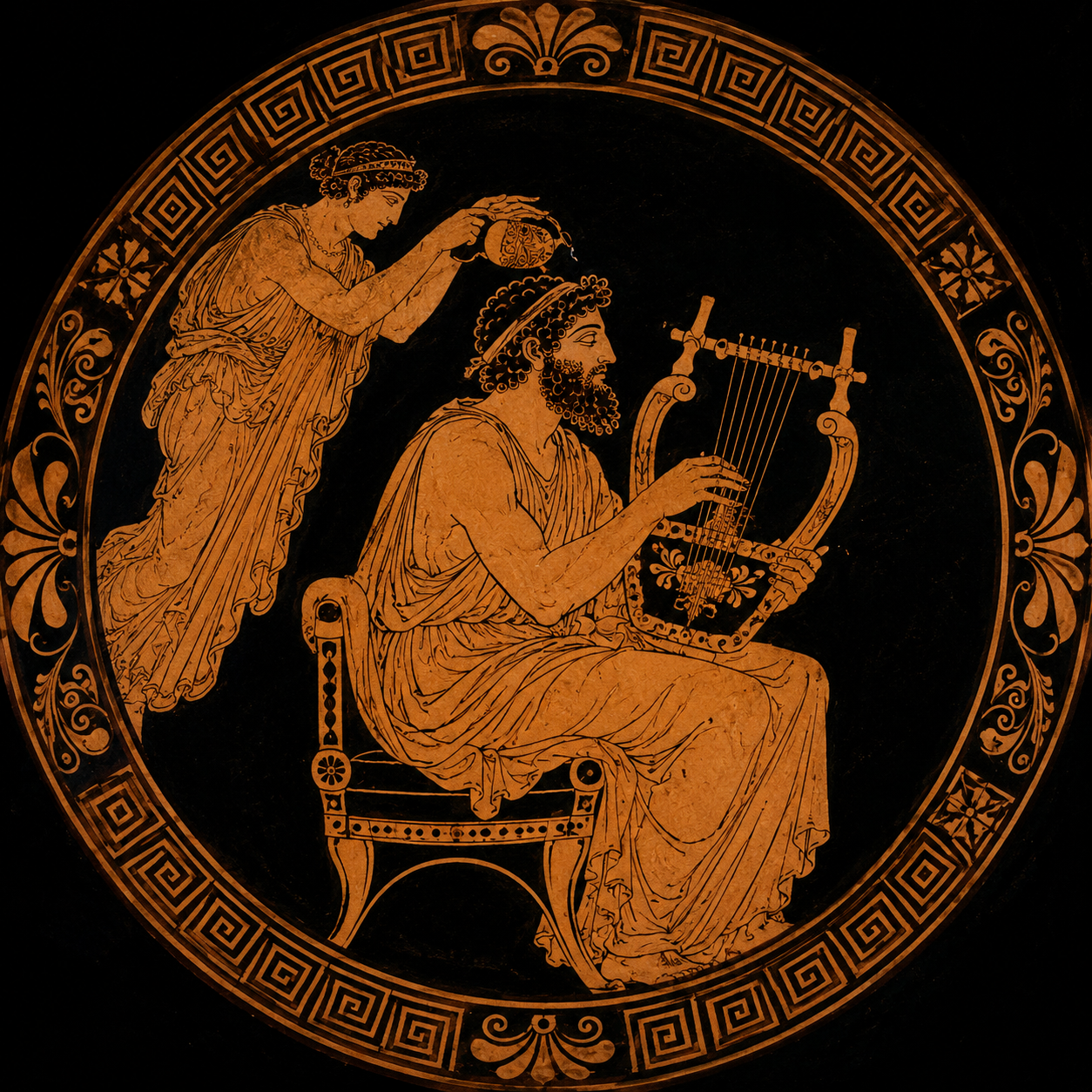
The most persistent tradition about Homer is that he was blind. Marble busts carved centuries after his supposed lifetime depict a bearded old man with sightless eyes turned upward, as if contemplating something invisible to the rest of us. It is one of the most recognizable images in art history, and it may be entirely invented.
The strongest evidence for Homer's blindness comes from within the poems themselves. In the Hymn to Delian Apollo, a work attributed to Homer in antiquity, the poet says of himself: "He is a blind man, and dwells in rocky Chios." In the Odyssey, the character Demodocus, the bard who performs at the court of the Phaeacians, is described as blind. Many readers have seen Demodocus as a self-portrait, Homer placing a version of himself inside his own poem.
But blindness was also a conventional attribute of poets and seers in Greek culture. The prophet Teiresias is blind. The tradition held that the gods often compensated for physical blindness with inner sight, the ability to perceive truths hidden from those who relied on their eyes. Calling a poet blind was, in a sense, calling him divinely inspired. It marked him as someone who saw with the mind rather than the body, who had access to a deeper kind of vision.
So Homer may have been literally blind, or the tradition may be metaphorical. We cannot know. What we can say is that the poems themselves contain some of the most extraordinarily vivid visual descriptions in all of literature. The shimmer of light on armor, the color of the sea at different hours, the way a dying warrior's eyes go dark. Whoever composed these lines had, at some point in his life, seen the world with devastating precision.
The Homeric Question: One Poet or Many?
In 1795, a German scholar named Friedrich August Wolf published a work called Prolegomena ad Homerum that ignited a debate still burning today. Wolf argued that the Iliad and the Odyssey could not have been composed by a single poet. They were too long, too complex, and too internally inconsistent to be the work of one mind. Instead, Wolf proposed, the poems were assembled over time from shorter songs by multiple bards, stitched together by later editors into the unified epics we know.
Wolf's argument launched what scholars call the Homeric Question, and for two centuries it has divided classicists into camps. The "analysts" followed Wolf, cataloguing inconsistencies in the text as evidence of multiple authorship. They pointed to passages where the plot seems to contradict itself, where characters forget things they learned earlier, where the style shifts abruptly. The "unitarians" pushed back, arguing that a single great poet could contain multitudes, that minor inconsistencies are the natural product of oral composition, and that the poems' overwhelming artistic coherence outweighs any local rough patches.
The debate took a dramatic turn in the 1930s when a young American scholar named Milman Parry traveled to Yugoslavia and recorded living oral poets composing epic songs of enormous length, entirely from memory, using formulaic phrases strikingly similar to Homer's. Parry demonstrated that the techniques of Homeric poetry (the stock epithets, the repeated lines, the type scenes) were not evidence of multiple authors pasting songs together. They were the tools of a single oral poet composing in real time. A skilled bard could, in fact, compose a poem the length of the Iliad or the Odyssey, one performance at a time, without a single written note.
Parry's work did not end the Homeric Question, but it changed it. The debate today is less about whether one person could have composed the poems and more about what "composed" means in an oral tradition. Did Homer create these stories, or did he inherit them and give them their final, brilliant shape? The answer is probably both.
Recommended Reading
As an Amazon Associate, we earn from qualifying purchases.
Was Homer a Woman?
In 1897, the English novelist Samuel Butler published a book called The Authoress of the Odyssey, in which he argued that the Odyssey was written by a young woman from the Sicilian city of Trapani. Butler's argument rested on the poem's sympathetic treatment of female characters, its interest in domestic life, and what he perceived as its distinctly feminine sensibility. He even identified the author with Nausicaa, the young princess who finds Odysseus on the beach in Book 6, and claimed she had written herself into the poem.
Butler's theory was not taken seriously by mainstream classicists in his own time, but it has been revisited periodically. Robert Graves, the poet and mythographer, supported the idea in his own work. More recently, feminist scholars have pointed out that the Odyssey does contain an unusually rich and complex portrait of women's lives, from Penelope's strategic intelligence to the agency of figures like Circe, Calypso, and Athena. The poem pays close attention to weaving, hospitality, and the emotional texture of homecoming, subjects that in the ancient world fell within women's domain.
The theory cannot be proven, and most scholars remain skeptical. But it raises a genuinely interesting question about the assumptions we bring to anonymous ancient texts. When we imagine Homer, we imagine a man, because that is the tradition. But the tradition is just a story about a story. The poems themselves do not declare the gender of their creator. If the Odyssey had come down to us with no name attached at all, would we assume a male author? Perhaps not. The question is worth sitting with, even if we cannot answer it.
Two Poems, Two Temperaments
Even among those who accept that Homer was a single historical person, there is a persistent question: did the same poet compose both the Iliad and the Odyssey? The two works are profoundly different in tone, structure, and moral vision.
The Iliad is a poem of war. Its emotional center is rage: Achilles' rage at Agamemnon, his rage at Hector, and finally his transformation from rage into something like compassion when he returns Hector's body to Priam. The poem is set almost entirely on the battlefield or in the camps beside it. Its vision is tragic. Its heroes die young and know they will. Glory is the only compensation for the brevity of human life, and even glory is shown to be inadequate.
The Odyssey is a poem of homecoming. Its emotional center is endurance: Odysseus's refusal to give up, to stop trying, to accept any substitute for his real life in Ithaca. The poem wanders across the entire Mediterranean. Its vision is comic in the classical sense, meaning it ends in reunion and restoration rather than death. Cleverness matters more than strength. Survival matters more than glory. The hero's goal is not to win fame but to get home alive and reclaim what is his.
These are very different poems, and some scholars believe they reflect different poets. The ancient critic Longinus suggested that the Iliad was composed in Homer's youth and the Odyssey in his old age, comparing the Iliad to the midday sun and the Odyssey to the sun setting, still brilliant but softer, more autumnal. It is a beautiful metaphor, and it captures something true about the relationship between the poems, regardless of whether one person wrote both.
Why It Does Not Matter (and Why It Does)
After two centuries of the Homeric Question, this much is clear: we will probably never know who Homer was. There is no archive to open, no tomb to excavate, no document waiting to be discovered that will settle the debate. The biographical Homer is lost to us, as thoroughly as any human being who lived three thousand years ago can be lost.
And in one sense, this does not matter at all. The poems exist. They are among the greatest works of art ever produced. They do not need an author's biography to be read, loved, studied, and performed. The Iliad is no less devastating if it was composed by a committee. The Odyssey is no less moving if its creator was a woman from Sicily rather than a blind man from Chios. The work stands on its own, and it always has.
But in another sense, the mystery of Homer's identity is itself part of the poems' power. There is something fitting about the fact that the greatest storyteller in Western history is also the most invisible. Homer vanishes behind his own creations, leaving nothing but the poems themselves. No ego, no autobiography, no literary persona getting between the reader and the story. Just the voice, telling you about a man who wandered the sea for ten years and fought his way back to his wife, his son, and his dog.
"Sing to me of the man, Muse, the man of twists and turns..." Homer, The Odyssey, Book 1
That voice has been speaking for three millennia. Whoever it belonged to, it is still speaking now.
Recommended Reading
As an Amazon Associate, we earn from qualifying purchases.
The Poems as Scripture and Literature
For the ancient Greeks, Homer's poems occupied a position similar to what the Bible holds in Judeo-Christian culture. They were the shared text, the common reference, the repository of values and stories that everyone knew. Greek children learned to read from the Iliad. Politicians quoted Homer in debates. Soldiers carried his words into battle. Philosophers like Plato criticized the poems precisely because they were so influential; he worried that Homer's gods, who lie, cheat, and deceive each other, were setting a bad moral example.
This quasi-scriptural status makes the absence of a clear author all the more remarkable. The Greeks never needed to know exactly who Homer was in order to revere his work. The poems were authoritative because of what they contained, not because of who wrote them. In a culture obsessed with individual fame and personal glory, the greatest glory of all was attributed to someone who was, for all practical purposes, anonymous.
Perhaps that is the final lesson of the Homeric Question. The poems teach us that identity is complicated, that a man can hide his name and still be known by his deeds, that what matters about a storyteller is not the teller but the tale. Homer, whoever he was, understood that better than anyone who has tried to find him since.
Explore Homer
As an Amazon Associate, we earn from qualifying purchases.
Continue Reading
Hear the Voice That Started Everything
Whoever Homer was, his poem was made to be heard. Full-cast narration with 60+ character voices. Book I is free. The complete Odyssey for $6.99.
Start Listening FreeContinue the Journey
Hear the complete Odyssey read aloud with 60+ character voices. Every word highlights as it is spoken.
Book I is completely free. No signup required.
Go Deeper Into the Odyssey Film
Get the free Odyssey Companion Guide: character map, timeline, family tree, and the essential scenes from Homer's poem and the film.
No spam. Unsubscribe anytime.
Sing to Me, O Muse
Homer's legacy, wearable. T-shirts, posters, mugs, canvas prints, and tote bags.
Browse All ProductsFEATURED DESIGNS