What Xenia Was and Why It Mattered
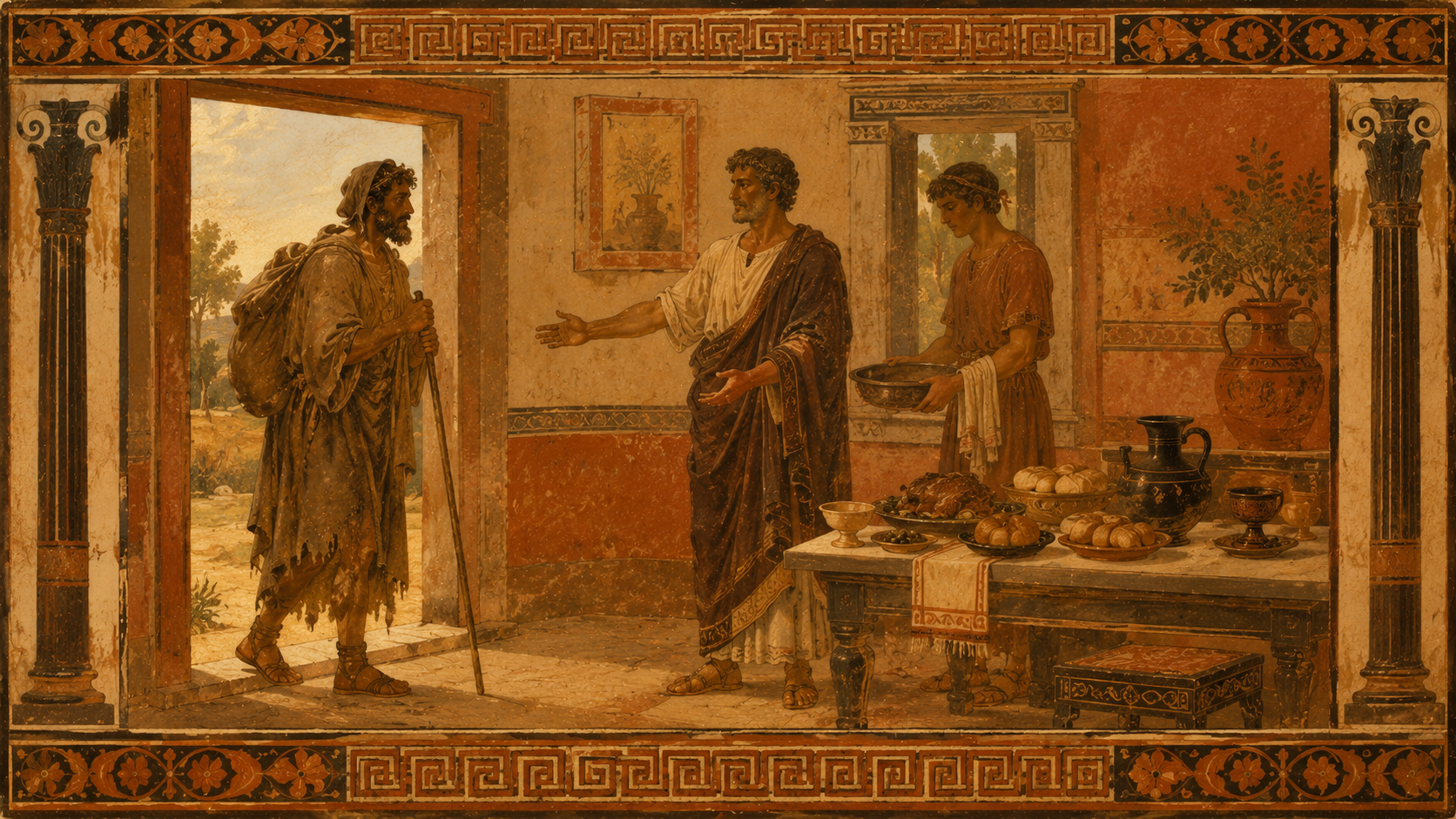
In the ancient Greek world, there were no hotels, no embassies, no international laws protecting travelers. If you showed up in a foreign land, your survival depended entirely on whether the people there would take you in. Xenia was the social contract that made travel possible. It was also a religious obligation. Zeus himself was the protector of guests and hosts, bearing the title Zeus Xenios. Violating xenia was not just rude. It was an offense against the king of the gods.
The rules of xenia were specific. A host was expected to welcome a stranger before asking who they were. This matters: you fed people first, asked questions later. You offered them a bath, clean clothes, food and drink. You gave them a place to sleep. When they left, you gave them gifts and helped them on their way. The guest, in return, was expected to be respectful, not to overstay, and to reciprocate if the host ever came to their door.
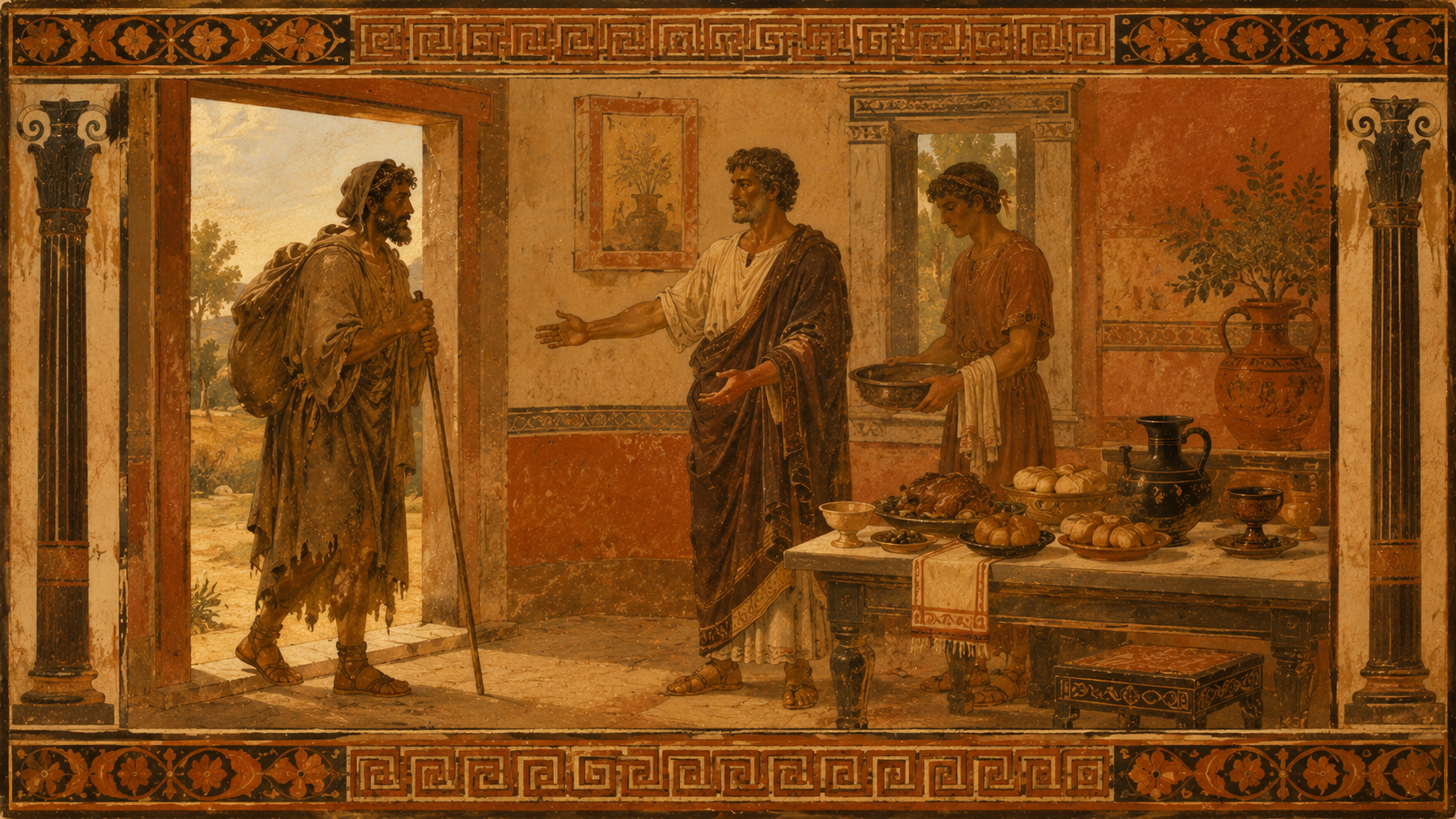
This was not mere politeness. In a world without police forces or standing armies, xenia created networks of mutual obligation that crossed tribal and national boundaries. A man who had been your guest was your friend for life. His children and your children would be bound by the same relationship. Break it, and you broke something that held civilization together.
The Good Hosts: Models of Xenia
Homer fills the Odyssey with examples of hospitality done right, and he uses them to establish the standard against which everything else is measured.
Nestor in Pylos (Book 3). When Telemachus arrives in Pylos looking for news of his father, old King Nestor and his people are in the middle of a sacrifice to Poseidon on the beach. They do not interrogate the stranger. They pull Telemachus into the feast immediately, hand him food and wine, and only then ask who he is. Nestor offers his palace for the night. He gives Telemachus a chariot and his own son Pisistratus as a traveling companion for the journey to Sparta. This is xenia operating perfectly: generous, warm, and entirely without suspicion.
Menelaus in Sparta (Book 4). Menelaus receives Telemachus in a palace full of gold and treasure, the spoils of his own long journey home from Troy. He bathes the young men, feeds them, and when he learns that Telemachus is the son of Odysseus, he weeps openly. He tells everything he knows about Odysseus's fate. He offers gifts. He even wants Telemachus to stay for eleven or twelve more days. Menelaus is a rich man who gives freely, and his hospitality is tinged with real emotion because he loved Telemachus's father.
Alcinous and the Phaeacians (Books 6-13). The Phaeacians are hospitality champions. When Odysseus washes up on their shore, naked and salt-encrusted, the princess Nausicaa gives him clothes and directions to the palace. King Alcinous and Queen Arete receive him without even knowing who he is. They hold a feast, athletic games, and a performance by the bard Demodocus. When Odysseus finally tells them his story, they load him with treasure and give him a ship to carry him home. The Phaeacians give so generously that they anger Poseidon, who punishes them for it. Their hospitality literally costs them everything, and they offer it anyway.
Eumaeus the swineherd (Books 14-15). This is perhaps the most moving example, because Eumaeus has almost nothing. He is a slave, tending Odysseus's pigs on a remote farm. When a ragged stranger (Odysseus in disguise) shows up at his door, Eumaeus takes him in, feeds him pork and wine, gives him the best seat by the fire, and wraps him in a warm cloak. He does all this while explaining that he serves a master who may never come home. Eumaeus has no idea he is hosting his own king. He is kind because kindness is the right thing to do, and because, as he says, all strangers and beggars come from Zeus.
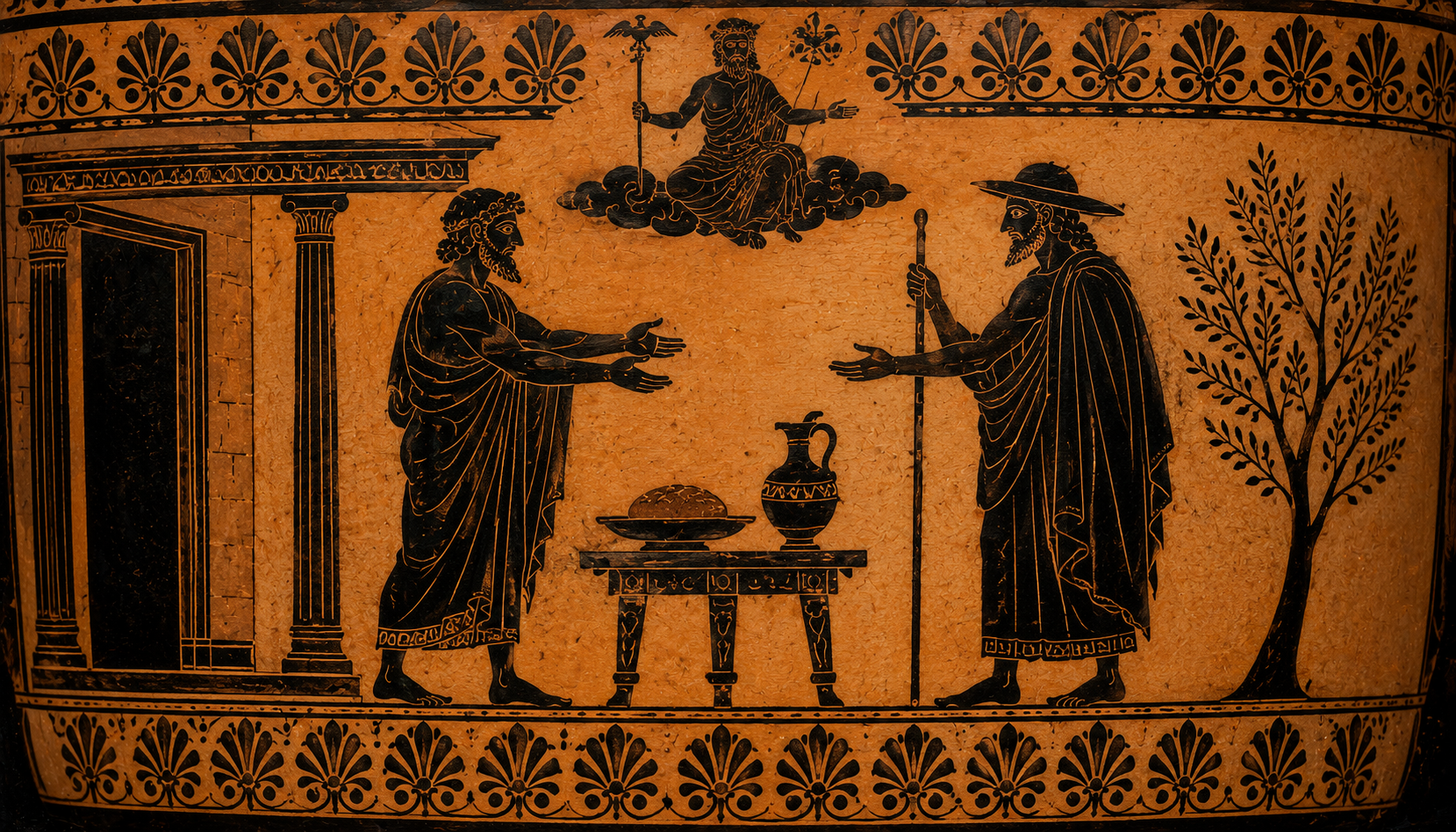
The sacred bond between host and guest, enforced by Zeus himself
The Bad Hosts: Violations of Xenia
If the good hosts show what xenia looks like, the bad hosts show what happens when it is destroyed. And in the Odyssey, violating xenia always leads to punishment.
Polyphemus the Cyclops (Book 9). The Cyclops episode is the Odyssey's most dramatic example of hospitality perverted. When Odysseus and his men enter Polyphemus's cave, they expect xenia. Odysseus even invokes it directly, reminding the Cyclops that Zeus protects strangers. Polyphemus's answer is chilling: he says the Cyclopes "do not care about Zeus" and are stronger than any god. Then he eats two of Odysseus's men for supper and two more for breakfast, washing them down with milk. He is not just a bad host. He is the anti-host, a creature who consumes his guests instead of feeding them. His blinding is divine justice for this violation.
The Laestrygonians (Book 10). These giants take the violation even further. When Odysseus sends scouts to their city, the Laestrygonian queen is "as huge as a mountain" and immediately summons her husband, who snatches one of the scouts and eats him. The rest of the Laestrygonians then swarm the harbor and destroy eleven of Odysseus's twelve ships, spearing the sailors like fish. They take the promise of a welcoming shore and turn it into a slaughterhouse.
The suitors (Books 1-22). The suitors are the poem's central example of xenia violation, and they are the most complex because they are not monsters. They are Greek noblemen from Ithaca and the surrounding islands. They know the rules. They simply do not care. They have been living in Odysseus's house for years, eating his food, drinking his wine, slaughtering his cattle, harassing his wife, abusing his servants, and plotting to murder his son. They have turned the host-guest relationship completely inside out. Instead of being grateful guests, they have made themselves parasites.
Penelope addresses this directly when she sets up the contest of the bow. She says to them: "Listen to me you suitors, who persist in abusing the hospitality of this house because its owner has been long absent." She names the crime. And the punishment, when it comes in Book 22, is explicitly framed as justice for that crime. Odysseus calls them "dogs" who "feared neither God nor man." Their violation of xenia is what makes their deaths justified in the logic of the poem.
Odysseus as Guest and Host
Odysseus himself is a fascinating case study in xenia, because he experiences it from both sides. For most of the poem, he is the guest, dependent on the hospitality of others. With the Phaeacians, he is a model guest: respectful, grateful, and entertaining (his four-book narration of his adventures is itself a guest's gift to his hosts). With Eumaeus, he accepts the swineherd's modest offerings with genuine gratitude, even though he is the rightful owner of everything in sight.
But Odysseus also tests hospitality. When he enters Polyphemus's cave, his men beg him to take the cheese and lambs and leave. He refuses. He wants to see the Cyclops, wants to find out whether the creature will offer guest-gifts. This curiosity nearly kills them all. The desire to test whether a stranger will honor xenia is a recurring impulse in Odysseus, and it does not always serve him well.
When he finally returns to Ithaca, disguised as a beggar, he becomes the ultimate test of other people's hospitality. How people treat him in his rags reveals their true character. Our character guide profiles everyone Odysseus encounters. Eumaeus passes the test beautifully. The suitors fail it catastrophically. They throw footstools at him, mock him, and suggest he leave. Antinous hits him with a stool and tells him to shut up. Every insult they heap on the disguised Odysseus is another count in the indictment against them.
There is a sharp irony in all of this. The suitors are sitting in Odysseus's house, eating his food, and abusing a stranger who turns out to be the master of the house. They are violating the hospitality of the very man standing in front of them. When the reckoning comes, it carries the weight of every unanswered insult.
Zeus Xenios: The Divine Enforcer
Xenia works in the Odyssey because the gods enforce it. Zeus, as Zeus Xenios, watches over every interaction between host and guest. When Odysseus tells Polyphemus that Zeus protects strangers, he is not making a philosophical argument. He is stating a fact about how the universe works in Homer's poem. The Cyclops's contempt for Zeus is what marks him for punishment.
The divine dimension of xenia explains why the suitors' punishment is so severe. They have not just been rude to Odysseus's household. They have offended Zeus himself. Athena acts as the agent of divine justice throughout the poem. It is she who persuades Zeus to free Odysseus from Calypso's island. It is she who guides Telemachus to Pylos and Sparta. It is she who stands beside Odysseus during the slaughter. She is not just Odysseus's patron goddess. She is the instrument of a cosmic order that the suitors have violated.
Even the poem's opening lines establish this framework. Zeus complains that mortals blame the gods for their troubles when they bring suffering on themselves through their own folly. This is the Odyssey's thesis statement: the universe has rules, and people who break them pay the price. Xenia is the most important of those rules, and the entire plot is the story of its enforcement.
Xenia as a Storytelling Engine
One of the remarkable things about xenia in the Odyssey is how much narrative work it does. It is not just a theme that Homer discusses. It is the mechanism that drives the plot forward.
Telemachus's journey in Books 3 and 4 is structured around hospitality scenes. He arrives at Pylos, is hosted by Nestor, travels to Sparta, is hosted by Menelaus. Each scene gives Homer an opportunity to deliver backstory, advance the plot, and develop Telemachus's character. The young man who arrives timidly at Nestor's beach is not the same young man who leaves Menelaus's palace. The hospitality he receives educates him about how the adult world works.
Odysseus's adventures in Books 9 through 12 are likewise organized around hospitality. Each island he visits poses the same question: will the inhabitants be good hosts or bad ones? Aeolus gives him a bag of winds (good host, up to a point). Circe turns his men into pigs, then becomes a generous hostess after Odysseus confronts her. The Phaeacians are the ultimate good hosts. Each encounter teaches Odysseus something and moves him closer to or further from home.
The second half of the poem, when Odysseus returns to Ithaca, is one long, sustained hospitality test. Every character is judged by how they treat the ragged stranger. The swineherd feeds him. The goatherd Melanthius kicks him. The maidservant Melantho insults him. The suitors throw things at him. Penelope invites him to sit by the fire and tell his story. Each reaction reveals character, and each contributes to the final accounting when the disguise comes off.
The Bed as the Ultimate Xenia
The most intimate moment of hospitality in the poem is also its climax. When Penelope tests Odysseus with the trick about their marriage bed, she is conducting the final xenia ritual: welcoming her husband back into the most private space they share. The bed built around the olive tree is the opposite of a guest bed. It is permanent, rooted, immovable. It belongs to one couple alone.
Throughout the poem, Odysseus has slept in other people's beds. Calypso's cave, Circe's palace, Alcinous's ship, Eumaeus's hut. Every bed has been temporary, a guest's bed. The olive-tree bed is the one place in the world that is his, and Penelope's test is the final confirmation that he has truly come home. The whole poem has been a journey toward this bed, and the concept of xenia, of belonging somewhere as more than a guest, is what gives the moment its emotional power.
What Xenia Means for Modern Readers
We do not practice xenia in the ancient Greek sense. We have hotels, embassies, refugee conventions, and international law. But the core of xenia, the idea that how you treat strangers reveals who you are, is still one of the most powerful moral ideas in Western thought. It runs through the Bible, through medieval hospitality codes, through the Enlightenment concept of human rights, and through modern debates about immigration and asylum.
The Odyssey does not moralize about xenia in an abstract way. It shows you what it looks like, good and bad, and lets the consequences speak for themselves. Eumaeus shares his last meal with a stranger and is rewarded with the return of his king. The suitors gorge themselves on another man's food and die for it. The lesson is not subtle, but it is effective. How you treat the person standing at your door, especially when they have nothing to offer you, is the measure of your character. Homer said it three thousand years ago, and nobody has said it better since.
Related Pages
Hear the Hospitality Scenes Come Alive
From Eumaeus's humble fire to the Phaeacian feast to the slaughter of the suitors, every hospitality scene in the Odyssey is performed aloud with a full cast of voices. Every word highlights as it is spoken.
Listen NowContinue the Journey
Hear the complete Odyssey read aloud with 60+ character voices. Every word highlights as it is spoken.
Book I is completely free. No signup required.
Go Deeper Into the Odyssey Film
Get the free Odyssey Companion Guide: character map, timeline, family tree, and the essential scenes from Homer's poem and the film.
No spam. Unsubscribe anytime.