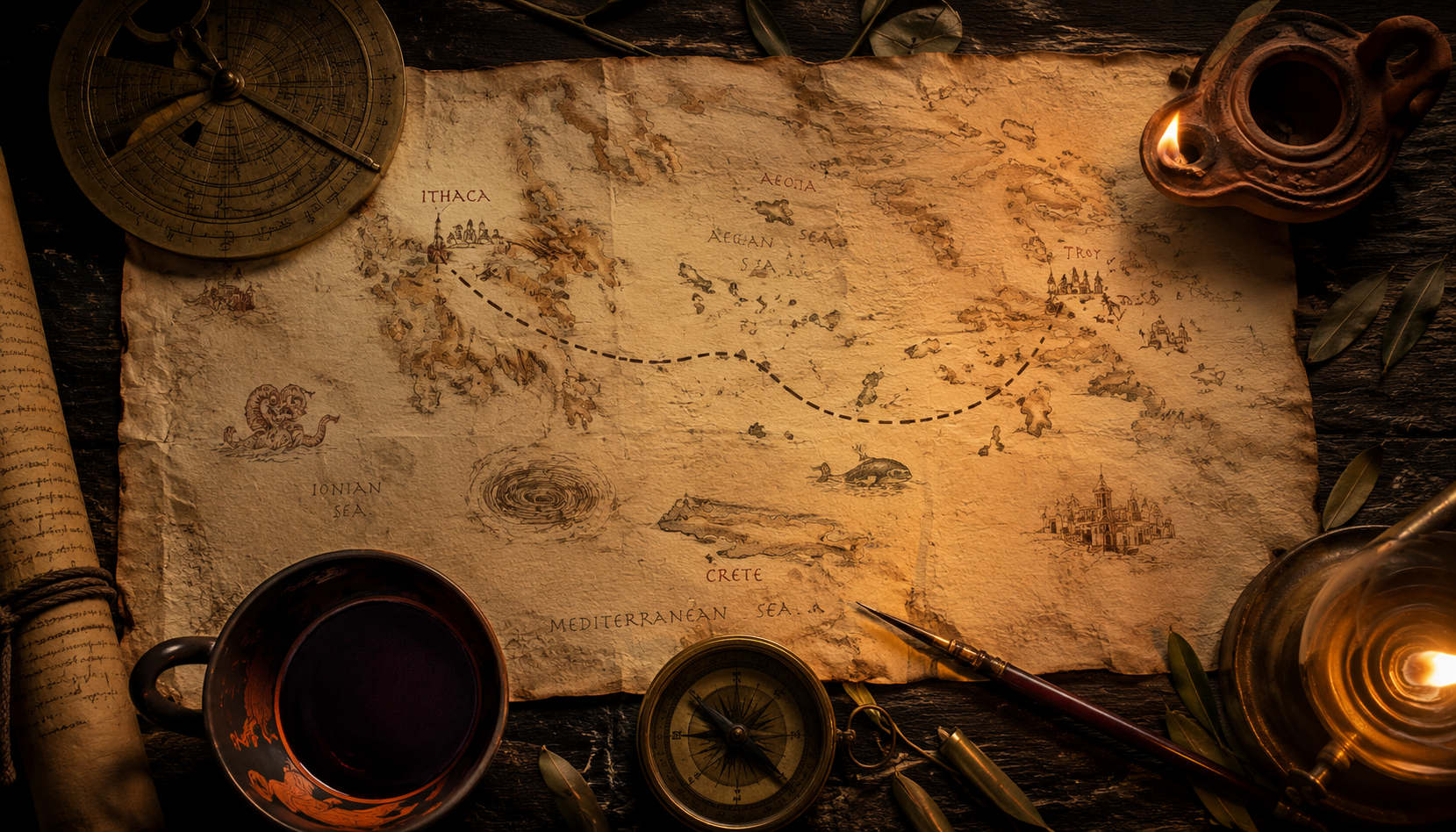
A king spends ten years trying to sail home and the sea keeps saying no. His wife unravels her own weaving each night to buy herself time. Their son crosses the water looking for a father he can barely remember. Meanwhile, the gods on Olympus argue about all of them. This is every book of the poem that invented the idea of the journey home, and the reason people are still reading it three thousand years later.
Last updated June 2026
What Is the Odyssey About?
Homer composed the Odyssey around the 8th century BCE, and it has shaped how we tell stories ever since. The Iliad is about the Trojan War itself, but the Odyssey picks up after the fighting ends and asks: what happens when the hero tries to go home? Odysseus, King of Ithaca, the man whose wooden horse trick ended the ten-year siege, just wants to get back to his family. But he blinded the Cyclops Polyphemus, who happens to be Poseidon's son, and the god of the sea is not letting him forget it. Back in Ithaca, more than a hundred suitors have moved into his palace. They are eating his food, drinking his wine, and pressuring his wife Penelope to pick one of them as her new husband and king. Everyone assumes Odysseus is dead.
The poem weaves three storylines together. The Telemachy (Books 1–4) follows Odysseus's son Telemachus as he grows up, sails to the courts of old warriors, and searches for any word of his father among the men who fought beside him at Troy. The Wanderings (Books 5–12) pick up with Odysseus himself, first stranded on Calypso's island, then telling the Phaeacians his whole incredible story: the Cyclops, the enchantress Circe, the land of the dead, the Sirens. The Return (Books 13–24) brings him home disguised as a beggar, moving through his own halls as a stranger, testing loyalties one by one before the great bow comes out and everything changes.
At its heart, this is a poem about what it costs to come home, what identity means when nobody recognizes you, and whether the people claiming to run your house deserve to be there. Three thousand years old, and it still feels immediate. Below is every book.
Part I: The Telemachy (Books 1–4)
The poem doesn't start with Odysseus. It starts with the hole he left behind. He's been gone twenty years and Ithaca has bent around his absence: a palace with no king, a wife with no husband, a son who has grown up knowing his father only as a name people say with sadness. Telemachus is stuck between boyhood and something harder, and Athena decides she can't leave him there. She comes down in disguise, puts a spark in the young man, and sends him sailing toward answers.
Book I
The Gods in Council · Athena in Ithaca
Athena, Zeus, Telemachus, Penelope, Phemius, the Suitors
Twenty years after Odysseus left for Troy, the gods on Olympus are arguing about him again. Athena catches Zeus in a generous mood (Poseidon is away, feasting with the Ethiopians) and wins permission for Odysseus to finally come home. She doesn't wait. She flies down to Ithaca disguised as Mentes, an old family friend, and finds the palace overrun. More than a hundred suitors are sprawled through the halls, eating Odysseus's cattle, drinking his wine, and demanding that Penelope pick one of them.
Telemachus, barely a man, is sitting in the middle of this mess daydreaming about the father he can't remember. Athena pulls him aside and lights something in him: not just courage but real anger, and the first sense that he might actually be his father's son. Call an assembly, she tells him, and then sail to Pylos and Sparta to find out if your father is alive. That evening Telemachus stands before the suitors and speaks up for the first time. Even Penelope, listening from the shadows upstairs, notices the change.
For the first time since Odysseus left, the men of Ithaca gather in assembly, and it's his son who called them. Telemachus stands up and demands that the suitors leave his house. Antinous, the most arrogant of the bunch, sneers back: blame your mother. He tells the crowd how Penelope strung them along for three years with her famous weaving trick. By day she wove a funeral shroud for old Laertes; by night she crept back and pulled her work apart by torchlight. A disloyal maid eventually gave her away.
Two eagles tear at each other overhead. The old prophet Halitherses reads the omen aloud: Odysseus is close, and the suitors are in trouble. They just laugh. They refuse to give Telemachus a ship. But Athena, wearing the face of Mentor, gathers a crew in secret and readies a fast ship in the harbor. That night Telemachus slips out of the palace, squeezes the old nurse Eurycleia's hands and begs her to keep quiet, and sails into the darkness toward Pylos. The boy who sat brooding among his enemies is gone.
The ship reaches Pylos, and Telemachus finds old King Nestor on the beach, offering sacrifice to Poseidon with the whole city gathered around him. Nestor is everything a host should be: generous with food and wine, generous with time, generous with his memory. He doesn't have word of Odysseus, but he gives the boy something almost as valuable: the stories of what happened to the other Greeks after Troy fell. He tells of Agamemnon murdered in his own home by his faithless wife, of Menelaus blown off course all the way to Egypt. The homecoming was kind to almost no one.
Nestor studies Telemachus and sees Odysseus in the way the boy talks, in how clearly he asks his questions. He marvels that Athena walks so openly beside this young man. Go to Sparta, he urges; Menelaus traveled the farthest and may know more. He sends his own son Pisistratus along as a companion, and the two young men ride out by chariot across the Peloponnese. With every mile, Telemachus's world gets bigger.
Sparta blazes with gold and firelight. Telemachus and Pisistratus walk into the palace of Menelaus and Helen, and the contrast with Ithaca is almost painful. Here is a home that has been put back together, a marriage that survived its own destruction, wealth on every wall. Helen recognizes Telemachus the moment she sees him: he has his father's eyes. She and Menelaus trade stories about Odysseus at Troy, his recklessness, his cunning, the night he slipped inside the city disguised as a beggar and nobody recognized him except Helen.
Then Menelaus gives the boy what he crossed the sea to find. On his own difficult voyage home, Menelaus wrestled the shape-shifting god Proteus on a beach in Egypt, pinning him through every transformation (lion, serpent, leopard, water, tree) until the old god gave in and told the truth. Odysseus is alive, Proteus said. He's trapped on the island of the nymph Calypso, sitting on the shore and weeping because he wants to go home. That is the first real news anyone has heard in years. But back in Ithaca, the suitors learn that Telemachus has sailed, and they begin planning something darker: they will ambush his ship in the strait and kill him before he reaches shore. When Penelope hears about both the voyage and the trap, the grief nearly breaks her.
The poem finally turns to Odysseus himself, and it finds him sitting on a rock at the edge of a lonely sea, crying. He escapes the nymph who loves him, gets wrecked by Poseidon's storms, and washes up among the Phaeacians, where he tells his own story. The next four books are one long flashback told in Odysseus's own voice: the Cyclops blinded in his cave, the enchantress who turns men to pigs, the trip to the land of the dead, the Sirens on their rock, the whirlpool, and the six-headed monster on the cliff. These are the episodes that burned themselves into people's imaginations and never left.
Here, finally, is Odysseus. The man whose cunning ended a ten-year war is sitting on a rock at the edge of a beautiful island, staring at water he can't cross, and crying. The nymph Calypso has kept him on Ogygia for seven years. She adores him and has offered him something no mortal can earn: immortality, eternal youth, her bed forever. He says no. He wants Penelope. He wants the smoke rising from his own hearth. He wants to go home.
Zeus sends Hermes to order Calypso to let the man go. She's furious (the gods always begrudge a goddess her mortal lover, she says) but she obeys. Odysseus chops down trees, lashes together a raft, and sails east. Seventeen days the sea is kind. Then Poseidon spots his enemy on the water and brings the sky crashing into the waves. The raft breaks apart. Odysseus goes under, surfaces, goes under again. The sea nymph Ino gives him her enchanted veil to keep him afloat, and he swims for two days and nights until his fingers close around a rock on the coast of Scheria. He drags himself ashore naked, crawls into a thicket, buries himself in leaves, and falls asleep.
Athena slips into the dreams of Nausicaa, the young Phaeacian princess, and suggests she take the palace laundry down to the river. Nausicaa goes with her handmaids, and after the washing is done they toss a ball back and forth along the riverbank, laughing. The noise wakes Odysseus. He staggers out of the undergrowth caked in salt, naked except for a leafy branch clutched over himself, wild-eyed and terrifying. The handmaids shriek and scatter.
Nausicaa doesn't move. She stands her ground and meets the stranger's eyes. Odysseus, always thinking, knows exactly what to say: he compares her to a young palm tree he once saw growing near Apollo's altar on Delos, and the compliment is so perfectly pitched that the girl blushes and helps him. She gives him food, oil for his skin, fresh clothes, and directions to the palace, but tells him to walk separately so people won't gossip. A shipwrecked king and a teenager who can recognize dignity even under a crust of sea salt. Odysseus follows her road toward the city, wrapped in Athena's mist, invisible, still nobody.
Still hidden in Athena's fog, Odysseus walks unseen through the streets and into the palace of King Alcinous. The place is stunning: walls covered in bronze, silver door frames, gardens where fruit ripens in every season and springs never run dry. He crosses the gleaming hall, kneels in the ashes of the hearth before Queen Arete (the real power behind this throne), and begs for the one thing he wants: a ship to carry him home.
Alcinous doesn't hesitate. He doesn't even ask the stranger's name. A ship, he promises, and safe passage, and rest. This is xenia, the sacred duty of host to guest, offered in its purest form. But Arete is sharper. She notices the stranger is wearing clothes woven by her own daughter's hand, and she presses him: who are you, and how did you get those garments? Odysseus tells her about Calypso and the storm and Nausicaa's kindness, but his name he keeps to himself. Alcinous, already half-charmed, murmurs that he wouldn't mind having such a man as a son-in-law. The court settles in around the nameless guest, and everyone is wondering the same thing nobody has asked yet.
The Phaeacians hold a feast and games in the stranger's honor. The blind bard Demodocus picks up his lyre and sings about the quarrel between Odysseus and Achilles at Troy. Odysseus, hearing his own life turned into a song, pulls his cloak over his face and cries. Nobody notices except Alcinous. At the games, a brash young Phaeacian named Broadsea sneers that the stranger looks more like a merchant than an athlete. Odysseus stands up, grabs a discus heavier than any the Phaeacians use, and hurls it past every mark on the field. The crowd goes quiet.
Demodocus sings again, first the funny story of Ares and Aphrodite caught in Hephaestus's unbreakable golden net while the gods roar with laughter, and then, at Odysseus's own request, the fall of Troy and the wooden horse. This time Odysseus can't hold it together. He weeps openly, and Homer reaches for an image that turns the whole poem on its head: the conqueror of Troy cries like a woman clinging to her husband's body on a burning battlefield, being dragged away by soldiers. The man who sacked the city weeps the way the city wept. Alcinous stops the song, turns to this shaking, nameless guest, and finally asks the question everyone has been holding back: who are you, where did you come from, and why does the fall of Troy make you cry?
"I am Odysseus, son of Laertes, and my home is Ithaca." The name drops into the firelit hall and every Phaeacian leans forward. He starts from the beginning. After Troy, his fleet raided the Cicones and paid for it in blood. A storm blew them south to the land of the Lotus-Eaters, where the fruit wiped out every memory of home; Odysseus had to drag his weeping men back to the ships by their wrists. Then came the island of the Cyclopes, and the disaster that cursed everything after.
Odysseus and twelve men walked into the cave of Polyphemus, a one-eyed giant and son of Poseidon. The monster sealed the entrance with a boulder and ate six of them, scooping them up two at a time. Trapped in the dark, Odysseus came up with a plan. He got Polyphemus drunk on strong wine, told the giant his name was "Nobody," and when that one great eye finally closed, drove a sharpened olive stake straight into it. The Cyclops screamed. The other giants called through the stone: who's hurting you? "Nobody is hurting me!" Polyphemus howled, and they wandered off. At dawn, Odysseus and his surviving men escaped by clinging to the bellies of the giant's rams, sliding out beneath the blind hands groping for them. They should have just sailed away. But Odysseus couldn't leave without being known. He stood at the stern and shouted his real name across the water, and Polyphemus, bleeding, prayed to his father Poseidon. The god heard him. That shout is the hinge of the whole poem. Every disaster that follows comes from Odysseus's need to be recognized.
Aeolus, lord of the winds, gives Odysseus a gift that should have ended the story right there: a leather bag holding every unfavorable wind, sewn tight, with only a gentle westerly left free to carry them home. It works. They sail for nine days, and on the tenth they can see Ithaca on the horizon, smoke curling from their own hearths. Then Odysseus falls asleep. His men, sure the bag holds gold their captain won't share, rip it open. The winds burst out and blow the entire fleet all the way back to Aeolus. The wind god slams his door. You're cursed, he says. Get out.
Things get worse. They sail to the harbor of the Laestrygonians, giants who hurl boulders from the cliffs and spear drowning sailors like fish. Every ship is destroyed except Odysseus's, because he had the instinct to anchor outside the harbor mouth. With one ship and a shattered crew, he reaches the island of Circe, the enchantress. She welcomes his scouting party with drugged wine and turns them into pigs with a tap of her wand. The god Hermes intercepts Odysseus on the path and gives him moly, a plant with a black root and white flower that blocks her magic. When Circe's sorcery fails against him, she's so stunned she drops the act and takes him to her bed. They stay a year. His men are the ones who finally remind him they're supposed to be going home, and Circe, letting go, warns Odysseus that before he can complete his journey he has to do one more thing: sail to the edge of the world and talk to the dead.
Odysseus sails to the rim of the world, where the sun never reaches. He digs a trench, pours in milk and honey and wine and the blood of a slaughtered ram, and the dead come swarming up, a grey crowd of shades pressing toward the warm blood. The first to speak is Elpenor, one of his own men who died falling drunk off Circe's roof, begging for a proper burial. Then the blind prophet Tiresias drinks from the trench and delivers the warning Odysseus crossed the world to hear: do not touch the cattle of the sun god, or you will lose everything and everyone.
But the encounter that really breaks Odysseus is with his own mother. He didn't know Anticleia had died. She tells him she wasted away from grief, missing him. He reaches for her. Three times he stretches out his arms and three times she drifts through them like smoke. After her come the great dead of the war. Agamemnon, bitter and ruined, warns Odysseus to trust no wife and come home in disguise. Achilles, the greatest warrior who ever lived, says something nobody expects: he would trade all the glory of the afterlife to be a living farmhand working another man's field. And Ajax, still furious over the armor of Achilles that went to Odysseus instead of him, turns away without a word and walks back into the dark.
They return to Circe's island, bury Elpenor, and Circe lays out the dangers ahead one by one. First, the Sirens, whose song is so beautiful that anyone who hears it steers toward the rocks and dies. Odysseus plugs his crew's ears with beeswax and has them lash him to the mast. When the song reaches him he thrashes against the ropes and screams to be untied; they just pull the knots tighter. Next comes the strait where there's no safe route: on one side Scylla, six serpent heads on six long necks lurking in a cliff cave; on the other, Charybdis, a whirlpool that swallows the sea three times a day. Odysseus chooses the monster over the abyss. Six men are snatched from the benches and eaten alive, reaching down toward him, calling his name. He says later it was the worst thing he ever saw.
They land on Thrinacia, where the sun god Helios keeps his golden cattle. Odysseus, with Tiresias's warning ringing in his head, tells everyone not to touch the herds. But storms pin them there for a month and the food runs out. While Odysseus sleeps, Eurylochus rallies the starving crew: better to die at sea than waste away on this beach. They slaughter the cattle. The hides crawl on the ground. The meat lows on the spits. When they finally sail, Zeus hits the ship with a lightning bolt and splits it apart. Every man drowns. Every man except Odysseus, who clings to a piece of wreckage and drifts for nine days until the current carries him to Calypso's island, where the poem found him weeping in Book 5. The story circles back on itself. Odysseus falls silent, and the Phaeacians sit in the dark, unable to speak.
Odysseus is standing on Ithacan soil for the first time in twenty years, and he can't let a single person know. Athena disguises him as an old beggar, stooped and dressed in rags, and sends him into his own palace as a stranger. He has to walk among the men devouring his wealth, take their insults, watch his wife grieve for him while he sits at her feet in disguise, and test every loyalty in the house before the right moment arrives. Twelve books of tension building toward the bow being strung and the doors being barred.
Book XIII
Odysseus Arrives in Ithaca
Odysseus, Athena, Poseidon, Alcinous
The Phaeacians load Odysseus with gifts of bronze and gold and fine cloth, lay him sleeping in their fastest ship, and carry him across the sea in a single night. He wakes on a misty shore and doesn't know where he is. For a terrible moment he thinks the Phaeacians cheated him and dumped him on some unknown coast. Then Athena appears, first disguised as a shepherd boy, testing him. Odysseus, who can't help himself, immediately lies about who he is. Athena laughs out loud, delighted. She drops the disguise and stands before him grinning: the two best liars in the universe, face to face, and each one loves the other for it.
Together they stash the treasure in a cave and start plotting. Athena withers his skin, strips the hair from his head, and dresses him in foul rags, turning the king of Ithaca into an old beggar nobody would look at twice. Go to the hut of Eumaeus your swineherd, she tells him. He's been faithful all these years. Learn what you can, and trust no one until I say. Meanwhile, Poseidon takes revenge on the Phaeacians for helping his enemy: as their ship glides into the harbor back home, he turns it to stone with a single blow. Odysseus stands on Ithacan ground, breathing the air of home, and the fight for his own house begins.
Odysseus, stooped and filthy in his beggar's rags, picks his way up the stony path to Eumaeus's hut. Eumaeus is the swineherd who has kept faith for twenty years without any proof that his master is still alive. The dogs rush out snarling; Eumaeus beats them back and brings the stranger inside. He sets out meat, pours wine, gives him a thick cloak for the cold, and talks about Odysseus with a tenderness that could crack stone. He has no idea the beggar warming his hands by the fire is the man he's been mourning. Homer calls him "divine swineherd" and speaks to him directly, the only character in the entire poem the poet addresses by name, as if even the narrator loves him.
Odysseus tests the man. He tells an elaborate fake story about being a Cretan soldier who fought at Troy and fell on hard times, dropping hints that Odysseus is alive and close. Eumaeus shakes his head. Too many drifters have come through with pretty stories, trading false hope for a meal. He won't be fooled again. For someone who has waited this long, hope itself has become a kind of wound. So the two of them sit together through the night, one hiding everything he is, the other giving everything he has.
Athena appears in Telemachus's chamber in Sparta and shakes him awake: go home, now. The suitors have set an ambush in the strait, and your mother's family is pressuring her to remarry. Telemachus leaves at once. Helen gives him a gown she wove herself, shimmering, for the bride he'll one day take. On the crossing home, a fugitive prophet named Theoclymenus begs for passage on the ship, and Telemachus, his father's son in this if nothing else, takes the stranger aboard.
Back at the hut, Eumaeus tells the disguised Odysseus the story of his own life: how he was born a prince on a distant island, kidnapped by Phoenician traders as a child, sold into slavery, and raised in Odysseus's household with a kindness that replaced everything he'd lost. It's a story of exile and belonging that mirrors the whole poem in miniature. Telemachus, following Athena's advice, steers clear of the ambush and puts ashore on a quiet stretch of coast. He sends his crew ahead and walks alone toward the smoke of Eumaeus's fire. Father and son are about to stand in the same room for the first time in twenty years, and only one of them knows it.
Odysseus, Telemachus, Athena, Eumaeus, the Suitors
Telemachus ducks through the low door of the hut, and Eumaeus rushes to him, grabbing the young man's head, kissing his forehead, weeping the way a father weeps over a son he thought was lost. Telemachus sends the swineherd to the palace to tell Penelope he's safe. The moment Eumaeus is gone, Athena appears at the door, visible only to Odysseus and the dogs (who whimper and slink away). She touches Odysseus and the disguise falls off: he stands tall, dark-bearded, his rags transformed. Telemachus backs away. No mortal changes like that. You must be a god, he whispers.
"I am no god," Odysseus says. "I am your father." The boy stares. He shakes his head. Then Odysseus says something else, and whatever it is breaks through, and Telemachus throws himself into his father's arms. They hold each other and cry. Homer compares them to sea-eagles whose chicks have been stolen from the nest: raw, piercing, animal. They weep until the light drains from the sky. Then they dry their faces and start to plan. The odds are terrible: more than a hundred suitors against the two of them, a swineherd, and a cowherd. Odysseus lays out the strategy in the dark. Go back to the palace, give nothing away, move the weapons out of the great hall when no one's watching. When the time comes, we fight.
Odysseus, bent and wretched in his beggar disguise, walks the road to his own palace with Eumaeus. On the way the goatherd Melanthius kicks him and spits insults; Odysseus swallows his rage and says nothing. At the palace gates, something stops him. On a dungheap by the entrance lies an old dog, matted and covered in ticks, too weak to stand. It is Argos, the hunting dog Odysseus raised from a puppy and left behind twenty years ago. Argos lifts his head. His ears prick forward. His tail thumps the ground. He knows. Odysseus looks away so nobody will see his eyes, and the old dog, having finally gotten the one thing he was waiting for, lets go and dies. It is somehow the moment in the entire poem that nobody ever forgets.
Inside the hall, Odysseus goes from suitor to suitor with his hand outstretched, begging. Most toss him scraps. Antinous picks up a footstool and throws it at his back. Even the other suitors flinch at that; what if this stranger is a god walking among them in disguise, the way gods are known to do? Word of the beggar reaches Penelope, who wants to talk to him; maybe he's heard some rumor about Odysseus. The prophet Theoclymenus tells her flatly that Odysseus is already on the island. She listens, and she doesn't dare believe it, and she can't quite stop hoping.
A big beggar named Irus, the suitors' errand-runner, swaggers up and tries to run Odysseus off the doorstep. There's only room for one beggar in this house, he growls. The suitors, delighted, egg on a fight. Odysseus stands up and drops his rags to the waist, and the hall goes quiet: the muscles under that weathered skin do not belong to an old vagrant. He breaks Irus's jaw with one punch and drags him out by the ankle, leaving a trail of blood on the flagstones. The suitors roar and raise their cups to the stranger. They are toasting the man who is going to kill them.
Then Penelope comes downstairs, and Athena makes the queen suddenly, startlingly beautiful. The suitors stare. Penelope, completely composed, tells them off: a proper suitor brings gifts to the house he hopes to marry into, not eats it from the inside out. They fall over each other sending for gold and robes. Odysseus, watching from the shadows, feels a surge of pride; his wife is outmaneuvering every one of them. Eurymachus throws a footstool at the beggar and misses. Telemachus orders the suitors to go home. They ignore him, but the tension in the hall has changed. Something is building.
After the suitors go to bed, Odysseus and Telemachus move through the empty hall removing weapons from the walls and locking them in the storeroom; Athena lights their way with a golden lamp. Then Penelope comes down. She sits by the fire across from the ragged stranger, and for the first time in the poem husband and wife talk face to face. She tells him everything: the weaving trick, the suitors, the grief that fills her nights. Odysseus, close enough to touch her, tells another fake Cretan story, but this time he works in details only someone who'd actually met Odysseus would know: the golden brooch he wore, the purple cloak, the herald who walked beside him. Penelope cries so hard that Homer says her cheeks melt like snow on a mountainside in spring.
She tells old Eurycleia to wash the stranger's feet. The nurse lifts his leg into the basin, and her fingers find the scar. A boar tore that gash into Odysseus's thigh when he was a boy hunting on Mount Parnassus. She knows it by touch the way a mother knows her child's face. The foot drops into the basin with a clang of bronze. She opens her mouth to cry out and Odysseus clamps his hand over it before she can speak. His eyes say everything. The old woman nods, shaking, and Penelope, her attention maybe turned aside by Athena, notices nothing. She tells the stranger she has made a decision: tomorrow she will set a contest. Whoever can string Odysseus's great bow and shoot an arrow through twelve axe-heads will become her husband. The trap is being set from both sides.
Odysseus lies awake all night, furious, listening to the disloyal maidservants sneak off to sleep with the suitors. He wants to kill them all right now. Athena appears and calms him: patience, she says. The plan will work. At dawn Odysseus hears a thunderclap from a clear sky, a sign from Zeus. A woman grinding grain in the palace prays aloud that this day will be the suitors' last feast.
The suitors gather for another day of eating and drinking. Ctesippus, a particularly nasty one, throws a cow's hoof at Odysseus, and Telemachus nearly loses his composure. Then the prophet Theoclymenus stands up and delivers a terrifying vision: the walls are dripping with blood, the porch is full of ghosts heading for the underworld, and the sun has gone out. The suitors laugh at him and call him crazy. He walks out. They don't know they're eating their last meal.
Penelope fetches Odysseus's great bow from the storeroom and announces the contest: whoever can string it and shoot through twelve axe-heads wins her hand. The suitors take turns. They struggle, sweat, heat the bow over fire to make it bend, grease it with tallow. None of them can even get the string on, let alone shoot. Antinous, watching the others fail, suggests they postpone to the next day.
The disguised Odysseus quietly asks for a turn. The suitors are outraged: a filthy beggar competing? But Telemachus overrules them and orders Eumaeus to hand over the bow. While Odysseus examines it, turning it in his hands the way a musician tunes a lyre, Eumaeus and the cowherd Philoetius slip outside and bar the courtyard doors. Odysseus strings the bow without effort; it sings under his hands like a swallow's cry. He sends an arrow cleanly through all twelve axe-heads. He looks at Telemachus. Telemachus reaches for his sword.
Odysseus strips off his rags and leaps onto the threshold with the great bow in his hands. He pours out the arrows at his feet and puts the first one through the throat of Antinous, who is raising a cup of wine to his lips. The cup falls. Blood pours from his nostrils. The other suitors jump up, reaching for swords that are not there: the weapons were moved in the night. Eurymachus tries to rally them and then tries to bargain, offering to repay everything. Odysseus refuses. Eurymachus charges and falls to an arrow. Amphinomus rushes in and Telemachus drives a spear through his back.
The fight becomes a melee. Telemachus fetches weapons for himself, his father, and the two herdsmen. But the treacherous goatherd Melanthius climbs into the storeroom and brings armor to the suitors. Eumaeus and Philoetius catch him on his second trip, tie him to a rafter, and leave him dangling. Athena appears in the form of Mentor and taunts Odysseus into fighting harder, then takes the shape of a swallow and watches from a roof beam, deflecting spears. One by one the suitors fall. When the killing is done, Eurycleia is summoned. She identifies the twelve maids who dishonored the house by sleeping with the suitors. They are made to carry out the dead and scrub the hall. Then Telemachus hangs them in the courtyard. Odysseus orders sulfur and fire to purify the blood-soaked hall.
Eurycleia rushes upstairs to tell Penelope that Odysseus has returned and killed the suitors. Penelope refuses to believe it. She comes downstairs and sits across from the stranger in silence, studying his face by firelight. Telemachus scolds her for her coldness, but Odysseus tells the boy to let her be: she will test him in her own time.
Penelope devises a trial. She tells Eurycleia to move the great bed out of the bedchamber so the stranger can sleep there. Odysseus erupts in anger: that bed cannot be moved, because he built it himself around a living olive tree, cutting and shaping the trunk into one of the bedposts. The room was constructed around it. No one who has not seen the bed could know this secret. Penelope's knees give way. She runs to him, throws her arms around his neck, and weeps. The olive-tree bed was the proof no impostor could fake. Athena holds back the dawn so the reunited couple can have a long night together. Odysseus tells Penelope everything: the Cyclops, Circe, the dead, the cattle of the Sun, Calypso. She tells him of the suitors and the weaving trick. At last he tells her of Tiresias' prophecy: he must make one more journey, carrying an oar inland until someone mistakes it for a winnowing fan. Only then will Poseidon's anger be appeased and a gentle death come to him in old age.
Odysseus, Laertes, Athena, Hermes, Agamemnon, Achilles, the suitors' shades, Eupithes
Hermes leads the souls of the dead suitors down to the underworld. There the shade of Agamemnon meets Amphimedon, one of the slain suitors, and hears the full story of Penelope's faithfulness and Odysseus' revenge. Agamemnon contrasts Penelope's loyalty with Clytemnestra's betrayal and declares that Penelope's fame will never die.
Meanwhile, Odysseus goes to the countryside to find his father Laertes, who has been living in grief and squalor on his farm. Odysseus tests the old man with a false story before revealing himself. Laertes asks for proof, and Odysseus shows his scar and names the trees in the orchard that Laertes gave him as a boy. The old man nearly collapses with joy. They share a meal together, the household reunited at last.
But the families of the dead suitors are gathering for vengeance. Eupithes, father of Antinous, leads them toward Laertes' farm. Athena asks Zeus whether he wants more war or peace. Zeus decrees peace. When the two sides meet, Laertes, rejuvenated by Athena, kills Eupithes with a spear throw. Odysseus and Telemachus charge, but Athena intervenes, shouting for the fighting to stop. The Ithacans scatter in terror. Athena, in the likeness of Mentor, brokers a pact of peace. The blood feud ends. Odysseus is king again. The epic is complete.
The first books of the Odyssey are free to listen to in our audiobook reader. No app download, no
account, no payment. Just open your browser and start hearing Homer's epic the way it was meant to be
experienced: spoken aloud, with every character given a distinct voice.