Last updated June 2026
The Situation She Faces
To understand Penelope, you have to understand the trap she is in. Her husband Odysseus left for the Trojan War when their son Telemachus was still a baby. Ten years of war, then silence. No word. No ship on the horizon. The other Greek heroes came home, one way or another, but Odysseus simply vanished. And as the years passed, the assumption grew: he must be dead.
Into this vacuum came the suitors. More than a hundred young men from Ithaca and the surrounding islands, all claiming to seek Penelope's hand in marriage. In reality, they moved into the palace, ate the household's livestock, drank the wine cellar dry, and pressured her every day to choose one of them. It was not courtship. It was occupation. They were waiting for her to give in so one of them could become king.
Penelope had no army. She had no husband. Her son was a teenager with no political power. She could not throw the suitors out by force. She could not refuse outright because the social pressure to remarry was enormous. In a culture where women had few legal protections and a widow's property was vulnerable, she was in an almost impossible position. What she had was her mind. And she used it.
The Weaving Trick: Three Years of Cunning
Penelope's most famous stratagem is the shroud of Laertes. She announced to the suitors that she could not remarry until she had finished weaving a funeral shroud for her elderly father-in-law. This was a reasonable request, an act of piety that no one could openly refuse. The suitors agreed to wait.
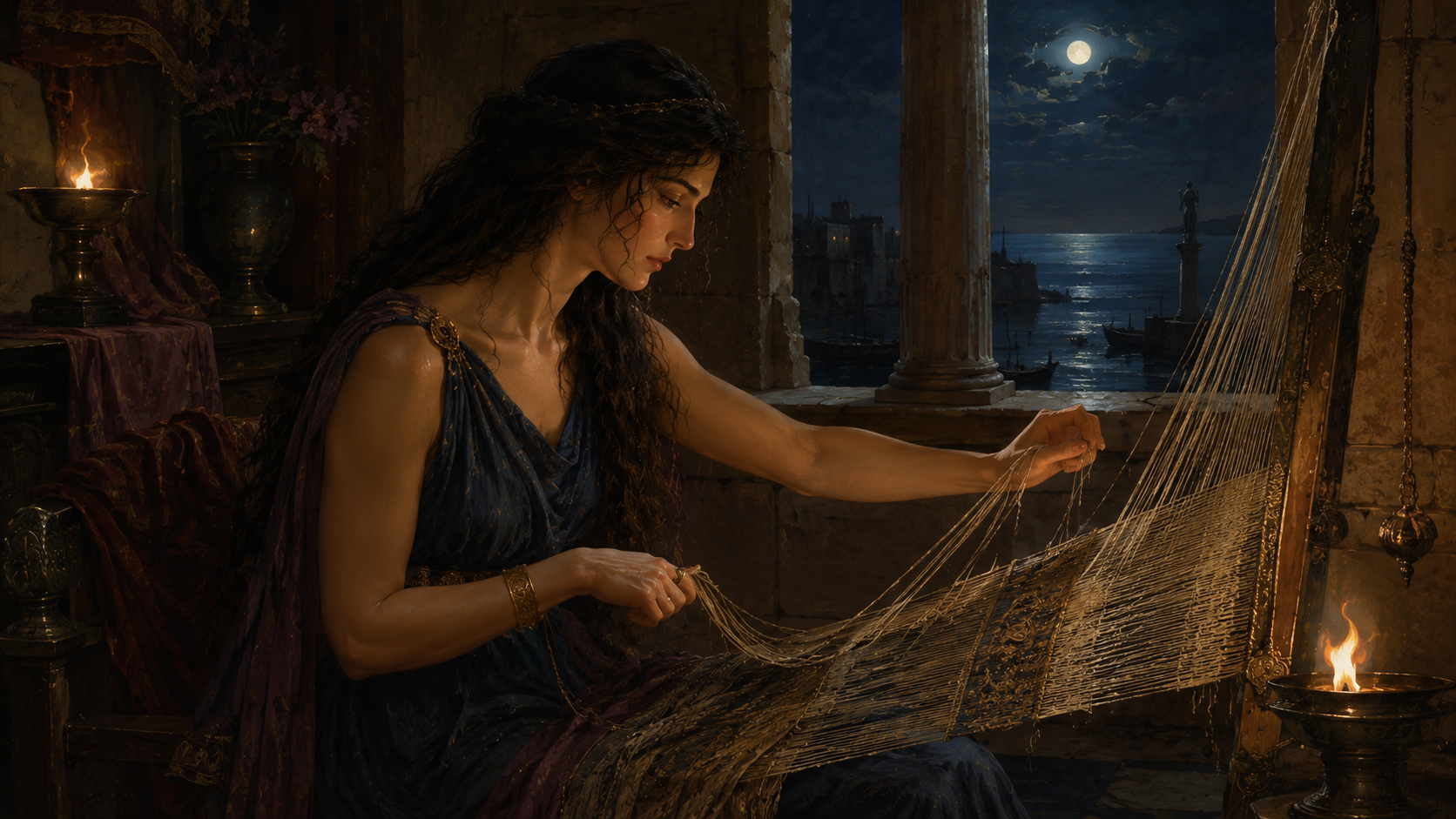
What they did not know is that every night, after the household went to sleep, Penelope crept back to the loom and unraveled the day's work by torchlight. She wove by day and unwove by night, making the shroud a task that could never be completed. For three full years, this worked. The suitors saw progress on the loom each day and assumed she was nearly done. But the finished shroud never came.
Eventually a disloyal maid betrayed the secret. The suitors caught Penelope at the loom in the dead of night, her fingers pulling threads from the fabric, and forced her to finish. But think about what she accomplished: three years of freedom, purchased entirely through deception. No violence, no confrontation, just a woman, a loom, and a plan that exploited her enemies' assumptions about what women do with their time.
The weaving trick mirrors Odysseus's own methods perfectly. He uses the Trojan Horse to hide soldiers inside a gift. She uses a funeral shroud to hide resistance inside an act of obedience. He tells the Cyclops his name is "Nobody." She tells the suitors her work is "almost finished." They are the same kind of mind. Homer is not subtle about this. Penelope is Odysseus's match.
.png)
Penelope's secret unweaving, a stratagem to match her husband's cunning
Living with Grief
One thing that often gets overlooked is how much pain Penelope is in. Homer does not let us forget it. She weeps constantly. She retreats to her room. She tells the disguised Odysseus in Book 19:
"Stranger, heaven robbed me of all beauty, whether of face or figure, when the Argives set sail for Troy and my dear husband with them. If he were to return and look after my affairs I should be both more respected and should show a better presence to the world. As it is, I am oppressed with care, and with the afflictions which heaven has seen fit to heap upon me." Homer, The Odyssey, Book 19 (Samuel Butler translation)
This is not self-pity. It is a precise description of her reality. Without Odysseus, she has lost both her personal happiness and her social standing. The suitors treat her with a kind of aggressive familiarity that she cannot prevent. Her household servants are disloyal. Her son, for all his growing courage, cannot protect her. She is a queen in name only, presiding over a palace that has been turned into a frat house.
And yet she keeps going. She comes downstairs to face the suitors. She manages the household. She negotiates, delays, and maneuvers. There is a scene in Book 19 where Homer describes her tears as she listens to the disguised Odysseus tell stories about her husband, and the image he uses is remarkable: her cheeks overflow with tears the way snow melts on a mountainside when warm winds blow. It is one of the most beautiful similes in the poem, and it is given to Penelope, not to Odysseus.
Recommended Reading
As an Amazon Associate, we earn from qualifying purchases.
Penelope and the Beggar: Book 19
The long conversation between Penelope and the disguised Odysseus in Book 19 is one of the great scenes in the poem. She does not know it is her husband (or does she? Scholars have argued about this for centuries). She sits across the fire from this stranger and speaks with an openness and vulnerability she shows no one else.
She tells him about the suitors. She tells him about the weaving trick. She describes her insomnia, her indecision, her dreams. And she tests him, exactly as Odysseus tests everyone he meets:
"Now, stranger, I shall put you to the test and see whether or no you really did entertain my husband and his men, as you say you did. Tell me, then, how he was dressed, what kind of a man he was to look at, and so also with his companions." Homer, The Odyssey, Book 19 (Samuel Butler translation)
Odysseus passes her test with flying colors. He describes the brooch Odysseus wore, the cloak, the tunic. Penelope weeps again, and Homer tells us that Odysseus felt for her but "kept his eyes as hard as horn or iron" and did not let his own tears fall. They are both performing. Both hiding. Both measuring the other while revealing as little as possible. It is an extraordinary scene because the two cleverest people in the poem are sitting three feet apart, and neither is willing to break cover first.
Near the end of their conversation, Penelope tells the beggar about a dream. Twenty geese were feeding in her yard, and an eagle swept down and killed them all. Then the eagle spoke in a human voice: the geese are the suitors, the eagle is your husband, and he is coming back. But Penelope says she does not trust the dream. She tells him about the two gates of dreams, one of ivory (which sends false visions) and one of horn (which sends true ones), and says she fears her dream came through the gate of ivory.
Is she being cautious? Or is she saying this to the man she half-suspects is her husband, testing whether he will reassure her? Homer never tells us. The ambiguity is the point. Penelope lives in a world where every word is strategic, where trust is dangerous, and where hope is the most painful thing of all.
The Contest of the Bow
It is Penelope who devises the contest that triggers the climax of the entire poem. She announces that she will marry whichever suitor can string Odysseus's great bow and shoot an arrow through twelve axe-heads in a row, a feat that only Odysseus himself could perform.
Why does she do this? On the surface, it seems like she is finally giving in. She is accepting that Odysseus is gone and choosing a new husband. But look at the terms. The contest is designed around a skill that only her missing husband possesses. She is setting a standard that no suitor can meet. Whether she consciously expects Odysseus to appear and string the bow, or whether she is simply making the terms of her surrender impossible, the result is the same: she creates the conditions for the suitors' destruction.
The disguised Odysseus encourages her. He tells her not to delay the contest, that Odysseus will return before any suitor can string the bow. Penelope replies with perfect, heartbreaking ambivalence:
"As long, sir, as you will sit here and talk to me, I can have no desire to go to bed. Still, people cannot do permanently without sleep, and heaven has appointed us dwellers on earth a time for all things." Homer, The Odyssey, Book 19 (Samuel Butler translation)
She goes upstairs and weeps until Athena closes her eyes. The next day the suitors try the bow, fail, and Odysseus reveals himself. The massacre follows. But it was Penelope who set the stage.
The Test of the Bed: Penelope's Greatest Moment
After the suitors are dead, the nurse Euryclea rushes upstairs to tell Penelope that her husband has returned. Penelope does not believe her. She has spent twenty years being lied to, deceived, and disappointed. She is not about to accept the first good news she hears. She comes downstairs and sits across from Odysseus, studying him, and says nothing.
Telemachus is furious:
"Mother, but you are so hard that I cannot call you by such a name. Why do you keep away from my father in this way? Why do you not sit by his side and begin talking to him and asking him questions? No other woman could bear to keep away from her husband when he had come back to her after twenty years of absence, and after having gone through so much; but your heart always was as hard as a stone." Homer, The Odyssey, Book 23 (Samuel Butler translation)
But Penelope is not being cold. She is being careful. She has heard that Odysseus is a master of disguise. She knows that gods can change a man's appearance. She needs proof that no impersonator could fake. So she sets a trap.
She orders Euryclea to move the marriage bed out of the bedroom. This seems like a simple domestic instruction. But Odysseus erupts:
"Wife, I am much displeased at what you have just been saying. Who has been taking my bed from the place in which I left it? He must have found it a hard task, no matter how skilled a workman he was, unless some god came and helped him to shift it. There is no man living, however strong and in his prime, who could move it from its place, for it is a marvellous curiosity which I made with my very own hands." Homer, The Odyssey, Book 23 (Samuel Butler translation)
He goes on to describe exactly how he built the bed: he found a full-grown olive tree, still rooted in the ground, and built the entire bedroom around it. He trimmed the trunk, smoothed it, and used it as the bedpost. The bed cannot be moved because it is literally a living tree. Only someone who built it, or shared it, would know.
Penelope bursts into tears. She has her proof. She rushes to him and explains:
"Do not be aggrieved or take it amiss that I did not embrace you thus as soon as I saw you. I have been shuddering all the time through fear that someone might come here and deceive me with a lying story." Homer, The Odyssey, Book 23 (Samuel Butler translation)
This is the great recognition scene of the Odyssey, and it belongs to Penelope. She tested the man who tested everyone. She applied the same standard of cunning verification that he used on his father, his servants, and his enemies. She is not "hard as a stone." She is smart enough to know that in a world full of tricks and disguises, you need proof that cannot be faked. The rooted olive tree that forms the bedpost is that proof. It is immovable, permanent, and known only to two people. The bed is their marriage. It cannot be moved.
Recommended Reading
As an Amazon Associate, we earn from qualifying purchases.
Penelope as Odysseus's Equal
Homer goes out of his way to show that Penelope's intelligence matches her husband's. She is described multiple times with language drawn from the vocabulary of cunning and craft. The Greek word metis, which means strategic intelligence, is applied to both of them. Where Odysseus uses physical disguise, Penelope uses emotional disguise, keeping her intentions hidden behind tears and apparent indecision. Where Odysseus tests the loyalty of his servants one by one, Penelope tests the identity of her husband with a trap only he could spring.
The poem even draws a direct contrast with the other great wife of the Greek legends: Clytemnestra, wife of Agamemnon. (Our character guide profiles all the key figures.) While Odysseus was away, Clytemnestra took a lover and murdered Agamemnon when he came home. In Book 24, the ghost of Agamemnon himself praises Penelope and condemns his own wife, making the comparison explicit. Penelope's faithfulness is held up not just as a virtue but as a salvation. She is the reason Odysseus's homecoming story is a triumph rather than a tragedy.
But reducing Penelope to her faithfulness misses the point. She is faithful, yes. She is also strategic, perceptive, grief-stricken, exhausted, brave, and occasionally ruthless. She manipulates the suitors with false encouragement. She sends them private messages hinting that she might choose one of them, while having no intention of doing so. She extracts gifts from them. She plays a game that requires absolute emotional control, and she plays it for years.
The Reunion
After the test of the bed, Homer gives us one of the most tender moments in all of ancient literature. Odysseus and Penelope embrace, and the poet compares her relief to that of shipwrecked sailors who finally reach shore:
"As the sight of land is welcome to men who are swimming towards the shore, when Poseidon has wrecked their ship with the fury of his winds and waves; a few alone reach the land, and these, covered with brine, are thankful when they find themselves on firm ground and out of danger." Homer, The Odyssey, Book 23 (Samuel Butler translation)
That simile is usually used for sailors, for men, for Odysseus-type figures. Homer gives it to Penelope. She is the one who has been lost at sea. She is the one who has been storm-tossed, not on actual waves but in the relentless chaos of her occupied home. And her husband, her living, breathing, proven husband, is her shore.
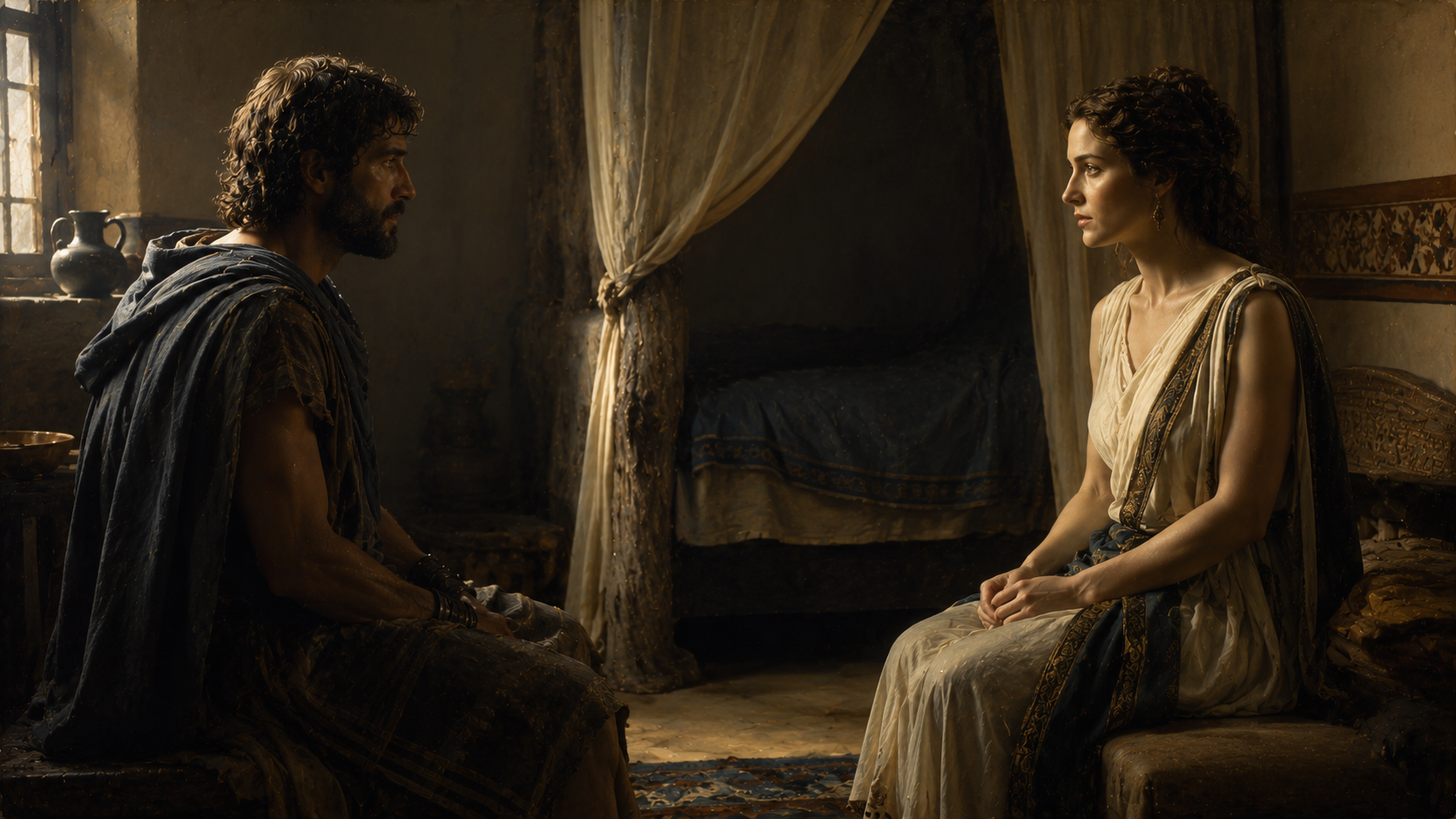
The ultimate test: Penelope's trial of the marriage bed
Then they talk all night. She tells him what she suffered. He tells her where he has been. And Homer handles it with the simplest, most devastating line in the poem: they came joyfully to the rites of their old bed. After twenty years, they are home. Both of them.
Why Penelope Still Matters
For three thousand years, Penelope has been held up as the model of the faithful wife. That reputation is earned, but it is also reductive. She is faithful, but she is not passive. She is loyal, but she is not naive. She is patient, but her patience is a weapon, not a weakness. She uses the tools available to her, weaving, tears, ambiguity, emotional intelligence, to survive in a situation where brute force would have destroyed her.
In a poem that is ostensibly about Odysseus's journey home, Penelope is the one who makes "home" mean something. If she had remarried, there would be nothing to return to. If she had given up, the poem would have no ending. She is the fixed point around which the entire Odyssey turns. And when she finally accepts her husband, it is on her terms, after her test, by her proof. She is not a prize to be won. She is a person to be recognized. And that is why she is one of the greatest characters in all of literature.
Explore Penelope
As an Amazon Associate, we earn from qualifying purchases.
Related Pages
Hear Penelope's Voice
Our full-cast audiobook gives Penelope her own voice, distinct and real. Hear her speak to the suitors, question the beggar, and finally recognize the man she has waited twenty years to hold. Every word highlighted as it is spoken.
Open the ReaderWear the Queen
Penelope merch across five product types. T-shirts, posters, mugs, canvas prints, and tote bags.
Shop This DesignMORE ODYSSEY DESIGNS
Hear this character's story in Homer's own words
Go Deeper Into the Odyssey Film
Get the free Odyssey Companion Guide: character map, timeline, family tree, and the essential scenes from Homer's poem and the film.
No spam. Unsubscribe anytime.