Athena and the Art of Concealment
Disguise in the Odyssey is not merely a plot device. It is a divine art, practiced most frequently by Athena, the goddess who loves Odysseus best among mortals. She is a shapeshifter of extraordinary range. In the opening books, she appears as Mentes, a family friend of the house, to rouse Telemachus out of his passivity. Later she becomes Mentor, the old trusted adviser, to guide him on his journey to Pylos and Sparta. When Odysseus finally reaches Ithaca, she meets him disguised as a young shepherd, and the scene that follows is one of the poem's great comic moments: two master deceivers sizing each other up, neither willing to be honest first.
When Athena finally reveals herself to Odysseus on the shore of Ithaca, she does so with affection and a touch of exasperation. She tells him she has always admired his cunning because it mirrors her own. Among the gods, she is the goddess of wisdom and strategy; among mortals, he is the man of many turns. They are kindred spirits, and her willingness to transform his appearance is both a tactical choice and an act of love. She ages him, withers his skin, strips the color from his hair, and clothes him in rags. She makes the most famous man in the Greek world invisible.
But Athena's transformations serve a deeper purpose than tactics. By making Odysseus unrecognizable, she creates the conditions for the poem's greatest emotional power: the slow, painful process of being recognized again. If Odysseus walked into his palace as himself, the poem would end in a battle. Because he walks in as a beggar, the poem becomes a study in what it means to know another person, and what it costs to prove who you really are.
The Beggar in His Own Hall
The image of Odysseus sitting in his own hall, dressed in rags, being abused by the very men who are eating his food and courting his wife, is one of the most excruciating in all of ancient literature. Homer sustains this tension across several books, and the restraint it demands from Odysseus is perhaps his greatest test. He has survived the Cyclops, the Sirens, and Scylla and Charybdis. He has resisted Circe's magic and refused Calypso's offer of immortality. But none of those trials required what Ithaca requires: the ability to watch injustice unfold in your own home and do nothing. Not yet.
The suitors mock the beggar. Antinous throws a footstool at him. Melanthius the goatherd kicks him and insults him on the road. The servant women who have taken up with the suitors laugh at his poverty. Through all of it, Odysseus endures. He absorbs every insult, catalogs every betrayal, and keeps his identity hidden. The man who shouted his own name at the Cyclops out of pride now swallows his pride completely, because the stakes are too high for anything else.
This patience is what separates the Odysseus who left Troy from the Odysseus who returns to Ithaca. He has learned, through twenty years of suffering, that cunning means nothing without timing. The disguise is not just a mask. It is a discipline.
Argos: Recognition Beyond Words
The first creature to recognize Odysseus in Ithaca is not a person at all. It is Argos, his old hunting dog, lying neglected on a heap of dung outside the palace gates. Argos has waited twenty years for his master. When Odysseus passes by, still disguised as a beggar, the dog lifts his head, pricks up his ears, and wags his tail. He does not have the strength to stand and go to his master. But he knows.
Odysseus sees the dog and recognizes him in return. Homer tells us that Odysseus quickly wipes away a tear, hiding his emotion from Eumaeus the swineherd, who is walking beside him. Odysseus cannot acknowledge the dog openly without risking his disguise. He can only glance at him and keep walking. Argos, having seen his master one last time, puts his head down and dies.
"Argos passed into the darkness of death, now that he had seen his master once more after twenty years." Homer, The Odyssey, Book 17 (Samuel Butler translation, 1900)
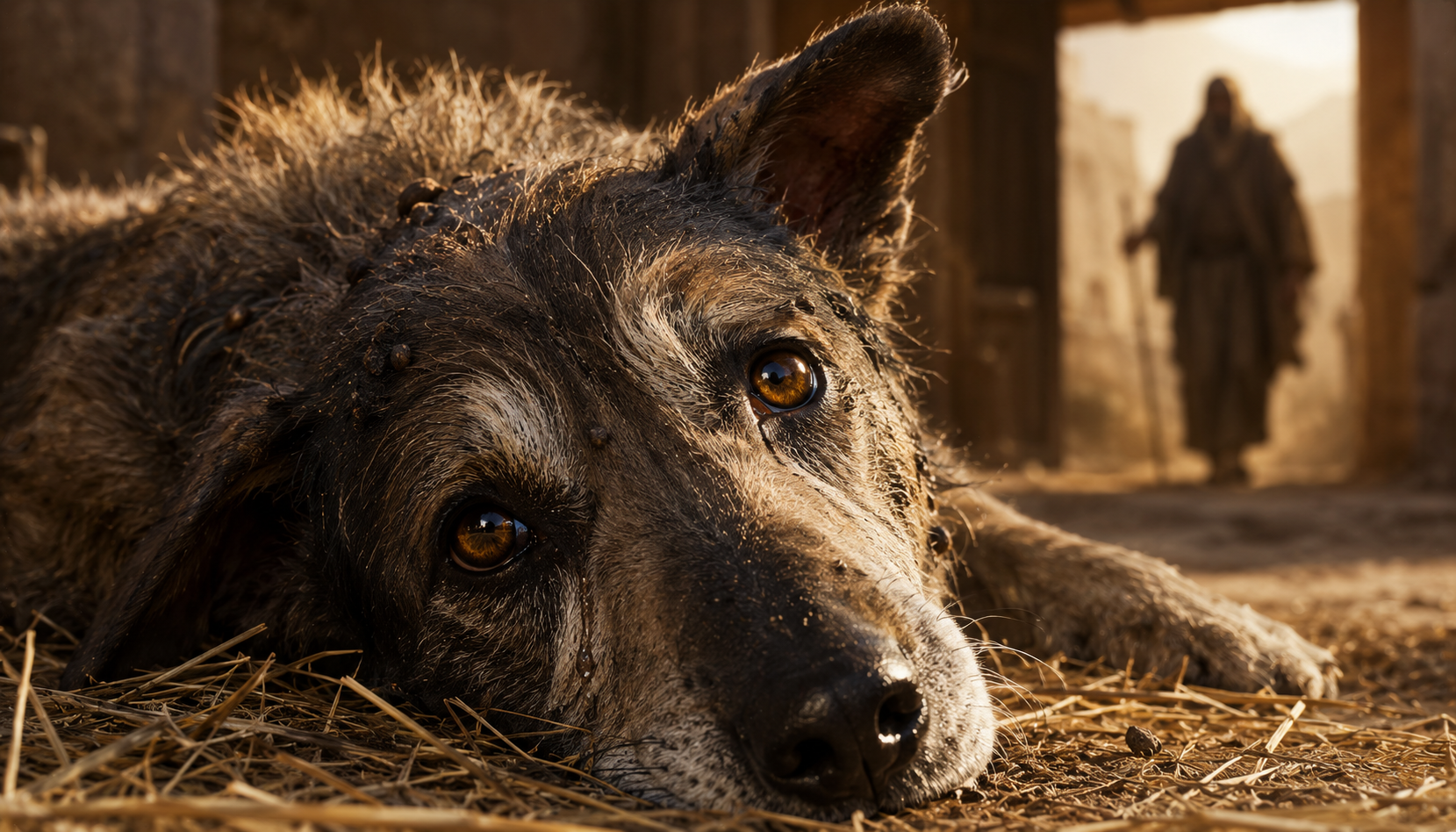
Argos, waiting twenty years, knows his master at last
This scene, just a few lines long, is among the most famous in the entire poem, and its power comes from what it reveals about recognition at its purest. Argos does not need a scar, a password, or a secret to know his master. He recognizes Odysseus by something deeper than appearance: by smell, perhaps, or by some older loyalty that twenty years of neglect could not erase. The dog knows him the way only a creature who has loved without conditions can know someone. No test is needed. No proof is demanded. Argos simply knows, and that knowing is enough to let him die in peace.
Recommended Reading
As an Amazon Associate, we earn from qualifying purchases.
Telemachus: The Son Who Was Told
The recognition between Odysseus and Telemachus stands apart from the others because it is not a discovery. It is a revelation. Athena lifts Odysseus's disguise in the hut of the swineherd Eumaeus, and Odysseus reveals himself directly to his son. It is, in some ways, the simplest of the recognition scenes, and in other ways the most complicated. Telemachus was an infant when his father left for Troy. He has no memories of the man standing before him. He has only stories, absence, and longing.
When Odysseus first tells Telemachus who he is, the young man does not believe him. He thinks it must be a god's trick, because no mortal could change his appearance so completely. Odysseus has to insist: no, it is really me. And then Telemachus breaks down and weeps, and they hold each other and cry together, and Homer compares their weeping to the cries of birds whose young have been stolen from the nest.
This scene carries the weight of twenty years of fatherlessness. Telemachus has grown up surrounded by men who disrespect his household, who court his mother, who eat his inheritance. He has searched for news of his father across the seas. And now here is this man, suddenly restored to youth and strength by Athena, claiming to be the father he has never known. The emotion is not just reunion. It is the collision of a son's lifelong hope with the bewildering reality of a stranger who says he is your father. Telemachus must take it on faith. He has no scar to touch, no secret to share. He has only the word of this man and the evidence of divine intervention. That he believes is itself an act of trust.
Eurycleia and the Scar: The Body Remembers
The recognition scene with Eurycleia is the most physical in the poem and arguably the most dramatic. In Book 19, Penelope orders a servant to wash the feet of the old beggar as a gesture of hospitality. Eurycleia, the aged nurse who cared for Odysseus as a boy, is given the task. Odysseus realizes the danger and turns away from the firelight, hoping the darkness will conceal the scar on his thigh. But as Eurycleia's hands move over his leg, her fingers find the ridge of old tissue, and she knows.
Homer pauses the entire narrative at this moment to tell the story of how Odysseus got the scar. It happened when he was a young man, barely more than a boy, visiting his maternal grandfather Autolycus on Mount Parnassus. During a boar hunt, the animal charged and gored him in the thigh before he could kill it. The wound healed, but the scar remained. This flashback is not a digression. It is Homer's way of saying that identity is inscribed on the body, that the past lives in flesh and bone, that who you are is written in the marks life has left on you.
When Eurycleia touches the scar, her reaction is instantaneous. She drops his foot, the water basin tips and spills across the floor, and she reaches for his face with a cry of joy and recognition. Odysseus grabs her by the throat. Not out of cruelty, but out of necessity. If she calls out, if the suitors hear, everything is lost. He whispers fiercely: you nursed me at your breast, yes, but you must be silent. You must tell no one. Eurycleia, trembling, agrees.
This is recognition by the body, by the intimate knowledge of someone who bathed you as a child and knows your skin the way only a caregiver can. It is not a test or a trick. It is involuntary, unavoidable, as physical as a heartbeat. The scar does not lie, and neither do the hands that find it.
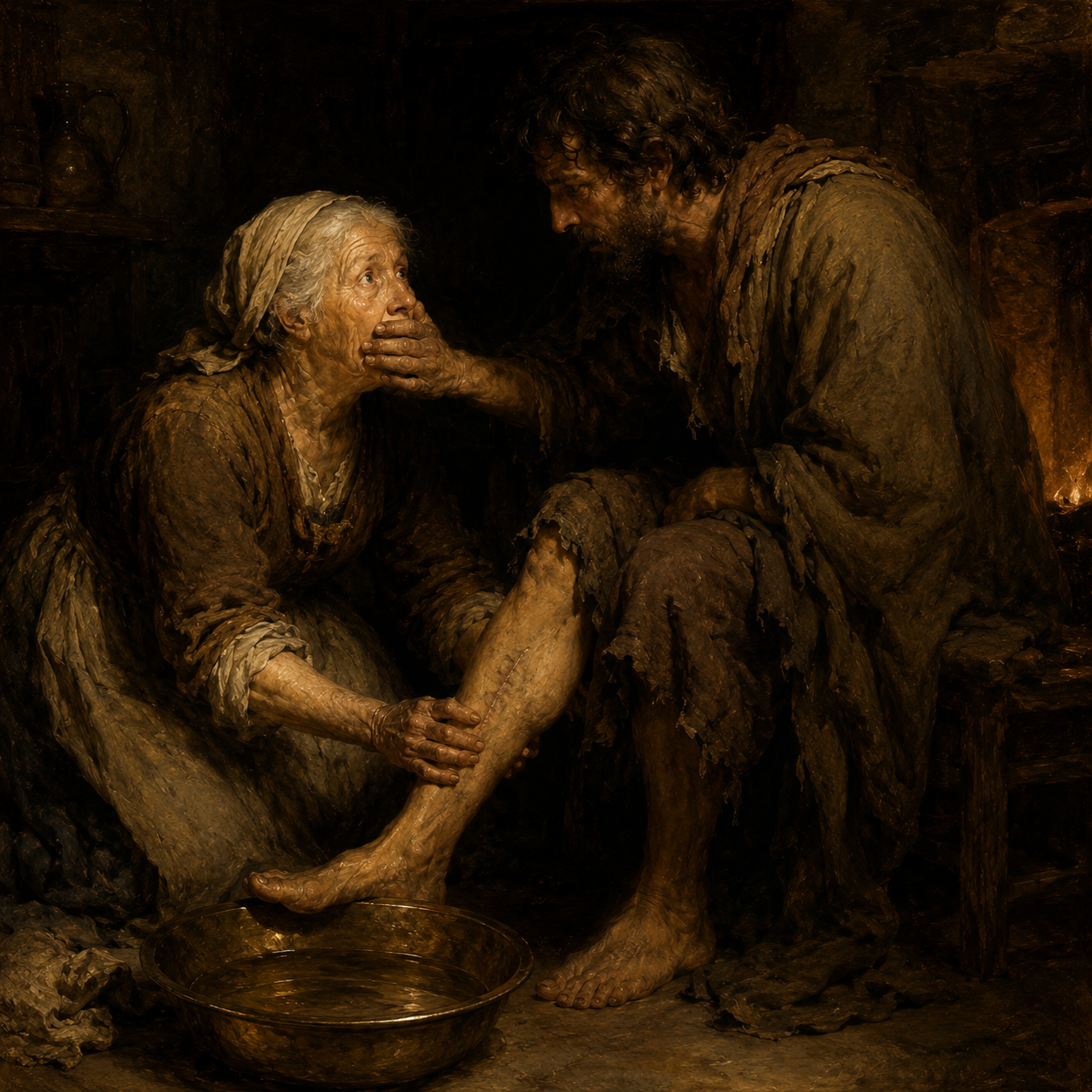
The faithful nurse discovers her master through the scar of his youth
Penelope and the Bed: The Secret Only Two People Share
The final and most extraordinary recognition scene belongs to Penelope. After Odysseus has killed the suitors, after the hall has been cleansed of blood, after the disloyal servants have been punished, Penelope comes downstairs and sits across from the man who claims to be her husband. She does not rush into his arms. She does not weep with joy. She sits in silence, studying him, and Telemachus grows furious at what he sees as her coldness.
But Penelope is not being cold. She is being careful. For twenty years, she has fended off over a hundred suitors through her own cunning. She has been lied to, pressured, and manipulated. Strangers have come to Ithaca before claiming to have news of Odysseus, and they have all been wrong or deceitful. She has learned, through two decades of waiting, that hope is dangerous and that appearances deceive. She will not be fooled now, not even by a man who has just performed an impossible feat of arms. She needs proof that no impostor could fabricate.
So she sets her test. She tells her servant Eurycleia to move the marriage bed out of the bedroom. Odysseus reacts immediately, with confusion and anger. How can anyone move the bed? He built it himself, years ago, around a living olive tree. He shaped the trunk of the tree into a bedpost, built the frame around it, and constructed the bedroom around the bed. The tree is rooted in the earth. The bed cannot be moved unless someone has cut the tree down. This is their secret, the detail of their shared life that no one else in the world could know.
"Woman, by heaven you have wounded me to the quick. Who has tampered with my bed? That would be a hard task for the most skillful craftsman, unless a god came and moved it." Homer, The Odyssey, Book 23 (Samuel Butler translation, 1900)
When Odysseus describes the bed, Penelope's knees give way. She runs to him, throws her arms around his neck, and weeps. It is the moment the entire poem has been building toward: twenty years of separation dissolved by a shared memory of a living tree at the heart of their home. The bed is the perfect symbol. It is rooted, permanent, immovable. It is the opposite of everything Odysseus has experienced on his journey: the drifting, the wandering, the ceaseless motion of the sea. The bed is where the wandering ends.
Penelope's test is the most demanding recognition scene in the poem because it requires not just physical proof but intimate knowledge. The scar proved Odysseus's body was the same. The bed proves his heart is the same. He remembers the life they built. He remembers the tree. He remembers what home means.
Recommended Reading
As an Amazon Associate, we earn from qualifying purchases.
Laertes in the Orchard: The Last Recognition
After the reunion with Penelope, there is one recognition left, and it may be the most tender of all. Odysseus goes to find his father, Laertes, who has withdrawn from the palace in grief and now works alone in his orchard, dressed in filthy clothes, bent with age and sorrow. The old man has been broken by his son's absence. He tends his trees because there is nothing else left for him.
Odysseus, even now, cannot bring himself to simply say who he is. He tests his father first, telling a false story, claiming to be a stranger who once hosted Odysseus. Laertes begins to weep, and Odysseus, overcome, finally drops the pretense. He shows his father the scar. And then he does something beautiful: he walks through the orchard and names the trees that Laertes gave him as a boy. Thirteen pear trees. Ten apple trees. Forty fig trees. Fifty rows of vines. He remembers every one, because his father taught him their names, one by one, when he was a child following the old man through the rows.
The trees are another kind of evidence, like the scar and the bed: proof that cannot be forged. But they are also something more. They are proof of a father's love, of time spent together, of knowledge passed from one generation to the next. The orchard is where Laertes poured his care into the earth while his son was gone, and now the son returns and gives that care back by remembering.
Anagnorisis: Why Recognition Must Be Earned
Aristotle, writing centuries after Homer, identified anagnorisis, the moment of recognition, as one of the most powerful elements in storytelling. He was thinking of the Odyssey when he wrote it. The poem does not give us a single grand reveal. Instead, it builds a chain of recognitions, each one earned differently, each one testing a different kind of knowledge.
Argos knows by instinct, by something older than memory. Eurycleia knows by touch, by the body she once cared for. Telemachus knows by faith, by choosing to believe in his father's return. Penelope knows by secret, by the shared architecture of their intimate life. Laertes knows by the orchard, by the education of love. Together, these scenes argue that identity is not a single thing. You are known differently by your dog, your nurse, your son, your wife, your father. Each of them holds a piece of you, and none of them holds all of you. To be fully known, you must be recognized by all of them, in all the different ways they carry you inside themselves.
This is why Homer makes recognition so difficult and so slow. In a lesser poem, Odysseus would arrive, reveal himself, and fight. In the Odyssey, he must earn the right to be himself again. The disguise is not just a tactical advantage. It is a narrative condition. Odysseus has been gone so long that his identity has become a question rather than a fact. The answer to that question can only come from the people who loved him, and each of them must find the answer in their own way.
Hear Every Recognition Scene Come Alive
Our full cast of voices brings these moments to vivid life: the sharp intake of breath when Eurycleia's fingers find the scar, the quiet death of Argos, the trembling anger in Odysseus's voice when Penelope tests him about the bed. With every word highlighted as it is spoken, you can follow the text in real time and feel the weight of each recognition as Homer builds it, scene by scene, toward the reunion that makes twenty years of wandering worthwhile. Book I is free to explore. The full poem, all twenty-four books, unlocks for $6.99.
Explore the Odyssey
As an Amazon Associate, we earn from qualifying purchases.
Continue Reading
Hear Odysseus Become Himself Again
Full-cast narration with every word highlighted as it is spoken. Start free with Book I, then unlock all twenty-four books for $6.99.
Start Listening FreeContinue the Journey
Hear the complete Odyssey read aloud with 60+ character voices. Every word highlights as it is spoken.
Book I is completely free. No signup required.
Go Deeper Into the Odyssey Film
Get the free Odyssey Companion Guide: character map, timeline, family tree, and the essential scenes from Homer's poem and the film.
No spam. Unsubscribe anytime.
The Odyssey Collection
Characters and cunning across five product types. T-shirts, posters, mugs, canvas prints, and tote bags.
Browse All ProductsFEATURED DESIGNS
MORE DESIGNS