The Word Itself: How "Odyssey" Became a Dictionary Entry
Start with the simplest and most telling proof of the poem's reach: the word "odyssey" is in the dictionary. Not as a proper noun referring to Homer's poem, but as a common noun meaning any long, eventful, difficult journey. That transition from title to definition is something almost no other work of literature has achieved.
NASA named a Mars orbiter "Mars Odyssey." Honda named a minivan "Odyssey." Stanley Kubrick called his space film "2001: A Space Odyssey." Nintendo's Mario stars in "Super Mario Odyssey." In every case, the word is doing the same work: it signals a journey that is long, transformative, and worth taking. The word carries so much cultural weight that you do not even need to know the poem to understand what it implies.
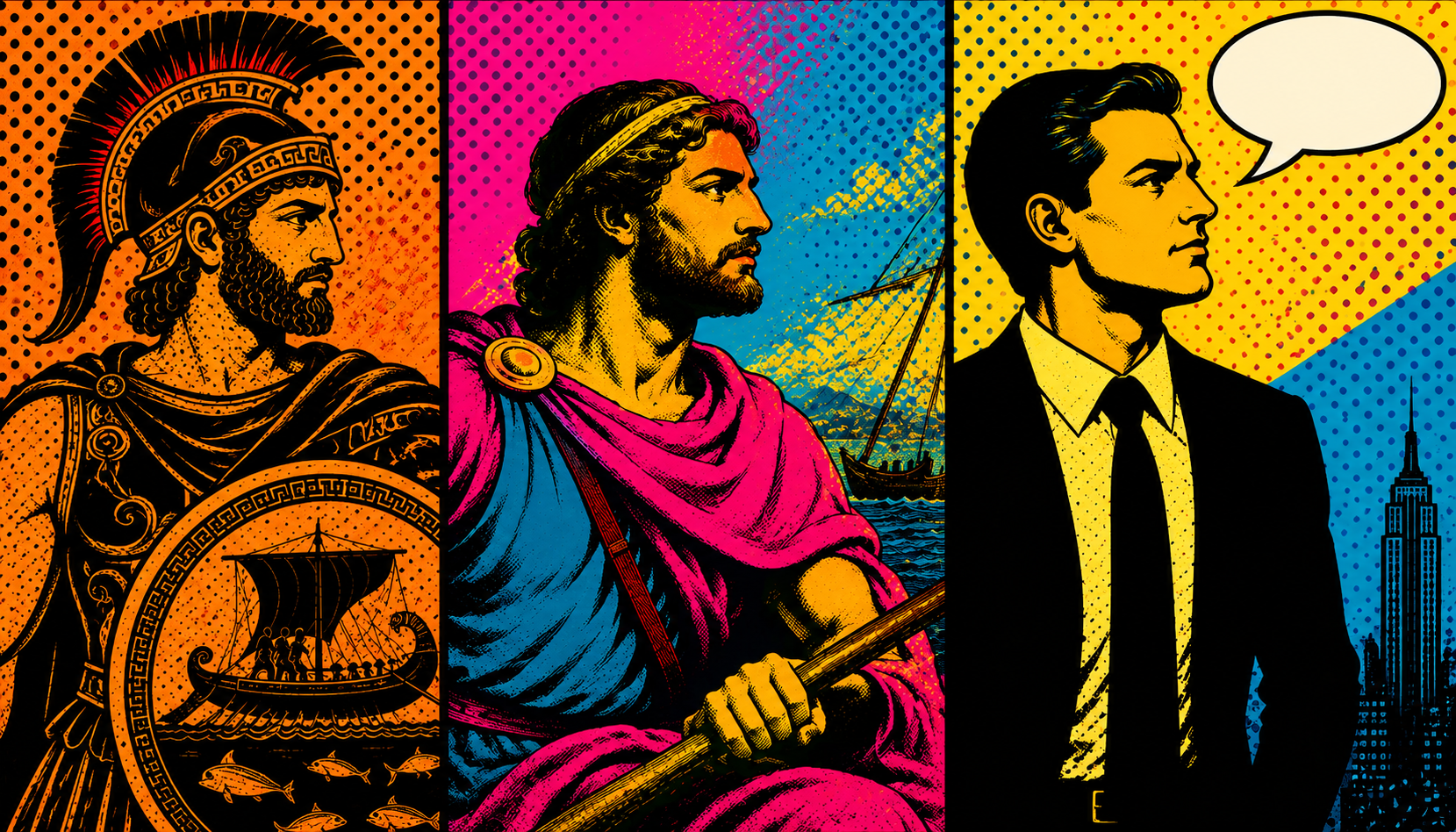
That is the deepest kind of influence. It is not just that people retell the Odyssey. It is that the Odyssey has become part of how we think about journeys at all. When someone says "it was a real odyssey getting here," they are channeling Homer whether they know it or not. Odysseus is not just a character. He is a concept.
Literature: The Odyssey as Foundation
James Joyce, Ulysses (1922). The most famous literary adaptation is also the most ambitious. Joyce took the entire structure of the Odyssey and mapped it onto a single day in Dublin, June 16, 1904. Leopold Bloom is Odysseus. Stephen Dedalus is Telemachus. Molly Bloom is Penelope. Every chapter corresponds to an episode from Homer: the Lotus-Eaters chapter follows Bloom through a series of pleasantly numbing encounters, the Cyclops chapter takes place in a pub with a narrow-minded nationalist, the Sirens chapter is set in a hotel bar where two barmaids sing. Joyce did not just borrow the plot. He used the Odyssey as a skeleton on which to hang the entire modern novel. The result is widely considered the greatest English-language novel of the twentieth century.
Margaret Atwood, The Penelopiad (2005). Atwood asked a question that Homer never addresses directly: what was Penelope thinking all those years? Her novel retells the Odyssey from Penelope's perspective, giving voice to the woman who held Ithaca together through twenty years of abandonment, pressure, and grief. It also foregrounds the twelve handmaids whom Odysseus hangs at the end of the poem, a detail Homer passes over quickly but that Atwood finds horrifying and worth interrogating. The Penelopiad is part of a larger trend of feminist retellings that ask what the women in these stories experienced while the men were having adventures.
Madeline Miller, Circe (2018). Miller took a secondary character from the Odyssey and gave her a full life. Her Circe is not just the sorceress who turns men into pigs. She is a daughter, a mother, a woman learning her own power over the course of centuries. The novel spends time on Circe's encounter with Odysseus but places it within a much larger story. It became a bestseller and introduced millions of readers to Greek mythology through a character Homer sketched in a single book.
Derek Walcott, Omeros (1990). The Nobel Prize-winning poet reimagined the Odyssey (and the Iliad) in the Caribbean, with fishermen on the island of St. Lucia standing in for Homer's heroes. The poem explores colonialism, identity, and displacement through the lens of the Greek epics, arguing that the experience of Caribbean people, torn from their homelands by slavery and empire, is its own kind of odyssey. It is one of the most powerful demonstrations of how Homer's themes translate across cultures.
The hero's journey. Joseph Campbell's The Hero with a Thousand Faces (1949) identified a universal story pattern that he called the monomyth: a hero leaves home, faces trials, gains wisdom, and returns transformed. Campbell drew heavily on the Odyssey, and his framework went on to influence everything from Star Wars to The Matrix to the Marvel Cinematic Universe. Whether or not Campbell's theory is universally valid, his use of the Odyssey as a template ensured that Homer's structure would be explicitly taught to generations of screenwriters, novelists, and game designers.
For a deeper look at how the poem has been reimagined across literature, film, and stage, see our full guide to Odyssey adaptations.
Film: The Odyssey on Screen
The direct adaptations. The Odyssey has been filmed multiple times. The 1954 Italian production Ulysses starred Kirk Douglas and played it as a straightforward sword-and-sandal adventure, emphasizing the spectacle of the Cyclops and the Sirens. The 1997 NBC miniseries with Armand Assante tried to include more of the poem and ran to three hours. Neither captured the full depth of Homer, but both introduced the story to audiences who would never have read the poem.
O Brother, Where Art Thou? (2000). The Coen Brothers' comedy is the most inventive Odyssey adaptation in film. Set in Depression-era Mississippi, it follows three escaped convicts on a journey through the American South. The parallels are playful and precise: the blind prophet on the railroad handcar is Tiresias, the women washing clothes by the river are the Sirens, the one-eyed Bible salesman Big Dan Teague is the Cyclops, and Penny (short for Penelope) is the wife who has moved on. The film even opens with Homer's invocation to the Muse. The Coens claimed they had never read the Odyssey, which is almost certainly a joke, but the point stands: the story is so deeply embedded in Western culture that you can riff on it in rural Mississippi and audiences get it.
2001: A Space Odyssey (1968). Kubrick's film does not retell Homer's plot, but the title is deliberate. The film follows a journey from Earth to Jupiter that transforms the traveler. The voyage through the star gate at the end, where Dave Bowman is broken down and reassembled as something new, echoes Odysseus's passage through the underworld and his eventual return as a changed man. The word "odyssey" in the title signals that this is a story about what a journey does to the person who takes it.
Cast Away (2000). Tom Hanks stranded on an island, struggling to survive, desperate to get home to the woman he loves. The parallels to Calypso's island are obvious. The film even echoes the Odyssey's ending: when Chuck finally returns, he finds that the world has moved on without him. His partner has married someone else. Home is not what it was. That bittersweet homecoming is one of the Odyssey's deepest themes, and Cast Away translates it with surprising fidelity.
The Odyssey (2026). The latest and most anticipated adaptation brought Homer to IMAX. The director's obsessions (time, memory, duty, the cost of ambition) map naturally onto the Odyssey's concerns. The film is an adaptation, not a line-by-line retelling, and audiences familiar with the poem will find themselves watching a conversation between the filmmaker and Homer across three millennia. If you haven't seen it yet, our guide to reading with the film is a good place to start. It is the biggest-budget, most technically ambitious Odyssey adaptation ever attempted.
Recommended Reading
As an Amazon Associate, we earn from qualifying purchases.
Television: The Long Journey Home, Serialized
Television, with its episodic structure and long arcs, is in some ways a more natural home for the Odyssey than film. A twenty-four-book poem with a different adventure in each book is basically a TV season.
Star Trek (1966 onward). Gene Roddenberry's original pitch for Star Trek described it as "Wagon Train to the stars," but the show's structure is pure Odyssey. A ship and its crew travel from world to world, encountering strange peoples, facing dangers, and relying on the captain's cunning to survive. Kirk is Odysseus with a phaser instead of a bow. The show even borrows specific episodes: the Sirens' irresistible song becomes the premise of multiple Star Trek episodes across different series, and encounters with Cyclops-like creatures appear regularly. Star Trek: Voyager (1995-2001) is the most explicitly Odyssean of the franchise, following a ship stranded far from home and fighting to get back across seven seasons.
Lost (2004-2010). A group stranded on a mysterious island, trying to get home while contending with supernatural forces and their own fractured relationships. The Odyssey parallels are everywhere: the island that does not want to let you leave (Calypso), the Others as hostile inhabitants (the Cyclopes, the Laestrygonians), the flashback structure that reveals characters' pasts (Odysseus narrating his own adventures to the Phaeacians). The show's central question, "Can you ever really go home?", is the Odyssey's central question too.
The Leftovers (2014-2017). Not a retelling of the Odyssey, but deeply concerned with the same themes: absence, grief, the struggle to find meaning after catastrophic loss, and whether homecoming is possible when the home you left no longer exists. The show's emotional texture, that ache of wanting to return to something that may already be gone, is the same ache that drives the Odyssey.
Video Games: The Odyssey as Interactive Experience
Video games may be the medium where the Odyssey's influence is most structural and least acknowledged. The basic format of most role-playing games (travel to a location, face a challenge, overcome it, gain something, move to the next location) is the format of the Odyssey's adventure books. Every RPG quest log is a descendant of Books 9 through 12.
Assassin's Creed Odyssey (2018). The most direct adaptation in gaming. Set in ancient Greece during the Peloponnesian War, the game lets you explore Ithaca, visit the Cyclops's cave, sail past Scylla and Charybdis, and interact with characters from Greek mythology. It is not a retelling of Homer's plot, but it drops you into Homer's world and lets you wander through it at your own pace. The game sold millions of copies and introduced an entire generation of players to the geography and mythology of the Odyssey.
The Legend of Zelda (1986 onward). Link's recurring quest to rescue Princess Zelda and restore Hyrule follows the Odyssean pattern: a hero separated from his homeland, traveling through a series of distinct and dangerous regions, overcoming a unique challenge in each one, and returning to reclaim what was lost. The Wind Waker (2002) is the most explicitly Odyssean, setting the adventure on a vast ocean where Link sails from island to island in search of a lost kingdom. Breath of the Wild and Tears of the Kingdom continue the tradition of the wandering hero piecing together a shattered world.
Hades (2020) and Hades II (2024). Supergiant Games' roguelikes are steeped in Greek mythology and feature Odysseus as a character. The games' structure (repeated attempts to escape, dying, learning, trying again) echoes the Odyssey's pattern of setback and perseverance. Zagreus trying to escape the underworld is not unlike Odysseus trying to escape the Mediterranean: every attempt teaches you something, every failure brings you closer, and the journey transforms you whether or not you reach the destination.
The RPG quest structure. Beyond specific games, the Odyssey lives in the DNA of game design. The concept of a quest giver (Athena, Circe, Tiresias all give Odysseus directions and objectives), the episodic structure of distinct challenges, the accumulation of experience and gear (Odysseus constantly acquires and loses equipment), and the triumphant homecoming as the final act: these are now so standard in gaming that designers do not even think of them as borrowed. But they are. Homer wrote the first quest log.
Music and Theater: The Song That Never Stopped
The Odyssey was originally performed as a song. Homer (or the tradition Homer represents) composed in dactylic hexameter, a rhythmic pattern designed for oral performance. A skilled bard would sing or chant the poem over multiple evenings, accompanying himself on a lyre. In that sense, the Odyssey has always been a musical work, and its influence on music and theater is a return to its origins.
Claudio Monteverdi's Il ritorno d'Ulisse in patria (1640) is one of the earliest operas and tells the story of Odysseus's return to Ithaca. The musical The Odyssey has been staged in various forms by companies around the world. Cream's 1968 song "Tales of Brave Ulysses" references the Sirens and the purple shore. Suzanne Vega's "Calypso" (1987) retells the goddess's perspective. The progressive rock genre, with its long-form compositions and mythological themes, has returned to Homer repeatedly.
The Odyssey's influence on theater extends beyond direct adaptations. The structure of many plays (departure, trial, recognition, homecoming) follows Homer's arc. The recognition scene, where a disguised character reveals their true identity, is one of the oldest dramatic devices, and the Odyssey contains several of the most famous examples: Odysseus revealing himself to Telemachus, to Penelope, to his father Laertes.
Recommended Reading
As an Amazon Associate, we earn from qualifying purchases.
Why the Odyssey Keeps Getting Retold
Three thousand years of adaptations raise an obvious question: why this poem? The Iliad is equally old and equally revered. Gilgamesh is even older. What is it about the Odyssey specifically that makes storytellers keep coming back?
The structure is infinitely flexible. The Odyssey's episodic format (hero travels through a series of distinct challenges) can accommodate any setting, any time period, any genre. You can set it in space, in the Depression-era South, in Dublin, in the Caribbean, in ancient Japan, or on a deserted island. The structure survives the transplant because it is not tied to any specific geography or mythology. It is tied to the experience of trying to get somewhere that matters.
The themes are universal. Everyone understands the desire to go home. Everyone understands the fear that home will not be the same when you get there. Everyone understands the tension between adventure and responsibility, between the excitement of the unknown and the pull of the familiar. These are not Greek themes. They are human themes. The Odyssey just happened to articulate them first and best.
The characters are archetypes. The cunning hero. The faithful wife. The son searching for his father. The seductive woman who offers paradise at the cost of identity. The monster in the cave. The suitors at the gate. These figures recur in story after story because they represent permanent features of human experience. Homer did not invent human nature, but he gave it a cast of characters that we have never stopped using.
The poem itself invites retelling. The Odyssey is, among other things, a poem about storytelling. Odysseus is a storyteller who shapes his own narrative. The bards Phemius and Demodocus perform within the poem, singing about the same events the poem describes. Homer constantly draws attention to the act of narration, to the choices a storyteller makes, to the power of a good tale told well. The Odyssey is a story that knows it is a story, and that self-awareness makes it a natural template for other storytellers to work with. When you retell the Odyssey, you are doing exactly what Homer showed his characters doing: taking an old story and making it new. For a taste of the lines that have echoed through three millennia of retellings, see our collection of memorable quotes.
The Odyssey Is Not a Museum Piece
It would be easy to treat the Odyssey as a historical artifact, a great work from the past that we study out of obligation. Every adaptation on this page proves otherwise. The Odyssey is not something we look back at. It is something we keep building on. Joyce did not write Ulysses because he was assigned Homer in school. He wrote it because the Odyssey was the best framework he could find for the novel he wanted to create. The Coen Brothers did not set O Brother in Mississippi as a gimmick. They did it because the story fit. The filmmaker is not adapting the Odyssey because it is prestigious. He is filming it because its themes are his themes.
That is the real legacy. The Odyssey is not preserved. It is alive. It is being rewritten in every medium, every generation, every language. And every retelling sends new readers back to the source. After you see the film, after you play Assassin's Creed, after you read Circe or the Penelopiad, the poem is still there. All 12,110 lines of it. It has been waiting three thousand years. It can wait a little longer. But when you are ready, it will show you things that no adaptation has ever fully captured: the rhythm of the verse, the texture of the similes, the sound of a voice telling a story that the whole world learned by heart.
Explore the Odyssey
As an Amazon Associate, we earn from qualifying purchases.
Related Pages
Read the Source That Started It All
Full-cast narration. Every word highlighted as it is spoken. Before the movies, the novels, the games, and the operas, there was Homer. Open any of the 24 books and hear the original.
Start ListeningContinue the Journey
Hear the complete Odyssey read aloud with 60+ character voices. Every word highlights as it is spoken.
Book I is completely free. No signup required.
Go Deeper Into the Odyssey Film
Get the free Odyssey Companion Guide: character map, timeline, family tree, and the essential scenes from Homer's poem and the film.
No spam. Unsubscribe anytime.
The Odyssey Collection
The original epic, wearable. T-shirts, posters, mugs, canvas prints, and tote bags.
Browse All ProductsFEATURED DESIGNS
SCENES & THEMES