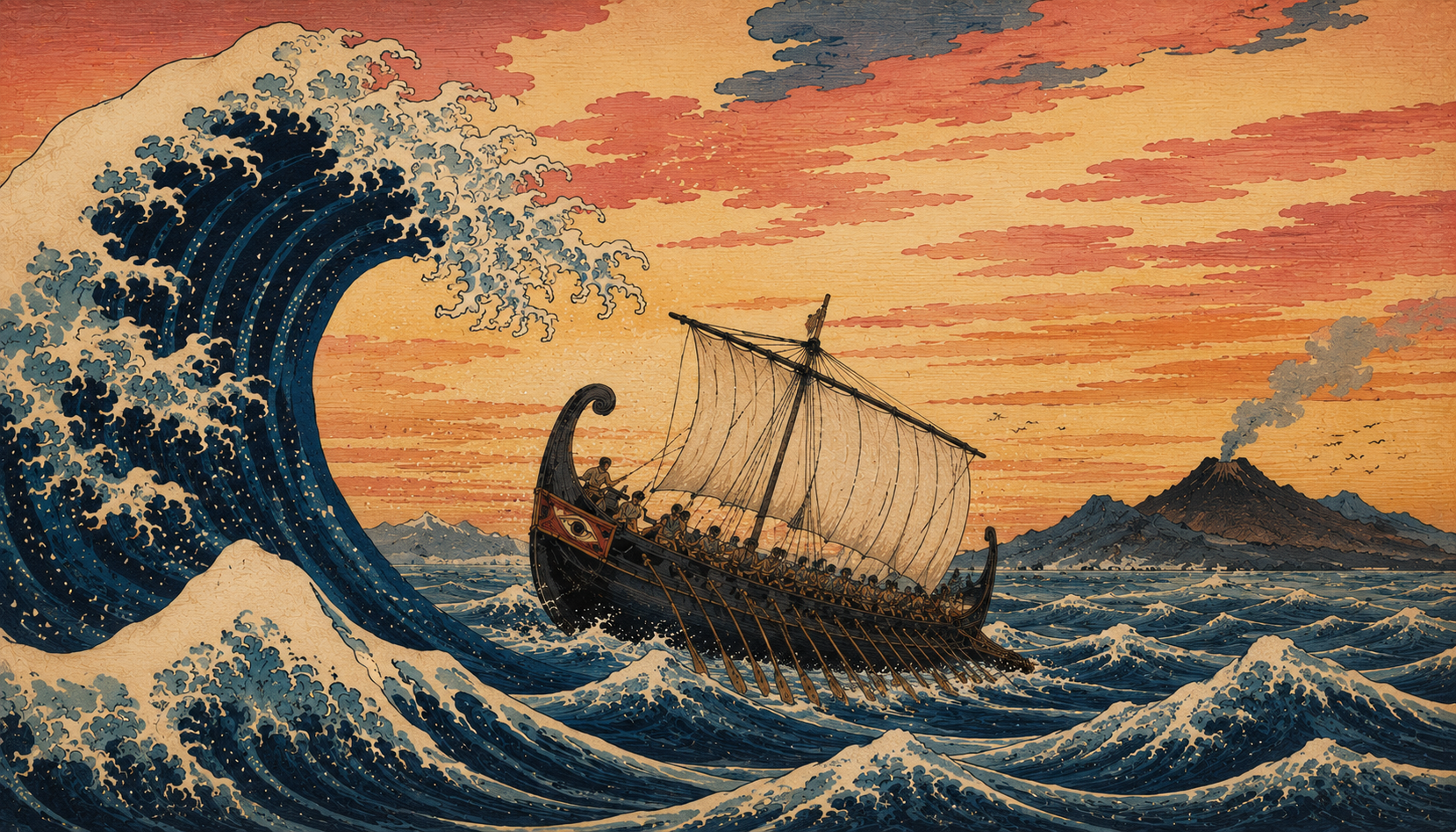
Odysseus's vessel braves the wine-dark sea
Ismarus and the Cicones: The First Mistake
The journey begins badly. Leaving Troy with twelve ships and their full crews, Odysseus's first stop is Ismarus, the city of the Cicones on the coast of Thrace. The Cicones had been allies of Troy, and Odysseus treats them as enemies. His men sack the city, kill the men, take the women and treasure, and divide the plunder.
Odysseus tells his crew to leave immediately. They refuse. They want to feast on the beach with their stolen cattle and wine. This is the first of many moments in the Odyssey where Odysseus gives the right order and his men ignore it. By morning, the Cicones have called for reinforcements from their inland allies, and a fierce battle erupts. Odysseus loses six men from each of his twelve ships, seventy-two soldiers in total. It is a significant loss, and it is entirely unnecessary. The lesson is clear from the start: greed and delay will be punished. Odysseus knows this. His men do not learn it.
The Lotus-Eaters: The Temptation to Forget
After a storm drives them south for nine days, Odysseus and his fleet reach the land of the Lotus-Eaters. The people there are not hostile. They offer Odysseus's scouts a taste of the lotus fruit, and the effect is immediate: the men who eat it lose all desire to go home. They forget Ithaca. They forget their families. They want nothing except to sit and eat lotus forever.
Odysseus has to drag them back to the ships by force and tie them under the rowing benches. He does not let anyone else go ashore. The episode is brief, only a few lines in Book 9, but it establishes one of the poem's central anxieties. The greatest threat to homecoming is not a monster or a storm. It is forgetting that you want to go home at all. The lotus does not kill. It erases purpose. And without purpose, Odysseus is just another man drifting on the sea.
The Cyclops: Curiosity and Its Price
The encounter with the Cyclops Polyphemus is the longest and most famous episode in Odysseus's narration. Arriving at an island near the land of the Cyclopes, Odysseus takes one ship and a select group of men to explore a cave filled with cheese and lambs. His men beg him to take what they can and leave. Odysseus refuses. He wants to see the cave's owner and find out whether he will offer them gifts of hospitality.
The owner is Polyphemus, a one-eyed giant and son of the sea god Poseidon. He seals the cave with a boulder too heavy for any human to move, then eats two of Odysseus's men for dinner and two more for breakfast. Trapped and horrified, Odysseus devises a plan. He gets Polyphemus drunk on strong wine, tells him his name is "Nobody," and then drives a sharpened, fire-hardened stake into the giant's single eye while he sleeps.
When the blinded Polyphemus screams for help and the other Cyclopes ask who is hurting him, he shouts "Nobody is hurting me," and they leave. Odysseus and his surviving men escape by clinging to the undersides of Polyphemus's sheep as the blind giant feels their backs to make sure no men are riding out.
"Cyclops, if any mortal asks you how your eye was put out, tell them it was Odysseus, sacker of cities, son of Laertes, who lives in Ithaca." Homer, The Odyssey, Book 9
And then Odysseus makes the mistake that defines the rest of his journey. Sailing away, unable to resist, he shouts his real name back at the blinded Cyclops. Polyphemus prays to his father Poseidon for vengeance, and Poseidon grants it. From this moment forward, the god of the sea is Odysseus's enemy. Every storm, every shipwreck, every delay that follows can be traced back to this single act of pride. Odysseus was too clever to die in the cave and too proud to escape without being known.
Recommended Reading
As an Amazon Associate, we earn from qualifying purchases.
Aeolus and the Bag of Winds: So Close to Home
Aeolus, the keeper of the winds, lives on a floating island with his family. He is hospitable and generous. He gives Odysseus a leather bag containing all the adverse winds, leaving only the gentle west wind free to blow the ships straight home to Ithaca. For nine days, Odysseus steers the ship himself, never sleeping, and on the tenth day, they can see Ithaca. They can see the smoke rising from the cooking fires on shore.
Then Odysseus falls asleep. His crew, suspicious that the bag contains gold and silver that Odysseus is keeping for himself, opens it. Every wind in the world erupts at once, and a hurricane drives them all the way back to Aeolus's island. Odysseus begs for help again, but Aeolus refuses. He recognizes a man cursed by the gods and wants no part of it. The ships sail on, and Odysseus has lost the closest thing to a guaranteed passage home that anyone in the poem ever receives.
This is perhaps the cruelest moment in the entire Odyssey. Home was visible. It was right there. And it was taken away not by a god or a monster but by the pettiness and distrust of Odysseus's own men.
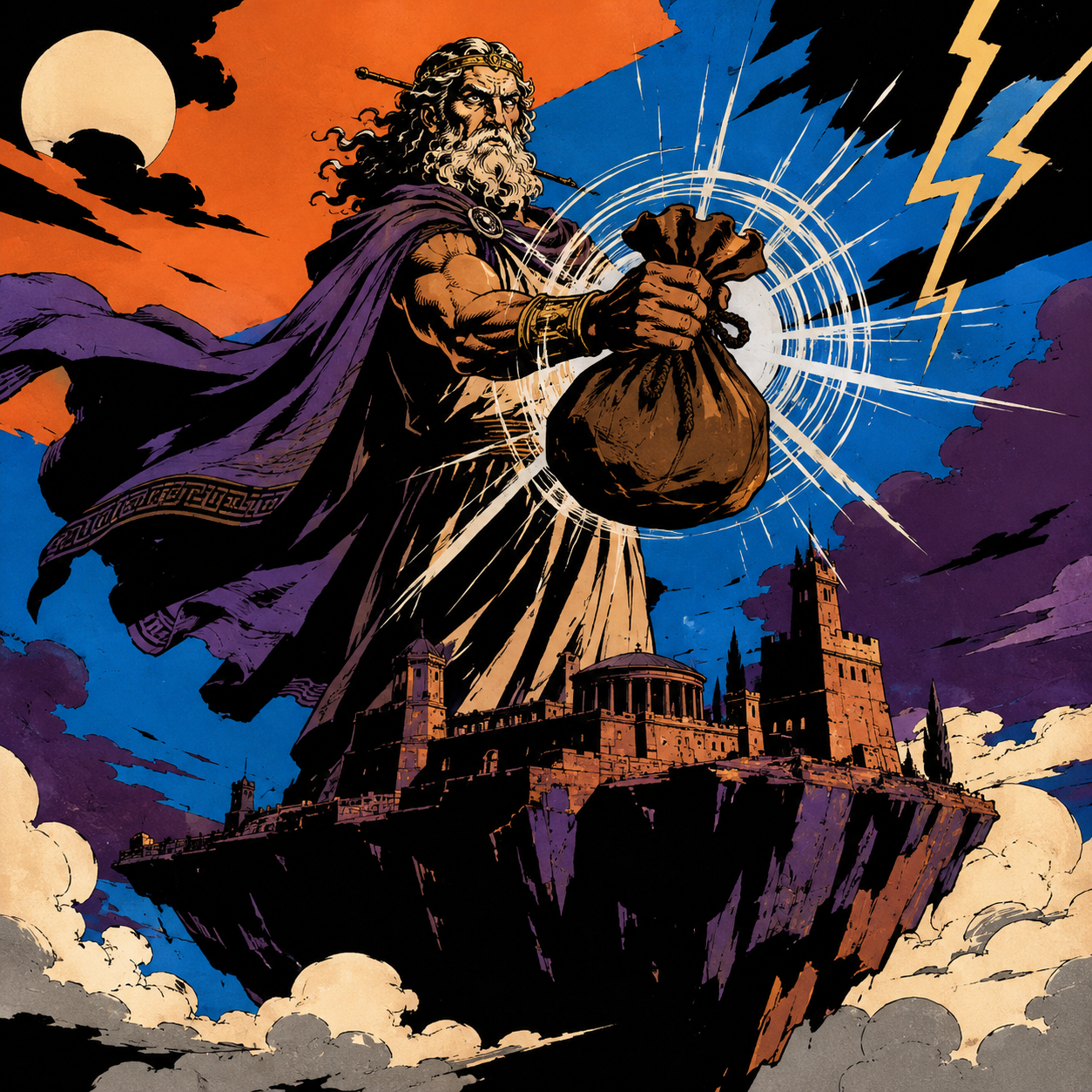
The keeper of winds offers a gift that proves a curse
The Laestrygonians: The Catastrophe
The Laestrygonians are cannibal giants, and the encounter with them is the single worst disaster of the voyage. Odysseus's fleet of twelve ships sails into a narrow harbor enclosed by steep cliffs on both sides. Only Odysseus, characteristically cautious, moors his own ship outside the harbor entrance.
The Laestrygonians stand on the cliffs above and hurl boulders down onto the trapped fleet. The ships are smashed. The men are speared like fish and carried away to be eaten. Eleven ships and all their crews are destroyed in minutes. Only Odysseus's ship escapes because it was moored outside the harbor.
Homer gives this episode very few lines, far fewer than the Cyclops, and that economy is itself a kind of horror. The death of hundreds of men is told quickly, almost casually, as if the scale of it is too large for the narrative to dwell on. After the Laestrygonians, Odysseus has one ship and perhaps forty-five men. Everything that happens for the rest of the poem happens to this remnant.
Circe's Island, Aeaea: The Year of Rest
Broken and grieving, the survivors reach Aeaea, the island of Circe. She is a goddess and sorceress who transforms Odysseus's scouts into pigs using a drugged potion and a magic wand. With help from the god Hermes, who gives him a protective herb called moly, Odysseus resists her magic, forces her to restore his men, and the whole crew stays on Aeaea for a full year.
The year with Circe is a pause in the catastrophe. After months of constant loss, Odysseus and his men eat well, drink well, and rest. Circe becomes Odysseus's lover and, eventually, his most important advisor. When they finally prepare to leave, she tells Odysseus he must first visit the land of the dead to consult the prophet Teiresias. And after that journey, she gives him a complete briefing on every danger between Aeaea and Ithaca: the Sirens, Scylla and Charybdis, and the cattle of the Sun. Her warnings are exact, and every one of them proves true.
The Land of the Dead: Voices from Below
Following Circe's instructions, Odysseus sails to the edge of the world and performs a ritual to summon the dead. He digs a trench, pours offerings of milk, honey, wine, and water, and sacrifices a black ram and a black ewe. The ghosts of the dead come crowding around, drawn by the blood, and Odysseus speaks with them one by one.
Teiresias, the blind prophet, tells him the route home and warns him about the cattle of the Sun. His mother Anticleia, who died of grief during his absence, tells him about conditions in Ithaca. The ghost of Agamemnon tells the story of his murder by Clytemnestra and warns Odysseus not to trust any woman too completely. Achilles, the greatest warrior of the Trojan War, tells Odysseus he would rather be a living servant than the king of the dead. Ajax, still angry about losing the contest for Achilles's armor, refuses to speak to him at all.
The journey to the underworld is the emotional center of Odysseus's narrative. Here he confronts what his absence has cost, a dead mother, a world of fallen comrades, and hears the truth about what awaits him if he fails. It is also the moment where the poem's scope expands beyond one man's voyage. The parade of dead heroes connects Odysseus to the larger story of the Trojan War and to the universal human confrontation with mortality.
The Sirens: The Song You Cannot Unhear
Returning from the underworld to Aeaea and then setting sail again, the crew's first obstacle is the Sirens, whose song is so beautiful that it lures sailors to steer toward the shore, where they wreck their ships and die. Following Circe's advice, Odysseus plugs his crew's ears with beeswax so they cannot hear. But because he is Odysseus, and because he cannot resist the chance to experience something extraordinary, he has his men tie him to the mast so he can listen.
The Sirens sing to him by name. They promise him knowledge: they say they know everything that happened at Troy, everything that happens on the face of the earth. Odysseus strains against his ropes, begging his men to untie him. They tie him tighter, as he ordered them to do. The ship passes safely.
Homer never tells us exactly what the Sirens' song sounds like. He tells us what it promises: knowledge, total knowledge, the very thing Odysseus craves above all else. The Sirens are dangerous not because they offer pleasure but because they offer the one thing a man like Odysseus cannot refuse. That he survives is a matter of foresight and restraint, two qualities that are at war in him throughout the poem.
Recommended Reading
As an Amazon Associate, we earn from qualifying purchases.
Scylla and Charybdis: The Impossible Choice
The strait between Scylla and Charybdis presents the poem's starkest choice. On one side, Charybdis, a massive whirlpool that swallows the sea three times a day, ships and all. On the other, Scylla, a six-headed monster living in a cliff cave who will snatch and eat six men from any ship that passes within reach.
Circe told Odysseus to choose Scylla. Losing six men is terrible, but losing the entire ship and crew to Charybdis is worse. Odysseus follows her advice, though he does not tell his men what he knows is about to happen. As they row through the strait, staring in terror at Charybdis on one side, Scylla strikes from above and seizes six men. They scream Odysseus's name as they are lifted into the air. He can do nothing.
Odysseus later calls this the most pitiful thing he witnessed in all his travels on the sea. He heard men screaming his name and reaching for him as they died, and he sailed on. The passage is a study in the kind of leadership the Odyssey values: not heroic, not glorious, but practical and willing to accept calculated losses for the sake of the greater number.
Thrinacia: The Cattle of the Sun
Teiresias warned him. Circe warned him. Both said the same thing in the same words: do not touch the cattle of the Sun god Helios on the island of Thrinacia. If you leave them alone, you will get home. If you harm them, your ship and your crew will be destroyed.
Odysseus tells his men. They promise to obey. But then the winds trap them on Thrinacia for a month, and their food runs out. Odysseus goes inland to pray, and while he sleeps, his lieutenant Eurylochus persuades the starving crew to slaughter the best of Helios's cattle and feast. They reason that it is better to die at sea, quickly, than to starve slowly on a beach. When Odysseus wakes and smells the roasting meat, he knows they are doomed.
Helios complains to Zeus. Zeus promises punishment. When the ship finally sails, Zeus strikes it with a thunderbolt. The mast falls. The ship breaks apart. Every man drowns except Odysseus, who clings to the wreckage and drifts, alone, back through the strait of Scylla and Charybdis. He grabs a fig tree growing from the cliff above Charybdis and hangs there until the whirlpool spits out the remains of his ship, then drops onto the debris and paddles away with his hands.
This is the end of Odysseus's crew. Every man he led from Troy is dead. The rest of the journey, he makes alone.
Ogygia: Seven Years with Calypso
The wreckage carries Odysseus to Ogygia, the remote island of the goddess Calypso. She is beautiful, immortal, and lonely. She takes Odysseus in, falls in love with him, and offers him the most extraordinary gift anyone in the poem receives: immortality and eternal youth, if he will stay with her forever and forget Ithaca.
He refuses. Or rather, he never stops wanting to go home, even though he has no way to leave. He has no ship, no crew, no tools to build a raft. He is stranded on paradise, and he spends his days sitting on the beach, staring at the sea, weeping. Seven years pass this way. It is the longest single stop on the journey, and Homer covers it in remarkably few lines because there is very little to say. Odysseus is stuck. Nothing happens. That is the point.
Calypso finally releases him only because Zeus, prompted by Athena, sends Hermes to order it. She is furious at the double standard, noting that the gods are always allowed to take mortal lovers but goddesses are punished for doing the same. She helps Odysseus build a raft, gives him provisions, and sends him on his way. Poseidon promptly wrecks the raft. Odysseus swims for two days and washes ashore on Scheria, naked, exhausted, and alone.
Scheria: The Phaeacians and the Final Passage
The land of the Phaeacians is the last stop before home, and it is where the poem's narrative structure performs its most elegant trick. Odysseus arrives at Scheria as a shipwrecked stranger. He is found by Nausicaa, the young princess, brought before King Alcinous and Queen Arete, and treated with extraordinary hospitality. He attends feasts, watches athletic games, and listens to the bard Demodocus sing songs about Troy.
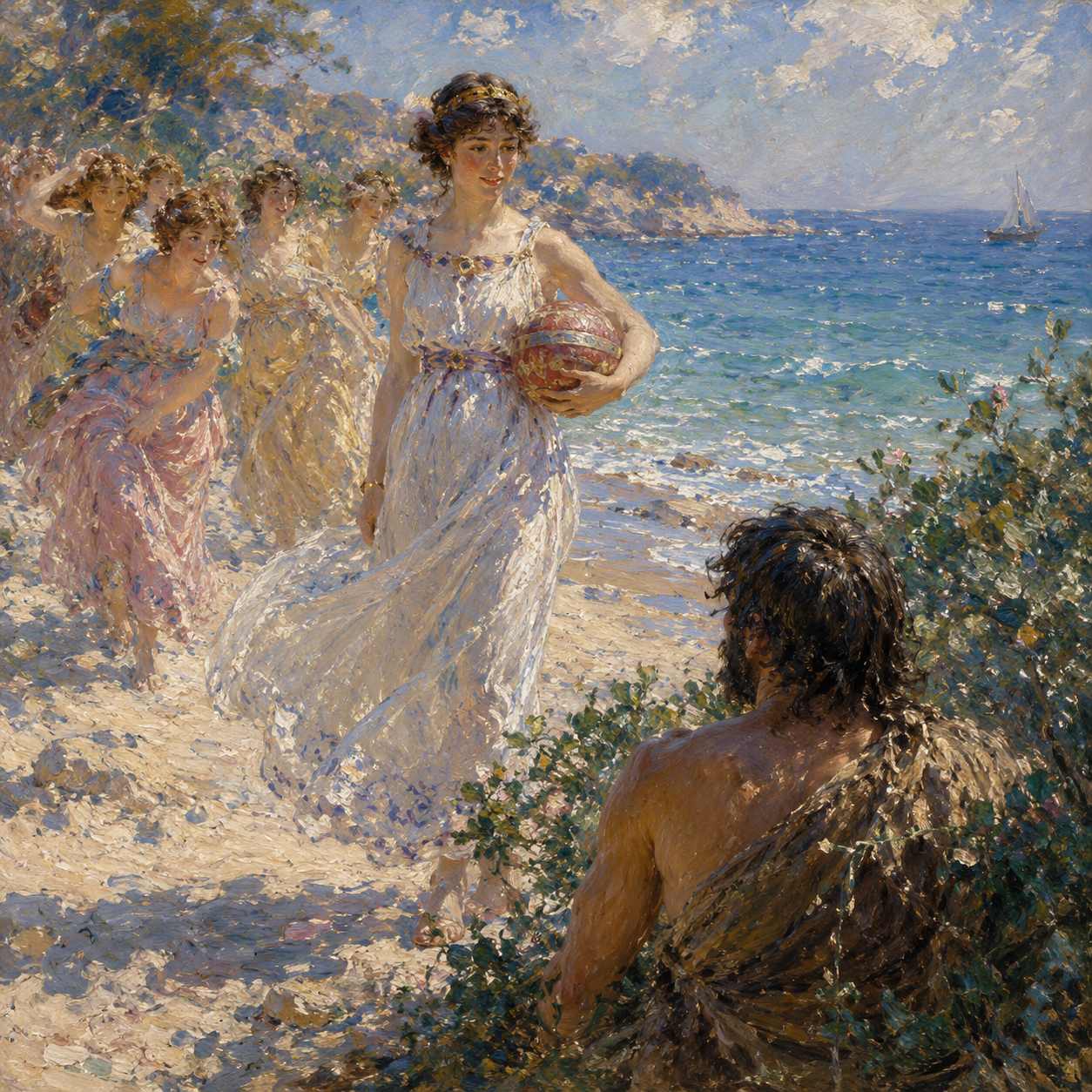
Princess Nausicaa finds the shipwrecked hero on the beach
It is here, when Alcinous asks who he is, that Odysseus tells the entire story of his journey, from Troy through every stop described above. This is the frame: everything from the Cicones to Calypso is narrated by Odysseus himself, at a dinner party, to an audience who controls whether he gets a ride home. The Phaeacians are so moved by his story that they load him with gifts and sail him to Ithaca overnight on one of their magical ships. Odysseus falls asleep during the crossing and wakes up on the beach of his own island, not quite recognizing it in the morning mist.
After twenty years, the journey is over. What follows is the return: the reunion with his son Telemachus, the test of the bow, the slaughter of the suitors, and the final recognition by Penelope. But the sea journey, the ten years of wandering that gave the poem its name, ends here, with a man asleep on the shore of the home he has fought a decade to reach.
"There is nothing more admirable than when two people who see eye to eye keep house as man and wife, confounding their enemies and delighting their friends." Homer, The Odyssey, Book 6
Explore the Journey
As an Amazon Associate, we earn from qualifying purchases.
Continue Reading
Sail Every League of the Journey
Full-cast narration with 60+ character voices. Book I is free. Unlock the complete Odyssey, all 24 books, for $6.99.
Start Listening FreeContinue the Journey
Hear the complete Odyssey read aloud with 60+ character voices. Every word highlights as it is spoken.
Book I is completely free. No signup required.
Go Deeper Into the Odyssey Film
Get the free Odyssey Companion Guide: character map, timeline, family tree, and the essential scenes from Homer's poem and the film.
No spam. Unsubscribe anytime.
Go Deeper
Explore our guides, audiobook, and merchandise inspired by the Odyssey.