Last updated June 2026
Circe's Warning: What Lay Ahead
The Sirens episode does not begin with the Sirens. It begins with Circe, the goddess who had already hosted Odysseus and his men for a year on her island of Aeaea. After Odysseus returned from his journey to the Underworld (the subject of the previous book), Circe sat him down privately and laid out everything he would face on the voyage home. The Sirens were first on her list.
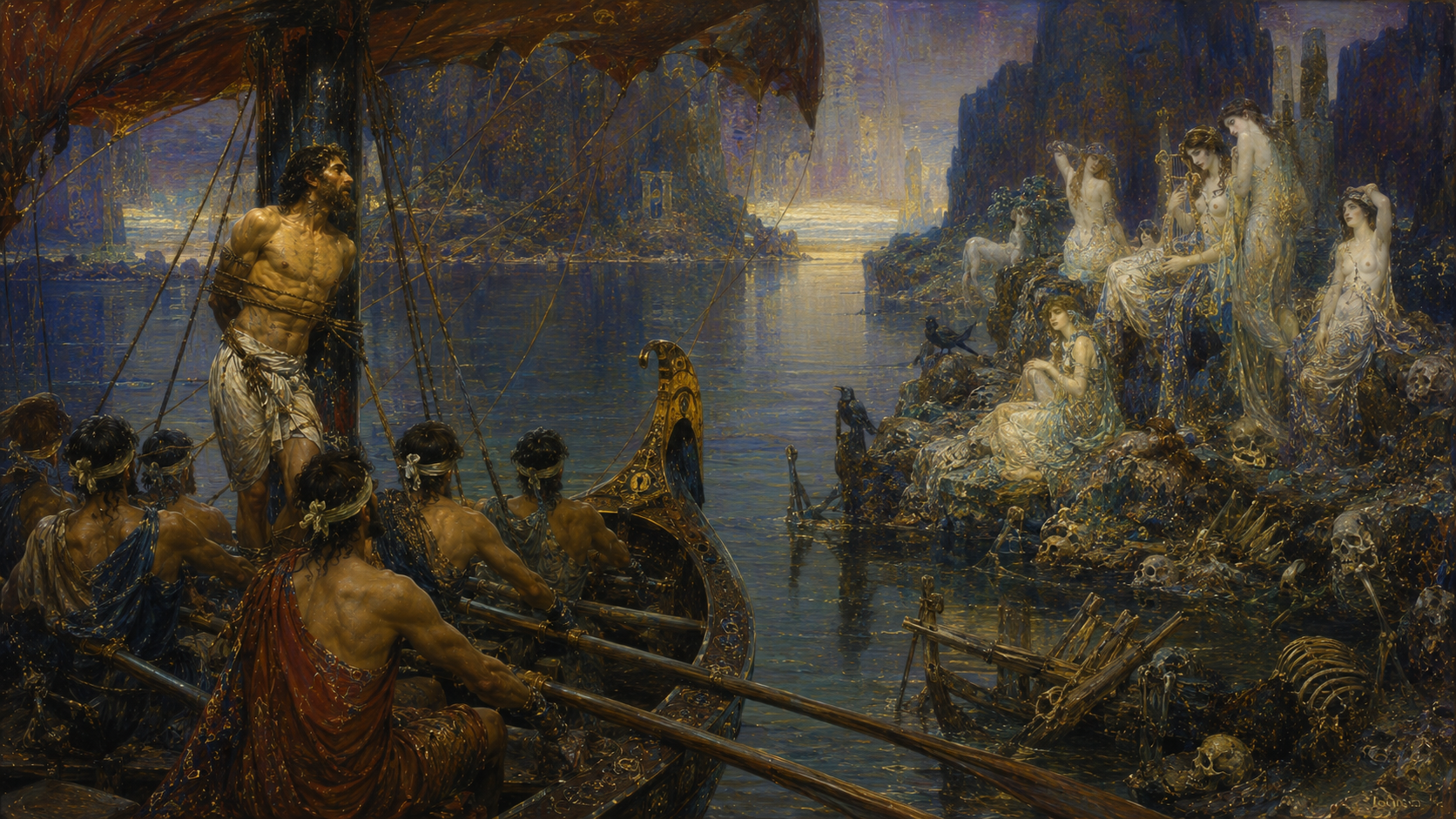
Circe's description is precise and horrifying. She tells Odysseus that the Sirens "enchant all who come near them," and that any sailor who hears their singing will never see his family again. But it is the image she paints around them that makes the passage so memorable. The Sirens do not live in some beautiful garden. They sit in a meadow surrounded by death: "There is a great heap of dead men's bones lying all around, with the flesh still rotting off them." These are the remains of every sailor who ever stopped to listen.
Circe tells Odysseus to plug his crew's ears with beeswax so they cannot hear. But she gives him a choice. He can listen if he wants to, as long as his men tie him to the mast and refuse to let him go no matter how much he begs. If he pleads with them to untie him, they must bind him tighter. This is the deal: knowledge at the price of complete helplessness. Odysseus, characteristically, takes it.
The Approach: Dead Calm and Beeswax
Odysseus does something unusual after hearing Circe's warning. He tells his crew about it. This is not always the case in the Odyssey. Later in Book 12, he deliberately hides Circe's warning about Scylla because he knows his men will stop rowing if they hear about a six-headed monster. But with the Sirens, he is transparent. He explains exactly what they are sailing toward and exactly what needs to happen.
The wind that had been pushing them along drops dead as they approach the Sirens' island. Homer describes it carefully: "Then all of a sudden it fell dead calm; there was not a breath of wind nor a ripple upon the water." The men furl the sails and take up their oars. The natural world itself seems to hold its breath. Into that silence, Odysseus prepares.
He takes a large wheel of wax, cuts it up with his sword, and kneads it soft with his hands, helped by the heat of the sun. Then he goes from man to man and stops their ears with it. His crew ties him upright to the crosspiece halfway up the mast and lashes the rope ends to the mast itself. There is something almost ritualistic about the preparation. Each man gives up one of his senses. Odysseus gives up his freedom. And then they row.
What the Sirens Actually Sang
This is the part that surprises people. In popular culture, the Sirens are usually depicted as seductresses, singing songs of desire and beauty to lure sailors to their doom. But that is not what Homer wrote. The Sirens' song in the Odyssey is not about pleasure at all. It is about knowing things.
Here is what they sing, addressing Odysseus by name:
"Come here, renowned Ulysses, honour to the Achaean name, and listen to our two voices. No one ever sailed past us without staying to hear the enchanting sweetness of our song -- and he who listens will go on his way not only charmed, but wiser, for we know all the ills that the gods laid upon the Argives and Trojans before Troy, and can tell you everything that is going to happen over the whole world."
Look at what they are promising. First, they flatter him: "renowned Ulysses, honour to the Achaean name." They know who he is. Then they promise wisdom: the listener will go on his way "not only charmed, but wiser." And they specify exactly what kind of wisdom they offer. They know everything about the Trojan War, and they know everything that is going to happen in the future.
This is a brilliantly targeted pitch. Odysseus is a man who sat inside a wooden horse for hours waiting for the right moment to spring out and take a city. He is a man who insisted on hearing Tiresias's prophecy in the Underworld. He is a man whose defining trait is not strength but intelligence. Offering him unlimited knowledge is like offering water to a man dying of thirst. The Sirens know their audience.
The promise is also a lie, of course. Nobody who listens goes on his way wiser, because nobody who listens goes on his way at all. The bones in the meadow prove that. But notice that Homer does not spell this out directly. He just lets the song sit there, beautiful and impossible, and lets the reader feel the pull of it.
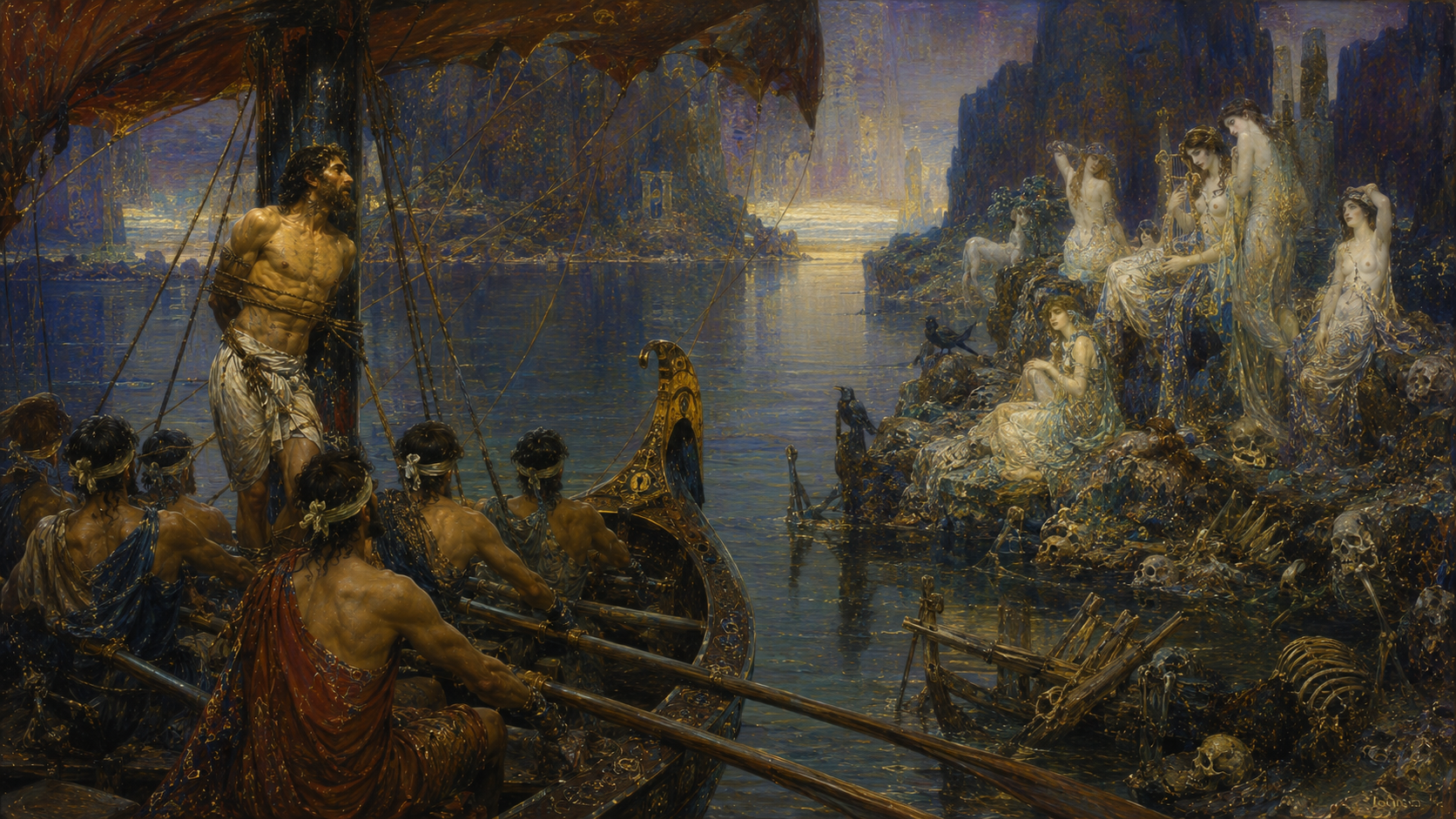
The Sirens' irresistible song promises knowledge at the cost of life
Recommended Reading
As an Amazon Associate, we earn from qualifying purchases.
Odysseus at the Mast: The Struggle
Homer does not give us a long, drawn-out scene of Odysseus writhing at the mast for pages. He gives us something more effective: a few tightly compressed lines that convey utter helplessness. The song hits, and Odysseus loses himself immediately:
"They sang these words most musically, and as I longed to hear them further I made signs by frowning to my men that they should set me free; but they quickened their stroke, and Eurylochus and Perimedes bound me with still stronger bonds till we had got out of hearing of the Sirens' voices."
Odysseus cannot speak, because his crew might hear him over their beeswax if he shouts loud enough, and he might convince them. So he communicates with his face. He frowns. He signals. He tries to use the only tool left to him, his expressiveness, to get free. And his men, who know exactly what is happening because he told them beforehand, ignore his silent pleading and tie him tighter.
There is something profound about this moment. Odysseus, the great talker, the man who can persuade anyone of anything, is reduced to frowning helplessly while other men make decisions about his body. He chose this. He wanted to hear the song and he accepted the price. But in the moment, the wanting overwhelms the choice. He would throw everything away, his homecoming, his wife, his son, his kingdom, for one more minute of that song. That is what the Sirens do.
Two of his men are named: Eurylochus and Perimedes. These are not random sailors. Eurylochus is the same man who will later defy Odysseus and convince the crew to eat the cattle of the sun god, leading to their destruction. But here, in this moment, he is the one who saves Odysseus by binding him tighter. The same man who will doom the crew later is the one who rescues their captain now. Homer does not comment on this, but the irony is there for anyone paying attention.
Why Knowledge Is the Most Dangerous Lure
The choice Homer made with the Sirens' song tells us something important about what he thought was most dangerous for human beings. He could have made them sing about anything: beauty, love, wealth, power, youth. Later writers and artists would reimagine them as sexual temptresses, half-bird women luring men with erotic desire. But Homer went straight for the thing that he apparently considered the most irresistible temptation of all: the desire to know.
This is consistent with everything else in the Odyssey. Odysseus's defining flaw throughout the poem is curiosity. He stays in the Cyclops's cave when he should have left because he wants to see what kind of creature lives there. He shouts his real name at Polyphemus after escaping because he cannot stand being anonymous. He asks to hear Demodocus sing the story of his own Trojan Horse. He is a man who always needs to know, always needs to see, always needs to hear one more thing.
The Sirens' song is the purest expression of that weakness. They offer complete knowledge of the past and future, and Odysseus, lashed to a mast in the middle of the ocean, cannot stop himself from wanting it. The scene works because we understand the pull. Who would not want to know everything? And that is exactly why it kills people.
There is also a deeper philosophical point. The Sirens claim their song makes you wiser, but the evidence surrounding them, the meadow of bones, proves the opposite. The knowledge they offer is not empowering. It is paralyzing. It fixes you in place and keeps you there until you die. Real wisdom, the kind Odysseus eventually earns, comes not from hearing everything but from knowing when to stop listening and keep rowing.
The Sirens in Context: Between the Dead and the Dying
The placement of the Sirens episode within Book 12 is deliberate. Odysseus comes to them immediately after his journey to the Underworld in Book 11, a stop on the long route from Troy to Ithaca, where he spoke with ghosts and learned about his future. He has just been surrounded by the dead. The Sirens sit in a meadow of the dead. And after the Sirens, he will face Scylla, who will snatch six of his men and eat them alive while they scream his name.
Book 12 is the most harrowing stretch of the Odyssey. The full chronological timeline shows how these events fit together. It begins with Circe's detailed catalog of horrors: Sirens, then Scylla and Charybdis, then the cattle of the sun god. Each trial costs Odysseus something. The Sirens cost him his composure. Scylla costs him six men. The sun god's cattle will cost him the rest of his crew and his ship. By the end of Book 12, Odysseus is alone on a makeshift raft, every companion dead, drifting toward seven years of captivity on Calypso's island.
The Sirens episode is the calm before the catastrophe. It is the last moment where Odysseus gets to satisfy his curiosity without anyone dying for it. He hears the song, his men row past, and they all survive. It is a victory. But it is the last clean victory he will get for a very long time.
Recommended Reading
As an Amazon Associate, we earn from qualifying purchases.
What Homer Leaves Out
One of the most striking things about the Sirens in the Odyssey is what Homer does not tell us. He does not describe what the Sirens look like. He does not say whether they are human, bird, fish, or something else entirely. The famous image of Sirens as winged women with bird legs comes from Greek vase painting, not from Homer. Later tradition would make them beautiful half-bird creatures, and later still they would merge with mermaids. But in the Odyssey, they are just voices.
Homer also does not tell us what happens to the Sirens after Odysseus passes. Do they keep singing? Do they stop? Are they angry, disappointed, indifferent? We do not know. They appear for a few lines, sing their brief song, and vanish from the poem forever. The restraint is deliberate. The less we know about them, the more unsettling they are.
He also does not tell us what the "enchanting sweetness" of their song actually sounds like. He gives us the words but not the music. This is, of course, a limitation of any written text. But in the audiobook, you can hear those words performed aloud, and something about hearing a voice sing "Come here, renowned Ulysses" lands differently than reading it on a page. Homer composed for the ear, not the eye. The Sirens were always meant to be heard.
The Sirens After Homer
The Sirens have had one of the richest afterlives of any element in Greek mythology. In the centuries after Homer, Greek writers and artists gave them physical form: bird-women perched on rocky shores, sometimes with musical instruments. The playwright Euripides mentions them. Apollonius of Rhodes, who wrote the Argonautica, has Jason and the Argonauts encounter them, drowning out their song with Orpheus's lyre.
The Romans inherited them. Ovid tells their backstory: they were originally companions of Persephone who were transformed after she was abducted by Hades. Virgil places them along Aeneas's route. By the medieval period, Sirens had merged with the concept of the mermaid, losing their bird features and gaining fish tails. The word "siren" itself entered every European language as a term for something dangerously alluring.
But all of it traces back to those few lines in Odyssey Book 12. Two unnamed singers in a field of bones, offering a man everything he wanted to know, and the man tied to a mast who wanted it badly enough to beg for his own destruction. Every retelling, every painting, every movie siren is a descendant of that moment.
Hearing the Sirens Today
Reading the Sirens episode is one thing. Hearing it is another. Homer composed the Odyssey as an oral poem, performed by bards who chanted or sang the verses to a live audience. The Sirens' song within the poem is a song within a song, a performance nested inside a performance. When you hear it read aloud, that layering comes alive in a way it cannot on the printed page.
In our audiobook, the Sirens episode is part of Book 12, and every word of Homer's text is spoken aloud with synchronized highlighting so you can follow along. You hear Circe's warning. You hear Odysseus tell his men to bind him. You hear the Sirens call out to him by name. And you hear the quiet moment after, when the men take the wax from their ears and untie their captain, and the ship sails on toward the next horror.
There is something fitting about experiencing the Sirens through sound rather than sight. These were creatures whose entire power was auditory. They did not chase ships or drag men overboard. They just sang, and men came to them. Homer understood that the most dangerous thing in the world is not a monster with claws. It is a voice that tells you exactly what you want to hear.
Explore the Odyssey
As an Amazon Associate, we earn from qualifying purchases.
Related Pages
Hear the Sirens' Song Spoken Aloud
All 24 books of the Odyssey, read with a full cast of distinct voices. Every word highlights as it is spoken. Press play on Book 12 and hear what Odysseus heard.
Listen NowContinue the Journey
Hear the complete Odyssey read aloud with 60+ character voices. Every word highlights as it is spoken.
Book I is completely free. No signup required.
Go Deeper Into the Odyssey Film
Get the free Odyssey Companion Guide: character map, timeline, family tree, and the essential scenes from Homer's poem and the film.
No spam. Unsubscribe anytime.
Hear Their Song, Wear Their Art
Sirens merch across five product types. T-shirts, posters, mugs, canvas prints, and tote bags.
Shop This Design