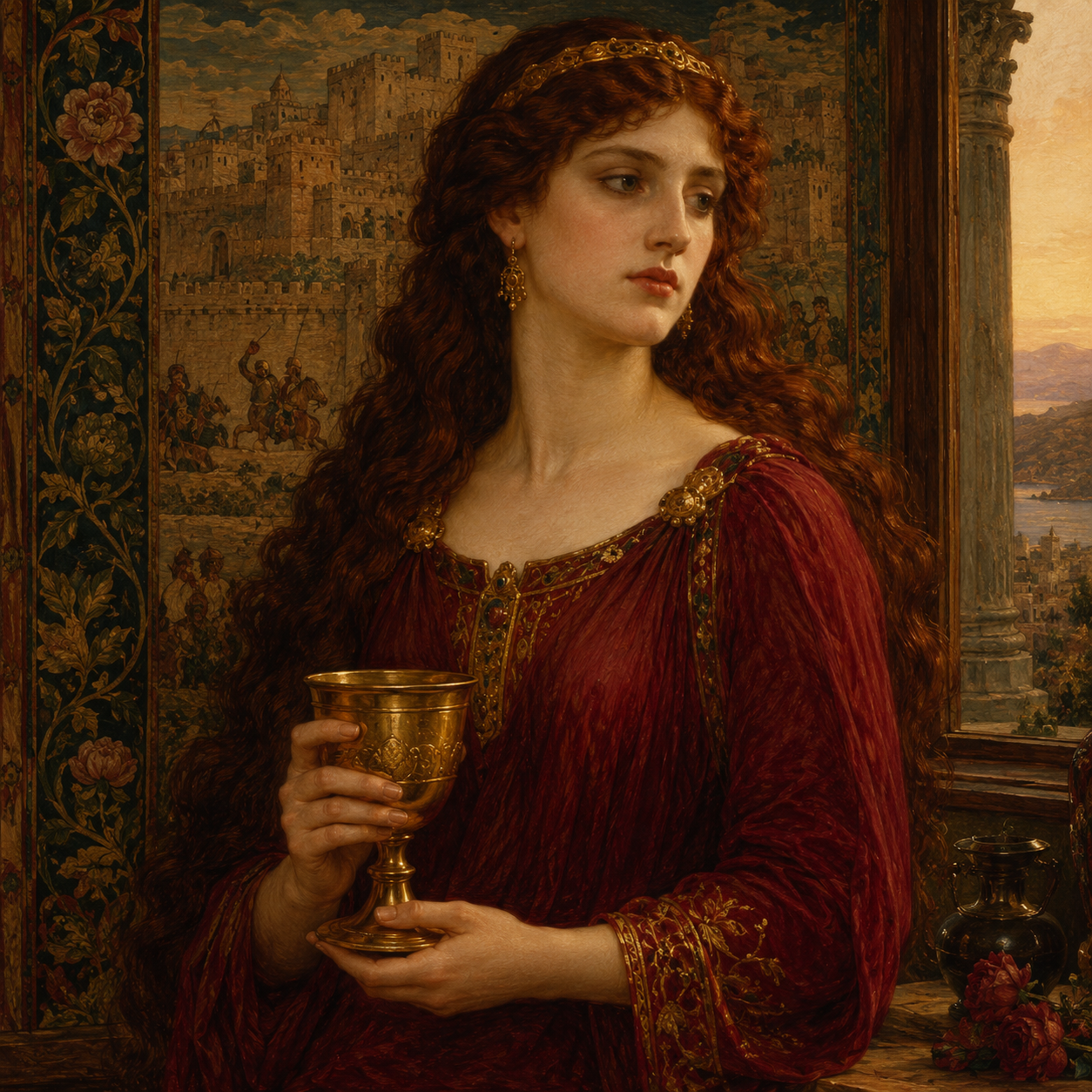
Helen, whose beauty shaped the fate of nations
Penelope: The Mind That Matches Odysseus
Penelope is often described as a faithful wife, and she is. But faithfulness is the least interesting thing about her. What makes Penelope remarkable is that she is, in Homer's own framing, the intellectual equal of the man the poem is named after. She is polytropos in her own way: resourceful, adaptive, always thinking several moves ahead of the people trying to control her.
For twenty years, Penelope manages the household of Ithaca while more than a hundred suitors occupy her home, eat her food, harass her servants, and pressure her to choose one of them as her new husband. She has no army. She has no divine patron stepping in to scatter them. She has her mind, and that is enough.
Her most famous stratagem is the shroud of Laertes. She tells the suitors she cannot remarry until she finishes weaving a funeral cloth for Odysseus's elderly father. Each day she weaves. Each night she unravels what she has woven. For three full years this deception holds, buying time that no warrior could have won with a sword. When a disloyal servant eventually reveals the trick, Penelope simply adapts. She finds new ways to stall, new reasons to delay, new tests to impose.
And then, at the poem's climax, she does something extraordinary. When the disguised Odysseus has slaughtered the suitors and revealed himself, Penelope does not rush into his arms. She tests him. She tells a servant to move their marriage bed, knowing full well that Odysseus built the bed around a living olive tree rooted in the earth. It cannot be moved. When Odysseus reacts with alarm and explains exactly how he built it, Penelope knows the man in front of her is real. It is the most elegant recognition scene in ancient literature: not tears, not a scar, but a shared secret that only two people in the world could know.
.png)
Penelope unravels her weaving by night, outwitting the suitors
Athena: The Goddess Behind Everything
If there is a single figure who controls the Odyssey's plot more than any other, it is not Odysseus. It is Athena. She is the one who opens the poem by petitioning Zeus to let Odysseus come home. She is the one who appears to Telemachus in Book 1, disguised as a family friend, and sends the boy on a journey that will turn him from an uncertain youth into a man capable of standing beside his father. She is the one who meets Odysseus on the shore of Ithaca and devises the plan to destroy the suitors. She is beside him in the final battle. And she brokers the peace that closes the poem.
Athena's affection for Odysseus is one of the most compelling relationships in the epic. She loves him because he thinks like she does. In one of their most memorable exchanges, she appears to him on Ithaca and they essentially admire each other's capacity for deception. She calls him the best of mortals at scheming, and he calls her the most relentless of the gods. It reads less like worship and more like professional respect between two strategists who recognize their equal.
But Athena is also doing something more subtle. She is shaping events so that Odysseus can reclaim his home through cunning rather than brute force. The disguise she gives him, the beggar's rags, the aged and stooped appearance, is not just protective. It is a narrative device. It allows Odysseus to see who in his household has remained loyal and who has betrayed him. Athena does not simply want Odysseus to win. She wants him to win in a way that is worthy of who he is. Intelligence, patience, and the precise application of violence at exactly the right moment.
Circe: Transformation and Knowledge
Circe is the goddess who lives on the island of Aeaea, and her first act in the poem is to turn Odysseus's advance party into pigs. It is a vivid, unsettling scene: the men drink her wine, she touches them with her wand, and they become animals. They retain their human minds, trapped inside pig bodies, weeping in the sty. It is the kind of image that lodges in your memory and refuses to leave.
But what happens after is more interesting than the transformation itself. Odysseus, protected by the herb moly (given to him by Hermes), resists her magic. When she realizes she cannot enchant him, something shifts. Circe does not rage or fight. She invites him to her bed and becomes his host, his lover, and eventually his most important advisor. For an entire year, Odysseus and his men stay on Aeaea, recovering from their losses, eating well, resting.
When Odysseus finally tells Circe he must leave, she does not try to keep him. Instead, she gives him the most crucial information in the entire poem. She tells him he must travel to the land of the dead and consult the prophet Tiresias. She tells him about the Sirens, about Scylla and Charybdis, about the cattle of the Sun. Without Circe's intelligence briefing, Odysseus would sail blind into every remaining danger.
Circe embodies a pattern that repeats across the poem: the women of the Odyssey are repositories of knowledge. They know things that men do not. They see patterns that warriors miss. And the men who listen to them survive, while the men who ignore them perish.
Recommended Reading
As an Amazon Associate, we earn from qualifying purchases.
Calypso: Love as a Beautiful Prison
Calypso is, in some ways, the most sympathetic of the Odyssey's divine women, and also the most tragic. She genuinely loves Odysseus. She does not trick him, transform him, or test him. She simply wants him to stay with her on the island of Ogygia, forever, as her husband. She offers him the one thing no mortal has ever been offered in earnest: immortality and eternal youth.
Odysseus says no. Not because Calypso is unkind, not because the island is unpleasant, but because eternity on Ogygia would mean never going home. And for Odysseus, a life without Ithaca, without Penelope, without the identity that comes from being embedded in a specific place among specific people, is not a life at all. It is merely existing, and existing is not the same as living.
When Hermes arrives to order her to release Odysseus, Calypso delivers one of the poem's most piercing speeches. She points out the hypocrisy of the gods: male deities take mortal lovers freely, but when a goddess dares to love a mortal man, the other gods destroy him or demand his release. Dawn loved Orion, and the gods had him killed. Demeter loved Iasion, and Zeus struck him with a thunderbolt. Calypso names this injustice plainly, and no one on Olympus refutes her. They simply enforce the rule anyway.
This speech elevates Calypso from a plot device to a voice of protest. She is not just an obstacle Odysseus must overcome. She is a person with legitimate grievances, trapped by a system that punishes her for the same desires it permits in male gods. Homer does not resolve her complaint. He lets it hang in the air, unanswered, which is perhaps the most honest thing he could do.
Nausicaa: Grace at the Shore
Nausicaa appears for only a brief stretch of the poem, but her scene is one of the most delicately handled in all of Homer. She is the teenage daughter of King Alcinous of the Phaeacians, and she encounters Odysseus at the lowest moment of his journey. He has just been shipwrecked again, battered by Poseidon's waves after leaving Calypso's island. He washes up on the Phaeacian shore naked, caked in brine, barely alive.
Nausicaa has come to the beach with her handmaidens to wash laundry. When the wild, salt-crusted stranger stumbles out of the bushes, the other girls scatter in terror. Nausicaa holds her ground. Her composure in this moment is extraordinary. She is young, she is unarmed, and the man in front of her looks more animal than human. But she speaks to him with dignity and he speaks to her with the careful, flattering eloquence that defines him. He compares her to a young palm tree he once saw on the island of Delos, and it is one of the most graceful compliments in the poem.
Nausicaa gives Odysseus clothing, food, and directions to her father's palace. She is shrewd enough to send him in separately so that no one will gossip about a young princess arriving with a strange man. It is a small, practical detail that reveals how carefully Homer draws his female characters. Nausicaa is not naive. She understands the social world she inhabits and navigates it with skill.
Without Nausicaa, Odysseus never reaches the Phaeacian court, never tells his story, and never gets the ship that finally carries him home to Ithaca. She is one of the quietest heroes in the poem, and one of the most essential.
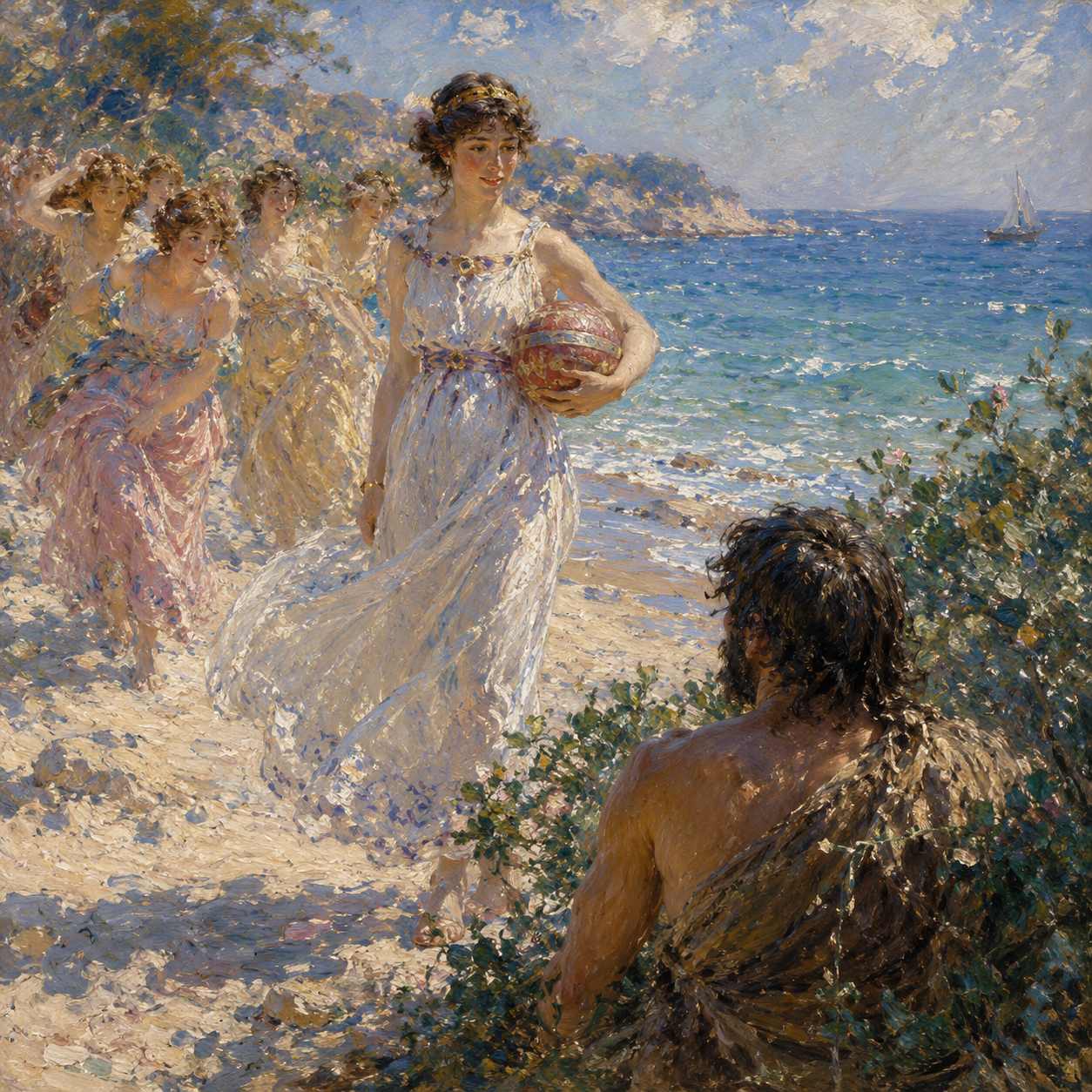
Nausicaa shows courage and composure before the shipwrecked stranger
Eurycleia: The Keeper of Memory
Eurycleia is the old nurse who raised Odysseus from infancy. She is a slave, which means the poem accords her no formal power whatsoever. And yet she may be the most quietly important mortal woman in the entire story after Penelope.
When the disguised Odysseus returns to his own palace as a beggar, Penelope orders Eurycleia to wash the stranger's feet, a standard act of hospitality. While washing him, Eurycleia touches the scar on his thigh, the scar he received as a young man during a boar hunt with his grandfather Autolycus. She knows that scar. She was the one who dressed the wound. She recognizes Odysseus instantly.
The scene is one of Homer's finest. Eurycleia nearly cries out, nearly drops his leg into the basin, and Odysseus grabs her by the throat and whispers fiercely: tell no one. She obeys. She holds his secret through everything that follows, through the tension of the suitor confrontation, through the stringing of the bow, through the slaughter itself. Her silence is an act of extraordinary loyalty and courage, because if the suitors had discovered the truth before Odysseus was ready, both of them would have been killed.
Eurycleia represents a category of character that the Odyssey takes seriously in a way the Iliad does not: the people who hold households together through daily, unglamorous labor. She nursed a baby, raised a prince, kept a home running for twenty years of war and chaos, and when the moment came, she proved herself as reliable under pressure as any warrior on the battlefield.
The Disloyal Maids: The Poem's Darkest Moment
No honest discussion of women in the Odyssey can avoid its most troubling episode. After the suitors are killed, Odysseus orders the execution of twelve female servants who had been sleeping with the suitors. Telemachus carries out the sentence. The maids are hanged in the courtyard.
Homer describes their death in a simile comparing them to birds caught in a net. It is a brief, cold passage, and it has haunted readers for centuries. Were these women traitors who chose the suitors' side? Were they slaves who had no choice in whose bed they shared? The poem does not ask this question, which is precisely what makes it so uncomfortable. Homer treats the execution as an act of household justice, but modern readers, and some ancient readers too, cannot help noticing that these women were the most powerless people in the palace. Their "disloyalty" may not have been a choice at all.
Writers from Margaret Atwood to Madeline Miller have returned to this moment again and again, drawn by the silence where an explanation should be. It is a testament to the Odyssey's complexity that the same poem giving us Penelope's brilliance and Calypso's protest also contains this unresolved act of violence against women who had no advocate and received no trial.
Recommended Reading
As an Amazon Associate, we earn from qualifying purchases.
The Pattern: Women as Thresholds
If you map the women of the Odyssey onto the plot, a pattern emerges. Every woman Odysseus encounters marks a threshold in his journey. Circe stands at the gate between the living world and the land of the dead. Calypso stands at the border between mortal life and immortality. The Sirens guard the passage between knowledge and destruction. Nausicaa stands at the entrance to the Phaeacian world that will carry him home. Penelope stands at the final threshold: the door to his own life, which he can only pass through by proving he is still the man who left.
Athena, meanwhile, stands outside the pattern entirely, orchestrating from above. She is not a threshold. She is the architect of the entire journey, the one who decides which doors will open and which will remain closed. When scholars call the Odyssey a poem about homecoming, they might just as accurately call it a poem about the women who determine whether homecoming is possible.
This is not a modern reading imposed on an ancient text. Homer himself draws these connections. Penelope and Circe are both described at looms, weaving. Calypso and Penelope both offer Odysseus a kind of marriage. Athena and Penelope both deal in disguise and deception. The echoes are deliberate. Homer wants you to see these women in relation to each other, as facets of a single question: what does it mean to hold power when the world does not recognize your right to hold it? (The role of women is one of more than a dozen major themes woven through the Odyssey.)
Modern Readings: Why the Women Endure
In recent decades, the women of the Odyssey have moved from the margins of classical scholarship to its center. Feminist readings of the poem have revealed how much of the story's meaning resides in its female characters, characters who were long treated as secondary to the hero's adventure. Novels like Madeline Miller's "Circe" reimagine the goddess as the protagonist of her own epic. Emily Wilson's landmark translation of the Odyssey, the first by a woman into English, pays careful attention to how earlier translations softened or obscured the poem's treatment of women.
What these modern engagements reveal is that the Odyssey was always, at its core, a poem deeply interested in gender. It asks who gets to speak and who is silenced. It asks who gets to choose and who must endure. It asks what loyalty means when power is unequal. It asks whether intelligence matters more than strength, and then it answers yes, repeatedly, through the actions of its women.
Three thousand years after its composition, the women of the Odyssey remain some of the most compelling characters in Western literature. Not because they are simple, but because they are not. Penelope is faithful and deceptive. Circe is dangerous and generous. Calypso is loving and possessive. Athena is protective and manipulative. Homer did not flatten his women into types. He gave them contradictions, which is the surest mark of a writer who understood that women, like men, are complex enough to contain more than one truth at a time.
Hear the Women Speak
In our full-cast narration, every woman in the Odyssey is given her own voice. Penelope's quiet authority. Circe's knowing power. Calypso's wounded eloquence. Athena's fierce precision. Nausicaa's steady grace. Eurycleia's trembling recognition. These are not background characters. They are the women who determine whether Odysseus lives or dies, whether he stays or goes, whether he remembers who he is or forgets entirely. Hear them for yourself, with every word highlighted as it is spoken, and discover why the Odyssey, for all that it bears a man's story in its title, belongs to its women as much as to its hero.
Explore the Women of the Odyssey
As an Amazon Associate, we earn from qualifying purchases.
Related Pages
Hear the Women of the Odyssey
Full-cast narration with 60+ character voices. Every word highlighted as it is spoken. Book I is free. Unlock all 24 books for $6.99.
Start Listening FreeContinue the Journey
Hear the complete Odyssey read aloud with 60+ character voices. Every word highlights as it is spoken.
Book I is completely free. No signup required.
Go Deeper Into the Odyssey Film
Get the free Odyssey Companion Guide: character map, timeline, family tree, and the essential scenes from Homer's poem and the film.
No spam. Unsubscribe anytime.
Women of the Odyssey
Penelope, Circe, and more across five product types. T-shirts, posters, mugs, canvas prints, and tote bags.
Browse All ProductsFEATURED DESIGNS