The Ancient Stage: Greek Tragedy and Comedy
The Odyssey's influence on Greek theater began almost as soon as theater itself. The great tragedians of fifth-century Athens, Aeschylus, Sophocles, and Euripides, all drew on Homeric material. Aeschylus wrote a trilogy about Odysseus's return, now lost. Sophocles composed Ajax, which dramatizes the aftermath of the Trojan War and Odysseus's role in the dispute over Achilles' armor. Euripides wrote Cyclops, the only complete satyr play to survive, which retells the Polyphemus episode from Book 9 with bawdy humor and a chorus of drunken satyrs.
What these early adaptations reveal is that the Greeks themselves did not treat Homer as sacred and untouchable. They reworked his stories freely, shifting perspectives, adding motivations, questioning the hero's morality. Euripides in particular was skeptical of Odysseus, portraying him in several plays as a cold manipulator rather than a clever survivor. The tradition of arguing with Homer, of loving the poem but challenging its assumptions, is as old as the poem itself.
Comedy, too, found rich material in the Odyssey. Aristophanes, the great Athenian comic playwright, peppered his works with Homeric references and parodies. The suitors feasting in Odysseus's hall, the monsters who eat his crew, the gods who bicker like a dysfunctional family; all of it lent itself to laughter as easily as to tragedy. Homer, it turns out, was funny from the beginning.
Virgil's Aeneid: The Roman Response
When the Roman poet Virgil sat down to write the Aeneid around 29 BCE, he was not merely imitating Homer. He was answering him. The Aeneid is structured as a deliberate mirror of both Homeric epics: its first six books parallel the Odyssey (a hero wandering the sea after Troy's fall), and its second six parallel the Iliad (a war fought over territory in a new land). Aeneas, Virgil's hero, is a Trojan rather than a Greek, and his journey takes him not home but to Italy, where he will found the civilization that becomes Rome.
Virgil's response to the Odyssey is complex and often critical. Where Odysseus is crafty and self-interested, Aeneas is dutiful and self-sacrificing. Where Odysseus fights to reclaim his personal past, Aeneas fights to build a collective future. Virgil even has Aeneas visit the underworld, as Odysseus does, but the Roman hero's encounter is grander, more structured, and more politically purposeful. It is as if Virgil is saying: your Greeks had their poem; now Rome has something greater.
Yet the Aeneid also reveals a deep anxiety about the cost of empire that Homer never quite confronts. Aeneas abandons Dido, the queen of Carthage, on divine orders, and her suicide haunts the poem. Virgil admired Homer, but he understood something Homer's heroes did not: that building a civilization requires sacrifices that cannot be redeemed by glory alone.
Dante's Inferno: Ulysses in the Eighth Circle
In Canto XXVI of the Inferno, Dante places Ulysses (the Latin name for Odysseus) in the eighth circle of Hell, punished among the fraudulent counselors. This is one of the most remarkable reinterpretations in all of literature. Dante did not read Greek and had no direct access to Homer's text. He knew the Odyssey only through Roman sources, primarily Virgil's Aeneid and Ovid's Metamorphoses. His Ulysses is, in many ways, a medieval invention.
Dante's Ulysses never made it home. Instead of returning to Penelope and Ithaca, he sailed past the Pillars of Hercules (the Strait of Gibraltar) into the unknown Atlantic, driven by an insatiable desire to know more, to see more, to go further than any man had gone. He urged his aging crew onward with a speech that Dante makes electrifying: "You were not made to live as brutes, but to follow virtue and knowledge." Then the sea swallowed them.
It is a stunning revision. Homer's Odysseus wants nothing more than to get home. Dante's Ulysses would rather die exploring than live at rest. Dante admires this restlessness, you can feel it in the poetry, but he also condemns it. The desire to transgress all limits, to know everything, to refuse the boundaries set by God or nature, is, for Dante, a form of pride. Ulysses is brilliant and damned. The medieval mind found in Homer's hero a warning against the very curiosity that makes him fascinating.
Recommended Reading
As an Amazon Associate, we earn from qualifying purchases.
Tennyson's "Ulysses": The Victorian Hero Refuses to Retire
Alfred, Lord Tennyson, wrote his dramatic monologue "Ulysses" in 1833, shortly after the death of his closest friend, Arthur Henry Hallam. The poem became one of the most famous in the English language, and it draws directly on Dante's version of the character rather than Homer's.
Tennyson's Ulysses has returned to Ithaca, but he is restless and dissatisfied. His kingdom bores him. Domestic life feels small after the adventures he has known. He hands the kingdom to Telemachus ("He works his work, I mine") and announces his intention to set sail again, to seek a newer world, to strive, to seek, to find, and not to yield.
"I am a part of all that I have met; yet all experience is an arch wherethrough gleams that untravelled world whose margin fades for ever and for ever when I move." Alfred, Lord Tennyson, "Ulysses"
The poem captures something the Victorian age valued above almost everything: the refusal to surrender, the determination to keep pushing forward regardless of age, loss, or diminished strength. It is a poem about aging with ferocity. But it is also, if you read it carefully, a poem about a man who cannot be present in his own life, who would rather chase horizons than sit with his wife and his son and his people. Tennyson gives us both readings and does not choose between them. That is what makes the poem last.
Joyce's Ulysses: The Epic of the Everyday
James Joyce's Ulysses, published in 1922, is the most audacious adaptation of the Odyssey ever attempted. Joyce took the grandest narrative in Western literature and mapped it onto the most ordinary day imaginable: June 16, 1904, in Dublin, Ireland. Leopold Bloom, a middle-aged advertising canvasser, wanders the city, eats a kidney for breakfast, attends a funeral, visits a pub, gets into an argument, and comes home to his wife, Molly. That is the plot. It takes 783 pages.
Each of the novel's eighteen episodes corresponds to an episode in the Odyssey. Bloom is Odysseus. Stephen Dedalus, the young artist, is Telemachus. Molly Bloom is Penelope. The Cyclops episode becomes a scene in a pub where a belligerent nationalist harasses Bloom. The Sirens become barmaids. Circe becomes the madam of a Dublin brothel. The parallels are simultaneously exact and absurd, and that is precisely the point.
Joyce's genius was to see that the Odyssey is not just a story about a hero fighting monsters. It is a story about a person trying to get through the day, trying to get home, trying to reconnect with the people who matter most. By stripping away the gods and monsters and leaving only the human core, Joyce revealed what had been true about Homer's poem all along: that it is, beneath the fantastic surface, a story about the difficulty and beauty of ordinary life. Bloom's journey through Dublin is heroic not because it involves danger but because it involves persistence, decency, and love in the face of a world that offers very little encouragement for any of these things.
Cinema: Kirk Douglas, the Hallmark Miniseries, and O Brother
The Odyssey arrived in cinema in 1954 with Ulisse, an Italian-American production starring Kirk Douglas as Odysseus and Silvana Mangano in the dual role of Penelope and Circe. The film compresses the poem's sprawling narrative into a manageable running time, focusing on the Cyclops episode, the Sirens, and the homecoming. It is a product of its era: bold, colorful, physically imposing, and not overly concerned with subtlety. Douglas brings a tough, American energy to Odysseus that is surprisingly effective, even if Homer might not have recognized it entirely.
The 1997 Hallmark television miniseries The Odyssey, starring Armand Assante, is the most faithful screen adaptation to date. It follows the poem's structure closely, covering the departure from Troy, each major adventure, and the long, violent reckoning in Ithaca. The production values are modest by today's standards, but Assante's performance captures something essential about Odysseus: his charisma, his cunning, and the weariness that accumulates over a decade of trying to get home. For many viewers, this remains the definitive filmed Odyssey.
Then there is O Brother, Where Art Thou? (2000), the Coen Brothers' film that transplants the Odyssey to Depression-era Mississippi. George Clooney plays Ulysses Everett McGill, a fast-talking escaped convict who needs to reach his home before his wife, Penny (Penelope), remarries. The film is a bluegrass musical, a social comedy, and a remarkably detailed Homeric parallel all at once. The Sirens appear as women washing clothes by a river. The Cyclops is a one-eyed Bible salesman named Big Dan Teague. A blind prophet on a railroad handcar plays the role of Teiresias. The Coens famously claimed they never actually read the Odyssey before making the film, which is almost certainly a joke, given the precision of the correspondences.
Recommended Reading
As an Amazon Associate, we earn from qualifying purchases.
The Penelopiad and Circe: Women Rewrite the Epic
For most of its history, the Odyssey has been told from the perspective of its male hero. The women of the poem, Penelope, Circe, Calypso, Nausicaa, even Athena, exist primarily in relation to Odysseus and his journey. In the twenty-first century, two novels changed that decisively.
Margaret Atwood's The Penelopiad (2005) retells the Odyssey from the perspective of Penelope, speaking from the underworld. Penelope narrates her side of the story: the twenty years of waiting, the suitors she had to manage, the strategies she devised to survive as a woman alone in a world of violent, entitled men. Interspersed with her narrative is a chorus of her twelve maids, the ones Odysseus hangs upon his return. In Homer, the hanging of the maids occupies a few brutal lines. In Atwood's version, it becomes the moral center of the book, an act of violence that cannot be excused by heroic convention.
Madeline Miller's Circe (2018) takes the goddess of Aeaea and gives her a full life story: her childhood among the Titans, her exile, her encounters with Odysseus, Daedalus, the Minotaur, and eventually Telemachus. Miller's Circe is not the enchantress of Homer's poem so much as a woman learning, over centuries, to claim her own power. The novel became a massive bestseller and introduced millions of readers to the Homeric world who might never have picked up a translation. It proved something that scholars have always known but publishers sometimes forget: that the ancient world is not a niche interest. It is the foundation of everything.
The Odyssey Film (2026): The IMAX Epic
The 2026 film represents the most ambitious cinematic treatment of the Odyssey ever attempted. The director, whose previous films include Interstellar, Dunkirk, and Oppenheimer, brings his signature commitment to practical effects, narrative complexity, and immersive visual storytelling to Homer's three-thousand-year-old poem. The film is being shot for IMAX, promising the kind of scale and sensory impact that the poem's most spectacular episodes, the Cyclops's cave, Scylla and Charybdis, the storm-tossed sea, have always deserved.
What makes the director a fascinating choice for this material is his longstanding interest in the themes the Odyssey explores: time, memory, identity, and the cost of survival. Interstellar is essentially an Odyssey in space, a father trying to get home to his children across an ocean of time. Dunkirk is a poem about the desperate need to reach home when the world is collapsing around you. Oppenheimer asks what it costs to be the cleverest person in the room. These are all Homeric questions, themes the filmmaker has been circling for his entire career.
The film's release makes this a remarkable moment for anyone who loves the Odyssey. Millions of people are now encountering Homer's story for the first time through the film. Some of them will want to go deeper. Some will want to hear the poem itself. And the best way to hear it is the way Homer intended: spoken aloud, in full voice, word by word.
What Every Adaptation Reveals
The history of Odyssey adaptations is, in a sense, a history of Western culture talking to itself. Each era finds in Homer's poem the thing it most needs to see. The Romans found a template for empire. The medieval world found a cautionary tale about the limits of human knowledge. The Victorians found a refusal to surrender. The modernists found the epic hidden inside the mundane. The twenty-first century found the voices that had been silenced: the women, the servants, the people left behind.
This is not a weakness of the poem. It is the poem's deepest strength. The Odyssey can be all of these things because it is, at its core, a story about the most fundamental human experiences. Leaving home. Wanting to return. Losing the people you love. Enduring what cannot be changed. Recognizing, after years of absence, what was there all along. These are not Greek concerns. They are human concerns, and they renew themselves with every generation.
Every adaptation is an act of translation, not from one language to another, but from one era's understanding of the human condition to another's. And the original poem survives all of them, unchanged and inexhaustible, ready for the next reader, the next viewer, the next listener who comes to it looking for something they cannot find anywhere else.
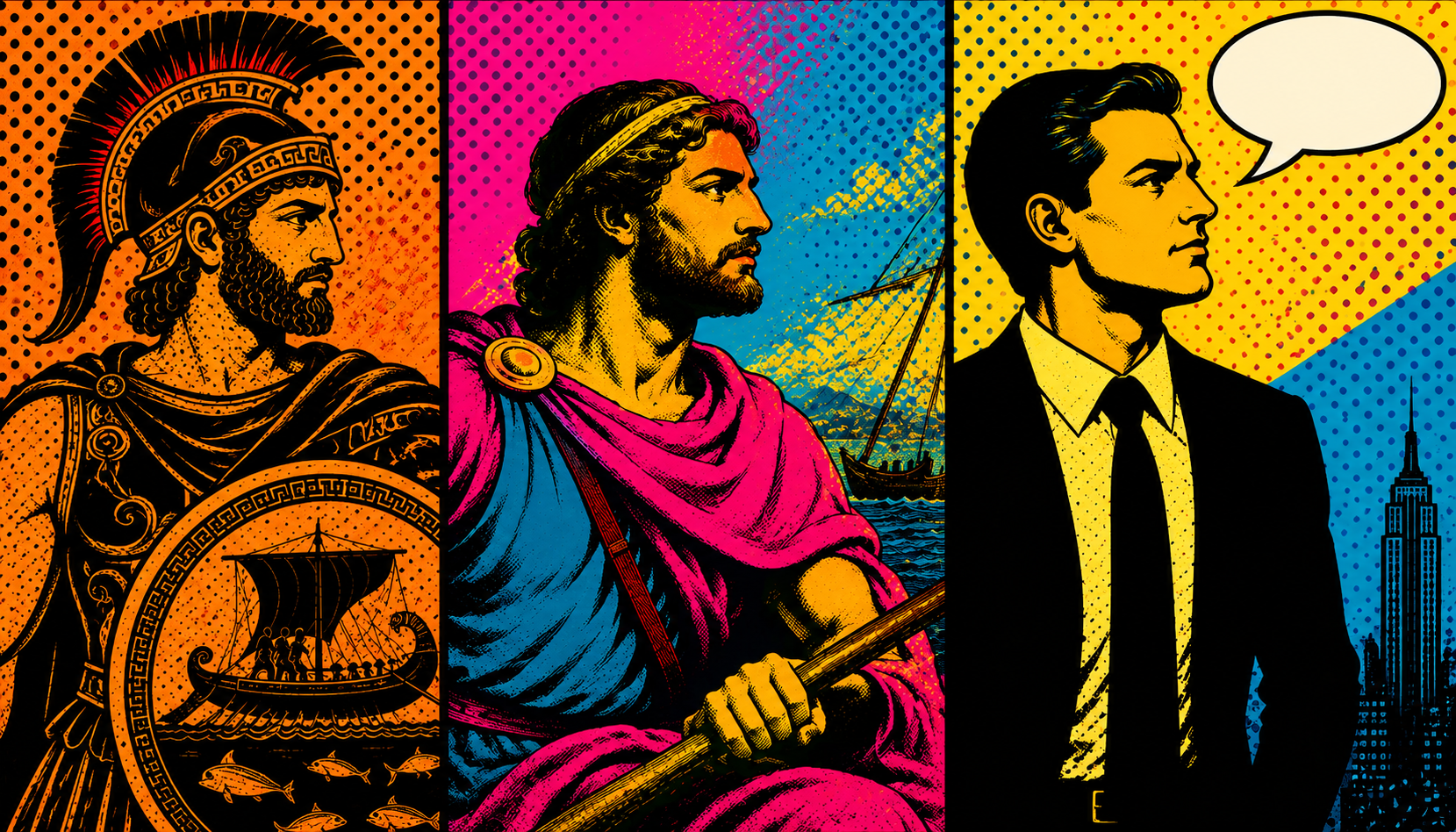
The Odyssey's influence echoes through centuries of art and storytelling
Experience the Odyssey
As an Amazon Associate, we earn from qualifying purchases.
Continue Reading
Seen the Film? Hear the Original
Every adaptation begins here. Full-cast narration with 60+ character voices, word-by-word highlighting. Book I is free. The complete Odyssey for $6.99.
Start Listening FreeContinue the Journey
Hear the complete Odyssey read aloud with 60+ character voices. Every word highlights as it is spoken.
Book I is completely free. No signup required.
Go Deeper Into the Odyssey Film
Get the free Odyssey Companion Guide: character map, timeline, family tree, and the essential scenes from Homer's poem and the film.
No spam. Unsubscribe anytime.
The Odyssey Collection
The original epic, wearable. T-shirts, posters, mugs, canvas prints, and tote bags.
Browse All ProductsFEATURED DESIGNS
SCENES & THEMES