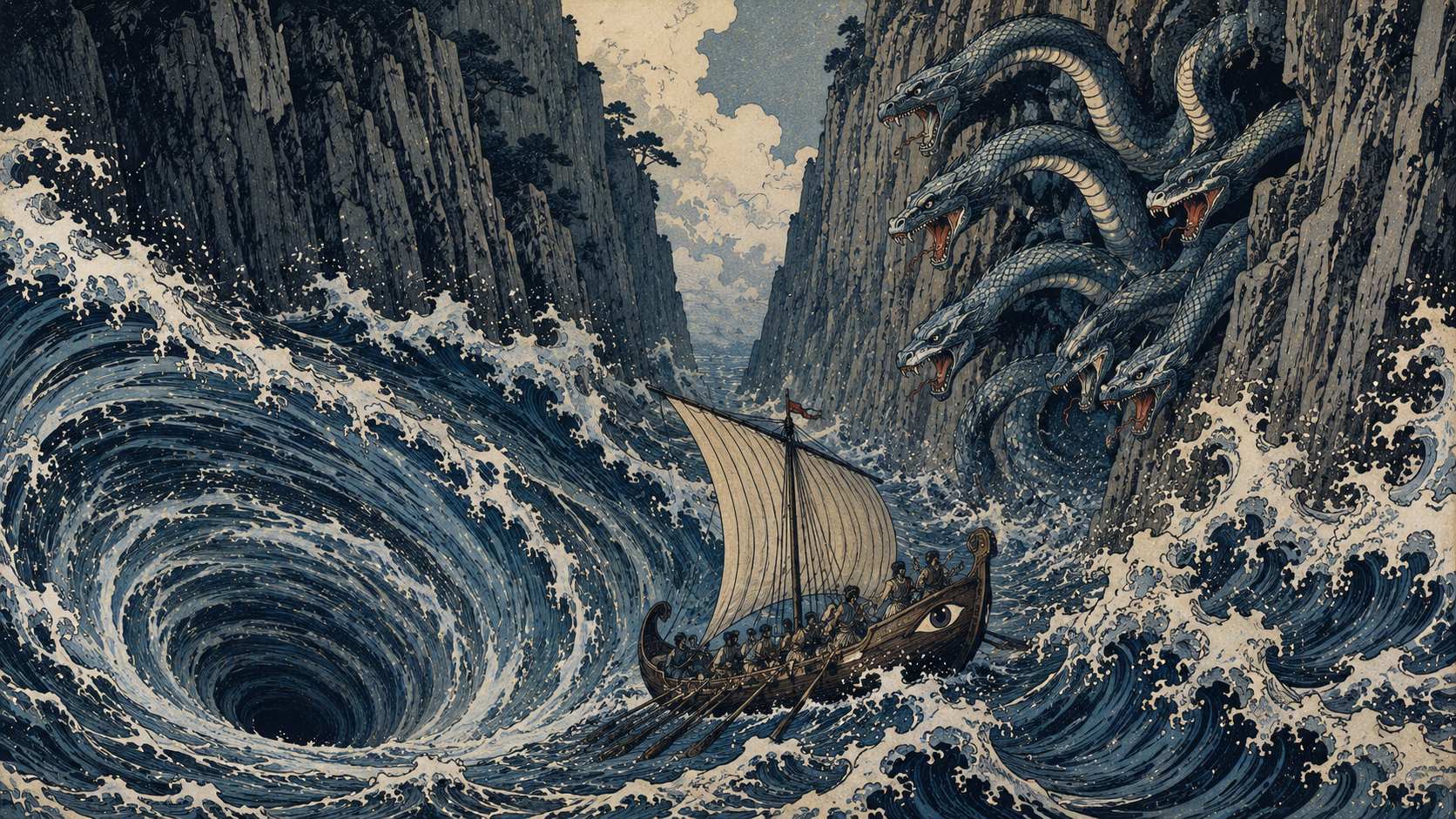
Circe's Warning: The Briefing Before the Strait
The Scylla and Charybdis episode does not happen without warning. In fact, it is one of the most heavily foreshadowed moments in the poem. Odysseus has spent a year on Circe's island, and before he leaves, the goddess sits him down and walks him through every danger that lies ahead. The Sirens. The Wandering Rocks. And then the strait.
Circe describes Scylla in terrifying detail. She lives in a cave high on a sheer cliff, so high that no mortal could climb to it. Her voice is like the yelping of a young puppy, which makes the description even more unsettling. She has twelve dangling legs, six long necks, and six heads, each with a triple row of teeth packed with death. She fishes for dolphins, seals, and larger creatures of the deep. And when a ship passes below, she reaches down with all six heads and snatches a man with each one.
"She has twelve mis-shapen feet, and six necks of the most prodigious length; and at the end of each neck she has a frightful head with three rows of teeth in each, all set very close together, so that they would crunch any one to death in a moment." Homer, The Odyssey, Book 12 (Samuel Butler translation)
On the other side, directly across the narrow strait, is Charybdis. Three times a day she sucks down the sea, and three times she vomits it back up. When she swallows, the water recedes to the bottom, exposing the sand and dark depths below. When she belches, it shoots up like a cauldron boiling over a great fire. Any ship caught in her pull goes straight down. Even Poseidon, Circe says, could not save you.
Then Circe delivers the instruction that Odysseus does not want to hear: sail close to Scylla. Yes, she will take six men. But the ship will survive. If you try Charybdis, you will lose everything.
Odysseus Asks the Wrong Question
Odysseus, being Odysseus, does not accept this. He asks Circe: can I fight Scylla? Can I put on my armor, take my spear, and stand on the deck ready to strike when she reaches down? It is a natural question from a man who defeated the Cyclops through cunning and force. Surely there is something he can do.
Circe's answer is blunt:
"You dare-devil, you are always wanting to fight something. Will you not give in even to the immortals? She is not mortal; moreover she is savage, extreme, rude, cruel and invincible. There is no help for it; your best chance will be to get past her as fast as ever you can, for if you waste time arming yourself by the rock, she may catch you with a second clutch of six more heads." Homer, The Odyssey, Book 12 (Samuel Butler translation)
This is a devastating moment for Odysseus, and for the reader. Throughout the Odyssey, Odysseus has always had a plan. The wine for the Cyclops. The beeswax for the Sirens. The moly herb for Circe's magic. He is the man of metis, cunning intelligence. There is always a trick, always an angle, always a way to outsmart the danger.
Not here. Against Scylla, there is no trick. She is immortal. She cannot be killed, wounded, or frightened. She cannot be bribed, drugged, or deceived. She will take her six, and the only question is whether Odysseus rows fast enough to prevent her from reaching down a second time. For a man whose entire identity is built on being smarter than the problem in front of him, this is the cruelest possible situation: a problem that has no clever solution.
The Passage Through the Strait
Odysseus does not tell his crew about Scylla. He follows Circe's orders about the Sirens (beeswax in the ears, tie him to the mast), and once they are past, he steers toward the strait. He puts on his armor despite Circe's warning. He stands on the prow with two spears, scanning the cliff for Scylla's cave. He cannot find it. The mist and the height make it impossible to see.
The crew sees Charybdis first, and they are terrified. The water is boiling, the spray reaches the tops of the cliffs on both sides, and the sea floor is visible when she sucks down. The men stop rowing. They huddle in the hull. Odysseus shouts at them to keep rowing, to look straight ahead, to ignore Charybdis. He does not mention Scylla. He knows that if they knew what was about to happen, they would freeze entirely.
"While we were taken up with this, and were expecting each moment to be our last, Scylla pounced down suddenly upon us and snatched up my six best men from the ship. I was looking at once after both ship and men, and in a moment I saw their hands and feet ever so high above me, struggling in the air as Scylla was carrying them off, and I heard them call out my name in one last despairing cry." Homer, The Odyssey, Book 12 (Samuel Butler translation)
This is one of the most haunting passages in the poem. Odysseus is watching from below as his men are lifted into the air. They are calling his name. They are reaching down toward the ship. And he cannot do anything. The man who outsmarted a giant, who resisted the Sirens, who survived the underworld, is standing on the deck watching his men die and he is helpless.
Homer adds one more detail that cuts deep:
"As a fisherman, sitting on some jutting rock, lets down his bait with its guard of horn to tempt the little fishes under him, throwing it into the water and then catches them, flings them gasping on to the land, so did Scylla land these panting creatures on her rock and munch them up at the mouth of her den, while they screamed and stretched out their hands to me in their mortal agony. This was the most sickening sight that I saw throughout all my voyages." Homer, The Odyssey, Book 12 (Samuel Butler translation)
That simile comparing his men to fish is one of Homer's most devastating. It reduces these warriors to prey. It reduces Scylla to a fisherman on a rock, casual and efficient. And it tells us that Odysseus, the greatest hero alive, is watching his men die the way a fish dies: gasping, helpless, and forgotten the moment it is over.
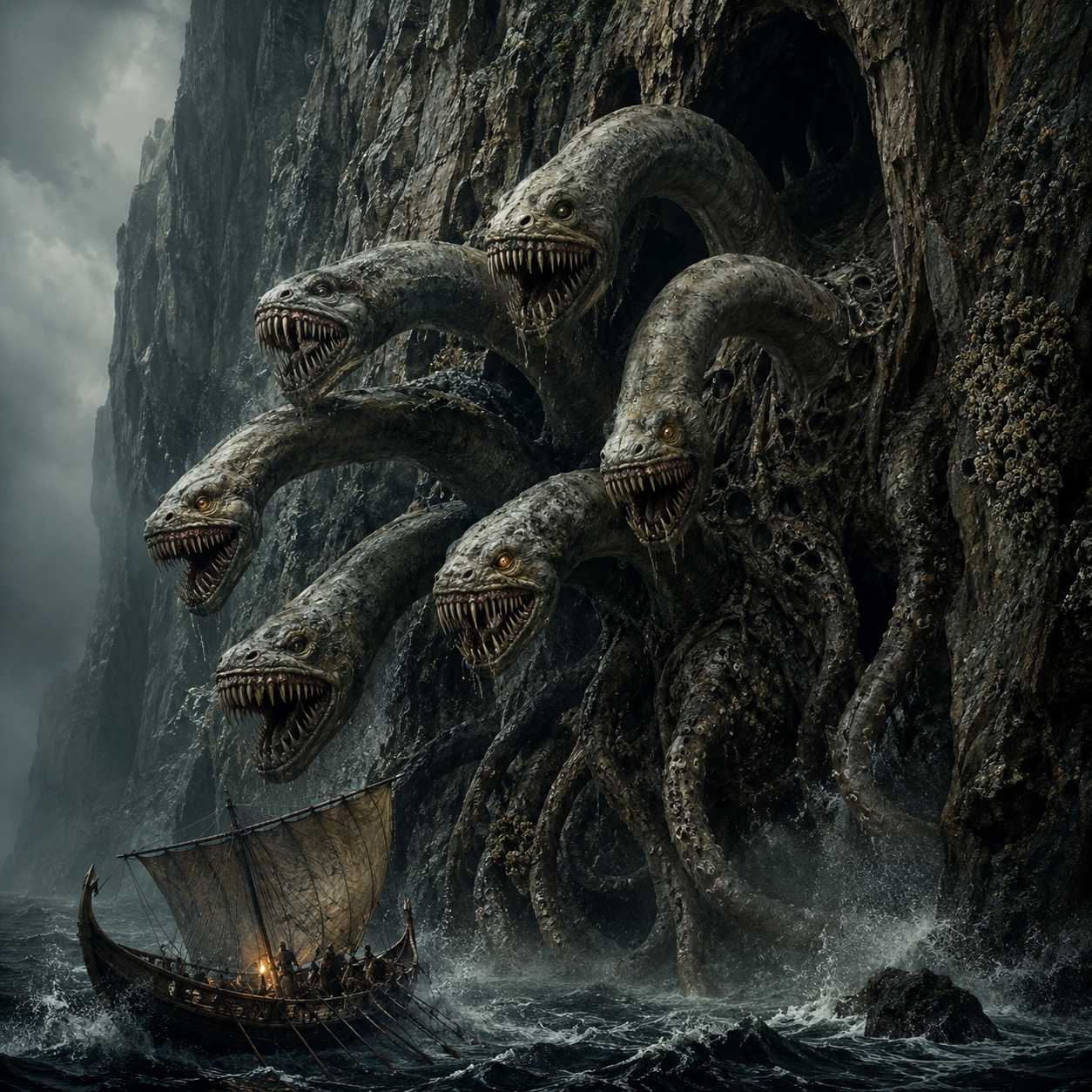
Six heads, twelve hands, and an appetite for sailors
Recommended Reading
As an Amazon Associate, we earn from qualifying purchases.
What Odysseus Does Not Tell His Crew
There is a moral problem at the center of this episode that Homer does not resolve, and that is part of what makes it great. Odysseus knew. He knew Scylla would take six men. Circe told him exactly what would happen. And he chose not to warn his crew.
Why? Because if the men knew, they would not row. They would drop their oars, grab weapons, and try to fight. Or they would refuse to enter the strait at all. Either way, the ship would slow down, linger in Scylla's range, and she would get twelve instead of six. Or they would drift toward Charybdis and everyone would die.
The calculation is sound. The decision is defensible. And it is still a decision to send six men to their deaths without telling them. Odysseus does not ask for volunteers. He does not draw lots. He does not give the men the choice to accept the risk or refuse it. He makes the call for them, and they die calling his name.
This is leadership as the Odyssey understands it: not the ability to make everyone happy, but the willingness to carry the weight of a decision that will haunt you. Odysseus says this is the worst thing he saw in all his voyages. Worse than the Cyclops eating his men. Worse than the Laestrygonians destroying his fleet. Because in those cases he was fighting. Here, he was choosing.
The Second Encounter: Odysseus Alone
The strait comes back. After the disastrous episode with the cattle of the Sun (where his remaining crew slaughters the sacred animals and Zeus destroys the ship in punishment), Odysseus is left alone on a piece of wreckage. The currents carry him right back to Charybdis.
This time, there is no crew to protect. There is no ship to steer. It is just Odysseus, clinging to a plank, drifting toward the whirlpool. As Charybdis sucks down the water, Odysseus reaches up and grabs the branches of a fig tree growing on the cliff above. He hangs there, arms aching, feet dangling, waiting for the whirlpool to spit out his wreckage. Homer compares him to a bat clinging to a rock.
Eventually Charybdis belches the water back up, and with it comes the mast and keel of his destroyed ship. Odysseus drops from the fig tree, lands on the debris, and paddles away using his hands as oars. Scylla, this time, does not see him. He drifts free, utterly alone, the last survivor of the twelve ships that left Troy.
The contrast between the two passages through the strait is everything. The first time, Odysseus is a captain making terrible calculations to save the greater number. The second time, he is a castaway using nothing but his bare hands and the will to survive. Both versions tell you something essential about who this man is: a leader when he has people to lead, and an endurer when everything else has been stripped away.
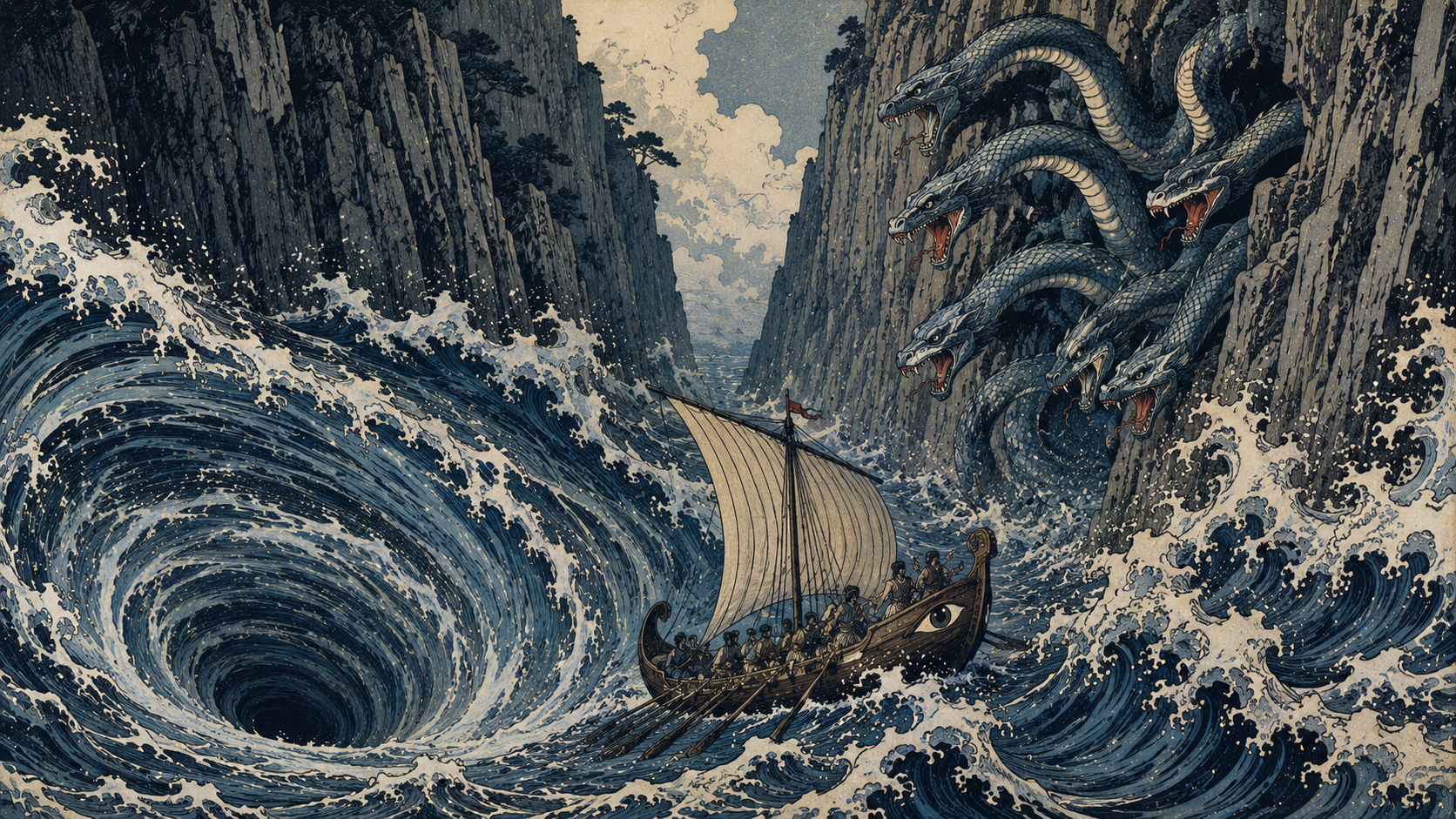
How a Scene Became a Saying
The phrase "between Scylla and Charybdis" has been in continuous use for thousands of years. Aristotle used it. Roman writers used it. Medieval scholars knew it. It entered English by the 16th century and has never left. It means exactly what it meant in Homer: a situation where both available options are dangerous and there is no safe middle ground.
The English equivalent is "between a rock and a hard place," which conveys the same idea but lacks the specificity. "Between Scylla and Charybdis" is not just about two bad options. It is about two different kinds of bad options. Scylla is a known, limited loss. You will lose six. Charybdis is a catastrophic, total loss. You might lose everyone. The phrase carries within it the painful calculation that Odysseus had to make: accept the certain smaller loss to avoid the possible total destruction.
That distinction is why the phrase survives. Every leader, every general, every executive, every parent has faced some version of this choice. Do you accept a guaranteed cost now to avoid a potentially larger one later? Do you sacrifice the few to save the many? The Odyssey does not tell you the right answer. It shows you what the choice looks like when it is happening, and it does not let you look away from the men being lifted into the air, screaming.
Recommended Reading
As an Amazon Associate, we earn from qualifying purchases.
Scylla and Charybdis in the Larger Poem
This episode sits in Book 12, near the end of Odysseus's account of his wanderings. By this point, he has already told the Phaeacians about the Lotus-Eaters, the Cyclops, the bag of winds, the Laestrygonians, Circe, the underworld, and the Sirens. The strait is the penultimate adventure before the cattle of the Sun and the final shipwreck.
Its placement matters. Homer puts Scylla and Charybdis at the moment when Odysseus has the fewest resources and the least room to maneuver. His fleet of twelve ships was destroyed by the Laestrygonians. He is down to one ship and one crew. Every loss from here forward is irreplaceable. The stakes have never been higher, and the danger has never been more inescapable.
It also marks a turning point in how the poem treats Odysseus. Before the strait, he is the clever hero who always finds a way. After the strait, he is increasingly helpless. The crew dies at the island of the Sun. The ship is destroyed by Zeus. Odysseus spends seven years trapped on Calypso's island. The man who threaded the needle between two monsters spends the next act of his life at the mercy of forces completely beyond his control. Scylla and Charybdis is the last moment where his decisions still matter, and even there, the best he can do is choose the shape of the loss.
What This Episode Teaches About the Poem's Themes
The cost of leadership. A leader does not always get to be the hero. Sometimes the best available outcome still involves people dying. Odysseus saves most of his crew by sacrificing six. He does it with full knowledge and without their consent. The poem does not celebrate this or condemn it. It simply shows you the weight.
The limits of cunning. The Odyssey is a poem about intelligence triumphing over brute force. But Scylla is the place where intelligence runs out. You cannot trick an immortal monster. You cannot negotiate with a whirlpool. Sometimes the world presents you with a situation that has no clever answer, only endurance.
The difference between courage and control. Odysseus is brave in the strait. He puts on his armor and stands on the prow. But his bravery accomplishes nothing. The armor does not protect his men. The spears are useless against a creature he cannot even see. Real courage, the poem suggests, is not standing with a weapon. It is making the terrible choice and living with it afterward.
Hear the Passage Read Aloud
The Scylla and Charybdis scene is one of the most visceral in the Odyssey. Our full-cast narration captures the crew's terror as Charybdis boils, the sudden violence of Scylla's attack, and the awful silence afterward. Every word highlighted as it is spoken, the way Homer meant it to be heard.
Explore the Odyssey
As an Amazon Associate, we earn from qualifying purchases.
Related Pages
Listen to the Strait of Scylla and Charybdis
Full-cast narration. Every word highlighted as it is spoken. Open Book 12 and hear the passage that gave the Western world its oldest metaphor for impossible choices.
Open Book 12Continue the Journey
Hear the complete Odyssey read aloud with 60+ character voices. Every word highlights as it is spoken.
Book I is completely free. No signup required.
Go Deeper Into the Odyssey Film
Get the free Odyssey Companion Guide: character map, timeline, family tree, and the essential scenes from Homer's poem and the film.
No spam. Unsubscribe anytime.
Monsters of the Deep
Odyssey merch across five product types. T-shirts, posters, mugs, canvas prints, and tote bags.
Browse All ProductsFEATURED DESIGNS
MORE ODYSSEY DESIGNS