The Island at the Edge of the World
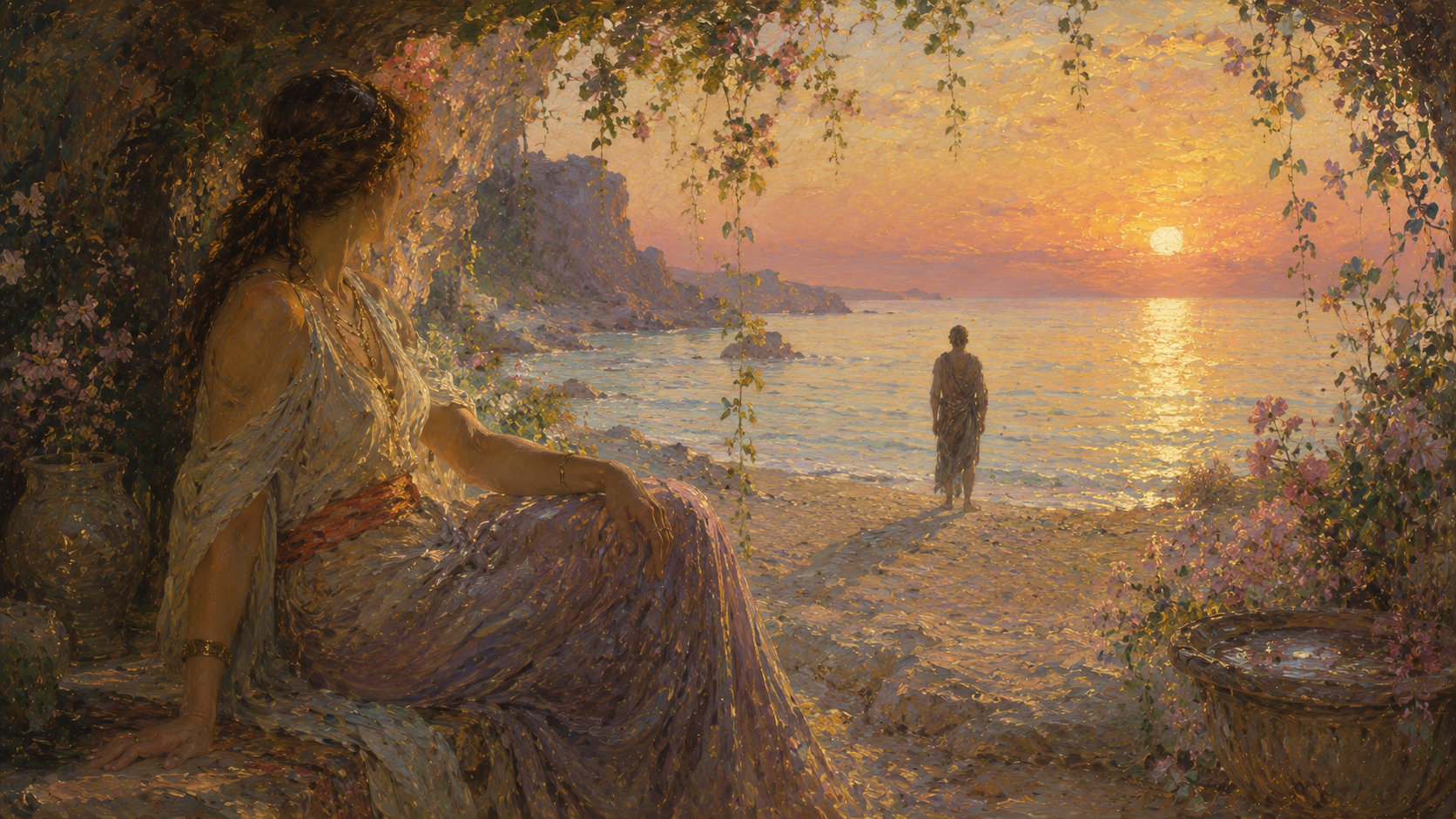
Ogygia is not a punishment. That is the first thing to understand. Homer describes it as a genuine paradise: thick forests of alder and poplar, meadows of violets and wild parsley, springs of clear water, grapevines heavy with fruit. Even Hermes, a god who has seen everything, stops and stares when he arrives. The island is beautiful in a way that makes you understand why someone could spend seven years there without realizing how much time had passed.
Calypso herself is described as a goddess of extraordinary beauty and power. She is a nymph, daughter of the Titan Atlas (who holds up the sky). She lives in a deep cave on the island, and Homer gives us a vivid picture of her at her loom, singing as she weaves with a golden shuttle. The domesticity is deliberate. In many ways, Calypso is offering Odysseus a mirror image of the life he left behind in Ithaca: a home, a partner, stability. The difference is that this version comes with immortality attached.
Odysseus arrives at Ogygia alone. His crew is gone. His ships are gone. After the disaster with the cattle of the Sun god, Zeus destroyed his last ship with a thunderbolt, and the sea carried him to Calypso's shore. He has nothing. He is at his absolute lowest point. And into that emptiness steps a goddess who says: stay with me. You never have to struggle again. You never have to grow old. You never have to die.
Seven Years of Captivity (or Is It?)
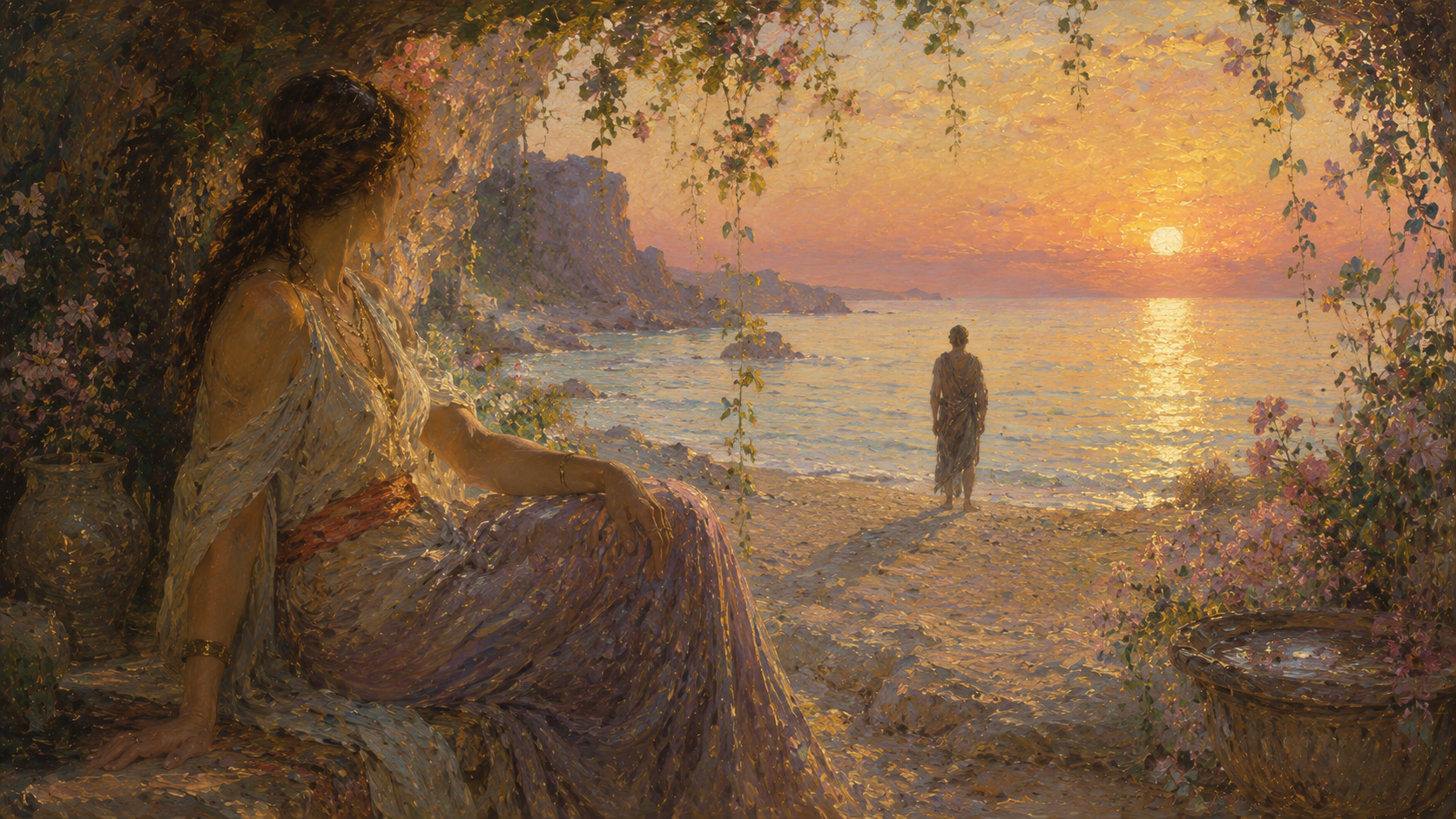
The poem is deliberately ambiguous about the nature of Odysseus's time on Ogygia, and that ambiguity is part of what makes the episode so interesting. Calypso is not locking him in a dungeon. He is not chained to the rocks. Homer tells us that Odysseus shares her bed at night, that she feeds him ambrosia and nectar, that the island provides everything he could need. By any external measure, his life on Ogygia is comfortable, even luxurious.
But Homer also tells us that Odysseus spends his days weeping on the shore. He has clearly told Calypso he wants to leave, and she has refused. So he is a prisoner, but a prisoner in a gilded cage. The question the poem asks is: does the comfort of the cage matter if you cannot leave?
The answer, for Odysseus, is no. And that answer is the heart of the entire Odyssey. Calypso can give him everything except the thing he actually wants: his own life, his own home, his own people. She can offer him a perfect existence, but it is her existence, on her island, by her rules. Odysseus has no agency on Ogygia. He has no identity. He is Calypso's consort, and nothing more. For a man whose defining trait is his cunning, his ability to shape his own fate, this is a kind of death even worse than the literal one Calypso is offering to save him from.
The Offer of Immortality
Calypso's offer is staggering when you think about it clearly. She is not just offering Odysseus a long life. She is offering him eternal life and eternal youth. No aging. No death. No loss. In a world where heroes die young and violently (Achilles, Patroclus, Ajax, Hector), where even the greatest warriors end up as shades in the underworld, Calypso is offering Odysseus an escape from the fundamental condition of being human.
And he says no.
When Calypso, after receiving Zeus's order to release him, confronts Odysseus about his choice, she makes it personal. She asks him directly: is Penelope really more beautiful than a goddess? And Odysseus gives one of the most honest answers in the poem. He says no, Penelope is not more beautiful. Calypso surpasses her in every physical way. A mortal woman cannot compete with a goddess. But he wants to go home anyway. He wants Penelope anyway. He wants his life anyway.
"Nevertheless I long, I pine, all my days, to travel home and see the dawn of my return. And if a god will wreck me yet again on the wine-dark sea, I can bear that too, with a spirit tempered to endure." Homer, The Odyssey, Book 5 (Samuel Butler translation, 1900)
This speech is the mission statement of the entire poem. Odysseus is choosing suffering over comfort, mortality over immortality, the messy and painful reality of human life over a perfect but empty eternity. He is saying that a life without struggle, without homecoming, without the people who know you, is not really a life at all. It is just existence. And existence, no matter how pleasant, is not enough.
Recommended Reading
As an Amazon Associate, we earn from qualifying purchases.
Calypso's Protest: The Gods' Double Standard
When Hermes arrives on Ogygia to deliver Zeus's command that Calypso must release Odysseus, she does not accept the order quietly. She delivers one of the sharpest, most pointed speeches in the entire poem, and it has nothing to do with Odysseus. It is about the gods themselves.
Calypso's argument is simple and devastating: male gods take mortal lovers all the time, and no one stops them. Zeus himself has fathered children with dozens of mortal women. But when a goddess loves a mortal man, the other gods cannot tolerate it. She gives specific examples. When rosy-fingered Dawn fell in love with the hunter Orion, the gods had Artemis kill him with her arrows. When the goddess Demeter loved the mortal Iasion, Zeus struck him dead with a thunderbolt. The pattern is clear. Gods can love mortals. Goddesses cannot.
This is a remarkable moment in a poem composed nearly three thousand years ago. Calypso is calling out a structural inequality in the divine order. She is not wrong. The rules genuinely are different for male and female deities in Greek mythology. Zeus's affairs are legendary; Hera punishes the women, never Zeus. But when a goddess exercises the same freedom, the punishment falls on the mortal man, and the goddess is forced to comply.
Homer does not resolve this complaint. Calypso makes her case, Hermes shrugs it off (essentially saying "I am just the messenger"), and the order stands. But by giving Calypso this speech, Homer ensures that she is not just an obstacle in Odysseus's path. She is a character with her own perspective, her own grievance, and her own kind of injustice to endure. She is trapped too, in her own way. Trapped by rules she did not make and cannot change. Calypso's protest is one of the reasons she stands out among the women who shape the Odyssey.
Letting Go: Calypso Helps Him Leave
What happens after Zeus's order arrives is quietly remarkable. Calypso does not simply push Odysseus into the water and wish him luck. She helps him. She provides tools and timber so he can build a raft. She gives him provisions for the journey: bread, wine, water. She sends a favorable wind. She even gives him navigational instructions, telling him to keep certain constellations on his left as he sails.
This generosity complicates her. If Calypso were simply a villain, a captor, a monster like the Cyclops or Scylla, the story would be simpler. But she is not. She genuinely loves Odysseus. She does not want him to leave. And yet when the order comes, she not only lets him go but actively helps him survive the journey. That is not the behavior of a captor. It is the behavior of someone who loves another person more than she loves having them.
Odysseus, for his part, does not fully trust her. When she tells him he is free to go, he is suspicious. He makes her swear an oath that she is not planning some new trick. It is a very Odysseus reaction: cautious, calculating, unwilling to take anything at face value. Calypso laughs at his suspicion, which is itself a touching moment. She knows him well enough by now to find his wariness amusing rather than insulting.
Their last night together, Homer tells us, is spent willingly on both sides. It is a farewell. Not a joyful one, but not a bitter one either. In the morning, Calypso dresses Odysseus in fine clothes, and he sails away from the only person who wanted to give him everything, resuming the long sea journey toward the wife who represents something Calypso could never offer: a shared history, a shared home, a shared mortality.
Calypso vs. Circe: Two Goddesses, Two Relationships
Readers often pair Calypso with Circe, the other divine woman who keeps Odysseus on her island, and the comparison is instructive. Circe is dangerous at first (she turns his men into pigs) but becomes an ally. She is practical, informative, and ultimately willing to let him go without drama. Their relationship is more like a partnership: Circe gives Odysseus critical information about the dangers ahead, and when the time comes to leave, she sends him on his way without protest.
Calypso is the opposite in almost every way. She is not dangerous, she is loving. She does not transform anyone, she nurtures. But she will not let go. Where Circe respects Odysseus's autonomy, Calypso cannot accept it. The contrast suggests that love, when it becomes possessive, can be a more effective prison than any magic spell.
Together, the two episodes frame a question that runs through the entire poem: what does it mean to be free? Circe tests Odysseus's physical courage (can you resist my magic?) and his leadership (can you save your men?). Calypso tests something deeper: can you choose a harder life over an easier one, simply because the harder one is yours?
Recommended Reading
As an Amazon Associate, we earn from qualifying purchases.
What Calypso Reveals About Odysseus
Every stop on Odysseus's journey reveals a different aspect of his character. The Cyclops reveals his cunning and his dangerous pride. The Sirens reveal his hunger for knowledge. Calypso reveals his values at the deepest level.
By refusing immortality, Odysseus is telling us what he believes matters most: not glory (he already has that), not pleasure (Calypso offers that in abundance), not safety (the sea is full of dangers). What matters most is belonging. Having a place in the world that is truly yours. Being known by the people who knew you before you became famous. Being a husband to the woman who waited twenty years. Being a father to the son who grew up without him. Being a king to the people who need him.
This is what separates the Odyssey from the Iliad. The Iliad is about glory and the willingness to die for it. Achilles chooses a short, glorious life over a long, ordinary one. The Odyssey inverts that completely. Odysseus chooses the ordinary life. He chooses aging and death and all the limitations of being human, because those limitations come attached to everything that makes life worth living.
Calypso, whose name comes from the Greek word kalyptein, meaning "to conceal" or "to hide," is the poem's great temptation. She offers to hide Odysseus from death, from time, from the consequences of being mortal. And Odysseus, after seven years of that hiding, chooses to be found instead.
Hear the Moment Odysseus Leaves Ogygia
Our full-cast narration brings Book 5 to life: Hermes arriving at the cave, Calypso's furious speech about the gods' hypocrisy, the quiet farewell, and the moment Odysseus pushes his raft into the waves and sails toward home. Every word highlighted as it is spoken. This is the turning point of the entire poem, the moment Odysseus stops waiting and starts moving. It deserves to be heard, not just read.
Explore the Odyssey
As an Amazon Associate, we earn from qualifying purchases.
Related Pages
Hear Odysseus Leave Paradise Behind
Full-cast narration. Every word highlighted as it is spoken. Start with Book 5 and hear Odysseus push off from Ogygia toward home.
Open Book 5The Odyssey Collection
From Calypso's island to Ithaca. T-shirts, posters, mugs, canvas prints, and tote bags featuring scenes from the Odyssey.
Shop This DesignHear this character's story in Homer's own words
Go Deeper Into the Odyssey Film
Get the free Odyssey Companion Guide: character map, timeline, family tree, and the essential scenes from Homer's poem and the film.
No spam. Unsubscribe anytime.