The Origin of the Grudge: A Father's Rage
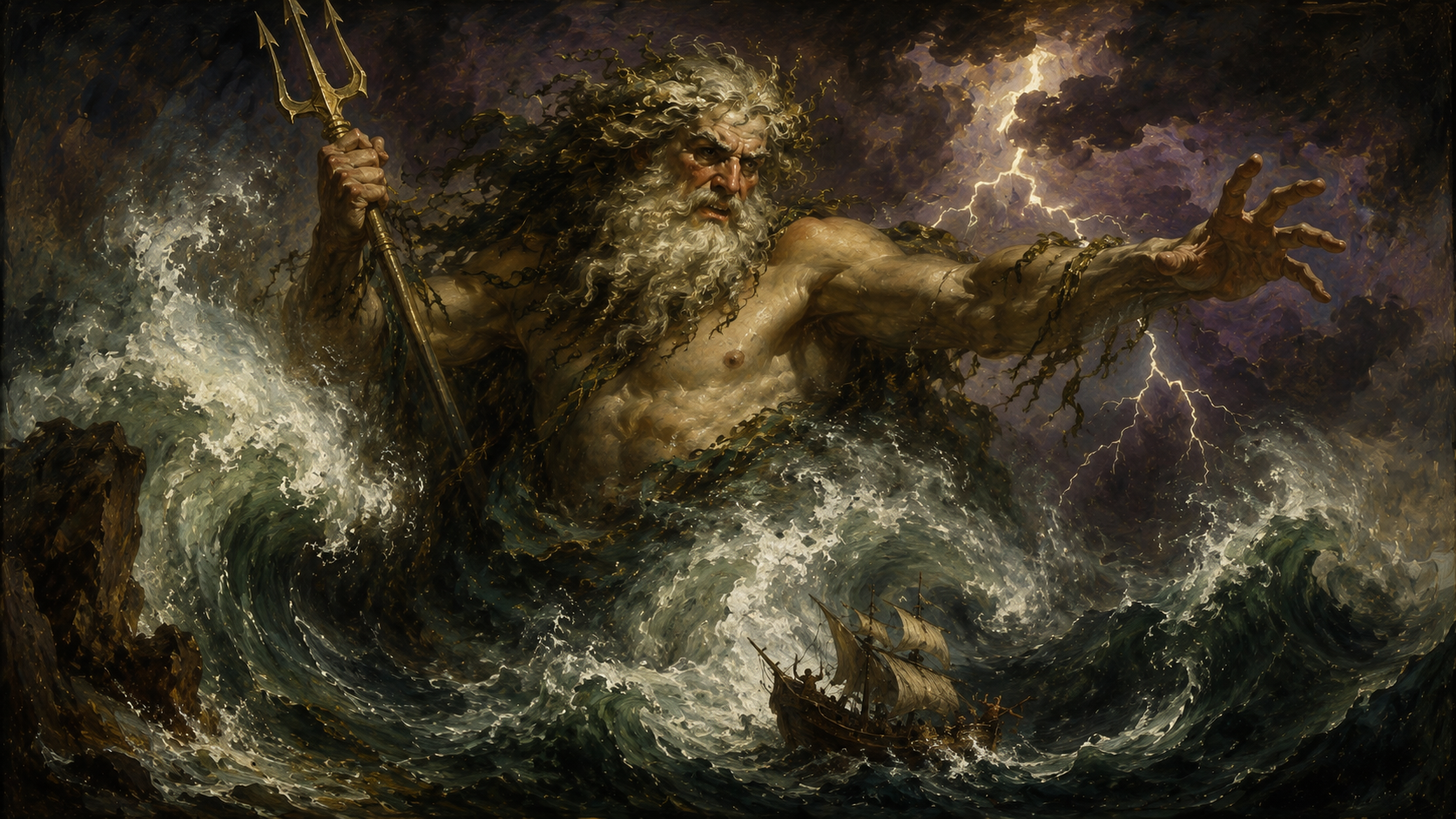
Poseidon's hatred of Odysseus has a single, specific cause. In Book 9, Odysseus and twelve of his men entered the cave of Polyphemus, a Cyclops who happened to be a son of Poseidon. The giant sealed the cave, ate six of Odysseus's men, and would have eaten the rest. To survive, Odysseus blinded Polyphemus by driving a sharpened, fire-hardened stake into his single eye while the giant slept.
The blinding was an act of survival. No reasonable person could fault Odysseus for it. But Poseidon is not a reasonable person. He is a god and a father, and his son is screaming on a beach with his eye burned out. Reason has nothing to do with it. This is the essential quality of Poseidon's anger in the Odyssey: it does not care about context. It does not weigh justification. A father's child was harmed, and the person who did it will pay.
What makes the situation worse, what turns a survivable grudge into a decade of torment, is Odysseus's own pride. After blinding Polyphemus and escaping from the cave by clinging to the undersides of the giant's sheep, Odysseus was safely away. His men begged him to stay quiet. Instead, he shouted back across the water and told Polyphemus his real name: "I am Odysseus, sacker of cities, son of Laertes, whose home is in Ithaca." That boast gave Polyphemus the information he needed to aim his prayer.
"Hear me, Poseidon, blue-maned god who rocks the earth. If I am truly yours, and you are truly my father, grant that Odysseus, sacker of cities, son of Laertes, whose home is in Ithaca, may never reach that home." Homer, The Odyssey, Book 9
Poseidon heard the prayer. And from that moment, the sea became hostile. Not randomly hostile, the way oceans are for all sailors, but personally, deliberately, intelligently hostile. The storms that hit Odysseus are not accidents. They are aimed.
The Convenient Absence: Why Poseidon Is Away When the Story Opens
The very first book of the Odyssey establishes something crucial. When the gods gather on Olympus to discuss Odysseus's fate, Poseidon is not there. He is visiting the Ethiopians at the eastern and western edges of the world, receiving a grand sacrifice in his honor. Homer tells us this detail with what seems like casual precision, but it is anything but casual. The entire plot depends on it.
With Poseidon away, Athena can advocate for Odysseus without opposition. She argues that he has suffered enough and deserves to come home. Zeus agrees. He sends Hermes to Calypso with the order to release Odysseus. Athena goes to Ithaca to set Telemachus in motion. The wheels begin turning. All of this happens in the narrow window while Poseidon is occupied elsewhere.
Homer is doing something sophisticated here. He is showing us how divine politics work. The gods do not form a unified front. They have their own interests, their own grudges, their own alliances. Zeus respects Poseidon's anger, and under normal circumstances he would not override it so bluntly. But with Poseidon absent, Zeus can respond to Athena's plea without directly confronting his brother. It is a diplomatic maneuver among immortals, and it tells us that even the king of the gods prefers to avoid conflict within his own family when he can.
The moment Poseidon returns and discovers what has happened, the consequences are immediate. He spots Odysseus on a raft in the open sea, heading toward the Phaeacian coast, and he is furious.
The Storm off Phaeacia: Poseidon Strikes
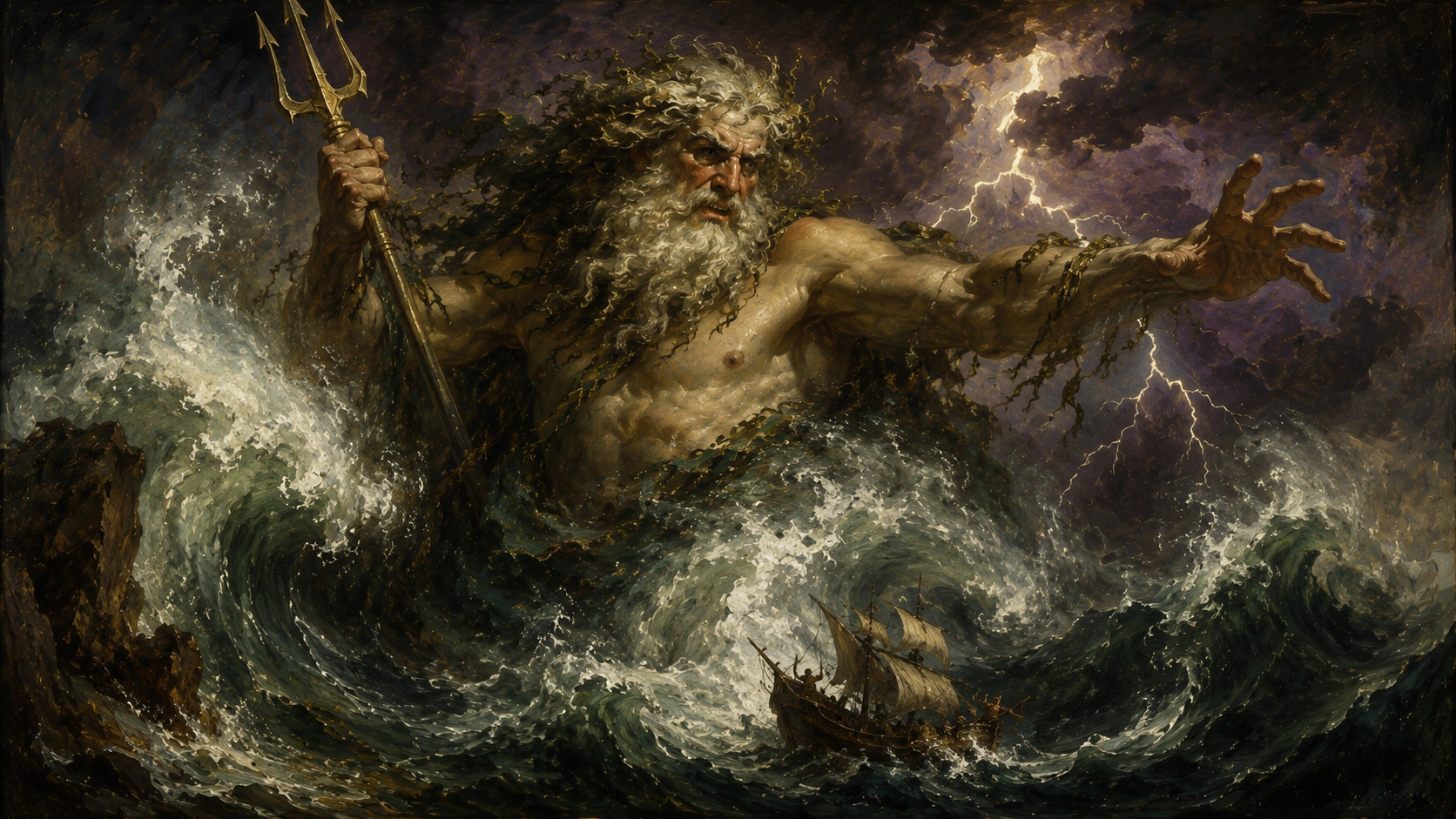
Book 5 contains the most vivid depiction of Poseidon's power in the entire poem. Odysseus is sailing on the raft that Calypso helped him build, seventeen days out, within sight of the Phaeacian coast. He can see land. He is almost safe. And then Poseidon returns from Ethiopia, looks down at the sea, and sees the man he hates most in the world floating on a pile of logs.
"So, the gods have changed their minds about Odysseus while I was among the Ethiopians. And there he is, close to the land of the Phaeacians, where it is fated that he shall escape the great net of sorrow. But I think I can still give him a good fill of trouble." Homer, The Odyssey, Book 5
Poseidon gathers the clouds. He stirs the sea with his trident. He sends winds from every direction at once, east and south and west and the cold north. The waves rise like mountains. The raft breaks apart. Odysseus is thrown into the water, dragged under by the weight of the clothing Calypso gave him, tossed and battered until he can barely breathe. Homer compares him to a clump of dry thistle blown across a field by the autumn wind, touching nothing, belonging nowhere, completely at the mercy of forces beyond his control.
What saves Odysseus is a sea nymph named Ino, who gives him a magical veil to wrap around his chest. With it, he cannot drown. But Poseidon's storm destroys everything else. The raft is gone. The supplies are gone. The gifts are gone. Odysseus swims for two days and two nights before reaching the Phaeacian coast, where the surf nearly kills him against the rocks. He grabs a boulder, is pulled away by the backwash, grabs again, loses skin from his hands, and finally finds a river mouth where he can crawl ashore.
He arrives at Phaeacia naked, caked in brine, barely alive. He has nothing. And that is exactly how Poseidon wants him to arrive everywhere: stripped of dignity, stripped of possessions, stripped of everything except the stubborn will to keep going.
Recommended Reading
As an Amazon Associate, we earn from qualifying purchases.
The Sea as Character: Poseidon's Domain
One of the striking things about Poseidon's role in the Odyssey is how little he needs to appear in person. He wrecks the raft in Book 5. He is mentioned in prayers and curses throughout. But for most of the poem, the sea itself does his work. Every storm, every shipwreck, every near-drowning carries his signature. The Mediterranean in the Odyssey is not a neutral space. It is Poseidon's territory, and Odysseus is trespassing. (For a full account of every stop on that voyage through Poseidon's domain, see The Sea Journey.)
This is what makes the Odyssey fundamentally different from the Iliad. The Iliad takes place on land, at Troy, where the battlefield is a fixed stage. The Odyssey takes place on water, where nothing is fixed. The sea has no roads, no landmarks, no walls. You cannot dig in and hold a position. You cannot plant your feet and fight. You are always moving, always vulnerable, always subject to forces you cannot see or predict. That is Poseidon's nature made physical. He represents everything about the world that is indifferent to human plans, and his conflict with Athena is one of the major themes woven through the poem.
Homer understood the sea in a way that only people who depend on it can. The ancient Greeks were a maritime civilization. They traded by sea, colonized by sea, fought by sea. The ocean was the source of their wealth and the most common cause of their deaths. Poseidon was not an abstract concept to Homer's audience. He was the power that decided whether you came home from a trading voyage or vanished without a trace. When the Odyssey describes a storm, it is not reaching for metaphor. It is describing something the audience knew in their bones.
Poseidon and Zeus: The Limits of Divine Anger
One of the most important dynamics in the Odyssey is the tension between Poseidon's anger and Zeus's will. Poseidon wants Odysseus to suffer. Zeus has agreed that Odysseus will go home. Both things are true at the same time, and the poem's plot lives in the gap between them.
Poseidon cannot kill Odysseus. Fate, which even the gods must respect in Homer's world, has decreed that Odysseus will return to Ithaca. Poseidon knows this. He says so himself in Book 5. His goal is not destruction but prolonged misery: the journey home stretched out over years, every arrival accompanied by loss, every safe harbor reached only after near-fatal struggle. Poseidon wants Odysseus to get home, eventually, as a broken man.
Zeus, for his part, does not override Poseidon out of any great love for Odysseus. He acts because Athena asks him to, and because it is time. The poem opens in the twentieth year of Odysseus's absence. Zeus has let Poseidon have his satisfaction for a decade. Now the balance tips. But Zeus does not force the issue. He waits until Poseidon is away, sends his message to Calypso through Hermes, and lets events unfold. It is a carefully managed de-escalation between two enormously powerful brothers who both know the rules but disagree about the timing.
There is a political lesson buried here, one that Homer's aristocratic audiences would have recognized. Power does not mean getting everything you want. Even among the gods, there are compromises, negotiations, face-saving maneuvers. Poseidon does not lose. He gets to punish the Phaeacians for helping Odysseus by turning their ship to stone as it returns to harbor. Zeus allows this. Everyone comes away with something. The only one who pays the full price is Odysseus himself.
Poseidon and Athena: Opposing Forces
If Poseidon is the Odyssey's antagonist, Athena is its guardian angel. Their opposition gives the poem its divine architecture. Poseidon sends storms; Athena calms them or steers Odysseus to safety. Poseidon wants to break Odysseus's spirit; Athena appears at every crisis to restore his courage and sharpen his thinking. They are not evenly matched, since Poseidon is older and arguably more powerful, but they are pulling in opposite directions throughout.
What makes this opposition interesting is that both gods have legitimate grievances, or at least legitimate interests. Poseidon is a wronged father. His son was blinded. His anger is understandable, even sympathetic. Athena admires Odysseus because he is clever, resourceful, and enduring, qualities she shares. She is not acting out of charity. She protects Odysseus because she sees herself in him. Their relationship is one of the warmest in all of Greek literature: the goddess of wisdom and the mortal who uses his wits to survive.
The poem does not ask us to choose between them. It asks us to see that both forces operate on any life. There is always something pushing you away from where you want to be, some blind, impersonal force that does not care about your plans. And there is always, if you are lucky and persistent, some quiet intelligence guiding you forward, helping you see the next move. The Odyssey places these two powers side by side and watches what happens when a single human being is caught between them for twenty years.
Recommended Reading
As an Amazon Associate, we earn from qualifying purchases.
The Prophecy of Teiresias: Poseidon's Long Shadow
In the underworld, the prophet Teiresias gives Odysseus a prophecy about what must happen after he reaches Ithaca. He must take an oar, the tool of the sea, and carry it inland. He must walk until he reaches a people who know nothing of the ocean, who do not salt their food, who have never seen a ship. When someone mistakes the oar for a winnowing fan, a tool used to separate wheat from chaff, Odysseus must plant the oar in the ground and sacrifice a ram, a bull, and a boar to Poseidon.
Only then will Poseidon's anger be fully appeased. Only then will Odysseus find lasting peace.
This prophecy is one of the most haunting passages in the poem because it extends Poseidon's influence beyond the Odyssey itself. Even after Odysseus slaughters the suitors and reclaims his home, even after he reunites with Penelope, the work is not finished. Poseidon's grudge requires a final act of submission, a journey into the interior, away from everything Odysseus knows, carrying the symbol of his suffering until he finds a place where it means nothing. The oar that carried him across the sea must be planted in earth where no one has heard of the sea. It is a beautiful image: the instrument of pain transformed into an offering of peace, driven into ground that has never known salt water.
Homer leaves this task unfulfilled within the poem. It stretches beyond the ending, into a future we never see. It suggests that some grudges, even divine ones, can be resolved. But not quickly. Not cheaply. Not without one last impossible journey.
What Poseidon Represents
Poseidon is not evil. Homer does not write evil gods. Poseidon is something harder to deal with: a force that does not care whether you are right. You can be justified. You can be clever. You can have every god on Olympus rooting for you. The sea does not care. The storm comes anyway. You lose your ship, your crew, your supplies, your dignity. And the force that took all of it is not punishing you for being bad. It is punishing you for being in its way.
This is why Poseidon resonates so deeply as a literary figure. He is not a monster you can outwit, like the Cyclops. He is not a temptation you can resist, like Circe or Calypso. He is the raw, impersonal weight of the world pressing against your plans, the thing that goes wrong not because you made a mistake but because the universe is under no obligation to cooperate. Every person who has ever been delayed, frustrated, shipwrecked by circumstances beyond their control has met Poseidon in some form.
And yet the Odyssey insists, quietly and without sentimentality, that Poseidon can be endured. Not defeated. Not appeased, at least not within the poem. But endured. Odysseus reaches Ithaca. He walks through his own door. He holds Penelope again. The god of the sea did everything in his power to prevent it, and it happened anyway. That is the Odyssey's answer to Poseidon, and it is the only answer Homer thinks worth giving: keep going. The shore is there. You just cannot see it yet.
Hear the Waves Break
The storm in Book 5 is one of the most powerful passages Homer ever composed. In our full-cast narration, you hear the wind rise, the raft splinter, the water close over Odysseus's head. You hear the silence when he finally crawls ashore. Every word highlighted as it is spoken, the rhythm of the original filling the room. This is a poem about the sea. It was made to be heard.
Explore the Gods Further
As an Amazon Associate, we earn from qualifying purchases.
Continue Reading
Hear the Storm for Yourself
Full-cast narration. Every word highlighted as it is spoken. Start with Book I free, then unlock all 24 books for $6.99.
Start Listening FreeWear the Earth-Shaker
Poseidon and sea-themed merch. T-shirts, posters, mugs, canvas prints, and tote bags.
Shop This DesignMORE DESIGNS
Hear this character's story in Homer's own words
Go Deeper Into the Odyssey Film
Get the free Odyssey Companion Guide: character map, timeline, family tree, and the essential scenes from Homer's poem and the film.
No spam. Unsubscribe anytime.