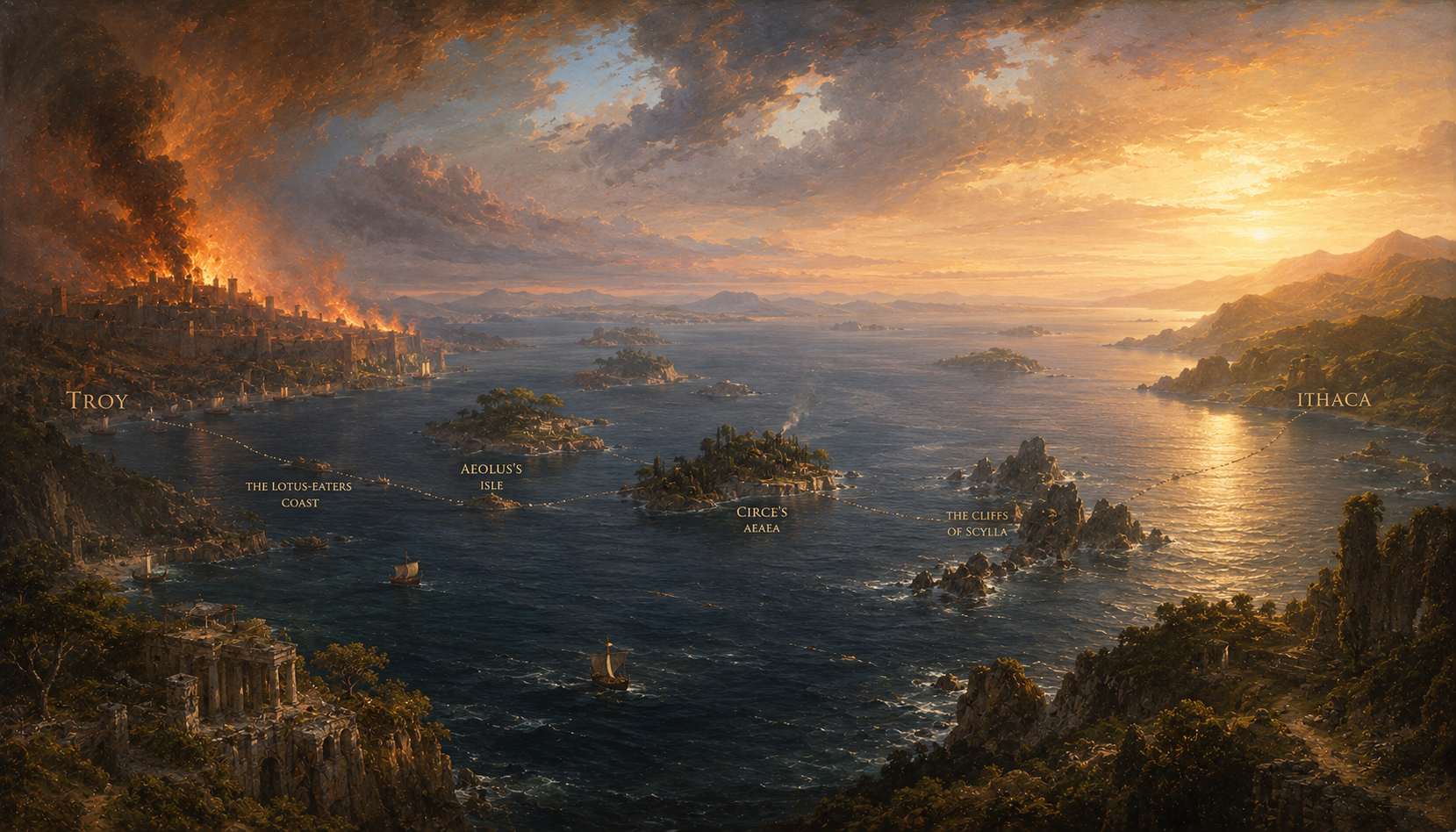
A Note About the Geography
People have been trying to map Odysseus's route onto real geography for as long as the Odyssey has existed. The ancient Greeks debated it. Roman-era scholars debated it. Modern archaeologists, classicists, and amateur enthusiasts debate it still. Some identifications are widely accepted (Troy, Ithaca). Others are plausible but unproven (the Cyclopes in Sicily, Scylla and Charybdis in the Strait of Messina). And some locations, like the land of the dead or Calypso's island, are openly mythical and were probably never meant to correspond to any real place.
The truth is that Homer was a poet, not a cartographer. He used geographic details when they served his story and invented them when they did not. The journey is meant to feel like it covers the entire known world and then spills past its edges into a realm of monsters and gods. Trying to pin every island to a spot on Google Maps misses the point. That said, the proposed identifications are fascinating, so I will mention them at each stop.
1 Troy (Ilium)
Book 9. Real location: Hisarlik, northwestern Turkey.
This is where the journey begins. Odysseus and his fleet of twelve ships set sail from Troy after the city falls. Troy is one of the few locations in the Odyssey that is unambiguously real. The archaeological site at Hisarlik, excavated since Heinrich Schliemann's famous digs in the 1870s, contains layers of ancient cities, one of which corresponds roughly to the period of the Trojan War (around 1200 BCE). Odysseus leaves Troy heading roughly southwest, aiming for home across the Aegean Sea.
2 Cicones (Ismarus)
Book 9. Proposed location: the coast of Thrace, northern Greece.
The first stop after Troy is a disaster of Odysseus's own making. His fleet raids the city of Ismarus, home of the Cicones, a people who had been allies of Troy during the war. Odysseus and his men sack the city, take plunder and women, and begin celebrating on the beach. Odysseus urges his men to leave quickly, but they refuse, preferring to feast and drink. The Cicones regroup, call for reinforcements from inland, and counterattack at dawn. Odysseus loses six men from each of his twelve ships, seventy-two men in total, before retreating to sea.
This is the Odyssey's first lesson: even when you win, if you linger too long, you lose. The Cicones were a real people who lived in Thrace, along the northern coast of the Aegean. This is one of the most geographically grounded episodes in the poem.
Recommended Reading
As an Amazon Associate, we earn from qualifying purchases.
3 The Lotus-Eaters
Book 9. Proposed location: the coast of Libya or Tunisia.
A storm drives the fleet south for nine days, and they land among the Lotus-Eaters. These people are not hostile. They simply offer the sailors lotus fruit to eat. Anyone who eats it loses all desire to go home. They just want to sit and eat more lotus. Odysseus has to drag his affected men back to the ships by force and tie them under the rowing benches.
The episode is brief but thematically important. The Lotus-Eaters represent the temptation of forgetting, of simply giving up on the struggle to get home. This is the opposite of everything Odysseus stands for. Ancient writers placed the Lotus-Eaters on the coast of North Africa, possibly near modern Libya or the island of Djerba off Tunisia. The lotus plant may correspond to the jujube fruit, which grows in that region, though the identification is speculative.
4 The Land of the Cyclopes
Book 9. Proposed location: eastern Sicily, near Mount Etna.
This is the Odyssey's most famous episode. Odysseus and a scouting party of twelve men enter the cave of the Cyclops Polyphemus, a one-eyed giant and son of Poseidon. Polyphemus traps them by rolling a massive boulder over the cave entrance, then eats six of the twelve men over three meals. Odysseus gets him drunk on wine, blinds him with a heated olive-wood stake, and escapes by hiding under the bellies of Polyphemus's sheep.
The disaster comes after the escape. Odysseus, unable to resist, shouts his real name back at the blinded Cyclops. Polyphemus prays to his father Poseidon for revenge, and Poseidon makes it his personal mission to prevent Odysseus from ever reaching home. This single act of pride is the root cause of most of Odysseus's subsequent suffering.
The most popular identification places the Cyclopes on the eastern coast of Sicily, near Mount Etna. The volcanic landscape, with its caves and boulders, matches Homer's description. Ancient writers including Thucydides and Virgil associated the Cyclopes with Sicily. The offshore rock formations near Aci Trezza, called the Faraglioni, are traditionally said to be the boulders Polyphemus hurled at Odysseus's departing ship.
5 The Island of Aeolus
Book 10. Proposed location: the Aeolian (Lipari) Islands, north of Sicily.
Aeolus, the keeper of the winds, lives on a floating island surrounded by a wall of bronze. He is a good host. He entertains Odysseus for a month, then gives him a leather bag containing all the winds, with only the west wind left free to blow the fleet straight home. They sail for nine days and actually see Ithaca on the horizon. Then, while Odysseus sleeps, his crew opens the bag, thinking it contains treasure. All the winds burst out at once and blow them all the way back to Aeolus's island. Aeolus refuses to help them again, deciding that the gods must hate Odysseus.
This is one of the cruelest moments in the poem. Home was visible. You could see the smoke rising from the chimneys. And then it was gone. The Aeolian Islands (the Lipari Islands) north of Sicily are the traditional identification. They are volcanic, dramatic, and isolated, fitting Homer's description of a spectacular floating island.
6 The Laestrygonians (Telepylos)
Book 10. Proposed location: uncertain. Sardinia, Corsica, or southern Italy have all been suggested.
This is the worst single catastrophe of the journey. The fleet enters a narrow harbor surrounded by high cliffs. Odysseus, cautious as always, moors his own ship outside the harbor mouth. The Laestrygonians turn out to be giants who rain boulders down from the cliffs, smashing the ships to splinters and spearing the drowning sailors like fish. Eleven of twelve ships are destroyed with their entire crews. Only Odysseus's ship, anchored outside, escapes.
From this point forward, Odysseus has one ship and one crew. The journey that began as a fleet of twelve becomes the survival story of a single vessel. Homer describes the harbor of the Laestrygonians as a place where the paths of day and night are close together, which some scholars interpret as a reference to very long summer days, pointing to a location far to the north. Others place it in Sardinia, Corsica, or the bay of Bonifacio between the two. The identification remains one of the most debated in Homeric geography.
7 Circe's Island (Aeaea)
Books 10-12. Proposed location: Monte Circeo on the Italian coast, south of Rome.
Odysseus's remaining crew lands on Aeaea, the island of the goddess Circe. A scouting party finds her palace in a forest clearing, surrounded by tame wolves and lions (men she has already transformed). She invites the scouts in, feeds them drugged food, and turns them into pigs with a stroke of her wand. Only Eurylochus escapes to report back. Odysseus goes to rescue his men, aided by the god Hermes, who gives him a magical herb called moly to protect him.
Odysseus confronts Circe, resists her magic, and forces her to restore his men. Then something unexpected happens: they stay. For a full year, Odysseus and his crew live on Circe's island, feasting and resting. When the crew finally urges Odysseus to leave, Circe tells him he must first visit the Underworld to consult the prophet Tiresias. After the journey to the dead and back, Circe gives Odysseus detailed instructions about the Sirens, Scylla and Charybdis, and the cattle of the sun god.
The most common identification is Monte Circeo (Cape Circeo), a promontory on the western Italian coast that was once an island. Its name matches, and its location fits within the western Mediterranean framework of the voyage.
8 The Land of the Dead
Book 11. Location: mythical. At the edge of the world, beyond the river Oceanus.
Following Circe's instructions, Odysseus sails to the edge of the world, where the river Oceanus circles the earth. He digs a pit, pours offerings of milk, honey, wine, and water, and sacrifices a ram and a black ewe. The ghosts of the dead rise from the pit to drink the blood, and only after drinking can they speak.
Odysseus speaks with the prophet Tiresias, who warns him about the cattle of the sun and tells him about his future beyond the Odyssey. He meets his mother Anticlea, who died of grief during his absence. He sees the shades of famous women, and of his comrades from Troy: Agamemnon, who was murdered by his wife; Achilles, who says he would rather be a living slave than king of the dead; and Ajax, who still refuses to speak to Odysseus over a grudge from the war.
This is not a place on any map. Homer places it at the far western edge of the world, where the sun never shines. It is the boundary of mortal geography, the place where the real world ends and the afterlife begins.
Recommended Reading
As an Amazon Associate, we earn from qualifying purchases.
9 The Sirens
Book 12. Proposed location: the Sirenuse Islands (Li Galli) off the Amalfi Coast, Italy.
After returning from the dead, Odysseus sails past the island of the Sirens, two creatures whose singing lures sailors to their deaths. He plugs his crew's ears with beeswax and has himself tied to the mast so he can hear the song without being able to act on it. The Sirens sing to him by name, promising knowledge of the past and future. He strains against his bonds, begging to be freed, but his men only tie him tighter. They row past and survive.
The Sirenuse Islands (Li Galli), a small rocky archipelago off the Amalfi Coast near Positano, are the traditional location. In antiquity, a temple to the Sirens stood on the nearby headland. The islands are barren and rocky, consistent with Homer's meadow of bones.
10 Scylla and Charybdis
Book 12. Proposed location: the Strait of Messina, between Sicily and mainland Italy.
Immediately after the Sirens, Odysseus must navigate a narrow strait between two horrors. On one side is Scylla, a six-headed monster who lives in a cave high on a cliff. On the other is Charybdis, a massive whirlpool that sucks down the entire sea three times a day and vomits it back up. Circe told Odysseus to hug the Scylla side, because losing six men is better than losing the whole ship.
Odysseus follows her advice but disobeys in one respect: he puts on his armor, hoping to fight Scylla. It does no good. While the crew stares at Charybdis in terror, Scylla strikes from above and snatches six men, one in each of her six mouths. Odysseus watches them lifted into the air, screaming his name, and can do nothing. He calls it the most sickening sight he saw in all his voyages.
The Strait of Messina between Sicily and the Italian mainland is the near-universal identification. The strait has dangerous currents and, in antiquity, a reputation for whirlpools. The rock formations on the Italian side could suggest Scylla's cliff. This identification was accepted in antiquity and remains the most widely endorsed today.
11 Thrinacia (The Island of the Sun God)
Book 12. Proposed location: Sicily (the ancient name Trinacria matches).
Despite Circe's and Tiresias's warnings, the crew forces Odysseus to stop at Thrinacia, where the sun god Helios keeps his sacred cattle. They are trapped on the island by contrary winds for a month. When their food runs out, Eurylochus convinces the crew to slaughter some of the cattle while Odysseus sleeps. Helios demands justice from Zeus, and when they put back to sea, Zeus sends a thunderbolt that destroys the ship and kills every man except Odysseus.
The name Thrinacia is strikingly close to Trinacria, an ancient name for Sicily (which is triangular, and the Greek word for trident or three-pointed). If the Sirens are near Amalfi and Scylla is in the Strait of Messina, then Sicily is the logical next stop heading south along the Italian coast. This identification has been accepted since antiquity.
12 Calypso's Island (Ogygia)
Books 1, 5, 7, 12. Proposed location: widely debated. Malta, Gozo, and various Atlantic islands have been suggested.
After the destruction of his last ship, Odysseus drifts on wreckage for nine days before washing ashore on Ogygia, the island of the nymph Calypso. She takes him in, falls in love with him, and keeps him there for seven years. She offers him immortality if he will stay with her forever. He refuses. He sits on the shore every day, weeping and looking out at the sea toward home.
Calypso's name comes from the Greek word kalyptein, meaning "to hide" or "to conceal." Her island is the place where Odysseus is hidden from the world for nearly a decade. Homer describes it as remote and lush, with forests, meadows, and springs. When Zeus finally orders Calypso to release Odysseus, she helps him build a raft and sends him on his way.
Ogygia's location is the most contested in the entire poem. The translator Samuel Butler argued for Pantelleria, an island between Sicily and Tunisia. Others have proposed Malta or the smaller island of Gozo. Some ancient sources placed it far to the west, even in the Atlantic, reflecting the idea that Odysseus had traveled to the very edge of the world. The honest answer is that Ogygia is wherever Homer needed it to be: far enough away that seven years of captivity feels plausible.
13 Scheria (The Land of the Phaeacians)
Books 5-13. Proposed location: Corfu (Kerkyra), Greece.
After eighteen days on his raft, Odysseus is shipwrecked again by Poseidon and washes up on the shore of Scheria, land of the Phaeacians. The princess Nausicaa finds him, naked and covered in salt, when she comes to the river to do laundry. She gives him clothes and directs him to her father's palace. King Alcinous and Queen Arete host him lavishly, hold games and feasts in his honor, and listen as he tells the entire story of his wanderings (Books 9 through 12). They load him with treasure and put him on a magical ship that carries him home to Ithaca overnight while he sleeps.
The ancient identification of Scheria with Corfu was accepted by Thucydides and has remained popular ever since. Corfu lies off the northwest coast of Greece, reasonably close to Ithaca, which would make it a plausible last stop before home. The Phaeacians are described as great sailors, and Corfu's seafaring tradition supports the connection.
14 Ithaca
Books 13-24. Real location: the island of Ithaca (Ithaki) in the Ionian Islands, Greece.
Home. The Phaeacian ship deposits Odysseus on the shore of Ithaca while he sleeps, along with all his treasure. He wakes up and does not recognize his own island because Athena has covered it in mist. When she reveals the truth, he kisses the ground. Then begins the second half of the poem: the disguise as a beggar, the reunion with Telemachus, the return to the palace, the contest of the bow, and the slaughter of the suitors.
Ithaca is a real island in the Ionian Sea, off the western coast of Greece. It is small, rocky, mountainous, and not particularly fertile, which matches Homer's description exactly. Odysseus himself says of it: "It is rugged and not a good driving country, but it is by no means a bad island." There has been some scholarly debate about whether Homer's Ithaca corresponds to the modern island of Ithaki or to the nearby island of Kefalonia, but the traditional identification holds strong. It is a modest place, and that is part of the point. Odysseus chose this small, rocky island over immortality with a goddess. That is how much home meant to him.
The Shape of the Journey
If you trace the route on a map using the most commonly accepted identifications, a pattern emerges. Odysseus starts in the eastern Mediterranean (Troy), gets blown south to North Africa (Lotus-Eaters), then swings west to Sicily and the waters around Italy (Cyclopes, Aeolus, Circe, the Sirens, Scylla and Charybdis). He is pushed to the far western edge of the known world (the land of the dead, Calypso's island), and then brought back east to Corfu (Phaeacia) before finally reaching Ithaca.
It is a vast, circular wandering, a journey that touches every edge of the Mediterranean and then pushes past it. The early stops are recognizably real. The middle stops get progressively more mythical. By the time Odysseus reaches the Underworld, he has left the map entirely. Then the journey loops back, through increasingly real locations, until he wakes up on his own island.
This is probably deliberate. Homer structures the journey as a descent into the unknown and a gradual return to the familiar. The further Odysseus gets from home, the stranger the world becomes. The closer he gets to home, the more the world starts making sense again. The geography of the Odyssey is not just a route. It is a narrative arc.
Explore the Journey
As an Amazon Associate, we earn from qualifying purchases.
Related Pages
Hear Every Stop on the Journey
All 24 books of the Odyssey, read aloud with a full cast of distinct voices. Follow Odysseus from Troy to Ithaca, one island at a time. Every word highlights as it is spoken.
Listen NowEvery Stop on the Journey
Wine-Dark Sea and journey merch. T-shirts, posters, mugs, canvas prints, and tote bags.
Browse All ProductsFEATURED DESIGNS