Choosing a Translation: Three Strong Options
The Odyssey was composed in ancient Greek, in a poetic meter called dactylic hexameter, around the eighth century BCE. Unless you read Homeric Greek (and very few people do), you will need a translation. The good news is that there are several excellent ones, and the choice depends more on what kind of reading experience you want than on which is "best."
Samuel Butler's prose translation, first published in 1900, is the easiest entry point. Butler translated Homer into clear, unadorned English prose. There is no verse, no elevated diction, no stylistic barrier between you and the story. It reads like a novel. Because it is in the public domain, it is freely available online and is the text used in our read-aloud app. If you have never read the Odyssey before and you want the least friction possible, Butler is where to start.
Richmond Lattimore's verse translation, published in 1967, is the most faithful to Homer's original Greek. Lattimore worked line by line to preserve Homer's word order, epithets, and sentence structure wherever English allows. His Odyssey feels like a direct encounter with the ancient text. If you want to study the poem seriously and get as close to the Greek as possible without learning Greek, Lattimore is the translation to choose.
Emily Wilson's translation, published in 2017, was the first complete English Odyssey by a woman. Wilson writes in a clean, contemporary style that favors precision over ornament. She is particularly attentive to the poem's treatment of women, slaves, and the power dynamics of ancient Greek society, and her choices in translation often reveal things that older versions smooth over. If you want a translation that reads like it was written for the twenty-first century, that challenges comfortable assumptions about the poem, Wilson is an excellent and thought-provoking guide.
Other worthy translations include those by Richmond Lattimore (close to the Greek, more literal), Robert Fitzgerald (elegant and poetic), and W.H.D. Rouse (lively prose). You cannot make a bad choice. The important thing is to start.
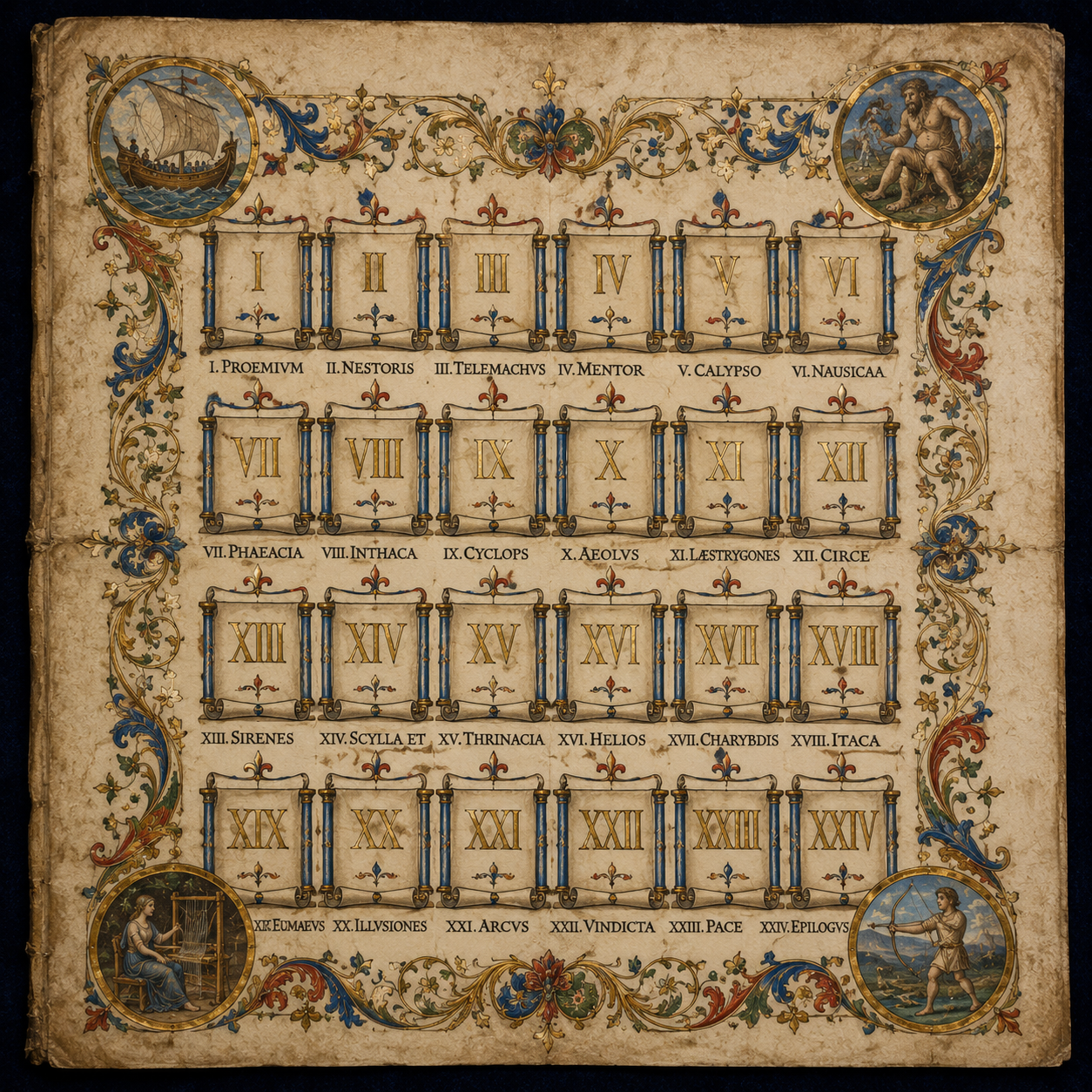
How the Poem Is Structured: A Map of 24 Books
The Odyssey has 24 books, which function roughly like chapters. They break down into four major sections, and knowing this structure in advance makes the poem much easier to follow.
Books 1 through 4: The Telemachy. The poem opens not with Odysseus but with his son, Telemachus. He is twenty years old, his father has been gone since before he was born (ten years at Troy, ten years lost at sea), and their household in Ithaca is overrun by suitors who are courting his mother Penelope and eating through the family's wealth. Prompted by Athena in disguise, Telemachus travels to Pylos and Sparta to ask old allies of his father, Nestor and Menelaus, for news. These four books establish the stakes and introduce the themes of hospitality, identity, and storytelling that run through the entire poem.
Books 5 through 8: Calypso to Phaeacia. Odysseus finally appears in Book 5, stranded on the island of the goddess Calypso, who has kept him there for seven years. Zeus sends Hermes to order his release. Odysseus builds a raft, is shipwrecked by Poseidon, and washes ashore on Scheria, the land of the Phaeacians. He is received by Princess Nausicaa and welcomed by King Alcinous, who offers him safe passage home. At a feast, the bard Demodocus sings about Troy, and Odysseus weeps. Alcinous notices and asks him to tell his story.
Books 9 through 12: The Great Wanderings. This is the section most people think of when they think of the Odyssey. In these four books, Odysseus himself becomes the narrator, telling the Phaeacians about his entire journey from Troy: the Cyclops, Circe, the descent to the underworld, the Sirens, Scylla and Charybdis, and the catastrophe with the cattle of the Sun. This is the poem at its most cinematic, and it moves quickly.
Books 13 through 24: The Return and Revenge. The Phaeacians sail Odysseus home to Ithaca while he sleeps. Disguised as a beggar by Athena, he enters his own house, evaluates the situation, reunites secretly with Telemachus, and plots the destruction of the suitors. The climax is the contest of the bow: Penelope announces that she will marry whoever can string Odysseus's great bow and shoot an arrow through twelve axe heads. None of the suitors can do it. The disguised beggar asks for a turn, strings the bow effortlessly, and fires the first arrow through the axes. Then he turns the bow on the suitors.
Getting Past the First Fifty Pages
Here is a truth that experienced readers rarely admit: the opening of the Odyssey can be difficult for a first-timer. Books 1 through 4 are slower and more politically complex than the adventure episodes that follow. There are long speeches, catalogues of names, elaborate descriptions of feasts, and a great deal of conversation about hospitality customs that may seem unfamiliar. Telemachus is not as compelling a character as his father, and you may find yourself wondering when the Cyclops is going to show up.
The trick is to trust the poem. Homer knew what he was doing. The Telemachy builds the emotional foundation for everything that comes later. When you finally see Odysseus in Book 5, weeping on a beach and staring at the ocean, the reunion is more powerful because you have spent four books in a world that desperately needs him to come back. When the suitors are killed in Book 22, it is satisfying because you watched them behave appallingly for twenty books. The slow start is not a flaw. It is a setup.
If you truly cannot get through Books 1 through 4, here is an alternative approach that some teachers recommend: start with Book 5, where Odysseus appears. Read through Book 12, which covers all the great adventures. Then go back and read Books 1 through 4 with the knowledge of what Odysseus has been through, and finish with Books 13 through 24. This is not how Homer intended it, but it works, and it has gotten many reluctant readers into the poem.
Recommended Reading
As an Amazon Associate, we earn from qualifying purchases.
What to Pay Attention To
Hospitality. The Odyssey is obsessed with the rules of guest-friendship, what the Greeks called xenia. Nearly every encounter in the poem can be read as a test of hospitality. The Cyclops violates it by eating his guests. The Phaeacians embody it perfectly by welcoming a naked stranger and sending him home with treasure. The suitors abuse it catastrophically by consuming another man's household while courting his wife. Watch how each character treats guests and strangers, and you will see the poem's moral framework emerge.
Disguise and recognition. Identity is unstable in the Odyssey. Athena appears as a young man, as a shepherd, as Mentor. Odysseus arrives in Ithaca disguised as a beggar and is recognized by his dog (who then dies), his old nurse (who sees a scar on his leg), his son (whom he reveals himself to), and finally his wife (who tests him with a trick about their bed). The pattern of concealment and revelation is one of the poem's deepest structures. Pay attention to who recognizes whom, and how.
Storytelling itself. As we explore in our essay on the Odyssey's narrative technique, this is a poem about the power of stories. Nearly every character tells one. Odysseus narrates four books in his own voice. Penelope's weaving trick is itself a kind of narrative. Watch for moments where telling a story changes the course of events, and ask yourself whether the storyteller can always be trusted.
The women. The Odyssey is full of female characters who are more complex than a first reading might suggest. Penelope is not just a faithful wife waiting at home; she is a strategist, a trickster, and arguably Odysseus's intellectual equal. Circe is not just a sorceress; she is the poem's most useful informant. Calypso raises hard questions about freedom and love. Athena orchestrates the entire plot. Nausicaa is one of the most charming minor characters in all of ancient literature. Even Helen, briefly appearing in Book 4, is fascinating, drugging the wine so everyone can talk about Troy without crying.
Common Misconceptions
The Odyssey is not an adventure story with a hero who fights monsters. It contains adventure episodes, yes, but the poem is far more interested in intelligence, endurance, and self-control than in physical combat. Odysseus does not defeat the Cyclops by fighting him. He defeats him by getting him drunk and telling him a false name. The Odyssey values cunning over strength, patience over glory, and coming home over winning fame. If you go in expecting the Iliad, you will be confused. The Odyssey is a different kind of poem entirely.
Odysseus is not a straightforward hero. He lies constantly. He gets his men killed through a mixture of curiosity and pride. He spends years in the beds of goddesses while Penelope waits at home. He is boastful, manipulative, and occasionally cruel. He is also brave, resourceful, loyal to his men (up to a point), and desperately homesick. Homer presents him without simple moral judgment. Whether you admire Odysseus or find him troubling is one of the questions the poem wants you to wrestle with.
The poem is not just about one man's journey. It is about the experience of coming home after a long absence and finding that everything, including yourself, has changed. It is about fathers and sons. It is about marriage and what holds it together. It is about the difference between living forever in comfort and choosing to go back to a hard, mortal life because it is yours. The monsters and magic are wonderful, but they are not the point. The point is Ithaca.
Why Listening Changes Everything
Here is the single most important thing to know about the Odyssey: it was never meant to be read. Homer composed for oral performance. The poem was sung or chanted aloud, probably over several evenings, to audiences who experienced it as a live performance, not as words on a page. The rhythms, the repeated phrases ("rosy-fingered dawn," "the wine-dark sea"), the way scenes build to emotional peaks, all of it was designed for the ear.
When you read the Odyssey silently, you get the plot and the characters and the ideas. When you hear it spoken, you get something else on top of that: the music. You hear the pacing of Homer's scenes, the way he slows down for emotional moments and speeds up for action. You hear how the repeated epithets work as rhythmic anchors, giving the listener a moment of familiarity before plunging into something new. You hear the difference between Odysseus's storytelling voice and Homer's narrative voice. You hear the poem breathe.
This is not a small difference. Many people who struggled with the Odyssey on the page find it comes alive when they hear it. There is a reason the oral tradition persisted for centuries before anyone thought to write these poems down. They sound better than they look. If you have tried to read the Odyssey and bounced off, try listening instead. Let someone else carry the rhythm while you settle into the story. You may find that the poem you struggled with on the page becomes the story you cannot stop hearing.
"Sing to me of the man, O Muse, the man of twists and turns, driven time and again off course, once he had plundered the hallowed heights of Troy." Homer, The Odyssey, Book 1
Recommended Reading
As an Amazon Associate, we earn from qualifying purchases.
A Suggested Reading Plan
If you want a structured approach, here is a way to move through the Odyssey in roughly two weeks, reading one or two books per day. Days one through two: Books 1 through 4 (the Telemachy). Telemachus in Ithaca, Pylos, and Sparta. Days three and four: Books 5 through 8 (Calypso, the journey to Scheria, the Phaeacian court). Days five and six: Books 9 through 12 (the great wanderings, told by Odysseus). This is the section that moves the fastest and hits the hardest. Days seven through ten: Books 13 through 20 (the return to Ithaca, the disguise, the buildup). Days eleven and twelve: Books 21 through 24 (the bow contest, the slaughter of the suitors, the reunion with Penelope).
You can also simply read at your own pace without a schedule. The books are short, typically ten to twenty minutes each, and the poem is generous about reminding you where you are. Homer composed for audiences who might join the performance midway through, so he built in recaps and reintroductions. You will not get lost.
One last piece of advice: do not skip the ending. Many readers, exhausted after the climactic slaughter in Book 22, skim or abandon the final two books. Do not. Book 23 contains the reunion between Odysseus and Penelope, which is one of the most beautiful scenes in all of literature. She tests him with a trick about their marriage bed, and his response proves that he is who he says he is. After twenty years and twelve thousand lines of verse, the poem earns that moment. It would be a shame to miss it.
Hear It the Way Homer Intended
Our app brings the Odyssey to life as a full-cast narration with over sixty distinct character voices. Every word of Samuel Butler's translation is spoken aloud and highlighted on screen as you follow along. You can read with the text, listen while you commute, or simply close your eyes and let the poem wash over you the way Homer's first audiences experienced it: as a voice in the room, telling you a story about a man who just wanted to come home.
Book I is free. Start there. If the Telemachy hooks you, you can unlock all 24 books and hear the complete Odyssey for $6.99. That is the price of a cup of coffee for one of the oldest and greatest stories in human civilization.
Start Reading
As an Amazon Associate, we earn from qualifying purchases.
Continue Reading
Start with Book I, Free
Full-cast narration with 60+ character voices. Book I is free. Unlock the complete Odyssey, all 24 books, for $6.99.
Start Listening FreeContinue the Journey
Hear the complete Odyssey read aloud with 60+ character voices. Every word highlights as it is spoken.
Book I is completely free. No signup required.
Go Deeper Into the Odyssey Film
Get the free Odyssey Companion Guide: character map, timeline, family tree, and the essential scenes from Homer's poem and the film.
No spam. Unsubscribe anytime.