The Contest of the Bow
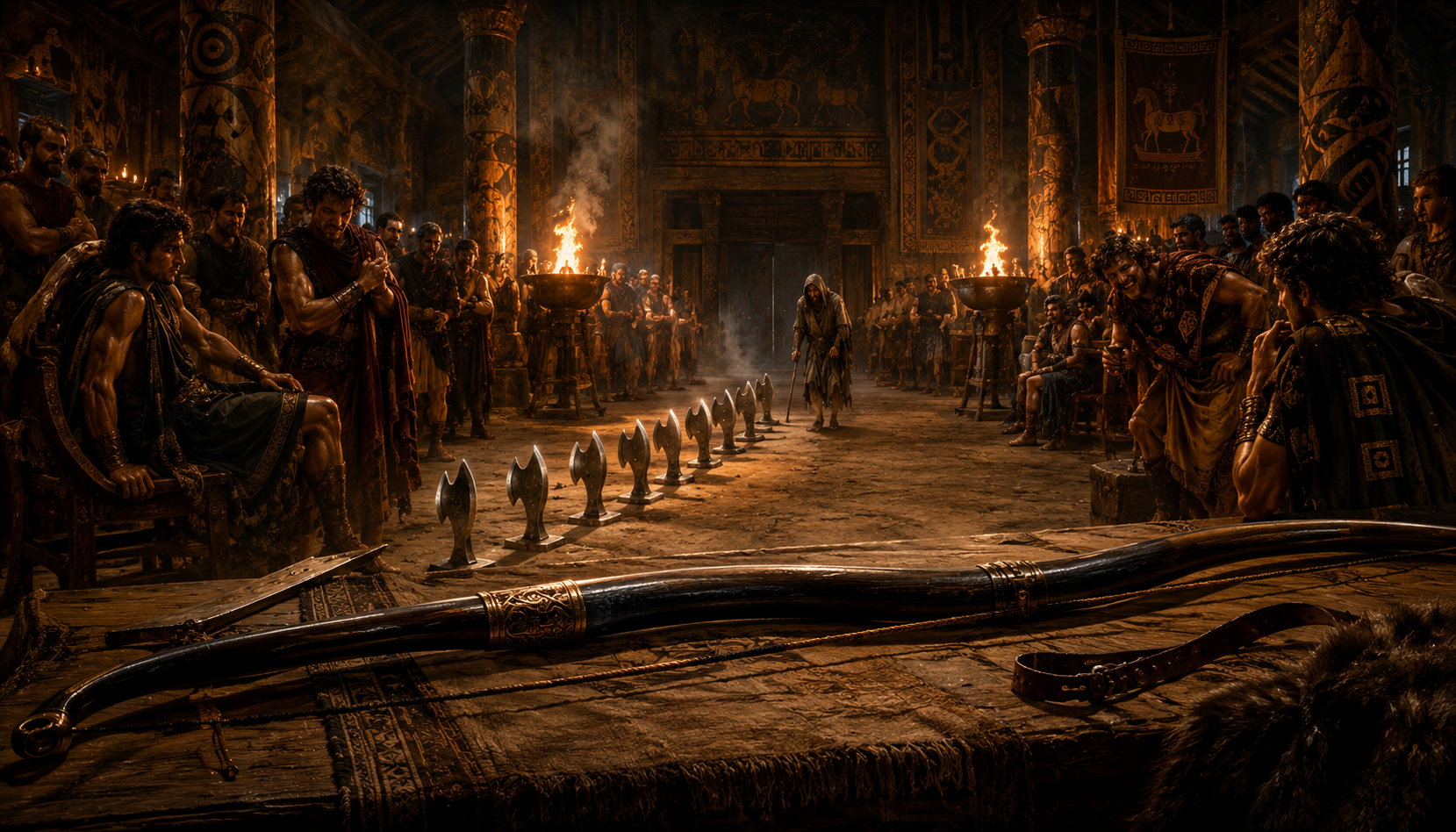
It begins with Penelope. In Book 21, she goes to the storeroom, takes down the great bow of Odysseus, and carries it into the hall. She announces a contest: whichever suitor can string the bow and shoot an arrow through the rings of twelve axe heads, set in a row, will become her husband. It is the trial of the bow. It is a challenge that Odysseus himself used to perform, and Penelope knows it. Whether she is consciously or unconsciously setting a trap that only her husband could spring is one of the great interpretive puzzles of the poem.
The suitors consume Odysseus's wealth with reckless abandon
Then the beggar asks for a turn. The suitors erupt in mockery and outrage. A homeless old man, filthy and weak, wants to try the bow that has defeated every prince in the room? Telemachus intervenes, insisting that the stranger be allowed his attempt. The swineherd Eumaeus brings the bow to Odysseus. The room goes quiet. And then, as Homer tells it, Odysseus handles the bow the way a musician handles a lyre, turning it in his hands, testing its flex, stringing it with a single fluid motion, and plucking the string so that it sings like a swallow's cry. The casual mastery of the gesture is more terrifying than any threat. Every suitor in the room should understand, in that instant, what is about to happen.
Odysseus sets an arrow to the string and sends it through all twelve axes. The contest is over. But the killing has not yet begun.
The fateful contest that seals the suitors' doom
The Revelation
Odysseus strips off his rags and leaps to the threshold of the great hall, the doorway that controls all entry and exit. He pours his quiver of arrows at his feet. And then he speaks. The first arrow is already on the string, and his words are as precise as his aim: he tells the suitors that their "reckless game" is over, and that now he will find another target. The phrase is chilling in its understatement. He is not announcing himself as king. He is not delivering a speech about justice. He is simply telling them, with the quiet authority of a man who has waited twenty years for this moment, that the game has changed.
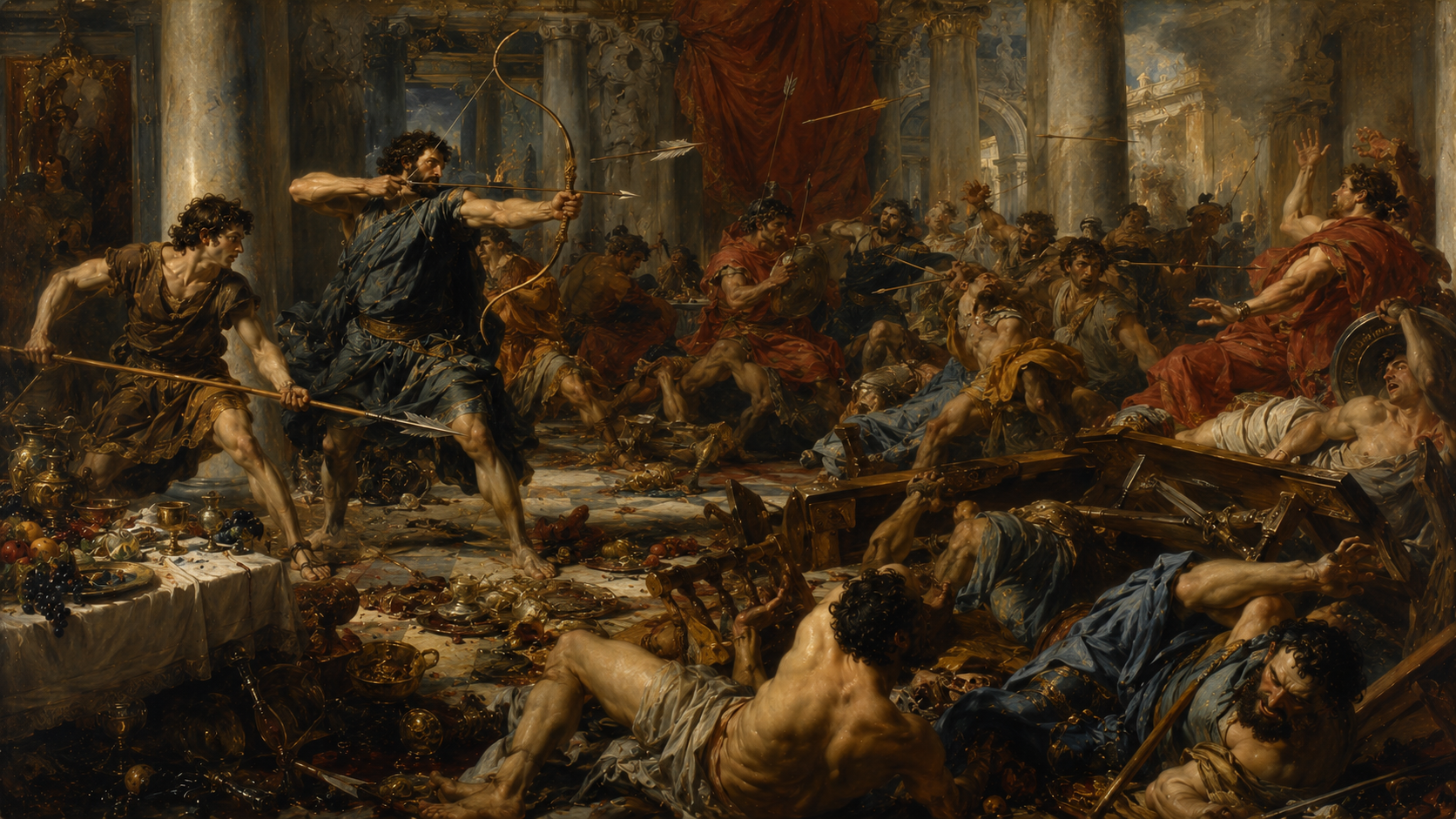
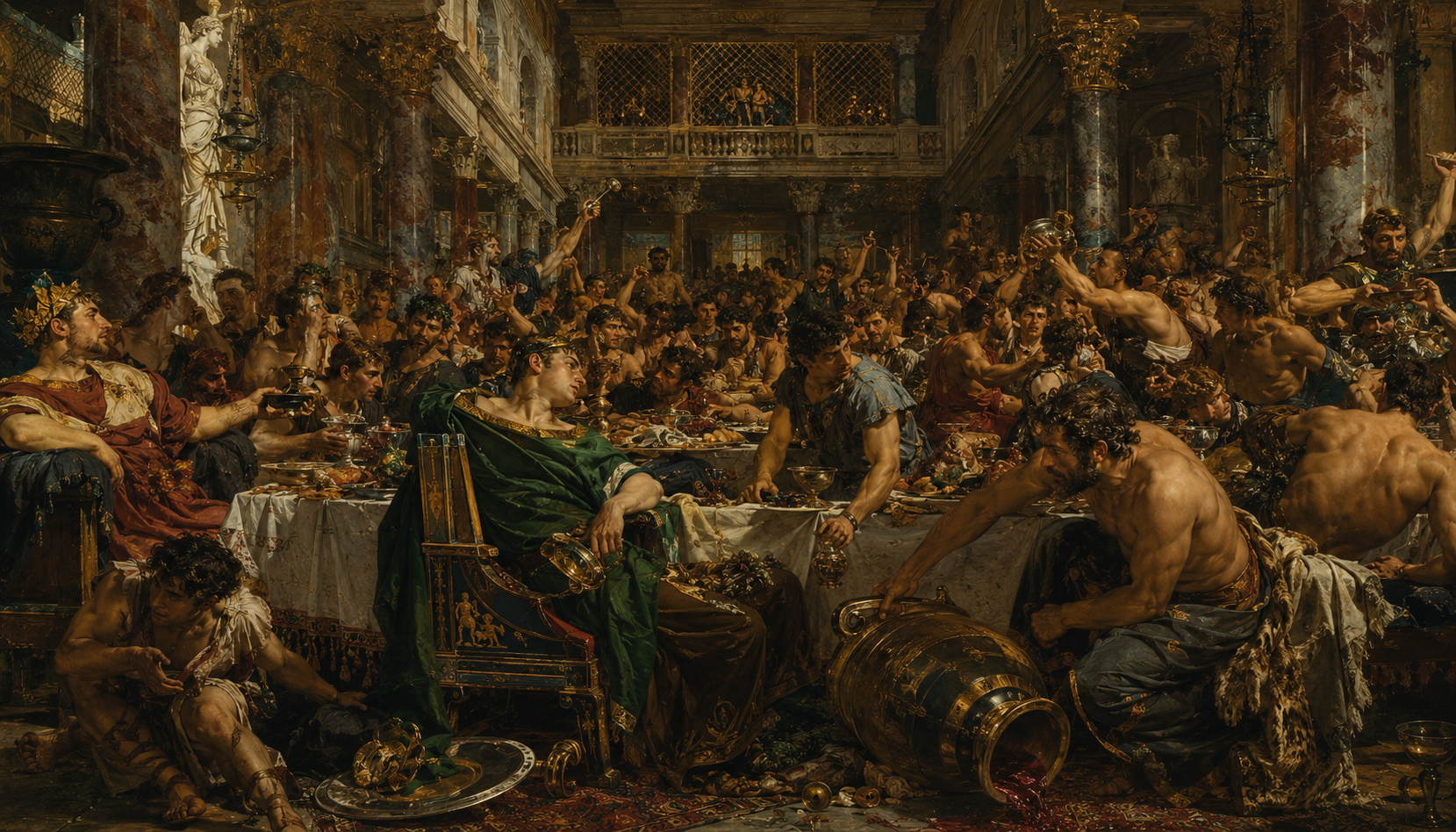
His first arrow goes through the throat of Antinous, the ringleader, who is lifting a cup of wine to his lips. Antinous dies mid-drink, the wine and blood pouring from his throat together. Homer describes the scene with brutal clarity: the table overturned, the food scattered across the floor, the bread and meat soaking in blood. It is a deliberate inversion of the feasting scenes that have dominated the poem. The suitors have been eating and drinking in Odysseus's hall for years. Now the feast becomes a slaughterhouse.
"You dogs! You never imagined I'd return from Troy. So you bled my house to death, ravished the serving women, courted my wife behind my back while I was still alive. No fear of the gods who rule the skies up there, no fear that men's revenge might arrive someday. Now all your necks are in the noose." Homer, The Odyssey, Book 22 (Samuel Butler translation, 1900)
The suitors panic. Some beg for mercy. Eurymachus tries to negotiate, offering to repay everything they have consumed. He blames Antinous for everything, calling him the real villain, the one who wanted not just Penelope but the throne itself. Odysseus's answer is immediate and absolute: no amount of wealth will satisfy him. Even if they offered everything their families own, he would not stop killing until every suitor has paid. The negotiations are over before they begin.
The Slaughter in the Hall
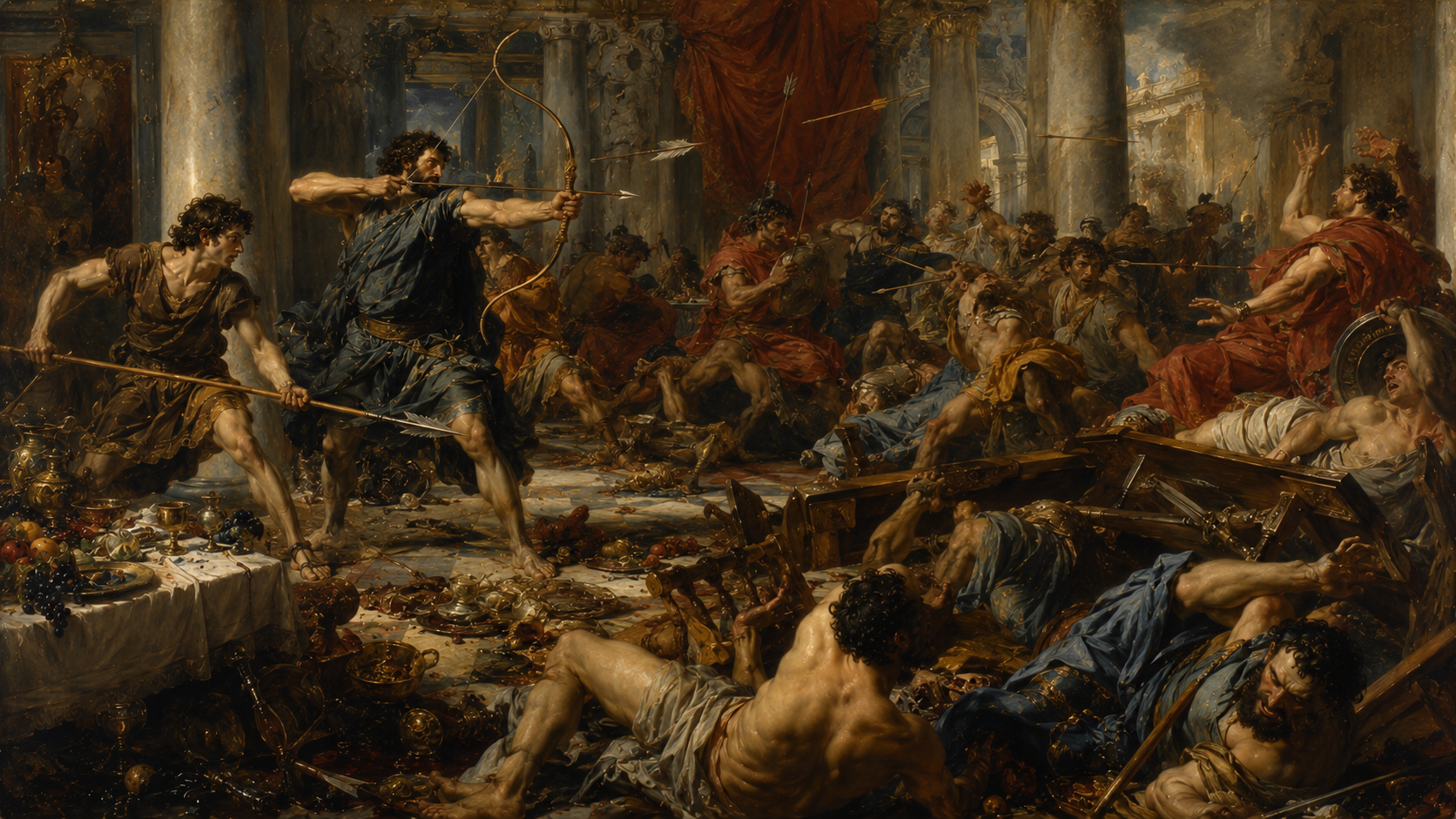
What follows is the longest sustained combat sequence in the Odyssey, and it is nothing like the stylized warfare of the Iliad. There are no speeches between champions, no pauses for the dying to deliver final words, no sense of honor or glory. It is a massacre. Odysseus stands at the threshold with his bow, picking off suitors one by one until his arrows run out. Then he takes up a spear, and the fighting becomes hand-to-hand.
Odysseus unleashes his long-awaited vengeance
Homer does not flinch from the details. Suitors are struck in the chest, the belly, the face. Blood pools on the floor. Bodies pile up. The poet describes the scene with the same unflinching precision he uses for the great battles of the Iliad, except that here there is no honor in the dying. The suitors are not warriors. They are young men, many of them from prominent families, who made the catastrophic mistake of assuming that Odysseus would never return. Their deaths are ugly, desperate, and without glory.
Two figures beg for their lives and are spared: the bard Phemius, who sang for the suitors under compulsion, and the herald Medon, who served the household faithfully. Telemachus vouches for both of them, and Odysseus lets them go. Their survival is significant. It shows that Odysseus is capable of mercy, that his rage is not blind, and that the poem distinguishes between those who chose to participate in the suitors' crimes and those who were forced into it. But the mercy is limited. For the suitors themselves, there is none.
Recommended Reading
As an Amazon Associate, we earn from qualifying purchases.
The Hanging of the Maids
After the suitors are dead, the killing does not stop. Odysseus turns his attention to the servants who betrayed him. Twelve of the palace maids had been sleeping with the suitors, and Odysseus orders them to clean the hall, scrubbing the blood and gore from the tables and floor, carrying out the bodies of the men they had lain with. When the cleaning is done, Telemachus takes the women outside and hangs them.
Homer's description of the hanging is one of the most disturbing passages in ancient literature. He compares the women to thrushes or doves caught in a net, their feet twitching briefly before going still. The simile is devastating because it is beautiful, because it brings a moment of lyric grace to an act of savage punishment, and because it compares these women to birds, creatures trapped by forces beyond their control.
This is the scene that has troubled readers most deeply, and with good reason. The maids are slaves. They had no legal standing, no recourse, no ability to refuse the suitors' advances. Some may have been coerced. Some may have been trying to survive in an impossible situation. The poem does not explore their perspectives. It does not ask whether they had a choice. It simply records their deaths as part of the restoration of order, one more item on the list of things that must be set right before Odysseus can reclaim his household.
For ancient audiences, the hanging was probably unremarkable. Slaves who betrayed their master could expect death, and the sexual behavior of enslaved women was considered a property matter, a violation of the master's rights, not a question of the women's autonomy. For modern readers, the scene is almost unbearable. It exposes the limits of the poem's moral vision, the places where its values and ours diverge so sharply that no amount of literary admiration can smooth over the gap. Margaret Atwood's novel "The Penelopiad" retells the Odyssey from the perspective of these maids, giving voice to the women Homer silenced, and its existence is itself a measure of how much this scene haunts the Western imagination.
Justice or Excess? Ancient and Modern Readings
Revenge is one of the central themes running through the Odyssey, and the question of whether Odysseus's revenge is just depends almost entirely on when and where you are reading. For Homer's original audience, the answer was probably straightforward. The suitors violated xenia, the sacred code of hospitality that Zeus himself enforced. They consumed another man's wealth. They plotted to murder his son. They pressured his wife. They defiled his household. By the moral logic of the poem, they had forfeited their right to live, and Odysseus, acting with the explicit support of Athena and the implicit approval of Zeus, was carrying out divine justice. The slaughter was not excessive. It was overdue.
This reading is supported by the poem's structure. Every element of the narrative builds toward the revenge as the necessary and satisfying conclusion. The suitors' crimes are enumerated again and again. Their arrogance is dramatized in scene after scene. Individual suitors are characterized just enough to make their deaths feel earned: Antinous is cruel, Eurymachus is manipulative, Ctesippus throws a cow's hoof at the disguised Odysseus. The poem wants you to feel that these men deserve what they get. And for twenty books, it works. When the bow sings and the arrows fly, there is a deep, primal satisfaction in watching the patient hero finally unleash his fury.
But modern readings complicate this satisfaction considerably. Some scholars point out that not all the suitors are equally guilty. Amphinomus, for instance, is described as the most decent of the group, a man who treats the disguised Odysseus with genuine kindness. Odysseus himself warns Amphinomus to leave the palace before it is too late. Amphinomus hesitates, almost goes, but Athena keeps him there to die. His death feels different from Antinous's. It feels like waste rather than justice.
The scale of the killing also troubles modern readers. Over a hundred men die, representing the leading families of Ithaca and the surrounding islands. This is not a surgical strike against the guilty. It is the annihilation of an entire generation of local nobility. The political consequences, which the poem addresses in Book 24, are severe: the families of the dead suitors rise in revolt, and only divine intervention prevents a civil war. The poem seems to acknowledge, in its final book, that the revenge has created as many problems as it solved.
After the Blood: Reunion and Peace
The killing takes up most of Books 21 and 22, but the poem does not end there. Book 23 gives us the reunion between Odysseus and Penelope, one of the most carefully crafted scenes in all of literature. Penelope does not simply fall into his arms. She tests him, just as he has been testing everyone else. She tells Eurycleia to move the great bed out of the bedroom, and Odysseus erupts in anger: he built that bed himself around the trunk of a living olive tree, and no one could move it unless they cut the tree down. His reaction proves his identity in a way no physical transformation could. He knows the secret of the bed because he is the man who made it.
This is the real ending of the Odyssey: not the violence, but the moment of recognition. After twenty years of separation, husband and wife are reunited over a shared secret, a piece of knowledge that belongs only to them. The bed rooted to the living tree is the poem's most beautiful symbol. It cannot be moved. It cannot be faked. It is as permanent and organic as the marriage it represents.
Book 24, which some ancient scholars believed was a later addition, deals with the aftermath. Odysseus visits his aged father Laertes, who has been living in squalor on his farm, devastated by grief. The families of the dead suitors arm themselves and march on Laertes' estate. A battle begins, and it looks like the cycle of revenge will continue indefinitely, blood calling for blood, until Athena descends and commands everyone to stop. Zeus throws a thunderbolt between the two sides. Peace is imposed from above, not negotiated from below. It is a divine ceasefire, and it feels both necessary and unsatisfying, as if even the gods could not figure out a better way to end the spiral of violence than simply forcing everyone to put down their weapons.
Recommended Reading
As an Amazon Associate, we earn from qualifying purchases.
The Violence the Poem Cannot Escape
The Odyssey is often described as the gentler of Homer's two poems, the one about homecoming rather than war, about cunning rather than combat. And for most of its length, that description holds. But the ending reveals something uncomfortable: the Odyssey cannot escape the violence it has been deferring for twenty books. The homecoming requires blood. The restoration of order requires death. The patient, clever hero who talked his way past the Cyclops and resisted the Sirens' song ultimately resolves his problems the same way Achilles would, with a weapon in his hand and bodies on the floor.
Whether you read this as a failure of imagination or as an honest acknowledgment of how power works in the real world depends on what you bring to the poem. Homer does not moralize about the violence. He does not tell you how to feel about it. He presents the slaughter with the same clear, observant eye he turns on everything else: the beauty of Calypso's island, the grief of Penelope's waiting, the warmth of Eumaeus's fire. The poem trusts you to wrestle with what it shows you. Nearly three thousand years later, we are still wrestling.
Hear the Bow Sing
The sequence from the bow contest through the slaughter of the suitors is the climax of the entire poem, twenty books of tension releasing in a single explosive act. Our full-cast narration brings every moment to life: the silence as Odysseus strings the bow, the singing of the bowstring, the first arrow finding Antinous's throat, and the terrible, exhilarating chaos that follows. Books 21 and 22 are the Odyssey at its most visceral. They were meant to be heard, and they deserve to be heard with voices that match the fury and the grief of what Homer composed.
Explore the Odyssey
As an Amazon Associate, we earn from qualifying purchases.
Continue Reading
Hear the Bow Contest and the Battle
A full cast of over 60 voices. Every word highlights as it is spoken. From the stringing of the bow to the final arrow, hear the revenge of Odysseus come alive.
Listen NowContinue the Journey
Hear the complete Odyssey read aloud with 60+ character voices. Every word highlights as it is spoken.
Book I is completely free. No signup required.
Go Deeper Into the Odyssey Film
Get the free Odyssey Companion Guide: character map, timeline, family tree, and the essential scenes from Homer's poem and the film.
No spam. Unsubscribe anytime.