First, Understand What the Poem Actually Is
Homer's Odyssey is not a single adventure story. It is 12,110 lines of poetry divided into 24 books, weaving together at least three separate storylines. There is Odysseus's voyage home from Troy, full of monsters and magic. There is Telemachus's journey to find news of his missing father (Books 1 through 4, called the Telemachy). And there is the crisis in Ithaca, where over a hundred suitors are eating through Odysseus's wealth and pressuring Penelope to remarry.
The poem is also not told in chronological order. It opens ten years after the fall of Troy, with Odysseus stranded on Calypso's island. The actual adventures (Cyclops, Sirens, Scylla, Charybdis, Circe) are told in flashback when Odysseus recounts them to the Phaeacians in Books 9 through 12. The second half of the poem (Books 13 through 24) takes place entirely in Ithaca as Odysseus, disguised as a beggar, plots to reclaim his home.
That structure is brilliant for a poem and challenging for a film. A movie needs forward momentum. It needs a clear protagonist on screen for most of the runtime. It needs to compress twelve hours of story into roughly two and a half. Every adaptation of the Odyssey has to make hard choices about what stays, what goes, and what gets rearranged. This film is no different.
What the Film Keeps: The Scenes You Will Recognize
Certain episodes from Homer are so iconic, so visually spectacular, and so central to the story that no adaptation can afford to skip them. Based on trailers, production reports, and the sheer logic of what makes cinematic sense, here are the scenes audiences can expect to see.
The Cyclops. This is the set piece. Polyphemus, the one-eyed giant who traps Odysseus and his men in a cave, eats several of them alive, and gets outsmarted by the Nobody trick. In the poem, this is Book 9 and it is told in Odysseus's own voice as a flashback. For the film, it is almost certainly presented as a direct, forward-moving action sequence. The blinding of the Cyclops with the red-hot olive stake, the escape tied under the rams, and the fatal moment when Odysseus shouts his real name from the ship are all tailor-made for IMAX.
The Sirens. The Sirens scene is short in the poem (only about 30 lines in Book 12), but it is one of the most visually reproduced images in Western art. Odysseus lashed to the mast, his crew with beeswax in their ears, the beautiful voices pulling him toward the rocks. For Christopher Nolan, who loves controlled sensory tension (think of the docking sequence in Interstellar), this scene is a gift.
Scylla and Charybdis. The impossible choice: sail close to the six-headed monster who will eat six men, or risk the whirlpool that will swallow the entire ship. In the poem, Odysseus chooses Scylla on Circe's advice, and watches helplessly as six of his crew are snatched from the deck. This is horror filmmaking territory, and Nolan is not one to shy away from it.
Penelope and the suitors. The domestic half of the story. Penelope has been holding off the suitors for years with the weaving trick (unraveling her shroud at night) and sheer willpower. The tension inside the palace is a slow burn that the poem handles across multiple books. The film compresses this into a tighter narrative, but the emotional core (a woman's intelligence and endurance under siege) remains central. Our character profiles cover every major figure you see on screen.
The suitor slaughter. This is the climax of the poem, and it is violent. Odysseus strings his great bow, reveals his identity, and kills every one of the suitors in a locked hall. In Homer, it is brutal and detailed. In the film, it is the final act set piece. Nolan approaches it the way he handled the beach at Dunkirk: controlled chaos, multiple perspectives, mounting dread.
What the Film Probably Changes: The Nature of Adaptation
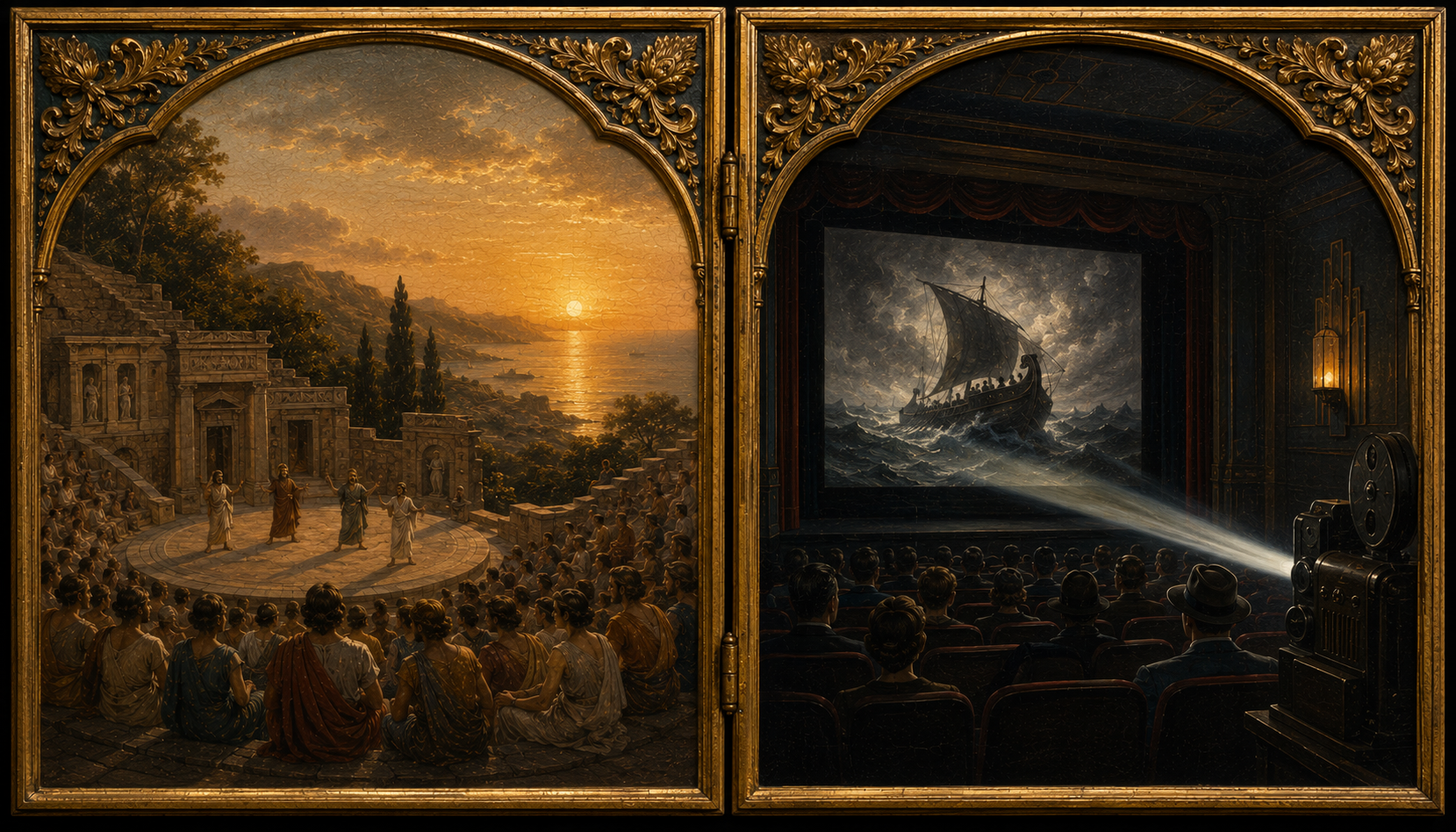
Here is the thing about adapting the Odyssey: the poem was composed for a culture that experienced stories by listening to them over multiple evenings. Homer's audience did not need fast pacing. They wanted richness, repetition, and the pleasure of a skilled bard spinning out a scene. A film audience wants something different.
The timeline becomes linear. Homer's flashback structure is elegant on the page. In the poem, we do not hear about the Cyclops until Book 9, even though it happened years earlier. The film tells the story in largely chronological order, starting with the departure from Troy and ending with the homecoming. That is not a flaw. It is how movies work.
The Telemachy is streamlined. Books 1 through 4 of the poem follow Telemachus as he travels to Pylos and Sparta looking for news of his father. It is beautiful character work, but it is a slow-burn subplot that pulls focus from Odysseus. The film folds Telemachus's arc into the Ithaca sequences rather than giving it a standalone act.
Calypso and Circe are compressed. In the poem, Odysseus spends seven years with Calypso and roughly a year with Circe. These are long, contemplative episodes about temptation and the pull of immortality. The film conveys what these women represent without spending twenty minutes on each. The result is powerful but brief.
The gods are handled subtly. In Homer, the gods are everywhere. Athena actively intervenes, Poseidon actively obstructs, Zeus mediates, and Hermes runs messages. A modern film has to decide how literally to portray divine intervention. Nolan tends toward grounded storytelling (even his science fiction feels tactile), and the gods manifest through natural forces, visions, and atmospheric suggestion rather than appearing as literal figures on screen.
The underworld journey is reimagined. Book 11, where Odysseus visits the land of the dead to consult the prophet Tiresias, is one of the strangest and most haunting sections of the poem. He meets the ghosts of his mother, Achilles, Ajax, and dozens of mythological figures. It is dense, philosophical, and deeply internal. The film translates this into a surreal visual sequence, integrating its revelations into the broader narrative.
Recommended Reading
As an Amazon Associate, we earn from qualifying purchases.
What the Film Cannot Capture: The Things Only the Poem Does
This is not a criticism of the film. It is an honest acknowledgment that some of what makes the Odyssey great lives in the language and the form, and those things do not translate to any screen.
The oral poetry tradition. The Odyssey was composed in dactylic hexameter, a rhythmic pattern that made it possible to memorize and perform. The poem is full of repeated phrases ("rosy-fingered dawn," "wine-dark sea," "much-enduring Odysseus") that served as building blocks for the performing bard. When you hear the poem read aloud, those repetitions create a musical quality that connects you to the thousands of years of oral tradition behind it. A film does not have that texture.
The interior monologues. Homer gives us direct access to what Odysseus is thinking and feeling at key moments. We hear his internal debate when his crew begs him to stop taunting the Cyclops. We feel his grief when he hears the bard Demodocus sing about Troy. A film shows us the actor's face. The poem shows us the character's mind.
The similes. Homer's extended similes are works of art in themselves. A warrior falling in battle is compared to a poppy bending under rain. The Cyclops's blinding is compared to a blacksmith quenching iron. These comparisons expand the world of the poem outward into everyday Greek life: farming, sailing, craftsmanship. They are the texture of the Odyssey, and they live only on the page (or in a good translation read aloud).
The layered narration. Odysseus is an unreliable narrator. He tells his own story to the Phaeacians, and he has every reason to make himself look good. The poem invites you to wonder: did it really happen exactly like that? Is the man who calls himself "renowned for cunning" also capable of embellishing his own legend? That narrative ambiguity is one of the Odyssey's deepest pleasures, and it vanishes when a camera shows you "what really happened."
Why Reading the Poem Makes the Film Better
You absolutely do not need to read the Odyssey to enjoy the film. The story is clear, the characters are compelling, and the spectacle speaks for itself. But here is what reading the source gives you. For a concise primer, see our guide on what to know about the film.
You will catch the references. When Odysseus makes a specific choice in the film, you will know whether Homer wrote it that way or whether Nolan invented it. That knowledge makes you an active viewer rather than a passive one. You are watching not just a movie but a conversation between Nolan and a poet across three millennia.
You will understand the stakes. The poem spends entire books establishing why getting home matters so much. The love between Odysseus and Penelope, the growth of Telemachus, the destruction of the household. The film shows you the emotional payoff. The poem shows you why that payoff has weight.
You will appreciate the changes. Every choice Nolan makes is a statement about what matters in the story. If you know the source, you can see which themes he emphasizes and which he sets aside. That turns the film from entertainment into art criticism. You are not just watching a movie. You are watching someone's reading of a masterpiece.
You will find things the film missed. After seeing the movie, you can go back to the poem and discover entire subplots, characters, and themes that the film could not fit. The Lotus-Eaters. The bag of winds from Aeolus. The cannibalistic Laestrygonians. Tiresias and the land of the dead. The encounter with the shade of Achilles, where the greatest warrior of the Iliad says he would rather be a slave on earth than king of the dead. These moments are waiting for you in the book, and they are extraordinary.
A History of Odyssey Adaptations
Nolan is far from the first to try this. The Odyssey has been adapted, reimagined, and retold for centuries, and every version reveals what that era valued in the story.
The 1954 Italian film Ulysses starring Kirk Douglas played it as a straightforward adventure. The 1997 TV miniseries with Armand Assante tried to include everything and ran to three hours. The Coen Brothers' O Brother, Where Art Thou? (2000) transplanted the story to Depression-era Mississippi and turned it into a comedy. Margaret Atwood's novel The Penelopiad retold it from Penelope's perspective. James Joyce's Ulysses mapped the entire Odyssey onto a single day in Dublin.
Each of these adaptations asks the same question: what is the Odyssey really about? Is it an adventure story? A love story? A meditation on identity? A critique of heroism? Homer's poem is big enough to contain all of those readings. The film is another answer, shaped by Nolan's particular obsessions with time, memory, duty, and the cost of ambition.
The interesting thing about the Odyssey is that it has survived every adaptation and still has more to give. The poem is not diminished by being filmed. It is not replaced. It is the headwaters, and every retelling is a tributary. After you see the movie, the poem will still be there, all 12,110 lines of it, waiting to show you what the camera could not.
Recommended Reading
As an Amazon Associate, we earn from qualifying purchases.
The Bottom Line: Book or Film First?
Whether you read it before or after the film, the poem is worth your time. Even a modern prose translation will take you about eight to ten hours. You do not have to read all of it. Start with Books 9 through 12 (the adventures: Cyclops, Circe, the underworld, Sirens, Scylla, the cattle of the sun), then jump to Book 21 (the bow contest) and Book 22 (the slaughter). Those six books give you the core of the story and the scenes that appear on screen.
If you do not have time, that is perfectly fine. See the movie. Let Nolan tell you the story its way. And then, after the credits, pick up the book. You will be astonished at how much more there is. The Odyssey has been waiting 3,000 years. It can wait until after the movie.
Experience the Source Material
Our app brings Homer's Odyssey to life with full-cast narration. Every word highlighted as it is spoken. Open any of the 24 books and listen to the poem the way it was originally experienced: as a performance. Whether you have already seen the film, are revisiting after reading, or discovering Homer for the first time, hearing the Odyssey read aloud is the closest you can get to what Homer's ancient audiences experienced.
Read the Original
As an Amazon Associate, we earn from qualifying purchases.
Related Pages
Read the Odyssey With the Film
Full-cast narration. Every word highlighted as it is spoken. Open any of the 24 books and hear Homer's poem the way it was meant to be experienced.
Start ListeningContinue the Journey
Hear the complete Odyssey read aloud with 60+ character voices. Every word highlights as it is spoken.
Book I is completely free. No signup required.
The Odyssey Film Guide
Get the free Odyssey Film Guide: character map, timeline, family tree, and the essential scenes from the film.
No spam. Unsubscribe anytime.
The Odyssey Collection
Characters and scenes from the epic. T-shirts, posters, mugs, canvas prints, and tote bags.
Browse All ProductsFEATURED DESIGNS
SCENES & THEMES