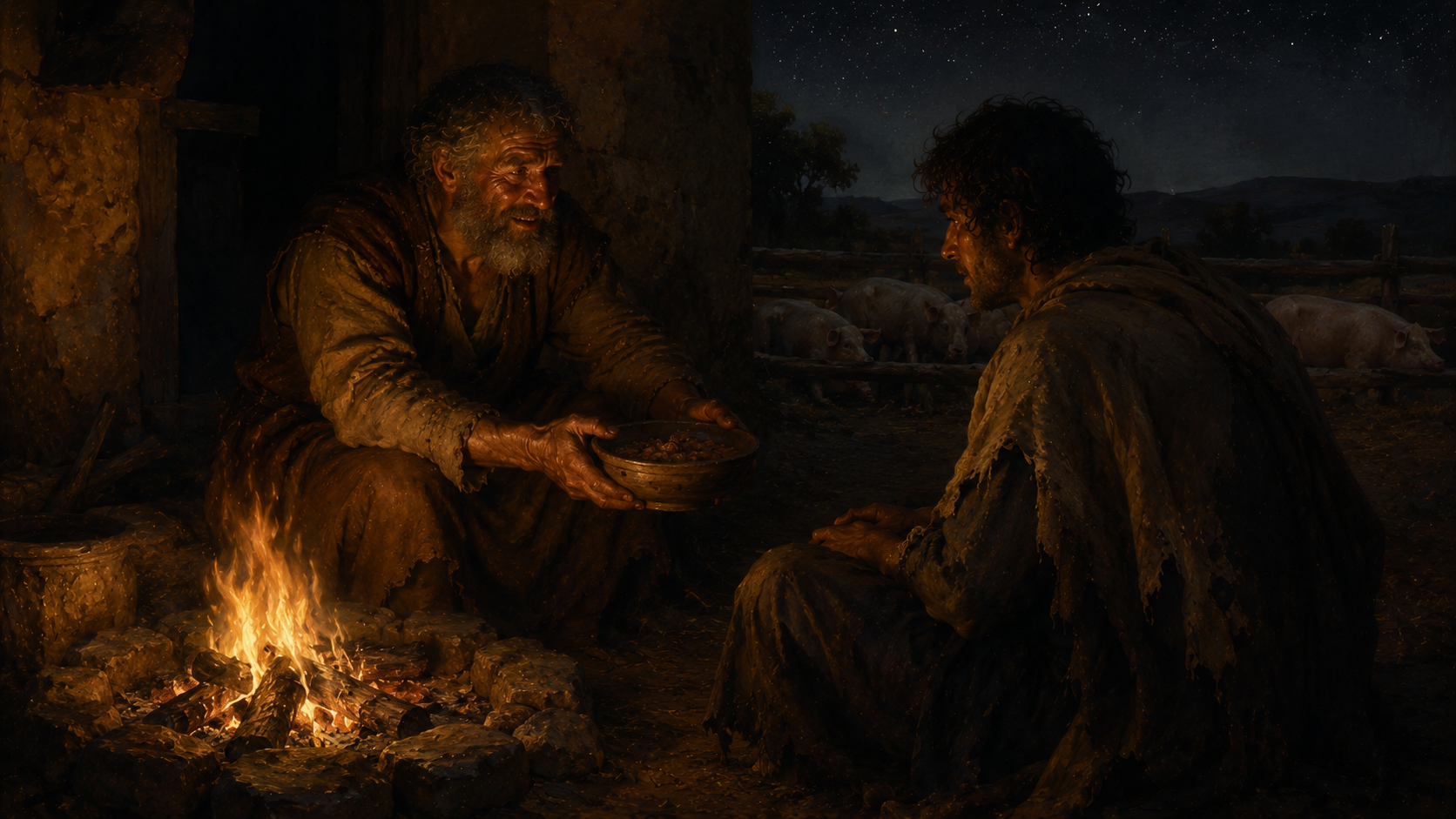
A Prince Disguised as a Slave
Eumaeus was not born to the pig yards. In Book 15, he tells the story of his origins to the stranger sitting by his fire, not knowing that the stranger is his own master in disguise. Eumaeus was born a prince, the son of a king named Ctesios who ruled the island of Syrie, a prosperous and peaceful place where no one went hungry and no one grew old from disease. His childhood ended when Phoenician traders arrived at the island. They seduced his nursemaid, a Phoenician woman herself, who had been captured in a raid years before. She agreed to steal the boy and bring him aboard their ship in exchange for passage home.
The nursemaid grabbed young Eumaeus during a feast when his parents were occupied, snatched three golden cups from the table, and ran for the harbor. She died during the voyage, her body thrown overboard, and the Phoenician traders sailed on with the child. They brought him to Ithaca and sold him to Laertes, the father of Odysseus. Anticleia, Odysseus's mother, raised the boy alongside her own daughter, treating him with kindness. But he was still property. However gently he was treated, Eumaeus grew up a slave in a house that was not his own, separated forever from his birthright.
This backstory accomplishes something crucial. It establishes that Eumaeus's nobility is not merely a quality of character. It is literally in his blood. He is as royal as Odysseus himself. The fact that he now tends pigs does not diminish him. If anything, it elevates him, because his goodness, his loyalty, his generosity to strangers are choices he makes despite having every reason to be bitter. He lost his kingdom, his family, his freedom. He could have become resentful or cruel. Instead, he became the most decent person in the poem.
Twenty Years of Faithfulness
While Odysseus was fighting at Troy and wandering the seas for twenty years, surviving the Cyclops, Circe, and Calypso, Eumaeus stayed. He tended the pigs. He maintained the property. He watched as the suitors moved into the palace and began consuming the wealth of the household, slaughtering the very animals he had raised. He could have stolen from the estate. He could have abandoned his post. He could have sided with the suitors, as some of the other servants did. Instead, he did his job. Quietly, faithfully, without recognition or reward, he kept working for a master who everyone assumed was dead.
The Odyssey is deeply interested in this question: what does loyalty look like when there is no one watching? When the person you are loyal to may never come back? When loyalty costs you something every day and rewards you nothing? The suitors represent one answer: self-interest, consumption, the assumption that the old order is gone and the strong can take what they want. Eumaeus represents the opposite. He is loyal not because he expects a reward, not because anyone is enforcing his obedience, but because he believes it is the right way to live. His loyalty is a moral stance, not a calculation. Eumaeus is, in many ways, the purest embodiment of the loyalty theme that runs through the entire Odyssey.
Homer underlines this by showing us the contrast between Eumaeus and the disloyal servants. Melanthius the goatherd openly mocks the disguised Odysseus, kicks him on the road, and has been feeding the suitors' appetites with animals from the royal herds. The maidservant Melantho sleeps with one of the suitors and insults the beggar to his face. These are people who have made the practical choice: the old master is gone, the suitors are in power, and survival means serving whoever holds the palace. Eumaeus's refusal to make that calculation is what makes him heroic, though he would never use that word for himself.
"And You Answered Him, Swineherd Eumaeus"
The most remarkable thing Homer does with Eumaeus is something no modern reader would notice without having it pointed out. At multiple points in the poem, Homer shifts from his usual third-person narration and addresses Eumaeus directly in the second person. Instead of writing "Eumaeus said" or "the swineherd replied," Homer writes "and you answered him, swineherd Eumaeus." In the Greek, the shift is striking: the verb moves from the third person to the second, and suddenly the bard is speaking to his character as if they were in the same room.
"And you answered him, swineherd Eumaeus: 'Eat now, friend, enjoy what is here to enjoy. God gives and God takes away, whatever he pleases.'" Homer, The Odyssey, Book 14
Scholars have debated for centuries why Homer does this. Some argue it is purely metrical, that the second-person form of "Eumaeus" happens to fit the dactylic hexameter line in positions where the third-person form does not. This is true as far as it goes. The Greek phrase "ton d'apameibomenos prosephes, Eumaie subota" ("and you answered him, swineherd Eumaeus") is a metrically perfect formula. But metrical convenience does not explain the emotional effect, which is unmistakable. When Homer turns to address Eumaeus directly, the distance between poet and character collapses. It feels intimate, almost tender, as if the bard cannot help stepping closer to this one person.
Homer does not address Odysseus this way. He does not address Penelope or Telemachus or Athena this way. The second-person address is reserved almost exclusively for Eumaeus (with a very few exceptions for other minor characters, like the swineherd Patroclus in the Iliad). The effect is that Eumaeus occupies a unique space in the poem: he is the character Homer loves, the one the poet feels most personally connected to, the one who gets a form of address that feels like a hand on the shoulder.
Recommended Reading
As an Amazon Associate, we earn from qualifying purchases.
The Disguised King at the Swineherd's Fire
When Odysseus arrives at Eumaeus's hut in Book 14, he is disguised as a ragged old beggar. Athena has transformed his appearance so thoroughly that no one could recognize him. This is the great test of the poem's second half, one of the recognition scenes that define the Odyssey's homecoming: who will be loyal to Odysseus when they do not know they are being tested? Who will treat a beggar with decency? Who will honor the laws of hospitality that Zeus himself protects?
Eumaeus passes the test immediately and completely. He welcomes the stranger without hesitation, offers him the best seat by the fire, shares his own food, and wraps him in a warm cloak against the cold. He apologizes for the poverty of his table, explaining that the suitors have consumed the best of the flocks. He speaks movingly of his absent master, whom he clearly loved not as property loves an owner, but as a younger man loves an older one who treated him well. He says he mourns for Odysseus more than for his own lost parents, a statement that is astonishing when you remember that Eumaeus's parents were a king and queen he was stolen from as a child.
Odysseus, sitting at the fire, listens to his own servant speak about him with genuine grief and love. He cannot reveal himself yet. The plan requires secrecy. So he sits and watches Eumaeus be exactly the man he hoped he was, and the scene becomes a quiet, powerful portrait of what loyalty looks like from the inside. Eumaeus does not know he is being observed. He is not performing. He is simply being himself, and what he is, is good.
Over the next several books, Eumaeus feeds the disguised Odysseus, defends him against the insults of other servants, accompanies him to the palace, and acts as a go-between for messages to Penelope. At every step, his behavior is consistent: generous, protective, patient. He treats a homeless stranger the same way he would treat a guest of honor, because that is what the gods demand and because it is how he was raised, first in a palace and then in a household that, at its best, taught the same values.
Loyalty and Social Class in the Odyssey
Eumaeus poses a problem for any simple reading of the Odyssey's social world. Greek epic poetry, with its epic similes and grand set pieces, generally operates with a clear hierarchy: gods above mortals, kings above commoners, free men above slaves. The heroes of the poem are aristocrats. Valor, eloquence, and beauty are treated as marks of noble blood. The poem is deeply invested in the idea that some people are born to rule and others to serve.
And yet here is Eumaeus, a slave, and he is arguably the most morally admirable character in the entire poem. He is more generous than the suitors, who are princes. He is more loyal than many of the free servants. He is more pious, more hospitable, more courageous. If nobility of character were the only criterion, Eumaeus would outrank everyone in the palace except perhaps Penelope herself.
Homer resolves this tension, at least partially, by giving Eumaeus royal blood. He is not really a commoner. He is a prince who was displaced by bad fortune. His goodness is not proof that any slave can be noble. It is proof that this particular slave was always noble, because he was born to be. Modern readers may find this unsatisfying, and it is worth acknowledging that the Odyssey does not challenge the institution of slavery itself. Homer never suggests that Eumaeus should be freed, or that the social order that made him a slave is unjust. What the poem does do, however, is insist that a person's current station in life does not determine their moral worth. Eumaeus may be a swineherd, but he behaves like a king. The suitors may be princes, but they behave like parasites. The Odyssey notices this gap between rank and character, and it cares about it deeply.
Eumaeus and the Revenge
When the moment of reckoning comes, Eumaeus is ready. After Odysseus reveals his true identity to Telemachus, the two of them bring Eumaeus and the cowherd Philoetius into the conspiracy. Both men weep with joy at the news that their master has returned. Both swear to fight. During the slaughter of the suitors, Eumaeus and Philoetius stand alongside Odysseus and Telemachus, four men against more than a hundred, and they hold their ground.
Eumaeus's role in the revenge is both practical and symbolic. Practically, he helps bar the doors, retrieves weapons from the storeroom, and fights in the melee. He also identifies the disloyal servants who aided the suitors, and he helps carry out the grim punishments that follow the battle. Symbolically, his presence at Odysseus's side completes the poem's argument about loyalty. The people who stayed faithful are rewarded. The people who betrayed their master are destroyed. Eumaeus, who never wavered, who never doubted that loyalty mattered even when no one was watching, stands at the center of the restored order.
Odysseus promises Eumaeus a future commensurate with his service: a wife, a house built near the king's own, and the status of a companion to Telemachus. In a poem that often rewards loyalty with more than words, this promise is the poem's way of saying that Eumaeus's twenty years of quiet faithfulness were not wasted. They were seen, and they mattered.
Recommended Reading
As an Amazon Associate, we earn from qualifying purchases.
Hear Eumaeus Welcome a Stranger
The scenes at the swineherd's hut in Books 14 through 16 are among the most intimate and moving in the entire Odyssey. There are no Sirens here, no shipwrecks, no divine interventions. Just a poor man sharing his fire with a stranger, speaking honestly about his grief, and treating a beggar with the dignity that the wealthy and powerful have forgotten. Our full-cast narration brings this quiet hospitality to life, with Eumaeus's warmth and Odysseus's barely concealed emotion heard in every exchange. These are the scenes where the poem's heart beats the loudest.
Explore the Odyssey
As an Amazon Associate, we earn from qualifying purchases.
Continue Reading
Hear the Swineherd's Welcome
A full cast of over 60 voices. Every word highlighted as it is spoken. Start with Book 14 and hear Eumaeus welcome a stranger into his hut.
Open Book 14The Odyssey Collection
Loyal hearts of Ithaca. T-shirts, posters, mugs, canvas prints, and tote bags featuring the Odyssey.
Shop This DesignMORE DESIGNS
Hear this character's story in Homer's own words
Go Deeper Into the Odyssey Film
Get the free Odyssey Companion Guide: character map, timeline, family tree, and the essential scenes from Homer's poem and the film.
No spam. Unsubscribe anytime.