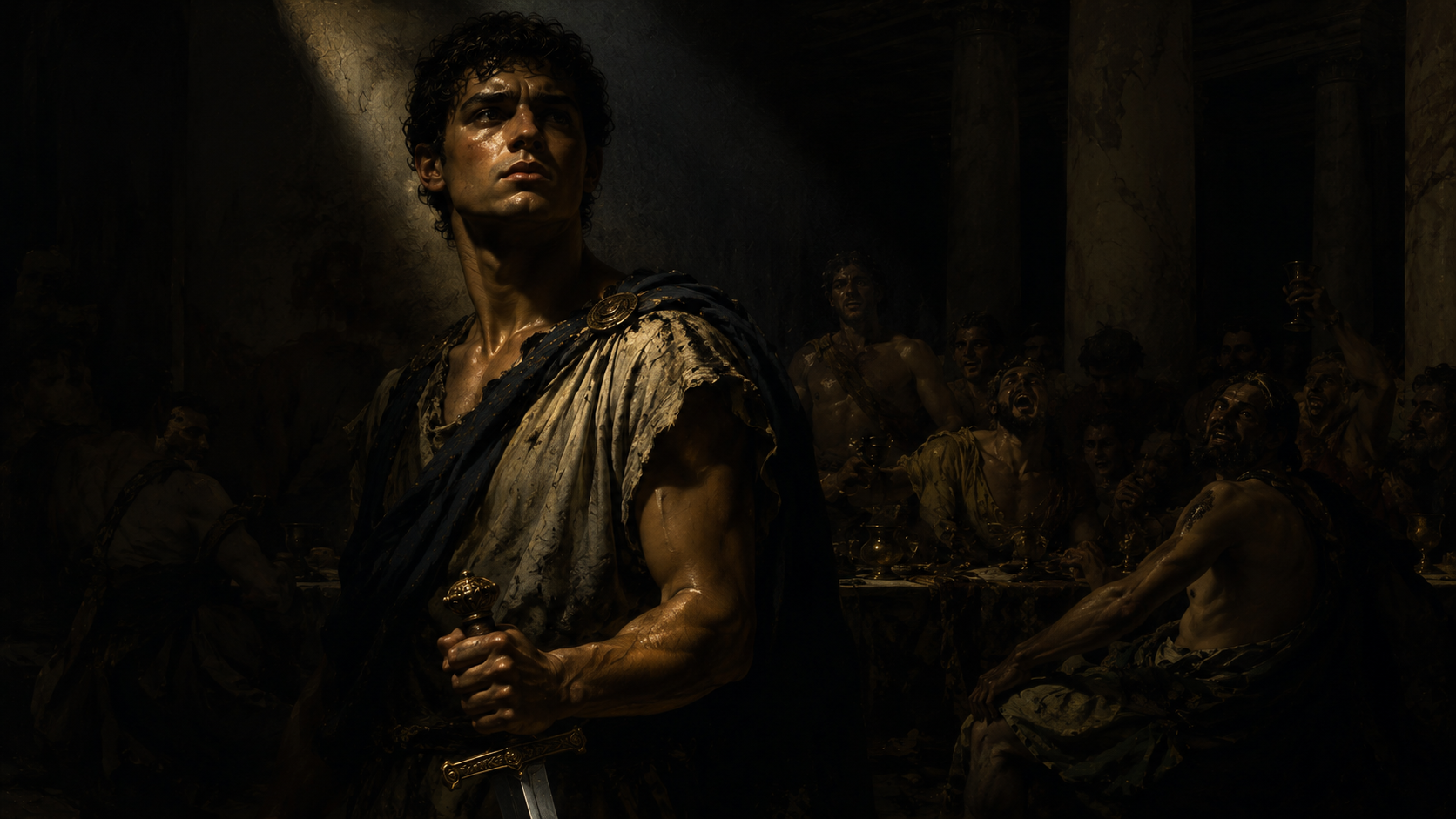
Growing Up in an Empty House
Telemachus was an infant when Odysseus left for Troy. He has no memory of his father. Everything he knows about Odysseus comes from stories, from his mother Penelope's grief, and from the gap in the household where a king should be.
That gap has been filled by the suitors. Over a hundred men from Ithaca and the surrounding islands have moved into Odysseus's palace, eating his livestock, drinking his wine, and pressuring Penelope to choose one of them as her new husband. They are not just guests overstaying their welcome. They are a hostile occupation. They slaughter Odysseus's cattle daily. They sleep with the household servants. They plot to kill Telemachus if he becomes too much of a problem.
For Telemachus, growing up in this environment means growing up humiliated. He is the son of the king, but he has no power. He cannot throw the suitors out because they outnumber him and he has no allies. He cannot appeal to the community because the suitors come from the leading families. He cannot leave because his mother needs him. He is stuck, and he is angry, and he has no idea what to do about it.
Homer captures this brilliantly in the poem's opening scenes. When we first meet Telemachus in Book 1, he is sitting among the suitors, daydreaming about his father coming home and scattering them. It is a child's fantasy: the powerful absent father arriving like a force of nature to make everything right. Telemachus does not yet understand that he will have to do some of the work himself.
Athena's Visit: The Push He Needed
The catalyst for Telemachus's transformation is Athena. She arrives at the palace disguised as Mentes, a family friend, and she does something no one else has done for Telemachus: she takes him seriously.
Athena tells him that Odysseus is alive. She tells him to call an assembly of the Ithacans and publicly confront the suitors. And she tells him to sail to Pylos and Sparta to seek news of his father from the veterans of the Trojan War. In other words, she gives him a plan. Not a plan to defeat the suitors (that will come later), but a plan to stop being passive. To act.
"You are no longer a child; you must put childish things away. Have you not heard how Orestes won himself a great name when he killed the traitor Aegisthus for murdering his noble father?" Homer, The Odyssey, Book 1 (Samuel Butler translation)
The Orestes comparison is significant. Orestes is the son of Agamemnon, who was murdered by his wife Clytemnestra and her lover Aegisthus when he returned from Troy. Orestes grew up, came back, and killed them both. Athena is holding up Orestes as the model of what a son does when his father's house is threatened. It is both an encouragement and a challenge: are you that kind of son?
Telemachus is not Orestes. His situation is different, his personality is different, and the poem is careful about that distinction. But the comparison lights a fire. For the first time, someone has told Telemachus that he has the right and the responsibility to act. That matters enormously for a young man who has spent his entire life being told, implicitly, that he does not count.
The Assembly: Standing Up in Public
In Book 2, Telemachus does something that has not been done in Ithaca for twenty years: he calls an assembly. The people gather. The elders sit. And Telemachus stands up, holds the speaker's staff, and addresses the community.
He does not call for war. He does not threaten the suitors with violence. He simply states the facts: these men are destroying his household, violating the laws of hospitality, and no one is stopping them. He appeals to shame. He appeals to justice. He asks the community to hold the suitors accountable.
The suitors respond with contempt. Antinous, their ringleader, shifts the blame to Penelope, accusing her of deceiving them with the weaving trick (working on a shroud by day and unraveling it by night to delay choosing a husband). Eurymachus insults Telemachus directly. The assembly accomplishes nothing politically. The suitors are not shamed, and the community does not act.
But the assembly accomplishes everything for Telemachus as a character. He has spoken. He has stood up in the public square and named the injustice. He has stopped being the quiet boy sitting in the corner. Even though no one helps him, the act of speaking changes something inside him. From this point forward, he is a person who acts rather than a person who waits.
Recommended Reading
As an Amazon Associate, we earn from qualifying purchases.
The Journey: Pylos and Sparta
With Athena's help (she disguises herself as Mentor, an old friend of Odysseus, and accompanies him), Telemachus sails first to Pylos, the kingdom of old Nestor, and then to Sparta, where Menelaus and Helen live.
These visits serve multiple purposes. On the surface, Telemachus is gathering intelligence about his father. Nestor tells him about the aftermath of Troy, the scattering of the Greek fleet, and the fates of various heroes. Menelaus tells him that Odysseus is alive, trapped on Calypso's island, based on what the sea-god Proteus revealed to him. This information is useful, but it is not the real point of the journey.
The real point is education. Telemachus has never left Ithaca. He has never seen how a properly run kingdom works. At Pylos, he watches Nestor perform sacrifices, host guests, and govern with wisdom and generosity. At Sparta, he sees the wealth and order of Menelaus's court. He learns what hospitality looks like when it is done right, and by extension, he learns how badly it has been violated in his own home.
He also learns about his father through other people's eyes. Nestor and Menelaus both speak about Odysseus with admiration and affection. They tell Telemachus stories of his father's bravery and cunning at Troy. For a young man who has only known his father as an absence, these stories are transformative. They give him something to live up to. They also give him a model of manhood that the suitors, for all their swagger, cannot match.
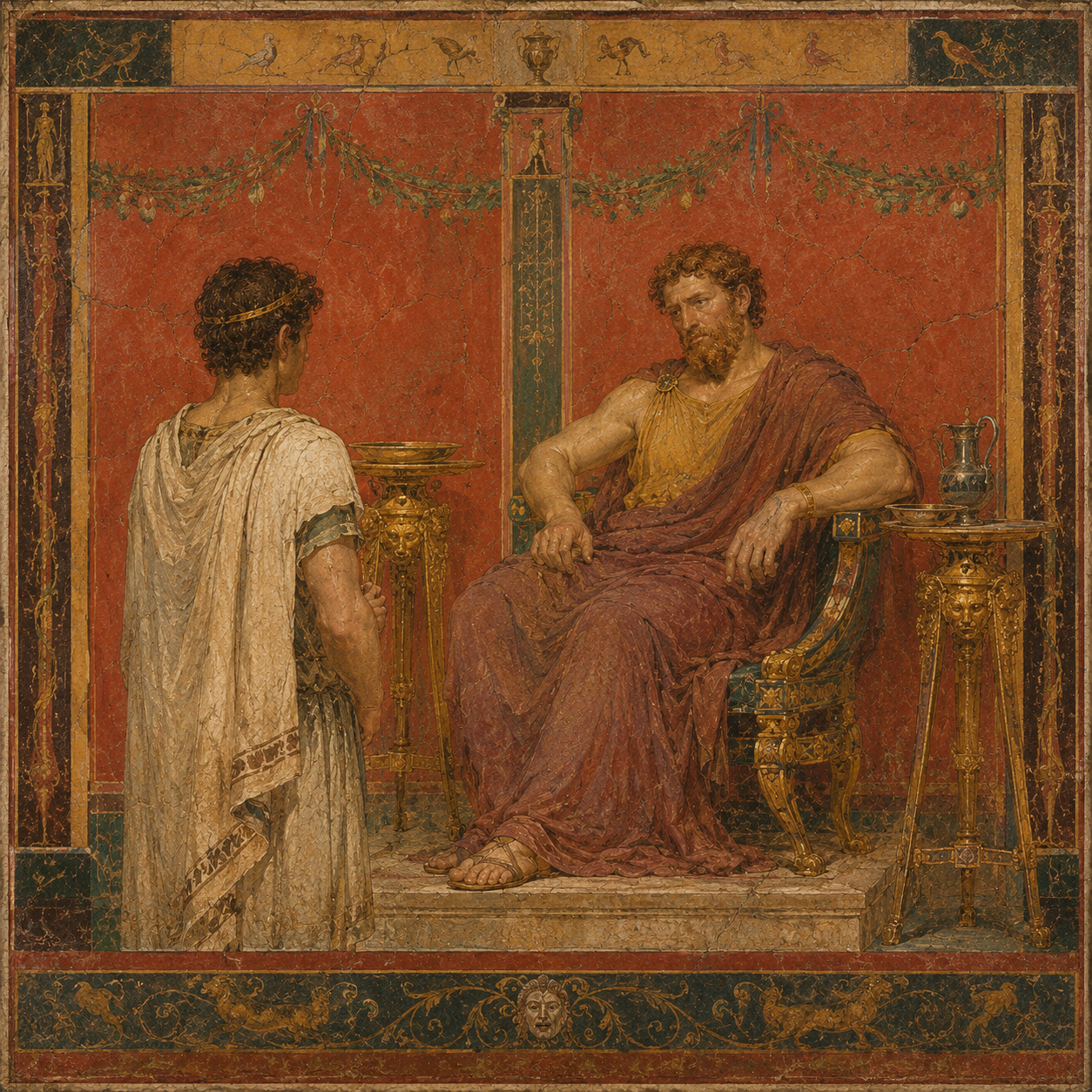
Homer is doing something subtle here. He is using the Telemachy (as scholars call Books 1 through 4) not just to develop Telemachus, but to develop the audience's understanding of what Odysseus means to the world. By the time we finally meet Odysseus in Book 5, stranded and weeping on Calypso's island, we have already heard everyone else talk about how extraordinary he is. The expectations are set. And they are set through the eyes of his son.
The Return and the Suitors' Plot
While Telemachus is away, the suitors learn of his journey and are alarmed. They did not expect this. The passive boy they have been ignoring has suddenly left the island, which means he might be building alliances, seeking help, or coming back with an army. They decide to ambush him on his way home, stationing a ship in the strait between Ithaca and the nearby islands.
The murder plot is a turning point. Up to now, the suitors have been arrogant and parasitic, but they have stayed within certain boundaries. Planning to kill the prince crosses a line. It shifts them from unwelcome guests to genuine villains, and it makes the audience feel that whatever Odysseus does to them later is justified.
Athena warns Telemachus, and he returns to Ithaca by a different route, avoiding the ambush. He lands on the far side of the island and goes first to the hut of Eumaeus, the loyal swineherd. This is where everything converges. Because Odysseus is already there, disguised as a beggar.
The Reunion: Father and Son
The recognition scene in Book 16 is one of the most emotionally charged moments in the poem. Odysseus reveals himself to Telemachus in the swineherd's hut. Athena lifts the disguise, and suddenly the ragged beggar is a tall, strong man in his prime. Telemachus does not believe it at first. He thinks it is a trick of the gods.
"I am no god; why should you take me for one? I am your father, on whose account you grieve and suffer so much at the hands of lawless men." Homer, The Odyssey, Book 16 (Samuel Butler translation)
They embrace. They weep. Homer says they cry like birds whose young have been taken from the nest by farmers. The simile is precise: it captures both the helplessness of separation and the fierceness of reunion. Odysseus has been gone for twenty years. Telemachus has waited his entire life for this moment. And now the fantasy from Book 1 (the powerful father arriving to set things right) is actually happening, except it is not simple, because the father needs the son just as much as the son needs the father.
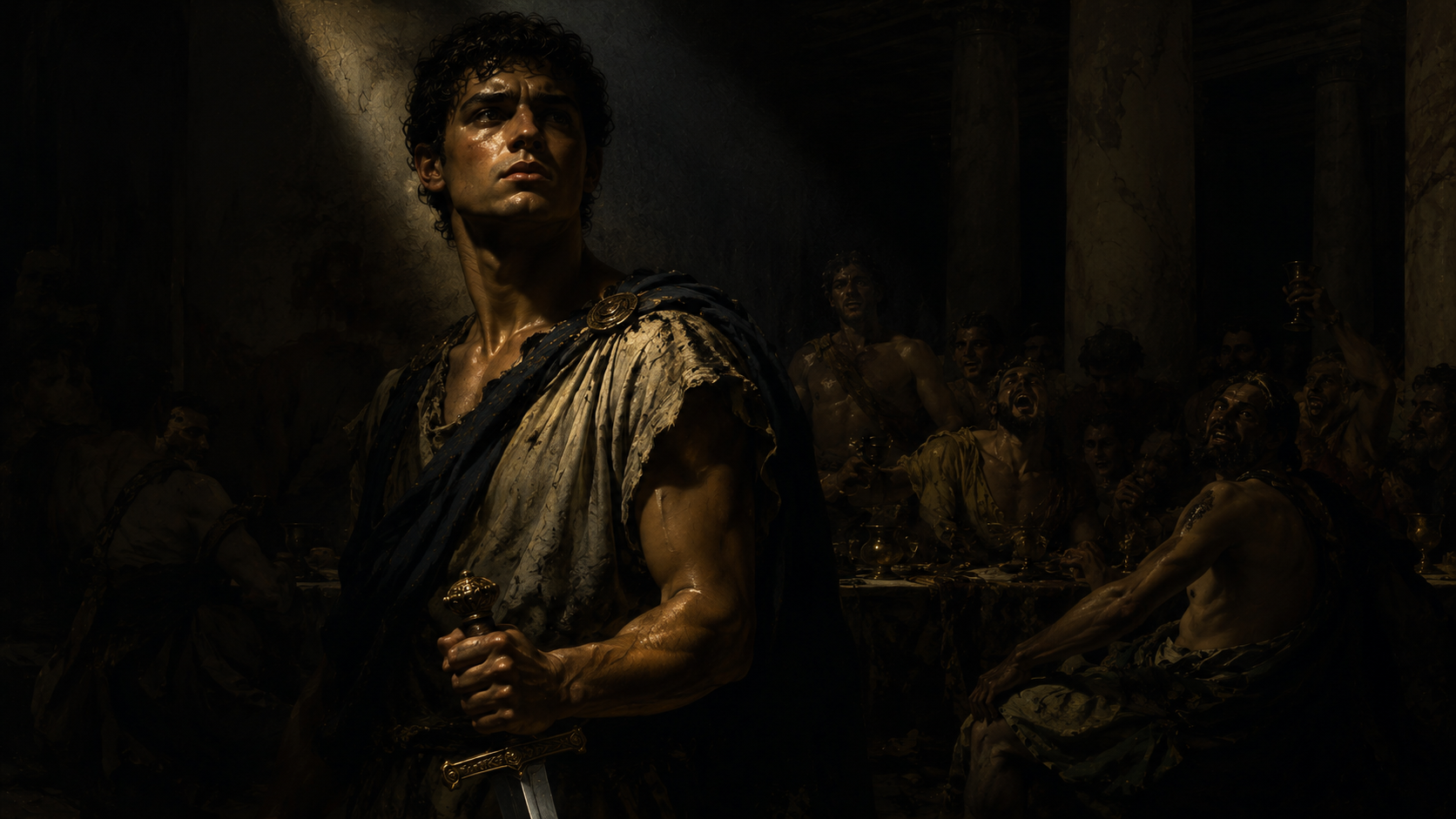
What follows is a plotting session. Odysseus and Telemachus plan the slaughter of the suitors together. Odysseus will enter the palace in disguise. Telemachus will remove the weapons from the great hall (leaving only their own hidden away). When the moment comes, they will strike together.
This is the crucial shift in their relationship. Odysseus does not tell Telemachus to stand aside. He does not treat him as a child. He gives him a role in the plan and trusts him to carry it out. For Telemachus, being taken into his father's confidence as an equal is the completion of the coming-of-age arc that began when Athena told him to stop being a boy.
In the Great Hall: The Test of Patience
The second half of the Odyssey is an extended exercise in self-control, and Telemachus is tested alongside his father. Odysseus enters the palace as a beggar. The suitors insult him, throw things at him, and mock him. Telemachus has to watch this and say nothing, because if he reveals that he knows who the beggar really is, the plan falls apart.
This is harder than fighting. In battle, you can channel your anger into action. In the great hall, Telemachus has to channel it into silence. He has to watch the suitors abuse his disguised father, knowing that any reaction could get them both killed. Homer gives us several moments where Telemachus nearly breaks. When the suitor Ctesippus throws a cow's hoof at the beggar's head, Telemachus controls himself, but barely. He speaks up, warning the suitors that they are going too far, but he does not reveal the truth.
This self-discipline is something the poem values enormously. Remember that Odysseus's fatal flaw in Book 9 was his inability to stay silent. He shouted his name at the Cyclops because his pride would not let the victory go unclaimed. In the great hall, both father and son succeed where the younger Odysseus failed: they hold their tongues, they endure the insults, and they wait for the right moment. Telemachus has learned the lesson that took Odysseus twenty years to learn.
Recommended Reading
As an Amazon Associate, we earn from qualifying purchases.
The Bow Contest and the Battle
When Penelope brings out Odysseus's great bow and announces the bow contest, that she will marry whoever can string it and shoot an arrow through twelve axe heads, Telemachus tries first. He nearly strings it. Homer says he would have done it on the fourth attempt, but Odysseus signals him to stop. It is not yet time.
That near-success matters. It tells us that Telemachus is physically capable, that he has grown into a man strong enough to handle his father's weapon. It also tells us that he is obedient enough to step aside when the plan requires it. Both qualities will be needed in the next few minutes.
Once Odysseus strings the bow and reveals himself, the battle begins. Telemachus is right there. He fetches armor and spears from the storeroom. He arms the loyal servants Eumaeus and Philoetius. He fights in the hall, killing suitors alongside his father. In one of the poem's more notable moments, he also makes a mistake: he leaves the storeroom door open, allowing one of the treacherous servants to bring weapons to the suitors. Odysseus rebukes him, and Telemachus admits the error. It is a human moment. He is brave and capable, but he is still young and not perfect.
The battle ends with the suitors dead and the palace reclaimed. Telemachus has fought and bled alongside his father. The boy who sat daydreaming in Book 1 has become a warrior in Book 22. The arc is complete.
Why Telemachus Matters to the Poem
It would be easy to see Telemachus as a supporting character, the son who exists to give Odysseus an extra motivation to get home. But Homer gives him far more than that.
He is the poem's emotional anchor in Ithaca. While Odysseus is dealing with monsters and goddesses, Telemachus shows us the human cost of his absence. The suitors are not just eating food. They are destroying a family. Through Telemachus, we feel the weight of twenty years without a father, the frustration of being powerless in your own home, and the slow corrosion of a household without its head.
He represents the next generation. The Odyssey is set in the aftermath of a ten-year war. The heroes of that war (Achilles, Ajax, Agamemnon) are dead or diminished. Telemachus is part of the generation that inherits the mess. His growth from passivity to action mirrors what a whole society needs after a catastrophic conflict: new leaders who can step into the roles their fathers left behind.
He completes Odysseus's arc. Odysseus's homecoming is not just about reaching Ithaca. It is about reclaiming his identity as a husband, a king, and a father. The relationship with Telemachus is the test of that last role. When Odysseus trusts his son with the plan, fights beside him, and acknowledges his mistakes, he is not just defeating the suitors. He is becoming a father for the first time in twenty years.
His arc mirrors the poem's themes. The Odyssey is about the journey home, both literal and metaphorical. Odysseus travels across the sea. Telemachus travels from boyhood to manhood. Both journeys are long, painful, and necessary. And both end in the same place: the great hall of Ithaca, where father and son stand together for the first time.
Hear Telemachus Come to Life
Our full-cast narration gives Telemachus his own voice, distinct from Odysseus, Penelope, and the suitors. Start with Book 1, where a frustrated young man sits in a hall full of enemies, and follow his journey all the way to Book 22, where he stands beside his father with a spear in his hand. Every word highlighted as it is spoken. This is a story about growing up in the hardest possible circumstances, and it deserves to be heard.
Explore the Odyssey
As an Amazon Associate, we earn from qualifying purchases.
Related Pages
Follow Telemachus from Boy to Man
Full-cast narration. Every word highlighted as it is spoken. Start with Book 1 and hear the young prince take his first steps toward becoming a hero.
Open Book 1Wear the Son of Odysseus
Telemachus merch across five product types. T-shirts, posters, mugs, canvas prints, and tote bags.
Shop This DesignHear this character's story in Homer's own words
Go Deeper Into the Odyssey Film
Get the free Odyssey Companion Guide: character map, timeline, family tree, and the essential scenes from Homer's poem and the film.
No spam. Unsubscribe anytime.