Last updated June 2026
Why Athena Favors Odysseus
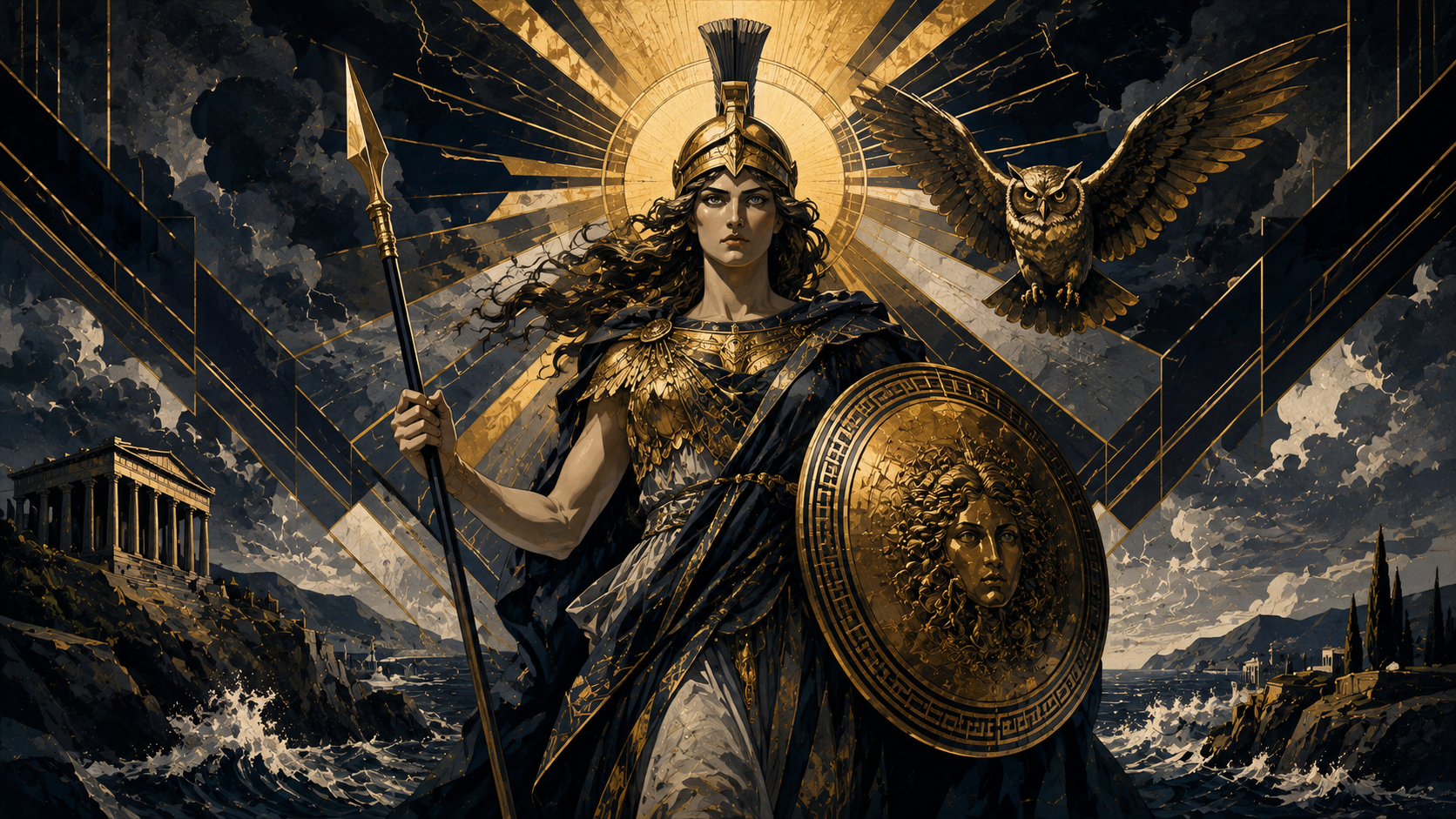
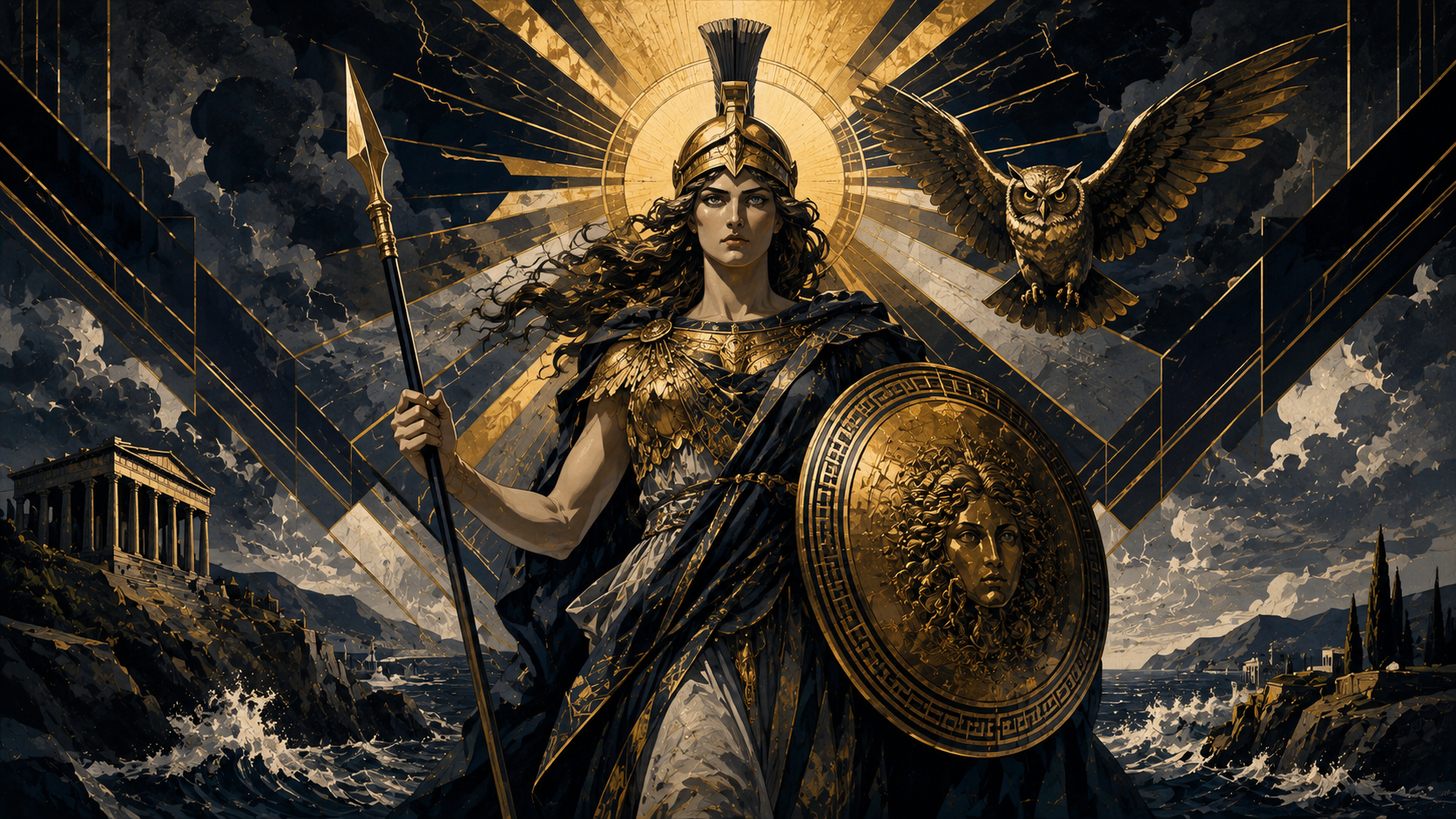
The short answer is that they are the same. Athena is the goddess of wisdom and strategic warfare. Odysseus is the cleverest man in the Greek world. They share a mind. They both prefer cunning over brute force, plans over impulse, disguise over direct confrontation. In a poem full of warriors, Athena chose the one who thinks before he fights.
This is made explicit in their extraordinary reunion scene in Book 13, one of the most remarkable conversations in all of ancient literature. When Odysseus lands on Ithaca, Athena appears first as a young shepherd, and Odysseus, not recognizing her, tells her a completely fabricated story about who he is and how he got there. He lies with total fluency, inventing a backstory on the spot. Athena listens, then drops her disguise and grins at him:
"He must be indeed a shifty lying fellow who could surpass you in all manner of craft even though you had a god for your antagonist. Dare devil that you are, full of guile, unwearying in deceit, can you not drop your tricks and your instinctive falsehood, even now that you are in your own country again?"
She is not angry. She is delighted. She tells him they are kindred spirits: "We can both of us deceive upon occasion -- you are the most accomplished counsellor and orator among all mankind, while I for diplomacy and subtlety have no equal among the gods." This is a goddess telling a mortal that he is her match. It is an astonishing compliment, and it explains everything about why she has spent twenty years fighting to get him home.
Book 1: Athena Sets Everything in Motion
The Odyssey begins with a council of the gods on Mount Olympus, and it is Athena who gets things moving. Poseidon is away visiting the Ethiopians, so Athena seizes the moment to plead Odysseus's case before Zeus. Her argument is passionate and personal:
"It is for Ulysses that my heart bleeds, when I think of his sufferings in that lonely sea-girt island, far away, poor man, from all his friends."
Zeus agrees to send Hermes to order Calypso to release Odysseus. But Athena does not wait for the bureaucracy of Olympus to work. She immediately flies down to Ithaca, disguised as Mentes, a Taphian chieftain, and goes straight to Odysseus's palace. There she finds Telemachus, now a young man, sitting moodily among the suitors who are eating his father's food and courting his mother.
Athena-as-Mentes does something crucial. She treats Telemachus like an adult. She tells him to go looking for news of his father, to visit Nestor in Pylos and Menelaus in Sparta. She tells him to stand up to the suitors. She plants the idea that he has a role to play in his own story. Before Athena's visit, Telemachus is passive and depressed. After it, he begins to act. She does not solve his problems for him. She gives him the courage to solve them himself.
Mentoring Telemachus: Books 2 through 4
Athena accompanies Telemachus on his journey to Pylos and Sparta, this time disguised as Mentor, a family friend. The name "Mentor" has entered every modern language as a word meaning "wise guide," and it comes directly from this section of the Odyssey. Athena-as-Mentor teaches Telemachus how to speak in assembly, how to carry himself among kings, and how to be the son of Odysseus.
What is remarkable about Athena's mentoring is its restraint. She does not solve Telemachus's problems or fight his battles. She nudges. She encourages. She gives him the right push at the right moment and then steps back. When Telemachus hesitates to approach the great King Nestor, Athena tells him to just go up and talk to the man. When he needs to be brave, she puts courage in his heart. She is building a man, not doing his work for him.
This mirrors her relationship with Odysseus. She never hands either father or son an easy victory. She helps them become the kind of people who can win their own victories. The difference between Athena and a god like Poseidon is precisely this: Poseidon uses his power to destroy. Athena uses hers to develop.
Recommended Reading
As an Amazon Associate, we earn from qualifying purchases.
The Long Absence: Books 5 through 12
Here is a puzzle that has fascinated readers for centuries: where is Athena during Odysseus's actual adventures? Through the Cyclops, Circe, the Underworld, the Sirens, Scylla, and the cattle of the sun, Athena is nowhere to be seen. Odysseus faces his most dangerous trials entirely on his own.
Odysseus himself raises this issue in Book 13. When Athena reveals herself on the beach in Ithaca, he confronts her: "You were very kind to me as long as we Achaeans were fighting before Troy, but from the day on which we went on board ship after having sacked the city of Priam -- from that day, Minerva, I saw no more of you, and cannot ever remember your coming to my ship to help me in a difficulty."
Athena's answer is revealing. She says she never doubted he would survive, but she stayed away because she did not want to quarrel with her uncle Poseidon, who was furious about the blinding of his son Polyphemus. This is a diplomatic answer, and like most diplomatic answers, it may not be the whole truth. But it establishes an important point: there are limits to what even a goddess can do. Athena cannot openly defy Poseidon on the open sea. She has to work within the politics of Olympus.
There is also a narrative logic to her absence. Odysseus's adventures in Books 9 through 12 are about survival through his own wits. If Athena were there deflecting every danger, those stories would lose their power. Odysseus has to face the Cyclops alone to prove he is clever enough to escape a cave with nothing but a sharpened stake and a fake name. He has to endure Scylla and Charybdis without divine help to show that even the smartest man alive cannot protect everyone. Athena's absence makes Odysseus's achievements his own.
The Reunion on the Beach: Book 13
Book 13 contains the single best scene between Athena and Odysseus, and one could argue it is the emotional pivot of the entire Odyssey. The Phaeacians have dropped Odysseus on the shore of Ithaca while he sleeps, piling his treasure beside him. He wakes up and does not recognize his own homeland because Athena has covered it in mist.
When she first approaches him, disguised as a shepherd, Odysseus does not know her. He tells her one of his elaborate lies, a whole invented backstory about being a fugitive from Crete. And Athena, behind her shepherd disguise, watches him lie with absolute mastery. Then she drops the disguise and the conversation shifts.
She tells him the truth: he is home. She lifts the mist and shows him the landmarks of Ithaca. Odysseus kisses the ground. Then they sit down together under an olive tree, like two old colleagues who have not seen each other in years, and they plan how to deal with the suitors.
This scene matters because it is the only time in the Odyssey where Athena and Odysseus interact as equals, without pretense, without disguise (once she drops hers), without anyone else listening. She tells him everything: the suitors, Penelope's situation, Telemachus's journey. He asks her for help, and she gives it willingly. She disguises him as a beggar, covering his body with wrinkles and rags. She gives him a plan: go to the swineherd Eumaeus first, then to the palace, then strike. It is a strategy session between the goddess of wisdom and the cleverest man alive, and the pleasure they take in each other's company is palpable.
Behind the Scenes: Books 14 through 20
Once the plan is set, Athena operates behind the scenes. She goes to Sparta to bring Telemachus home (Book 15). She arranges for father and son to meet at Eumaeus's hut, then lifts Odysseus's disguise so Telemachus can see who the stranger really is (Book 16). The reunion between father and son, one of the most moving scenes in the poem, is orchestrated by Athena.
Throughout the palace scenes in Books 17 through 20, Athena is present but subtle. She enhances Penelope's beauty to keep the suitors interested and their gifts flowing. She inspires Penelope to bring out the bow. She restrains Odysseus when he is tempted to strike too early. She is the director of this drama, moving her actors into position for the climax.
One of her most important interventions is invisible. In Book 20, Odysseus lies awake at night, wrestling with anger and doubt. He watches the disloyal maidservants sneak out to sleep with the suitors and wants to kill them on the spot. Athena comes to him and calms him, assuring him that she is with him. It is a moment of genuine tenderness from a goddess who is not typically associated with emotional warmth. She does not just help him fight. She helps him wait.
Recommended Reading
As an Amazon Associate, we earn from qualifying purchases.
The Battle: Books 21 through 22
When the contest of the bow begins in Book 21, it is Athena who put the idea in Penelope's mind to set it up. When Odysseus strings the bow and the fight begins in Book 22, Athena appears in the form of Mentor to encourage him. But she does something interesting: she does not simply annihilate the suitors with divine power. She lets Odysseus, Telemachus, Eumaeus, and Philoetius do the fighting. She deflects a few spears, but the killing is done by mortal hands.
This is consistent with everything Athena does in the poem. She helps people help themselves. She creates the conditions for victory and then steps back to let her favorites earn it. When the suitors realize they are losing, they see Mentor's form on the ceiling of the hall and know that a god is involved. But by then, their arrows have been missing and Odysseus's have not. Athena tipped the scales, but the fight was Odysseus's.
The Final Act: Book 23 and 24
After the killing, Athena performs one last act of beautification. She makes Odysseus taller, stronger, and more handsome, so that when Penelope sees him, he looks like a god. She washes away the grime and blood and makes "the hair grow thick on the top of his head." She is preparing him for the most important meeting of his life: the reunion with the woman who has waited twenty years for him.
After Odysseus and Penelope reunite, Athena does something quietly beautiful. She holds back the dawn, stretching the night so the couple can have more time together. This is the goddess of war and wisdom using her power for the most intimate purpose imaginable: giving two people who love each other a few more hours.
In Book 24, Athena takes command one final time. When the families of the dead suitors march on Laertes's farm, she first rejuvenates old Laertes so he can fight, then stops the battle by raising her voice: "Men of Ithaca, cease this dreadful war." Zeus backs her with a thunderbolt. Athena brokers the final peace, taking the form of Mentor one last time. The poem ends with her voice, establishing the covenant that will let Ithaca heal.
What Makes Athena Different
The gods in Homer can be petty, vindictive, and self-interested. Poseidon persecutes Odysseus for ten years over a blinded son. Zeus sends storms and shipwrecks to punish the crew for eating sacred cattle. The gods of the Iliad pick sides in the war like sports fans and let their favorites die to settle divine grudges.
Athena is different. Her relationship with Odysseus has genuine affection. She worries about him. She argues for him in front of Zeus. She mentors his son when she cannot help the father directly. She takes pleasure in his cleverness. She gives him time alone with his wife. She is not using Odysseus as a pawn in some divine game. She cares about him as a person.
This makes the Odyssey's theology warmer and more personal than the Iliad's. In the Iliad, the gods watch men die from a distance and occasionally mourn. In the Odyssey, Athena walks beside a man for twenty years, helping him survive not because it serves some cosmic purpose but because she genuinely wants him to get home to his family. The relationship between Athena and Odysseus is one of the things that makes the Odyssey feel modern. It is about someone who cares watching over someone who struggles, and intervening not with overwhelming force but with exactly enough help at exactly the right moment.
Explore Athena
As an Amazon Associate, we earn from qualifying purchases.
Related Pages
Hear Athena's Voice in Every Book
All 24 books of the Odyssey, read aloud with a full cast of distinct voices. From Athena's plea on Olympus to her final peace on Ithaca, every word highlights as it is spoken.
Listen NowWear the Goddess of Wisdom
Athena and cunning-themed merch. T-shirts, posters, mugs, canvas prints, and tote bags.
Shop This DesignMORE DESIGNS
Hear this character's story in Homer's own words
Go Deeper Into the Odyssey Film
Get the free Odyssey Companion Guide: character map, timeline, family tree, and the essential scenes from Homer's poem and the film.
No spam. Unsubscribe anytime.