Penelope: The Loyalty That Holds Everything Together
Penelope's loyalty is the foundation on which the entire poem stands. Without it, there is nothing for Odysseus to come home to. For twenty years, she has held the household together against impossible pressure: over a hundred suitors occupying her home, consuming her husband's wealth, demanding she choose one of them as her new husband. She has no army, no divine protector standing visibly at her side, no certainty that Odysseus is even alive. And still she refuses to yield.
Her most celebrated act of resistance is the weaving trick. She tells the suitors she will remarry once she finishes weaving a funeral shroud for her father-in-law, Laertes. Each day she weaves at the loom, and each night she unravels what she has done, buying time through craft rather than force. The trick works for three years before a disloyal servant betrays the secret. But even after the weaving ruse collapses, Penelope continues to delay, invent obstacles, and find reasons not to choose.
What makes Penelope's loyalty extraordinary is not its duration, though twenty years is staggering. What makes it extraordinary is its intelligence. She does not wait passively. She schemes, she tests, she maneuvers. When Odysseus finally returns and kills the suitors, she tests him too, with the famous bed trial, because her loyalty is not blind faith. It is a considered devotion, clear-eyed and tough, offered only to the man who can prove he deserves it. Homer presents her not as a patient wife but as a worthy counterpart to the cleverest man alive. Her cunning matches his. Her endurance exceeds his.
.png)
Eumaeus and Philoetius: Loyalty Without Rank
If Penelope represents loyalty at the highest social level, Eumaeus the swineherd and Philoetius the cowherd represent loyalty at its most humble and, in some ways, its most pure. These are servants, men without power, wealth, or status. They have nothing to gain by remaining faithful to an absent master and a great deal to gain by joining the suitors. Yet they never waver.
Eumaeus is one of the most lovingly drawn characters in the entire poem. Homer calls him "the noble swineherd" and, in a gesture almost unique in ancient epic, addresses him directly in the second person: "And you replied, Eumaeus, my good swineherd." Scholars have debated for centuries why Homer grants this intimacy to a servant. The answer may be simpler than it seems. Homer admires him. In a poem full of kings and gods and monsters, the swineherd who tends his master's pigs with care, who offers a stranger his own cloak on a cold night, who weeps when he speaks of the master he fears is dead, is treated as one of the noblest figures in the story.
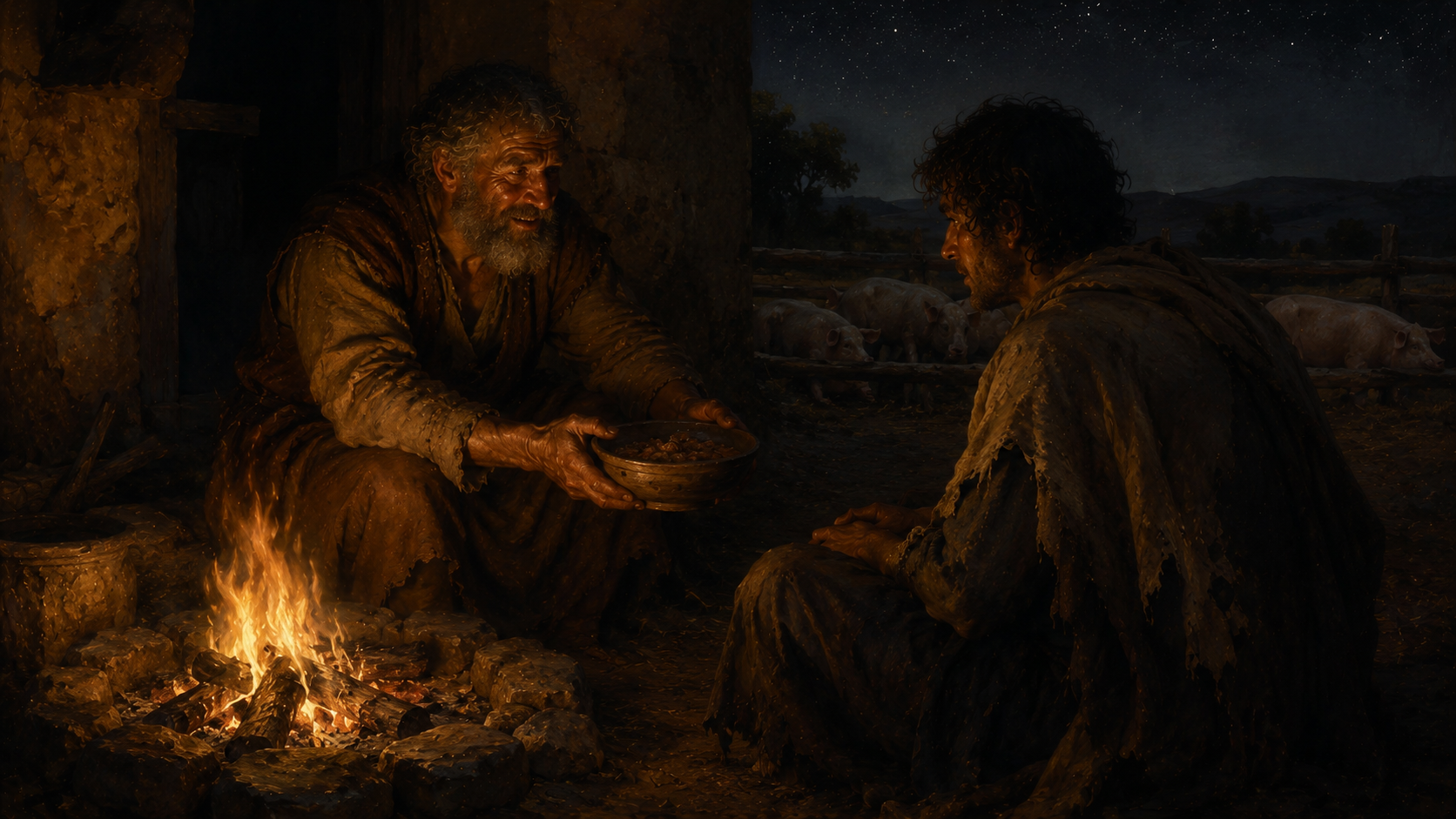
Eumaeus remains faithful to his absent master through all the years
Philoetius, the cowherd, is cut from the same cloth. When the disguised Odysseus meets him, Philoetius is near tears at the state of the household. He has kept his master's cattle safe and healthy, refusing to let the suitors slaughter them all, even though it has earned him nothing but contempt. When Odysseus finally reveals himself, both men weep with joy and immediately volunteer to fight. They stand beside their king in the great hall, armed with borrowed weapons, and help him kill the suitors who abused the household they served.
What Homer understands about loyalty, and what he shows through these two men, is that it does not require power to be meaningful. Eumaeus and Philoetius cannot save the household by themselves. But they can preserve their own integrity, and that preservation matters. When Odysseus reclaims his throne, they are there beside him, not because they were powerful enough to change the outcome, but because they were faithful enough to deserve a place in it.
Argos: Loyalty Beyond the Grave
No discussion of loyalty in the Odyssey can pass over Argos, and yet the scene is so brief you could miss it if you read too quickly. Argos is Odysseus's old hunting dog, once a magnificent animal, now lying abandoned on a pile of dung outside the palace gates. The suitors feast inside. The dog lies outside. That single image tells you everything about what has gone wrong in Ithaca.
When the disguised Odysseus passes by, Argos recognizes him. The dog wags his tail. He flattens his ears. He does not have the strength to stand and go to his master, but he knows. Odysseus sees the dog, secretly wipes away a tear, and keeps walking. He cannot acknowledge Argos without revealing himself. And Argos, having waited twenty years for this one moment, puts his head down and dies.
"But the doom of dark death now closed over the dog, Argos, once he had seen Odysseus, in the twentieth year." Homer, The Odyssey, Book 17 (Samuel Butler translation, 1900)

Twenty years of loyalty, fulfilled in a single glance
The scene lasts barely a dozen lines, and yet it has moved readers for nearly three thousand years. Its power lies in the purity of the loyalty it represents. Argos does not understand politics. He does not know about the suitors, the journey, the war. He knows only that his master left and did not come back. And he waited. Through neglect, through the deterioration of his own body, through years of lying on dung while strangers walked through the gates, he waited. His loyalty is not a strategy or a calculation. It is simply what he is. And when it is finally fulfilled, he can let go.
Recommended Reading
As an Amazon Associate, we earn from qualifying purchases.
The Suitors: Betrayal as a Way of Life
The suitors are the great betrayers of the Odyssey, and their crime is not simply that they court another man's wife. Their crime is that they violate xenia, the sacred Greek code of hospitality and guest-friendship that governs the relationship between host and guest. Xenia is reciprocal: a host offers food, shelter, and gifts; a guest behaves with respect and gratitude. The suitors invert this entirely. They are guests who have become parasites, consuming their host's wealth while abusing his family and household.
Homer gives us over a hundred suitors, but he individualizes several to make the moral case clear. Antinous is the cruelest, the ringleader who throws a footstool at the disguised Odysseus and plots to murder Telemachus. Eurymachus is the smooth talker, outwardly charming and inwardly corrupt. Amphinomus is the most sympathetic; Odysseus himself warns him to leave before the reckoning comes, but Amphinomus stays, and Athena ensures he does not escape. Even the "best" of the suitors cannot be pardoned, because the crime is collective. They are all consuming what does not belong to them. They are all disrespecting a household that should be sacred.
The suitors' betrayal is also a betrayal of their own families and communities. They are the sons of Ithaca's noble houses, and their behavior shames their parents and dishonors their lineages. When Odysseus kills them, the poem presents it not as murder but as justice. The suitors were warned, repeatedly, by omens, by Telemachus, by the seer Halitherses, by Odysseus himself in disguise. They chose to stay. They chose to keep eating, drinking, and courting. Their deaths are the direct consequence of their refusal to leave.
Melanthius and Melantho: Betrayal from Within
If the suitors represent betrayal from outside the household, Melanthius the goatherd and his sister Melantho represent something worse: betrayal from within. These are servants of the house, raised and fed by Odysseus's family, who choose to side with the suitors against their own master's interests.
Melanthius is the moral opposite of Eumaeus. Where Eumaeus guards Odysseus's property and weeps for his master's return, Melanthius has thrown in his lot with the suitors, providing them with the best goats from the herd, currying favor, and hoping to profit from the new order. When he encounters the disguised Odysseus on the road to the palace, he kicks him, insults him, and tells him to beg elsewhere. During the final battle, Melanthius does something even worse: he sneaks into the storeroom and brings armor and weapons to the suitors, actively arming the enemy against his own king.
Melantho, one of the serving women, has become the lover of Eurymachus. She mocks the disguised Odysseus in the palace, speaking to him with a contempt that shocks even the suitors. Penelope, who raised Melantho like a daughter, is deeply wounded by the girl's behavior. Melantho's betrayal is personal in a way the suitors' is not. She did not come from outside. She was part of the family, and she chose to turn against it.
Homer makes the punishment of these traitors harsh and specific. After the suitors are killed, the twelve disloyal serving women are forced to clean the blood from the hall and are then hanged. Melanthius suffers a particularly gruesome death. The severity of their punishment reflects the severity of their crime in Homer's moral world. Betrayal by a stranger is one thing. Betrayal by someone who belongs to you is something else entirely.
The Crew: Loyalty's Limit
Odysseus's crew occupies a complicated middle ground in the poem's moral landscape. They are not traitors in the way Melanthius is. They genuinely try to follow their captain. But they are weak, and their weakness, again and again, undoes everything Odysseus works to achieve.
The most devastating failure happens on the island of Thrinacia, where Helios the sun god keeps his sacred cattle. Odysseus makes his men swear an oath not to touch the animals. Then contrary winds trap them on the island for a month. Their supplies run out. Odysseus goes off to pray, and while he sleeps, Eurylochus persuades the starving crew to slaughter the cattle. The consequences are absolute: Zeus destroys their ship with a thunderbolt. Every man drowns. Only Odysseus survives.
Earlier, there is the bag of winds from Aeolus. Odysseus has been given a leather bag containing all the winds that might blow him off course. He sails for nine days, within sight of Ithaca, so close he can see the cooking fires on shore. Then he falls asleep, and his men, believing the bag contains gold, open it. The winds escape, and the fleet is blown all the way back to Aeolus's island. Home was within reach. Curiosity and greed snatched it away.
Homer does not condemn the crew as villains. They are ordinary men facing extraordinary circumstances, and their ordinary weakness is their downfall. The poem's treatment of the crew suggests that loyalty requires more than good intentions. It requires discipline, trust, and the ability to endure discomfort without breaking. The crew cannot do this. They try, and they fail, and they die. Their failure makes Odysseus's survival a lonelier, heavier thing.
Telemachus: Loyalty Learned
Telemachus begins the poem as a boy who does not know how to be loyal because he does not yet know what loyalty demands. He has grown up without a father, surrounded by men who disrespect his household, and he has been unable to stop them. His loyalty to Odysseus is real but abstract; he has no memories of the man, only stories and a longing shaped by absence.
The Telemachy, the first four books of the poem, traces the young man's education in loyalty. He travels to Pylos and Sparta, where he meets Nestor and Menelaus, men who fought beside his father and who model what loyalty between warriors looks like. He begins to understand that loyalty is not just a feeling. It is a stance, a way of conducting yourself in the world, a willingness to fight for what belongs to you.
When Odysseus reveals himself to Telemachus in Eumaeus's hut, the young man must make a choice. He can remain the passive boy who lets the suitors run his household, or he can become the loyal son who stands beside his father in battle. He chooses the second, and in doing so, he completes his coming of age. Telemachus fights in the great hall. He does not run. He does not waver. Twenty years of fatherlessness have given him every reason to doubt, and he chooses trust instead.
Recommended Reading
As an Amazon Associate, we earn from qualifying purchases.
What Loyalty Costs and What It Earns
Homer is clear-eyed about the cost of loyalty. Penelope's twenty years of waiting are years of loneliness, pressure, and uncertainty. Eumaeus and Philoetius serve faithfully and receive nothing for it until the very end. Argos waits in squalor and dies the moment his patience is rewarded. Loyalty in the Odyssey is not glamorous. It is grueling, unglamorous, daily work, sustained not by hope of reward but by an inner conviction that some things matter more than comfort.
But the poem is equally clear about what loyalty earns. The faithful are restored. Penelope gets her husband back. Eumaeus and Philoetius get their king back and, with him, a household that functions again. Telemachus gets a father. Even Argos, in his way, gets the only thing he ever wanted: one last look at the man he loved.
The faithless, by contrast, lose everything. The suitors lose their lives. Melanthius and the disloyal servants lose theirs in ways that are deliberately, pointedly brutal. Homer does not offer a nuanced take on betrayal. In his moral universe, the line is bright and hard. You are either with the household or against it. You are either loyal or you are not. And the poem, which has spent thousands of lines watching and remembering, delivers its verdict with finality.
This may seem rigid to modern readers, but it speaks to something the Odyssey understands deeply: that loyalty is what holds a community together. Without it, households fall, kingdoms crumble, and the bonds between people dissolve into self-interest. The poem does not argue that loyalty is easy. It argues that loyalty is necessary, and that the people who practice it, from the queen on her throne to the swineherd in his hut, are the ones who make homecoming possible.
Hear the Voices of the Faithful and the Faithless
Our full cast of voices brings every shade of loyalty and betrayal to life: the warmth in Eumaeus's welcome, the contempt in Melanthius's insults, the quiet desperation in Penelope's resistance, the thunder of Odysseus's bow when the reckoning finally arrives. With every word highlighted as it is spoken, you can follow the poem in real time and feel the moral weight Homer places on every choice, every silence, every act of faithfulness held across twenty years of absence. Book I is free. The full poem, all twenty-four books, unlocks for $6.99.
Explore Loyalty
As an Amazon Associate, we earn from qualifying purchases.
Continue Reading
Hear Who Stayed True
Full-cast narration with every word highlighted as it is spoken. Start free with Book I, then unlock all twenty-four books for $6.99.
Start Listening FreeContinue the Journey
Hear the complete Odyssey read aloud with 60+ character voices. Every word highlights as it is spoken.
Book I is completely free. No signup required.
Go Deeper Into the Odyssey Film
Get the free Odyssey Companion Guide: character map, timeline, family tree, and the essential scenes from Homer's poem and the film.
No spam. Unsubscribe anytime.