Last updated June 2026
The War Behind the Story
Before the Odyssey begins, there is the Iliad. The Trojan War lasted ten years. A coalition of Greek kings sailed to Troy to retrieve Helen, the wife of King Menelaus, after she was taken by the Trojan prince Paris. Odysseus was one of those kings. He did not want to go. He had a young wife, Penelope, and a newborn son, Telemachus. But he was bound by an oath and could not refuse. He left Ithaca and did not come back for twenty years.
At Troy, Odysseus distinguished himself not through strength but through cunning. He was the one who devised the Trojan Horse, the hollow wooden structure filled with soldiers that the Trojans wheeled inside their walls, thinking it was a gift. That stratagem ended the war. Troy fell. The Greeks won. And then Odysseus set out for home with twelve ships and their crews, not knowing that the journey itself would be worse than the war.
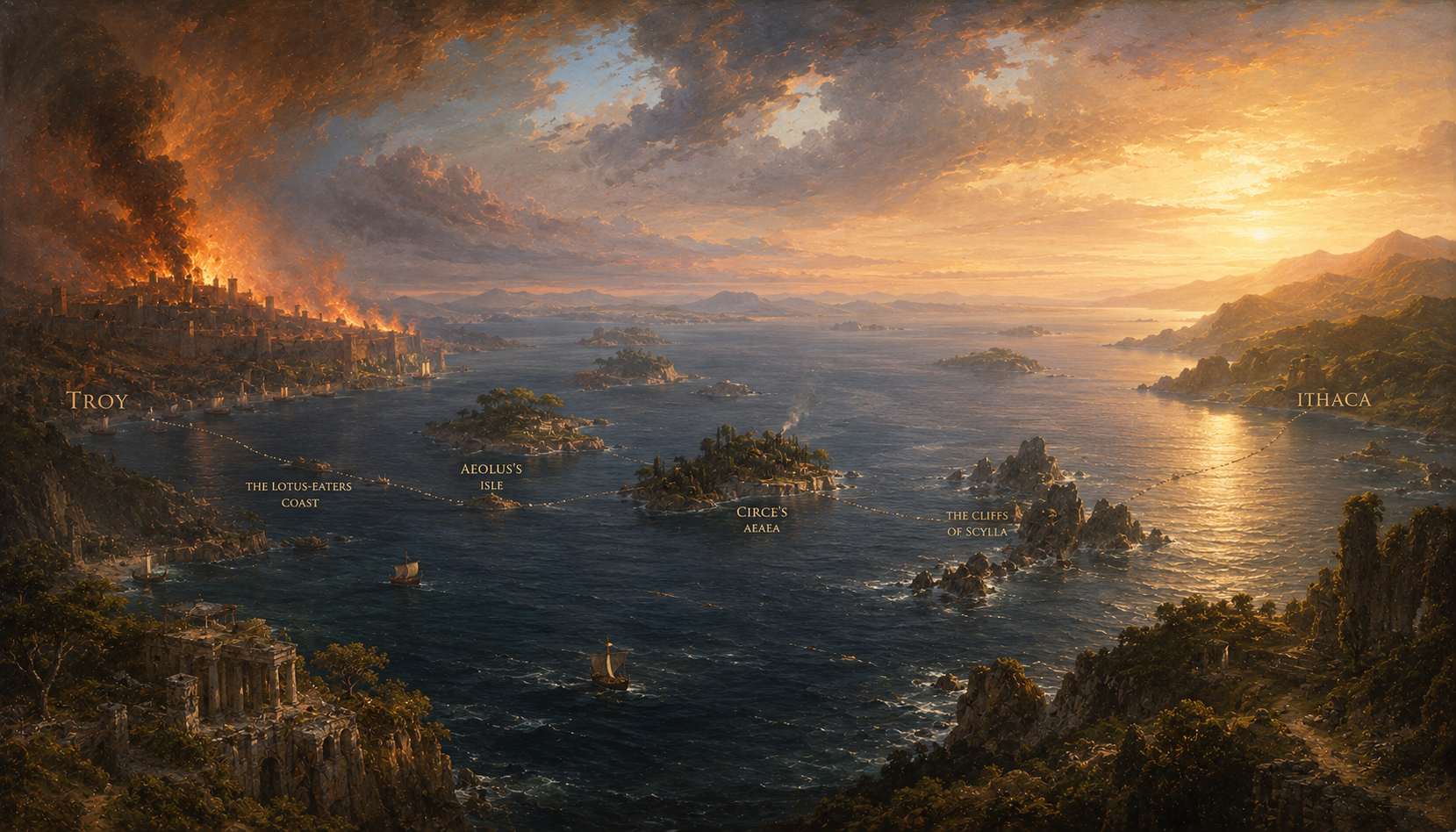
The epic journey from the ruins of Troy to the shores of Ithaca
Telemachus and the Situation in Ithaca
The Odyssey does not begin with Odysseus. It begins with his son. When the poem opens, Odysseus has been gone for twenty years, and Ithaca is in crisis. One hundred and eight young men from the surrounding islands have moved into Odysseus's palace. They are suitors, each one seeking to marry Penelope and take control of the household. They eat Odysseus's livestock, drink his wine, and abuse his servants. They have been doing this for years.
Penelope has held them off through cleverness. She told the suitors she would choose a husband once she finished weaving a funeral shroud for Odysseus's elderly father, Laertes. Each day she wove. Each night she unraveled her work. The trick lasted three years before a disloyal maid revealed it, and now Penelope is running out of ways to delay.
Telemachus, now about twenty years old, has grown up without a father and without authority. The suitors disrespect him openly. The goddess Athena appears to him in disguise and tells him to go looking for news of his father. He sails first to Pylos, where the old king Nestor tells him what he knows, and then to Sparta, where Menelaus and Helen describe Odysseus's role in the fall of Troy. Nobody knows if Odysseus is alive or dead, but Telemachus returns with something important: the belief that his father may still be out there.
Calypso's Island and the Journey to Phaeacia
Meanwhile, Odysseus is alive, trapped on an island called Ogygia. The goddess Calypso has kept him there for seven years. She loves him. She has offered him immortality if he will stay. But Odysseus refuses. Every day he sits on the shore and weeps, staring at the sea, wanting only to see the smoke rising from his own hearth on Ithaca. It is one of the most striking images in the poem: a man offered eternal life, turning it down because he wants to go home.
On Mount Olympus, the gods debate his fate. Athena argues that Odysseus has suffered enough and should be allowed to return. Zeus agrees and sends the messenger god Hermes to Calypso with an order: let him go. Calypso is angry and heartbroken, but she obeys. She helps Odysseus build a raft, gives him supplies, and sends him on his way.
The sea god Poseidon, who hates Odysseus for blinding his son the Cyclops, spots the raft and destroys it with a storm. Odysseus nearly drowns. He washes ashore, naked and half dead, on the island of Scheria, home of the Phaeacians. A young princess named Nausicaa finds him on the beach and brings him to her father, King Alcinous. The Phaeacians are famous sailors and generous hosts. They welcome Odysseus, feed him, and ask him to tell his story.
Recommended Reading
As an Amazon Associate, we earn from qualifying purchases.
The Wanderings: Odysseus Tells His Own Tale
At the Phaeacian court, Odysseus narrates the adventures that brought him from Troy to Calypso's island. This long flashback, covering Books 9 through 12, contains the most famous episodes in the poem.
After leaving Troy, Odysseus raided the Cicones and lost men in the counterattack. Then a storm blew his fleet off course. They reached the land of the Lotus-eaters, where anyone who ate the lotus fruit forgot everything, including the desire to go home. Odysseus dragged his affected men back to the ships by force.
Next came the Cyclops. Odysseus and twelve of his men entered the cave of Polyphemus, a one-eyed giant and son of Poseidon. The giant sealed them inside with a boulder and began eating the crew, two men at each meal. Odysseus devised a plan. He got Polyphemus drunk on strong wine, told the giant his name was "Nobody," and then drove a sharpened, heated stake into the sleeping giant's single eye. When Polyphemus screamed and the other Cyclopes asked who was hurting him, he shouted "Nobody," and they went away. The next morning, Odysseus and his surviving men escaped by clinging to the undersides of Polyphemus's sheep as the blinded giant let his flock out to graze.
It should have ended there. But as he sailed away, Odysseus could not resist shouting his real name back at the Cyclops. That act of pride gave Polyphemus the information he needed to pray to his father Poseidon for vengeance. From that moment forward, the sea itself became Odysseus's enemy.
"Hear me, Poseidon, blue-maned god who rocks the earth. If I am truly yours, grant that Odysseus, sacker of cities, may never reach his home." Homer, The Odyssey, Book 9
The wind god Aeolus gave Odysseus a bag containing all the adverse winds, leaving only a favorable breeze to carry them home. They sailed for nine days and came within sight of Ithaca. Then, while Odysseus slept, his crew opened the bag, thinking it contained treasure. The winds burst out and blew them all the way back. Aeolus refused to help them a second time.
They came to the Laestrygonians, cannibal giants who destroyed eleven of the twelve ships and ate the crews. Only Odysseus's vessel escaped because he had anchored outside the harbor.
Circe, the Dead, and the Monsters of the Sea
With one ship left, Odysseus reached Aeaea, the island of Circe. This goddess turned his scouting party into pigs. With the help of the god Hermes and a magical herb called moly, Odysseus confronted Circe and forced her to restore his men. She became his host and lover, and they stayed a full year. When they finally prepared to leave, Circe told Odysseus he must first visit the land of the dead to consult the prophet Teiresias.
In the underworld, Odysseus spoke with the shades of the dead. Teiresias warned him about the cattle of the Sun and told him what he would find in Ithaca. He saw his mother, Anticleia, who had died of grief during his absence. He met the ghosts of Agamemnon, Achilles, and Ajax. Achilles told him something that echoes through the centuries: he would rather be a living slave working another man's fields than king of all the dead. Glory, the great prize of the warrior world, meant nothing to a dead man.
Odysseus returned to Aeaea, and Circe briefed him on every danger ahead. She warned him about the Sirens, whose irresistible song lured sailors to their deaths. She told him about Scylla and Charybdis: a six-headed monster and a ship-swallowing whirlpool on opposite sides of a narrow strait. And she warned him never to touch the sacred cattle of the Sun god Helios.
Odysseus survived the Sirens by having his men plug their ears with beeswax while he listened, tied to the mast. He chose Scylla over Charybdis and lost six men to the monster's six heads. But on the island of Thrinacia, his starving crew killed and ate the Sun god's cattle while Odysseus slept. Zeus destroyed the ship with a thunderbolt. Every man drowned except Odysseus, who clung to the wreckage and drifted for days before washing up on Calypso's island. There his story to the Phaeacians ends.
The Return to Ithaca
The Phaeacians, moved by his story, load Odysseus with gifts and sail him home to Ithaca while he sleeps. They lay him on the beach and depart. When he wakes, Athena meets him, disguised at first, and tells him what awaits: 108 suitors in his hall, a wife under siege, and a son who is brave but outnumbered. She transforms Odysseus into a ragged old beggar so that no one will recognize him.
His first stop is the hut of Eumaeus, the loyal swineherd who has continued to serve the household faithfully in Odysseus's absence. Odysseus does not reveal himself. He sits in the hut and listens, learning who has remained loyal and who has betrayed the family. Telemachus arrives at the hut, sent there by Athena, and Odysseus finally reveals himself to his son. They embrace. They weep. And then they begin to plan.
Odysseus enters his own palace as a beggar. The suitors abuse him, throwing stools and insults. He endures it all. He observes their behavior, notes who among the servants is loyal and who has sided with the enemy. An old dog named Argos, lying on a dung heap, recognizes his master after twenty years, wags his tail, and dies. It is one of the most quietly devastating moments in all of literature.
Penelope, not knowing the beggar is her husband, invites him to speak with her. They sit together by the fire. He tells her a false story about himself but weaves in details about Odysseus to reassure her that her husband is coming. Penelope is moved but cautious. She has waited twenty years. She will not be fooled now.
The Bow Contest and the Slaughter of the Suitors
Penelope announces a contest. She will bring out Odysseus's great bow, the one he left behind twenty years ago, and set up a row of twelve axe heads. Whoever can string the bow and shoot an arrow through all twelve will become her husband. The suitors agree. One by one, they try to string the bow. None of them can even bend it.
The beggar asks for a turn. The suitors mock him. But Penelope insists he be allowed to try, and Telemachus sends her upstairs. Odysseus takes the bow, strings it as easily as a musician fitting a new string to a lyre, and shoots an arrow clean through all twelve axe heads. Then he turns the bow on the suitors.
"You dogs, you thought I would never come home from Troy. You devoured my house, forced yourselves on my serving women, and courted my wife while I was still alive. You feared neither the gods above nor the judgment of men. Now the ropes of death are made fast around you, every one." Homer, The Odyssey, Book 22
With Telemachus, Eumaeus, and one other loyal servant fighting beside him, Odysseus kills every suitor in the hall. Athena helps, deflecting spears and filling the suitors with panic. The disloyal servants are executed. The great hall is cleaned with fire and sulfur. The house belongs to Odysseus again.
Recommended Reading
As an Amazon Associate, we earn from qualifying purchases.
The Reunion and the Peace
The slaughter is not the climax. The reunion is. Penelope comes downstairs and sees a man who claims to be her husband. She does not rush to him. She has been tricked before, by hope and by time, and she will not be tricked now. She tests him. She tells a servant to move the marriage bed out of the bedroom. Odysseus erupts in anger: that bed cannot be moved. He built it himself, years ago, around a living olive tree that forms one of its posts. The bed is rooted to the earth. Only Odysseus and Penelope know this.
That is the proof. That is the secret. Penelope's knees go weak. She runs to him. She throws her arms around his neck and weeps. They stand together, and Homer compares her relief to the joy of shipwrecked sailors who finally see land. The comparison is deliberate. Penelope has been lost at sea in her own way, alone in her own house for twenty years. She, too, has come home.
In the final book, Odysseus visits his father Laertes on his farm, and the families of the dead suitors come looking for revenge. Before another cycle of bloodshed can begin, Athena intervenes. She commands both sides to accept peace. The feuding stops. The poem ends not with violence but with reconciliation, as if Homer understood that the hardest part of any homecoming is not arriving. It is learning to live in peace after everything that has happened.
Why the Odyssey Still Matters
The Odyssey is nearly three thousand years old, and people still read it because it is about things that do not change. The desire to go home. The fear that home may have changed while you were away. The temptation to give up and accept comfort instead of pushing on. The question of what makes a person who they are after years of hardship. These themes run through every book of the poem, and the main characters embody them in ways that still feel urgent. Every generation finds itself in this poem because the poem is not really about monsters and gods. It is about what it costs to stay human when the world is determined to break you.
It is also, at its heart, a love story. Not the dramatic, tragic love of the Iliad, but the stubborn, patient love of two people who refused to forget each other across twenty years and an ocean. Odysseus turned down immortality because it was not Ithaca. Penelope unraveled her weaving every night because she was not ready to give up. Their reunion at the olive-tree bed is one of the great moments in all of literature, not because it is dramatic but because it is earned.
Hear the Whole Story
This summary gives you the plot, but the Odyssey was made to be heard. It was composed as oral poetry, performed aloud for audiences who leaned forward in firelight. Our full-cast narration brings that experience back: 60+ character voices, every word highlighted as it is spoken, the rhythms of Homer filling the room the way they were always meant to. Listen to the full audiobook and hear the words themselves. Book I is free. The full poem, all 24 books, unlocks for $6.99.
Read the Full Epic
As an Amazon Associate, we earn from qualifying purchases.
Continue Reading
Now Hear the Words Themselves
The summary tells you what happens. The poem tells you what it feels like. Full-cast narration, every word highlighted, Book I free. The complete Odyssey for $6.99.
Start Listening FreeContinue the Journey
Hear the complete Odyssey read aloud with 60+ character voices. Every word highlights as it is spoken.
Book I is completely free. No signup required.
Go Deeper Into the Odyssey Film
Get the free Odyssey Companion Guide: character map, timeline, family tree, and the essential scenes from Homer's poem and the film.
No spam. Unsubscribe anytime.