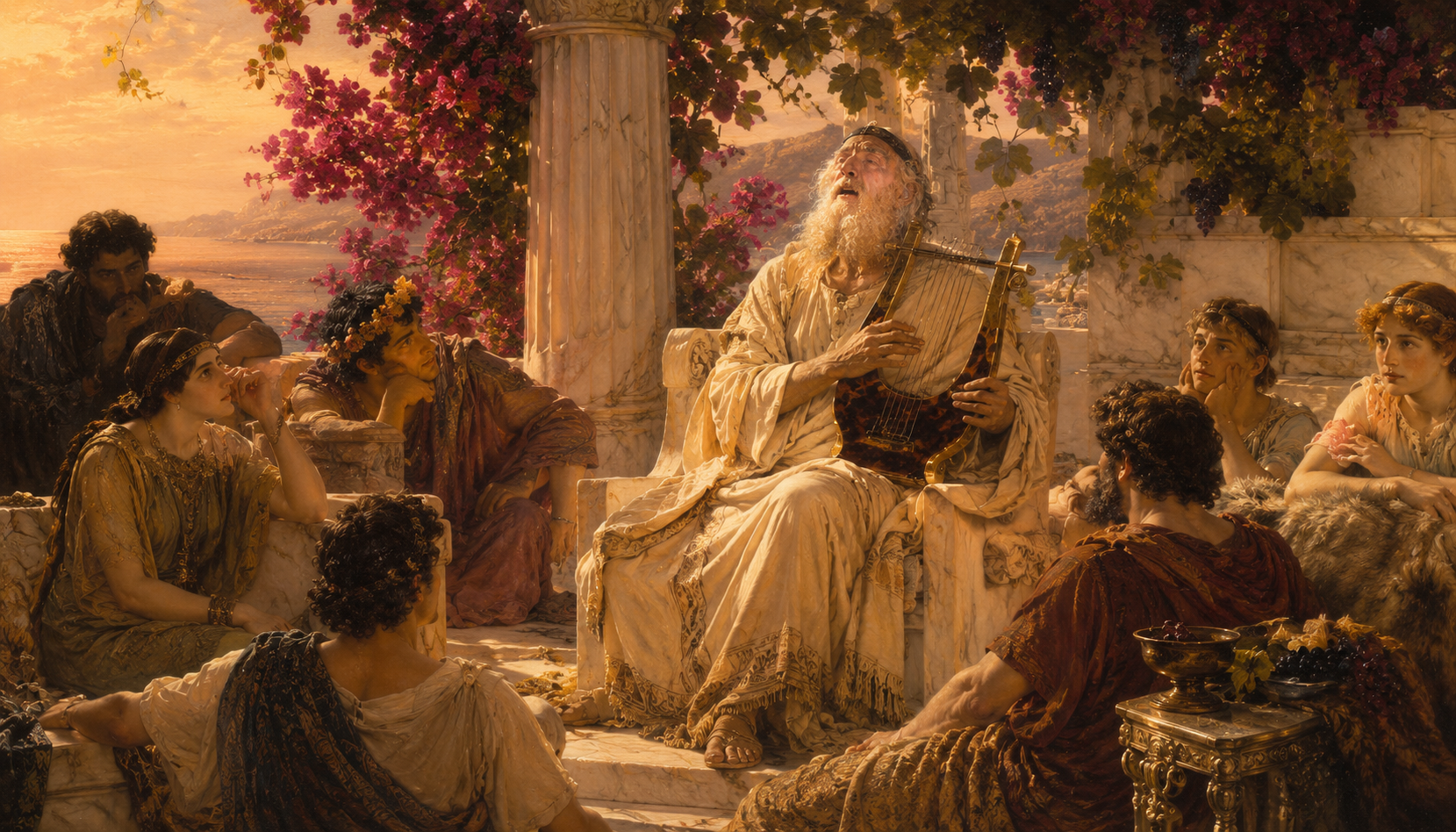
The Invocation
The poem begins with nine of the most famous words in literature.
Tell me, O Muse, of that ingenious hero who travelled far and wide after he had sacked the famous town
of Troy. Many cities did he visit, and many were the nations with whose manners and customs he was acquainted;
moreover he suffered much by sea while trying to save his own life and bring his men safely home; but do
what he might he could not save his men, for they perished through their own sheer folly in eating the cattle
of the Sun-god Hyperion; so the god prevented them from ever reaching home. Tell me, too, about all these
things, oh daughter of Zeus, from whatsoever source you may know them.
The Narrator
Book I
The opening invocation of the entire epic. The poet calls upon the Muse to tell the story of Odysseus, immediately
establishing the poem's central tension: a hero who cannot save his own men from their folly. These lines have
been the gateway to the Odyssey for every reader in history.
The Gods and Mortal Fate
The gods of Olympus speak on the destiny of mortals and the folly of men.
See now, how men lay blame upon us gods for what is after all nothing but their own folly. Look at Aegisthus;
he must needs make love to Agamemnon's wife unrighteously and then kill Agamemnon, though he knew it would
be the death of him; for I sent Hermes to warn him not to do either of these things, inasmuch as Orestes
would be sure to take his revenge when he grew up and wanted to return home. Hermes told him this in all
good will but he would not listen, and now he has paid for everything in full.
Zeus
Book I
The very first divine speech in the poem. Zeus, king of the gods, complains that mortals blame the gods for
their own suffering. This speech sets the Odyssey's theological framework: mortals have free will, and when
they ignore divine warnings, the consequences are their own fault.
Father, son of Cronus, King of kings, it served Aegisthus right, and so it would any one else who does as he
did; but Aegisthus is neither here nor there; it is for Odysseus that my heart bleeds, when I think of his
sufferings in that lonely sea-girt island, far away, poor man, from all his friends.
Athena
Book I
Athena's response to Zeus, immediately pivoting from the fate of Aegisthus to the plight of Odysseus. Her
passionate advocacy for the stranded hero sets the entire plot in motion. Without Athena's intervention in
this divine council, Odysseus might remain on Calypso's island forever.
My child, what are you talking about? How can I forget Odysseus than whom there is no more capable man on
earth, nor more liberal in his offerings to the immortal gods that live in heaven? Bear in mind, however,
that Poseidon is still furious with Odysseus for having blinded an eye of Polyphemus king of the Cyclopes.
Zeus
Book I
Zeus's reassurance to Athena, confirming that the gods have not forgotten Odysseus. But the caveat is
crucial: Poseidon is still angry, and the sea-god's wrath explains everything that has gone wrong.
The domestic conflict between gods mirrors the domestic conflicts of mortals below.
Odysseus Speaks
The man of many turns, in his own words.
King Alcinous, it is a good thing to hear a bard with such a divine voice as this man has. There is nothing
better or more delightful than when a whole people make merry together, with the guests sitting orderly to
listen, while the table is loaded with bread and meats, and the cup-bearer draws wine and fills his cup for
every man.
Odysseus
Book IX
Odysseus addresses the Phaeacian court before launching into the tale of his wanderings. This opening captures
the Greek ideal of civilized pleasure: music, food, wine, and good company. It is also a masterful rhetorical
move, flattering his hosts before asking them to listen to a very long story.
I am Odysseus son of Laertes, and I am known among all men for the subtlety of my craft. My fame ascends
to heaven.
Odysseus
Book IX
The moment Odysseus reveals his true identity to the Phaeacians. After concealing himself for two full books,
he finally declares who he is—and he does so with a boast that defines his character. He is not known
for strength or beauty but for "the subtlety of my craft." This is the hero of the mind.
Cyclops, you ask my name and I will tell it you; give me, therefore, the present you promised me; my name
is Noman; this is what my father and mother and my friends have always called me.
Odysseus
Book IX
Trapped inside the Cyclops's cave with a boulder blocking the exit, Odysseus gives a false name that will
save his life. When the blinded Polyphemus screams to the other Cyclopes that "Noman is killing me," they
dismiss his cries. This pun—a play on "nobody"—is the most famous trick in Western literature.
Cyclops, if any one asks you who it was that put your eye out and spoiled your beauty, say it was the
valiant warrior Odysseus, son of Laertes, who lives in Ithaca.
Odysseus
Book IX
Having escaped the Cyclops's cave, Odysseus cannot resist shouting his true name from the ship. It is a
moment of fatal pride—hubris—that allows Polyphemus to pray to Poseidon by name and
brings ten more years of suffering. Even the cleverest man alive cannot always master his own ego.
Goddess, do not be angry with me about this. I am quite aware that my wife Penelope is nothing like so
tall or so beautiful as yourself. She is only a woman, whereas you are an immortal. Nevertheless, I want
to get home, and can think of nothing else. If some god wrecks me when I am on the sea, I will bear it
and make the best of it. I have had infinite trouble both by land and sea already, so let this go with
the rest.
Odysseus
Book V
Calypso has just offered Odysseus immortality if he will stay with her forever. His response is one of
the most human moments in all of literature: he freely admits Penelope cannot compare to a goddess, then
says it does not matter. He would rather age and suffer and die as himself than live forever in someone
else's paradise.
Dogs, did you think that I should not come back from Troy? You have wasted my substance, have forced my
women servants to lie with you, and have wooed my wife while I was still living. You have feared neither
God nor man, and now you shall die.
Odysseus
Book XXII
The disguise is over. Odysseus has just killed Antinous with an arrow and now stands revealed before the
stunned suitors. This speech—cold, furious, absolute—is the moment twenty years of suffering
has been building toward. The word "dogs" strips the suitors of their humanity before the slaughter begins.
Wife, I am much displeased at what you have just been saying. Who has been taking my bed from the place
in which I left it? He must have found it a hard task, no matter how skilled a workman he was, unless some
god came and helped him to shift it. There is no man living, however strong and in his prime, who could
move it from its place, for it is a marvellous curiosity which I made with my very own hands.
Odysseus
Book XXIII
Penelope has told a servant to move the marriage bed outside the bedroom, knowing that the bed is built
around a living olive tree and cannot be moved. Odysseus's indignant reaction—describing how he built
the bed himself, detailing the construction only the real Odysseus would know—is the proof that
finally breaks through Penelope's caution.
Wife, we have not yet reached the end of our troubles. I have an unknown amount of toil still to undergo.
Odysseus
Book XXIII
Even after reclaiming his home and his wife, Odysseus knows the journey is not over. Teiresias prophesied
that he must travel inland carrying an oar until he reaches a people who know nothing of the sea. This
quiet admission, spoken in the marriage bed, is a reminder that no homecoming is ever truly final.
Penelope's Words
The queen who matched Odysseus in cunning and surpassed him in patience.
My good nurse, you must be mad. The gods sometimes send some very sensible people out of their minds, and
make foolish people become sensible. This is what they must have been doing to you; for you always used to
be a reasonable person.
Penelope
Book XXIII
Eurycleia rushes upstairs to tell Penelope that Odysseus has returned and killed the suitors. Penelope's
response is extraordinary: she does not jump for joy. She assumes the nurse has lost her mind. After twenty
years of hoping and being disappointed, Penelope's first instinct is to reject good news. Her caution is
itself a form of intelligence.
I have no wish to set myself up, nor to depreciate you; but I am not struck by your appearance, for I very
well remember what kind of a man you were when you set sail from Ithaca. Nevertheless, Euryclea, take his
bed outside the bed chamber that he himself built. Bring the bed outside this room, and put bedding upon it.
Penelope
Book XXIII
The test of the bed. Penelope casually orders a servant to move the unmovable bed, and watches for the
reaction. This is her version of the Noman trick: a stratagem disguised as an innocent statement, designed
to reveal the truth through the other person's response. Penelope is every bit as cunning as the man she
married.
Do not be angry with me Odysseus. You, who are the wisest of mankind. We have suffered, both of us. Heaven
has denied us the happiness of spending our youth, and of growing old, together; do not then be aggrieved
or take it amiss that I did not embrace you thus as soon as I saw you. I have been shuddering all the
time through fear that some one might come and deceive me with a lying story.
Penelope
Book XXIII
The dam breaks. Having confirmed Odysseus's identity through the test of the bed, Penelope finally embraces
her husband and explains her caution. Her words are devastating in their honesty: she has been afraid—not
of attackers or suitors, but of hope itself. This is one of the most emotionally raw speeches in ancient
literature.
Stranger, heaven robbed me of all beauty, whether of face or figure, when the Argives set sail for Troy
and my dear husband with them. If he were to return and look after my affairs I should be both more
respected and should show a better presence to the world. As it is, I am oppressed with care, and with
the afflictions which heaven rains upon me.
Penelope
Book XIX
Penelope speaks to the disguised Odysseus without knowing who he is. She attributes her lost beauty not
to age but to grief, and not to grief in general but to one specific absence. The irony is crushing:
the man she is mourning is sitting right in front of her.
If the gods are going to vouchsafe you a happier time in your old age, you may hope then to have some
respite from misfortune.
Penelope
Book XXIII
After Odysseus tells Penelope about the further travels Teiresias has prophesied, she responds with
quiet hope. It is the final words of a woman who has spent twenty years enduring, now looking forward
to whatever remains. The understatement carries enormous emotional weight.
Calypso, Circe, and the Enchantresses
The immortal women who offer paradise—and the price it demands.
You know a great deal, but you are quite wrong here. May heaven above and earth below be my witnesses,
with the waters of the river Styx—and this is the most solemn oath which a blessed god can take—that
I mean you no sort of harm, and am only advising you to do exactly what I should do myself in your place.
I am dealing with you quite straightforwardly.
Calypso
Book V
Calypso swears the most solemn oath in the Greek pantheon to prove she is releasing Odysseus in good faith.
There is genuine tenderness here: a goddess who has loved a mortal for seven years, letting him go because
Zeus commands it, but also because she understands that he can never be happy with her.
Odysseus, noble son of Laertes, so you would start home to your own land at once? Good luck go with you,
but if you could only know how much suffering is in store for you before you get back to your own country,
you would stay where you are, keep house along with me, and let me make you immortal, no matter how
anxious you may be to see this wife of yours, of whom you are thinking all the time day after day.
Calypso
Book V
Calypso makes her final offer: immortality, eternal youth, and the end of suffering. She is not threatening;
she is genuinely warning him of what lies ahead. The tragedy of the speech is that she is right—Odysseus
will suffer terribly—and it still does not change his mind.
You have done a bold thing in going down alive to the house of Hades, and you will have died twice, to
other people's once; now, then, stay here for the rest of the day, feast your fill, and go on with your
voyage at daybreak tomorrow morning.
Circe
Book XII
Circe greets Odysseus upon his return from the Underworld. Her acknowledgment that he has "died twice"
underscores the extraordinary nature of what he has accomplished—no living mortal visits the land
of the dead and returns. She then offers practical advice about the dangers ahead: the Sirens, Scylla,
and Charybdis.
Voices from the Underworld
In Book XI, Odysseus descends to the land of the dead and hears from the ghosts of the fallen.
Say not a word in death's favour; I would rather be a paid servant in a poor man's house and be above
ground than king of kings among the dead.
Achilles
Book XI
Odysseus tries to comfort the ghost of Achilles by praising his glory. Achilles' reply is one of the most
famous lines in all of ancient literature: glory means nothing to the dead. The greatest warrior in Greek
mythology would trade all his fame for a single day of life as a servant. It is a devastating rejection
of the heroic ideal that the Iliad celebrated.
My poor Odysseus, noble son of Laertes, are you too leading the same sorry kind of life that I did when
I was above ground? I was son of Zeus, but I went through an infinity of suffering, for I became bondsman
to one who was far beneath me—a low fellow who set me all manner of labours.
Hercules
Book XI
The ghost of Hercules recognizes a fellow sufferer. Even the son of Zeus, the strongest man who ever lived,
was forced into servitude and endless labor. His sympathy for Odysseus is the sympathy of one hero for
another, both trapped by forces larger than themselves.
When you get home you will take your revenge on these suitors; and after you have killed them by force or
fraud in your own house, you must take a well made oar and carry it on and on, till you come to a country
where the people have never heard of the sea, and do not even mix salt with their food.
Teiresias
Book XI
The blind prophet Teiresias delivers the prophecy that haunts the rest of the poem. Odysseus will reclaim
his home, but he must then journey to a land so far from the sea that the people mistake an oar for a
winnowing fan. Only then will he find peace. Even in the house of the dead, the journey extends further.
Thrice I sprang towards her and tried to clasp her in my arms, but each time she flitted from my embrace
as it were a dream or phantom.
Odysseus
Book XI
Odysseus encounters the ghost of his mother Anticlea in the Underworld and tries three times to embrace
her. Each time she slips through his arms like a shadow. The image of a son reaching for a mother he can
never hold again is one of the most heartbreaking moments in the poem.
Wisdom, Craft, and Cunning
On the quality the Greeks valued above all others: the intelligence to survive.
He must be indeed a shifty lying fellow who could surpass you in all manner of craft even though you had
a god for your antagonist. Dare devil that you are, full of guile, unwearying in deceit, can you not drop
your tricks and your instinctive falsehood, even now that you are in your own country again? We will say
no more, however, about this, for we can both of us deceive upon occasion.
Athena
Book XIII
Athena reveals herself to Odysseus on Ithaca and cheerfully calls him the greatest liar alive. What is
remarkable is her tone: she is not scolding him. She is admiring him. The goddess of wisdom recognizes
that Odysseus's instinct to deceive is the same quality she values in herself. They are kindred spirits.
Noman is killing me by fraud; no man is killing me by force.
Polyphemus
Book IX
The blinded Cyclops screams for help, but his words work against him. The other Cyclopes hear that "no man"
is attacking him and walk away. The entire scheme hangs on this wordplay, and it is one of the purest
demonstrations of cunning over strength in all of literature.
Madam, who on the face of the whole earth can dare to chide with you? Your fame reaches the firmament
of heaven itself; you are like some blameless king, who upholds righteousness, as the monarch over a great
and valiant nation: the earth yields its wheat and barley, the trees are loaded with fruit, the ewes
bring forth lambs, and the sea abounds with fish by reason of his virtues, and his people do good deeds
under him.
Odysseus
Book XIX
Odysseus, still disguised as a beggar, flatters Penelope with one of the most extravagant compliments in
the poem. He compares her fame to heaven and her virtue to that of a perfect king whose land flourishes
under his rule. It is both sincere praise and a masterful piece of rhetoric from a man who needs her trust.
The Homecoming
The moments when the journey finally ends—or does it?
The mighty contest is at an end. I will now see whether Apollo will vouchsafe it to me to hit another
mark which no man has yet been able to hit.
Odysseus
Book XXII
Odysseus has just strung the great bow and shot an arrow through twelve axe-heads. He tears off his beggar's
rags and stands revealed. The "other mark" is Antinous—and the audience knows, even if the suitors
do not, that every man in the hall is about to die.
Wake up Penelope, my dear child, and see with your own eyes something that you have been wanting this
long time past. Odysseus has at last indeed come home again, and has killed the suitors who were giving
so much trouble in his house, eating up his estate and ill treating his son.
Eurycleia
Book XXIII
The old nurse rushes upstairs with the news, her aged knees made nimble by joy. It is the simplest
announcement in the poem and the most emotionally charged: after twenty years, the waiting is over.
That Penelope responds with disbelief only deepens the pathos.
Then Odysseus in his turn melted, and wept as he clasped his dear and faithful wife to his bosom. As the
sight of land is welcome to men who are swimming towards the shore, when Poseidon has wrecked their ship
with the fury of his winds and waves; a few alone reach the land, and these, covered with brine, are
thankful when they find themselves on firm ground and out of danger—even so was her husband welcome
to her as she looked upon him.
The Narrator
Book XXIII
The most celebrated simile in the poem. Homer compares Penelope's relief at seeing Odysseus to the relief
of shipwrecked sailors who finally reach land. The comparison is breathtaking because it reverses the
expected analogy: it is not the wandering Odysseus who is like a shipwrecked sailor reaching shore, but
the waiting Penelope. She, too, has been at sea for twenty years.
When Odysseus and Penelope had had their fill of love they fell talking with one another. She told him
how much she had had to bear in seeing the house filled with a crowd of wicked suitors who had killed
so many sheep and oxen on her account, and had drunk so many casks of wine. Odysseus in his turn told
her what he had suffered.
The Narrator
Book XXIII
After twenty years apart, Odysseus and Penelope lie in bed and tell each other everything. Homer does not
give us the content of their conversation—he summarizes it in a few sentences. The restraint is
masterful: some things are too private even for an epic poem. The real reunion is not the embrace but
the talking, husband and wife becoming known to each other again.
The Faithful
Those who kept faith through twenty years of absence.
So you are come, Telemachus, light of my eyes that you are. When I heard you had gone to Pylos I made
sure I was never going to see you any more. Come in, my dear child, and sit down, that I may have a
good look at you now that you are home again.
Eumaeus
Book XVI
The loyal swineherd greets Telemachus with a father's love, kissing his head and hands. Eumaeus has
faithfully tended Odysseus's herds for twenty years, and his affection for Telemachus is undiminished.
Homer addresses Eumaeus directly in the second person—a mark of singular intimacy given to no
other character.
I am not mocking you. It is quite true as I tell you that Odysseus is come home again. He was the stranger
whom they all kept on treating so badly in the cloister. Telemachus knew all the time that he was come
back, but kept his father's secret that he might have his revenge on all these wicked people.
Eurycleia
Book XXIII
Eurycleia insists to the doubting Penelope that Odysseus has truly returned. The old nurse who recognized
her master by his scar now serves as the witness who bridges the disguise and the truth. Her joy is
uncomplicated by caution—she has no doubt at all.