Last updated June 2026
Setting the Scene: Who Is Telling This Story?
Before we get into the cave, there is something worth noticing about how Homer sets this up. Book 9 is not narrated by the poet. It is narrated by Odysseus himself. He is sitting at a banquet in the palace of King Alcinous among the Phaeacians, a people who have taken him in after finding him shipwrecked on their shore. They have fed him, given him gifts, and listened to their bard Demodocus sing about Troy. Now they want to hear the story from the man who lived it.
So when Odysseus begins to speak, he is performing. He is a guest trying to earn his passage home. He is a storyteller choosing which details to share and which to leave out. He is a man constructing his own legend in real time. That matters, because the Cyclops episode is the story Odysseus wants you to hear. It is his greatest hit, the moment where he was at his cleverest. But as we will see, it is also the moment where he was at his most reckless.
Odysseus opens with a flourish, introducing himself to the court:
"I am Odysseus son of Laertes, renowned among mankind for all manner of subtlety, so that my fame ascends to heaven." Homer, The Odyssey, Book 9 (Samuel Butler translation)
That is not a humble man talking. And the tension between his brilliance and his ego is exactly what Book 9 is about.
The Land of the Cyclopes
After recounting a quick raid on the Cicons (which went badly) and the strange land of the Lotus-Eaters (where some of his men ate a plant that made them forget everything), Odysseus brings the narrative to the land of the Cyclopes. Homer paints them as a people entirely outside civilization. They have no laws, no assemblies, no agriculture. They live in mountain caves, each one a law unto himself, tending sheep and goats. There is no community, no obligation to strangers, no concept of what the Greeks called xenia, the sacred guest-host relationship.
This is important because in the Greek worldview, hospitality was not optional. It was a divine law. When you showed up at someone's door, they were supposed to feed you, give you gifts, and ask your name only after you had eaten. The Cyclopes do none of this. They exist in a state of nature. And Polyphemus, the most formidable of them all, is about to demonstrate what that looks like in practice.
Odysseus anchors his fleet at a lush island just offshore, full of wild goats and fresh water. His men feast well. But Odysseus cannot leave well enough alone. He spots the mainland, sees smoke rising from a cave, and decides he needs to investigate. He picks twelve of his best men, loads up a goatskin of especially strong wine (a gift from a priest of Apollo named Maron), and rows across. Curiosity is pulling him forward. His men will pay for it.
Inside the Cave
They find the cave empty. The Cyclops is out with his flocks. The place is enormous, stocked with cheeses, pens of lambs and kids, and buckets of whey. Odysseus's men immediately recognize the danger and beg him to grab some cheese and livestock and leave before the owner comes back. But Odysseus refuses. He wants to meet the host. He wants to see if the Cyclops will offer him gifts. That decision will cost six men their lives.
When Polyphemus returns, the first thing he does is haul a massive boulder across the cave entrance. It is so heavy that, as Homer tells us, twenty-two four-wheeled wagons could not have moved it. The men are sealed inside. Then the Cyclops spots them. Instead of offering food and welcome, he asks who they are, with a voice that shakes the cavern. Odysseus, trying the diplomatic approach, reminds him that Zeus protects travelers and guests. The Cyclops laughs at him:
"We Cyclopes do not care about Zeus or any of your blessed gods, for we are ever so much stronger than they." Homer, The Odyssey, Book 9 (Samuel Butler translation)
Then, without warning, Polyphemus grabs two of the men and dashes them against the ground like puppies. He eats them. Bones, marrow, entrails, everything. Homer does not look away from this. The description is gruesome and meant to be. The crew, helpless, weeps and lifts their hands to heaven. There is nothing they can do. The boulder seals the exit, and only the Cyclops is strong enough to move it. If they kill him in his sleep, they will be trapped in the cave forever.
That is the trap. Odysseus cannot fight his way out. He cannot escape through force. The only way out is through the Cyclops, which means the Cyclops has to be alive and functional enough to open the door. This is the constraint that forces Odysseus to think, and it produces one of the most layered plans in all of literature.
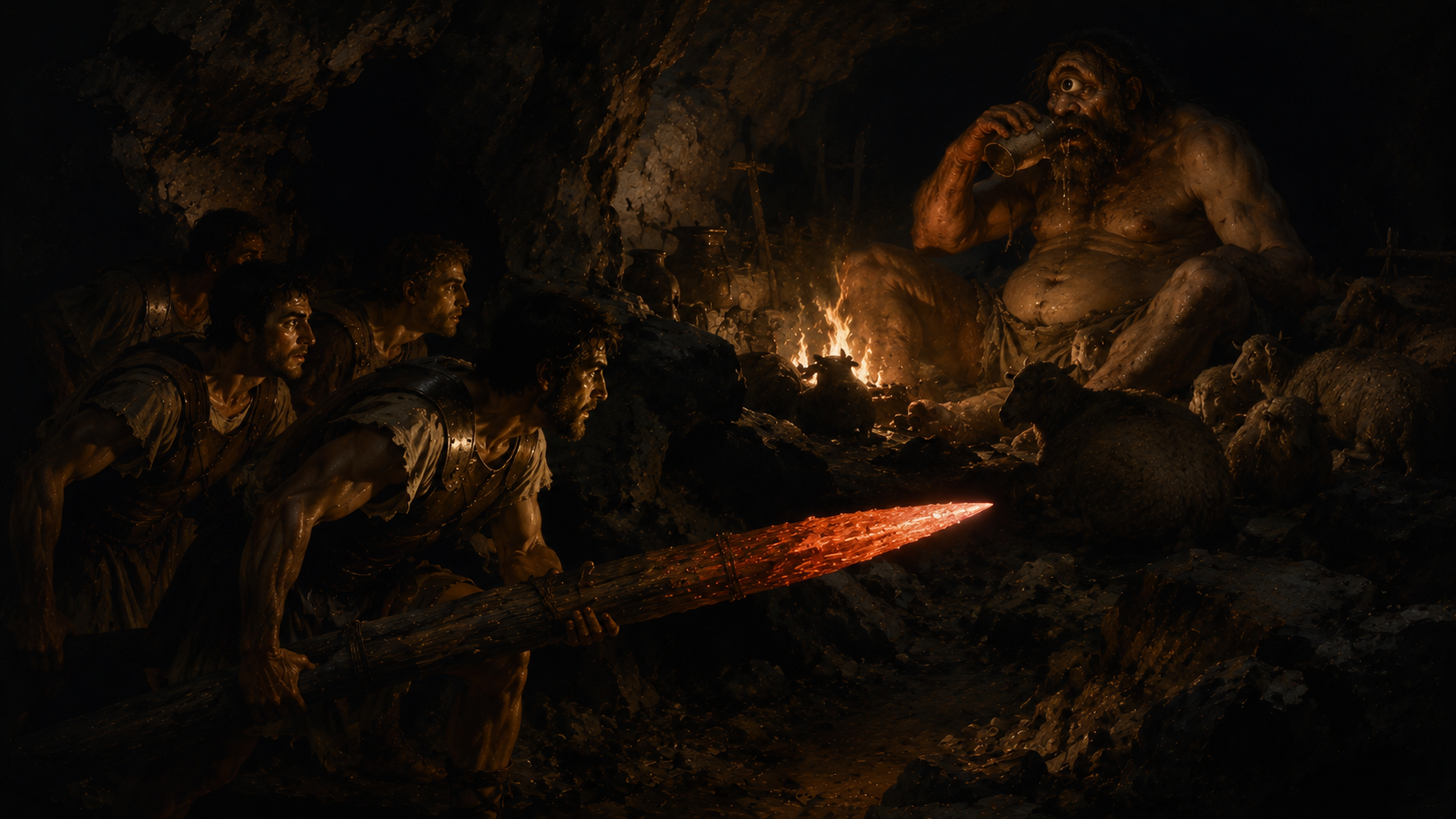
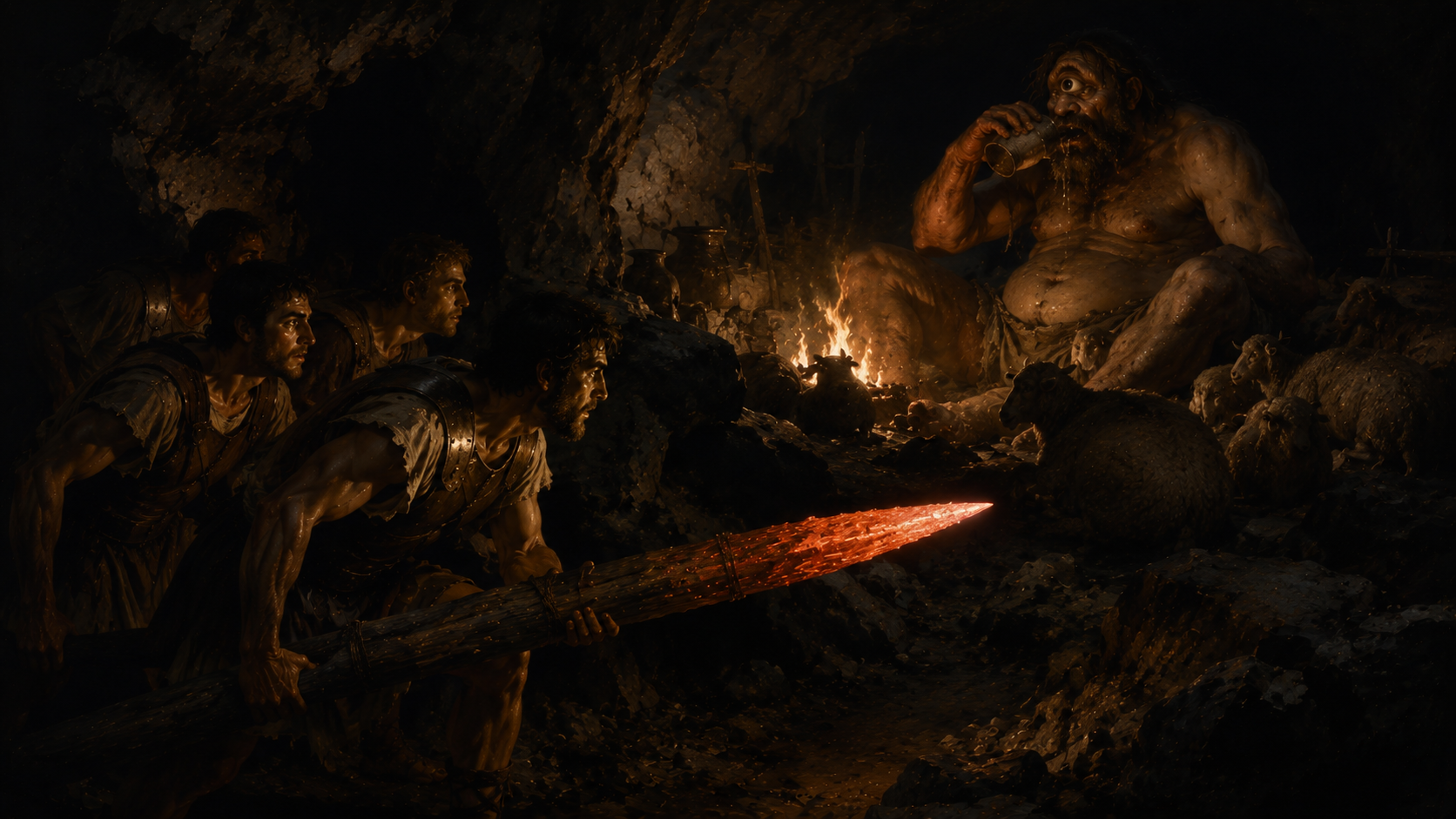
Trapped in the lair of Polyphemus, where cunning is the only weapon
Recommended Reading
As an Amazon Associate, we earn from qualifying purchases.
The Plan: Wine, a Name, and Fire
Odysseus notices the Cyclops's great club, a piece of green olive wood the size of a ship's mast. He quietly cuts off about six feet of it and has his men sharpen one end to a point. Then they hide it. Meanwhile, he approaches Polyphemus with the wine he brought from Maron's cellar. This is not ordinary wine. It is so potent that it was usually mixed twenty parts water to one. Odysseus serves it straight.
"Look here, Cyclops, you have been eating a great deal of man's flesh, so take this and drink some wine, that you may see what kind of liquor we had on board my ship." Homer, The Odyssey, Book 9 (Samuel Butler translation)
Polyphemus loves it. He drains one cup and demands more. Three cups later, he is lurching. And he asks the question Odysseus has been waiting for: what is your name?
"Cyclops, you ask my name and I will tell it you; give me, therefore, the present you promised me; my name is Noman; this is what my father and mother and my friends have always called me." Homer, The Odyssey, Book 9 (Samuel Butler translation)
Noman. Nobody. It is a lie so simple it sounds like a joke, but it is actually a weapon. Polyphemus, drunk and stupid, thinks this is hilarious. He promises Odysseus a "present" of his own:
"Then I will eat all Noman's comrades before Noman himself, and will keep Noman for the last. This is the present that I will make him." Homer, The Odyssey, Book 9 (Samuel Butler translation)
Then the Cyclops passes out, face up, vomiting wine and chunks of human flesh. This is the moment. Odysseus and his men pull the olive-wood stake from hiding, heat it in the embers until it glows, and drive it straight into the Cyclops's single eye. Homer compares the hissing sound to a blacksmith plunging a red-hot axe into cold water. It is visceral, violent, and unforgettable.
The Nobody Trick Pays Off
Polyphemus screams. He tears the stake from his eye and howls in agony. The other Cyclopes hear him and come running to the mouth of the cave, calling through the sealed entrance: what is wrong? Who is hurting you?
"Noman is killing me by fraud; no man is killing me by force." Homer, The Odyssey, Book 9 (Samuel Butler translation)
The neighbors shrug. If no man is hurting you, they say, then it must be a sickness sent by the gods. Pray to Poseidon. And they walk away.
This is the moment Odysseus laughs to himself. The trick worked perfectly. He erased his own identity and turned it into a shield. The entire Greek language is working in his favor: the name "Noman" sounds enough like "no man" that the other Cyclopes hear a negative rather than a proper noun. It is wordplay at its most lethal.
But Polyphemus is not finished. Blind and raging, he feels his way to the cave entrance, removes the boulder, and sits in the doorway with his arms outstretched. He is guessing that the men will try to slip out with the morning flock. He will feel every animal as it passes through. No man is getting out on a sheep's back. Or so he thinks.
Under the Rams
Odysseus is already thinking ahead. He ties the thick-fleeced rams together in groups of three, then straps a man underneath the middle animal of each trio, hidden by the flanking rams' wool. For himself, he picks the biggest ram in the flock and clings to its underbelly, fingers twisted into its dense fleece, face pressed into the wool.
At dawn the sheep file out. Polyphemus runs his hands over their backs, but does not think to feel underneath. When the great ram passes last (slowed by Odysseus's weight), the blind Cyclops actually speaks to it, tenderly:
"My good ram, what is it that makes you the last to leave my cave this morning? You are not wont to let the ewes go before you, but lead the mob with a run whether to flowery mead or bubbling fountain, and are the first to come home again at night; but now you lag last of all." Homer, The Odyssey, Book 9 (Samuel Butler translation)
He wonders aloud whether the ram is mourning its master's eye. He wishes the animal could speak and tell him where "that wicked Noman" is hiding. The dramatic irony is almost unbearable. Odysseus is right there, inches from the giant's hands, holding his breath while the Cyclops pets the wool above his head. Then the ram walks on, and they are free.
They run for the ships. They load the stolen sheep. They push off from shore. And at that point, any sensible person would shut up, count their blessings, and row as fast as they could. But Odysseus is not any sensible person.
The Fatal Mistake
Safe on the water, Odysseus cannot resist. He shouts back at the blinded giant on the shore:
"Cyclops, you should have taken better measure of your man before eating up his comrades in your cave. You wretch, eat up your visitors in your own house? You might have known that your sin would find you out, and now Zeus and the other gods have punished you." Homer, The Odyssey, Book 9 (Samuel Butler translation)
Polyphemus, enraged, tears the top off a mountain and hurls it at the voice. The rock lands just in front of the ship, and the wave it creates pushes them back toward shore. The crew rows frantically. They get clear again. Odysseus's men beg him to stop. Do not provoke the monster. We barely got out alive.
But Odysseus cannot stop. The Nobody trick was the cleverest thing he has ever done, and now he is erasing it. Pride wins. He shouts again, and this time he tells Polyphemus exactly who he is:
"Cyclops, if any one asks you who it was that put your eye out and spoiled your beauty, say it was the valiant warrior Odysseus, son of Laertes, who lives in Ithaca." Homer, The Odyssey, Book 9 (Samuel Butler translation)
There it is. The man who called himself Nobody just gave the monster his address. And Polyphemus, who could not curse "Noman" by name, can now pray to his father Poseidon against "Odysseus, son of Laertes, who lives in Ithaca." Poseidon hears that prayer. The god of the sea spends the next decade making sure Odysseus never gets home easily. Every shipwreck, every lost crew member, every year stranded on Calypso's island traces back to this moment: the shout from the ship.
What makes this scene so powerful is that Odysseus knows what he is doing. He is not stupid. He is not ignorant of the risk. His men are literally begging him to stop. But his identity is the thing he cannot surrender. He did something extraordinary and he needs the world to know it was him. Being "Nobody" saved his life, but it is intolerable to his sense of self. He would rather be cursed and famous than safe and anonymous. And that tension, between the cunning that keeps him alive and the pride that keeps getting him in trouble, is the engine that drives the entire Odyssey.
Recommended Reading
As an Amazon Associate, we earn from qualifying purchases.
Why This Episode Defines the Whole Poem
The Cyclops scene is not just a good adventure story (though it is absolutely that). It is a blueprint for everything that follows.
It establishes the divine conflict. Before Book 9, Poseidon is just vaguely angry. After it, his grudge has a name, a prayer, and a personal edge. The entire cosmic obstacle that keeps Odysseus from reaching Ithaca originates here, in this cave, with this shout. Remove this episode and the poem loses its central conflict.
It defines Odysseus as a character. He is a man of metis, the Greek word for cunning intelligence. The Nobody trick, the wine, the olive-wood stake, the rams: every piece of the plan is layered and precise. But that same man is ruled by kleos, the desire for glory and fame. He literally cannot leave without making sure the victim knows who beat him. This duality is not resolved in the poem. It is the poem.
It introduces the hospitality theme. Polyphemus violates xenia in the most extreme way imaginable: by eating his guests. But Odysseus also violates the code, in a subtler way, by entering the cave uninvited and helping himself to the cheese before the host arrives. The poem is constantly asking: who is the guest, who is the host, and what do they owe each other? This question comes up again and again, at Circe's palace, on Calypso's island, among the Phaeacians, and finally in Ithaca, where the suitors have turned the entire concept of hospitality inside out.
It foreshadows the homecoming. In Ithaca, Odysseus will again be trapped in a house full of enemies who do not know who he is. He will again use a false identity (the beggar disguise) to survive. He will again need to restrain himself, biding his time while the suitors insult him. And the question will again be whether he can hold back long enough for the plan to work, or whether his pride will betray him before the moment is right. The Cyclops cave is a rehearsal for the great hall of Ithaca.
It is phenomenally good storytelling. Homer locks his hero in a room with an unsolvable problem and then solves it piece by piece: the wine, the name, the stake, the sheep. Every element is set up early and pays off later. The Cyclops's affection for his ram becomes the vehicle for escape. The strong wine becomes a weapon. The name becomes a punchline that reverberates through the entire poem. There is a reason this is one of the most retold stories in human history. It is structurally perfect.
The Aftermath
Odysseus and his remaining crew sail back to the island where the rest of the fleet is waiting. They divide the Cyclops's sheep among the twelve ships. Odysseus keeps the great ram for himself and sacrifices it to Zeus on the beach, burning the thigh bones. But Zeus, Homer tells us, does not accept the offering. The god is already turning against Odysseus. The consequences of that shout from the ship are already in motion.
From here, the disasters pile up across the timeline. The bag of winds from Aeolus. The cannibalistic Laestrygonians who destroy eleven of the twelve ships. Circe's island. The land of the dead. The Sirens, Scylla, and Charybdis. The cattle of the sun god, whose slaughter kills the rest of the crew. Every one of these catastrophes follows from the Cyclops episode, the moment where Odysseus had a clean escape and chose glory over safety.
Three thousand years of readers have asked the same question: why did he shout his name? And the answer is always the same. Because he is Odysseus. Because being nobody was worse than being cursed. Because the man who devised the Trojan Horse and outsmarted a giant cannot bear to let his greatest feat go uncredited. It is the most human moment in the poem. And it costs him everything.
Hear Book 9 Come Alive
You have read the analysis. Now hear the scene the way it was meant to be experienced. Our full-cast audiobook brings Book 9 to life with distinct voices for Odysseus, Polyphemus, and the narrator, with every word highlighted as it is spoken. The wine, the blinding, the ram's speech, the fatal shout. Listen to it from the cave to the shore.
Explore the Odyssey
As an Amazon Associate, we earn from qualifying purchases.
Related Pages
Listen to the Cyclops Scene
Full-cast narration. Every word highlighted as it is spoken. Hear Polyphemus rage, hear Odysseus taunt, and hear the ram carry him to freedom. Open Book 9 and listen.
Open Book 9Continue the Journey
Hear the complete Odyssey read aloud with 60+ character voices. Every word highlights as it is spoken.
Book I is completely free. No signup required.
Go Deeper Into the Odyssey Film
Get the free Odyssey Companion Guide: character map, timeline, family tree, and the essential scenes from Homer's poem and the film.
No spam. Unsubscribe anytime.
Nobody Escapes Without Merch
Cyclops and Polyphemus designs across five product types. T-shirts, posters, mugs, canvas prints, and tote bags.
Shop This DesignMORE ODYSSEY DESIGNS