Getting There: The Edge of the World
The journey itself is eerie. Circe tells Odysseus to sail north until he reaches the land of the Cimmerians, a people who live in perpetual darkness. The sun never reaches them. Mist and cloud wrap everything. It is a place between places, where the world of the living borders the world of the dead.
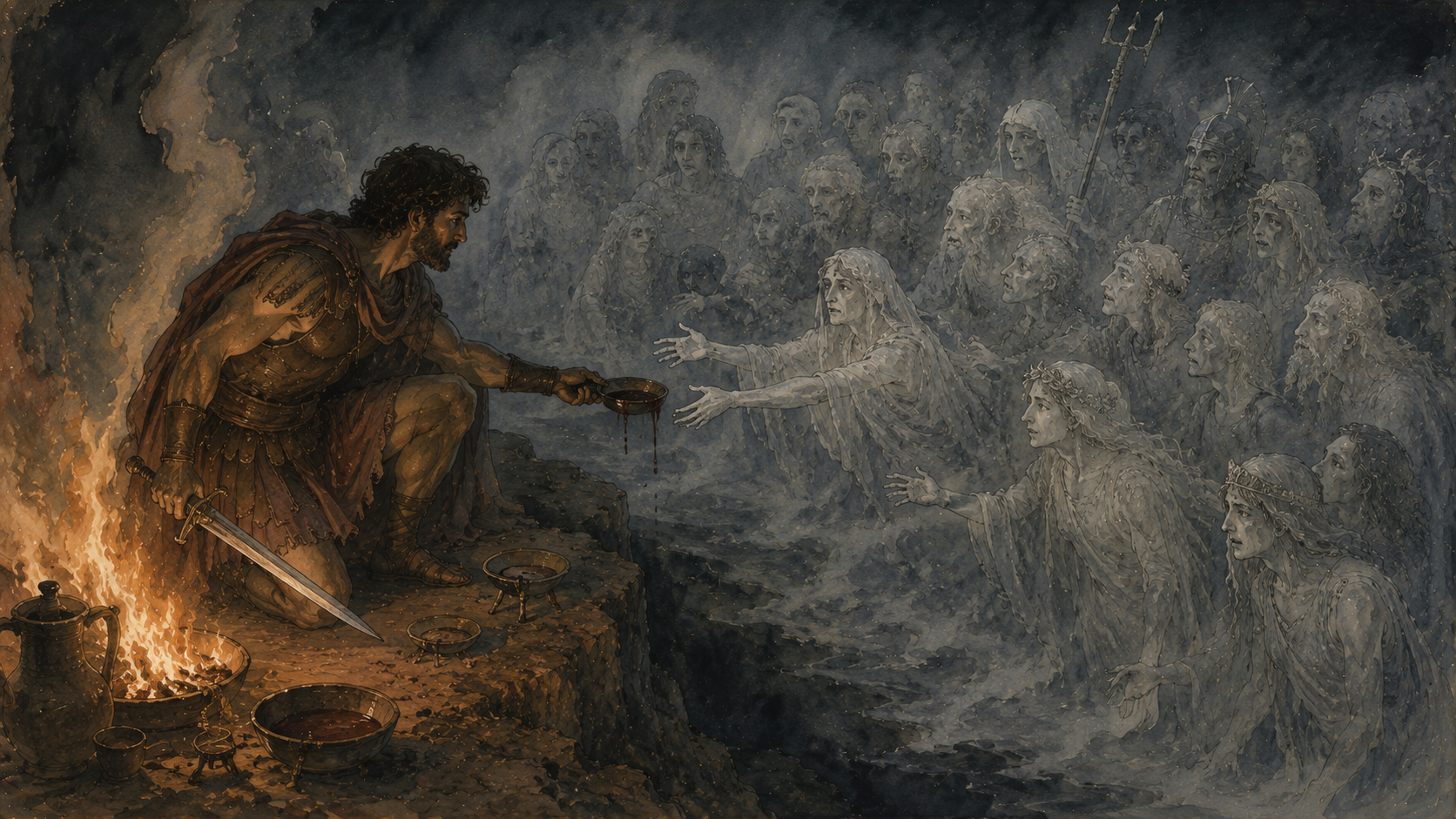
When they arrive, Odysseus performs the ritual exactly as Circe instructed. He digs a trench about a cubit long on each side. He pours libations around it: first a mixture of honey and milk, then sweet wine, then water. He sprinkles white barley over the top. He prays to the dead, promising that when he reaches Ithaca he will sacrifice his best cow and burn a pyre of treasures for them, and that he will sacrifice a black ram especially for Teiresias.
Then he cuts the throats of the sheep over the trench and lets the dark blood flow in.
The dead come immediately. Homer describes them as a crowd, a throng, pressing in from every direction. Brides, young men, old men worn with hardship, tender girls with grief still fresh in their hearts, warriors with battle wounds still showing on their bodies. They swarm around the trench, reaching for the blood, and Odysseus holds them off with his sword, because Circe told him that Teiresias must drink first.
The image is haunting. All these ghosts, all these former lives, reduced to shadows that cannot even remember who they were until they taste blood. It is Homer's vision of death at its bleakest: not punishment, not reward, just a slow fading. The dead exist, but they do not live. They drift. They forget. And the only thing that brings them back, briefly, is blood and the rituals of the living who still remember them.
Elpenor: The Forgotten Man
The first ghost Odysseus meets is not Teiresias. It is Elpenor, one of his own crew members, and the encounter is both unexpected and deeply sad.
Elpenor was not a great warrior. Homer describes him as "not very valiant in war, nor very sound in mind." On the last night on Circe's island, he got drunk, fell asleep on the roof of Circe's house, and when the crew prepared to leave at dawn, he woke suddenly, forgot where he was, stepped off the edge, and broke his neck. He died before the ship sailed. And in the rush to depart, his body was left behind, unburied and unmourned.
Elpenor's ghost begs Odysseus for proper burial. Not for glory, not for revenge, not for any grand purpose. Just burial. A mound of earth, his oar planted on top, so that someone passing by might know that a man was here. He asks for the bare minimum of remembrance, the simplest act of human dignity. And Odysseus, who has been fighting monsters and seducing goddesses, is brought up short by this small, ordinary request from an unremarkable man.
The episode matters because it grounds the Nekuia in something real. Before we get to the great heroes and the grand prophecies, we get Elpenor: a nobody who died stupidly and wants only to be buried. It reminds us that the dead are not all legendary. Most of them are ordinary people. And their needs are simple and human and heartbreaking.
Teiresias: The Prophecy
Teiresias is the reason Odysseus came. The blind prophet of Thebes, dead for generations, but still gifted with foresight because Persephone granted him his mind even in death. All the other shades are dim, confused, barely conscious. Teiresias is sharp. He drinks the blood and speaks clearly.
His prophecy covers three things. First, the immediate danger: the cattle of the Sun god on the island of Thrinacia. Do not touch them. If Odysseus can keep his men away from those cattle, they may still reach home. If not, the ship and crew will be destroyed, and Odysseus will arrive in Ithaca alone, on a stranger's ship, after many years. (Circe will later expand on these dangers when she describes the Sirens and Scylla and Charybdis.)
Second, the situation at home: suitors are overrunning his house, eating his livestock, and courting his wife. He will have to deal with them. Teiresias does not say how.
Third, and most mysteriously, a final journey. After Odysseus has killed the suitors and restored order, he must take an oar and walk inland until he reaches a people who have never seen the sea, who do not salt their food, who know nothing of ships. When someone mistakes his oar for a winnowing fan (a farming tool for separating grain), he must plant the oar in the ground and sacrifice to Poseidon. Only then will the sea god's anger be satisfied. And death will come to Odysseus gently, "from the sea," in his old age.
That final prophecy extends the Odyssey beyond the poem itself. It tells us that even after the homecoming, even after the suitors, there is more. The journey does not end in Ithaca. It ends somewhere far from the sea, in a land that has no idea what an oar is. The image of Odysseus walking inland with an oar on his shoulder, searching for people who have never heard of the ocean, is one of the most evocative in all of Homer.
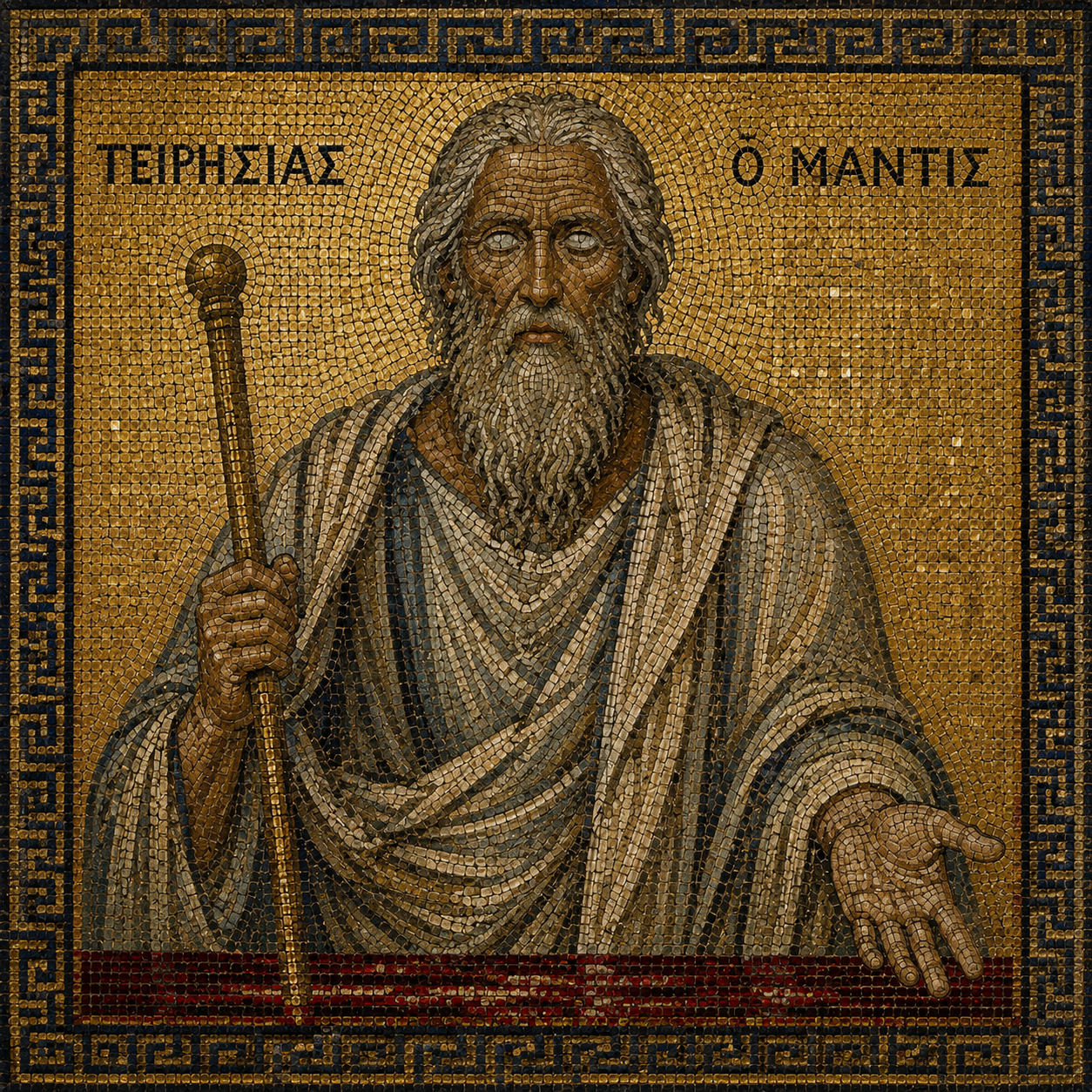
Teiresias delivers his prophecy to Odysseus in the land of the dead
Recommended Reading
As an Amazon Associate, we earn from qualifying purchases.
Anticlea: A Mother's Ghost
After Teiresias steps back, Odysseus sees his mother, Anticlea. He did not know she was dead. When he left for Troy, she was alive. Now her shade stands before him, and the shock is visible. He did not come to the underworld expecting this.
Anticlea tells him what happened. She did not die of illness or violence. She died of grief. She missed her son so much, worried about him so constantly, that her heart simply gave out. She wasted away waiting for him to come home.
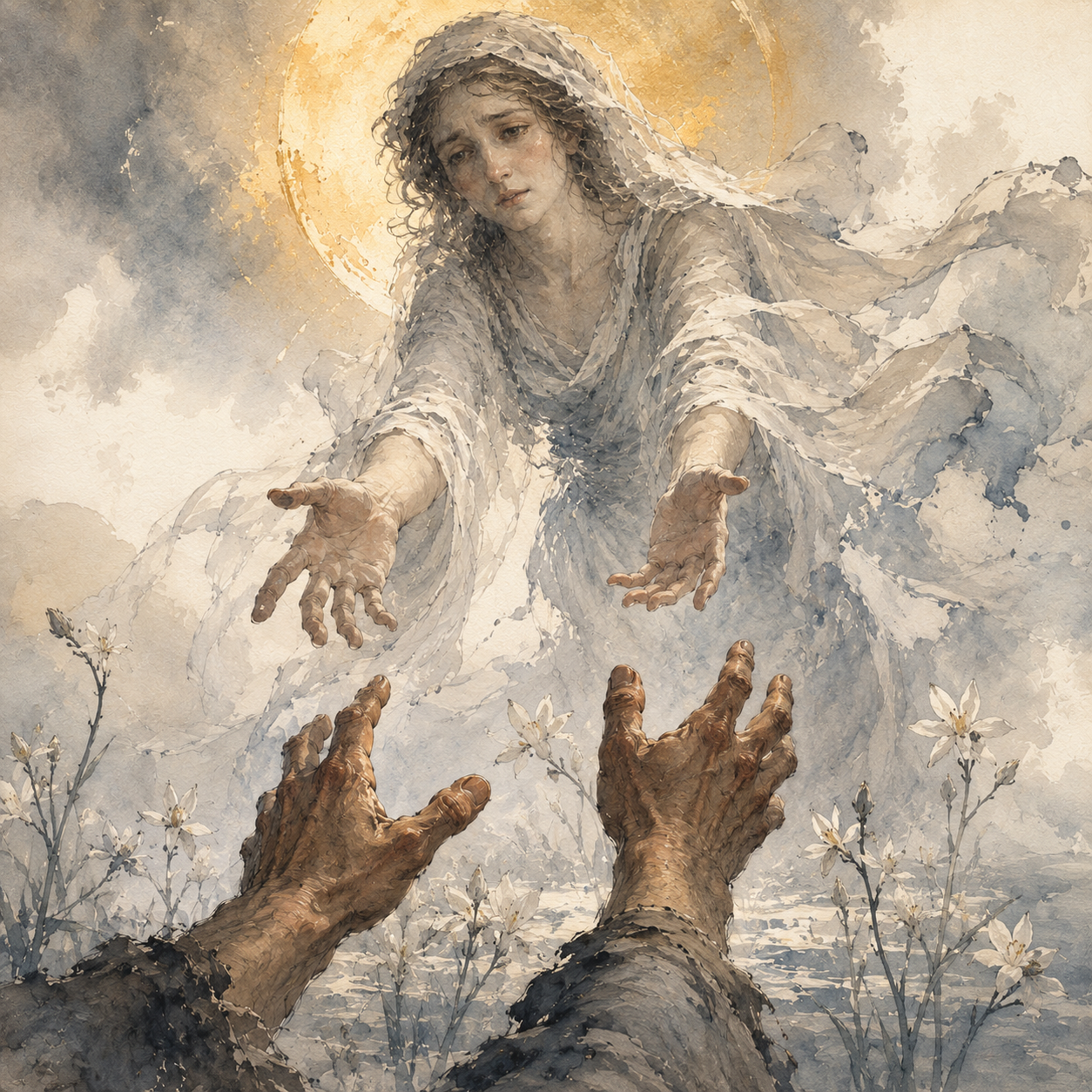
Odysseus encounters his mother's shade, learning she died of grief
She gives him news of Ithaca. Penelope is still faithful, still waiting, still weeping. Telemachus is managing the estate but is struggling. And Laertes, Odysseus's father, has withdrawn from the palace entirely. He lives on a farm in the countryside, sleeping in rags, eating servant food, broken by sorrow. He will not enter the city. He will not act as king. He is waiting to die.
The most devastating moment comes when Odysseus tries to embrace her. Three times he reaches out. Three times his arms pass through her like shadow or dream. She has no body. She is smoke and air. He cannot touch her. He cannot hold her. He can only listen to her voice and watch her fade.
"This is the way it is with mortals when they die. The sinews no longer hold flesh and bone together. The blazing fire consumes them. The spirit slips away like a dream and flutters here and there." Homer, The Odyssey, Book 11
This scene is, for many readers, the emotional center of the entire Odyssey. Not the Cyclops, not the Sirens, not the bow contest. A son trying to hug his dead mother and failing. The poem strips away all the adventure and spectacle and leaves you with something unbearably simple: the people we love die while we are away, and we cannot go back and hold them.
Agamemnon: A Warning from a Murdered King
Agamemnon, the great king who led the Greek armies to Troy, appears as a ghost still furious about how he died. His story is the Odyssey's dark mirror, the homecoming that went horribly wrong.
When Agamemnon returned from Troy, his wife Clytemnestra and her lover Aegisthus were waiting. They did not kill him in battle or in a fair fight. They killed him at dinner. They set a feast for his homecoming and murdered him at the table, along with his companions and Cassandra, the Trojan prophetess he had brought back as a captive. Agamemnon describes dying at his own dinner, surrounded by bodies, while his wife watched.
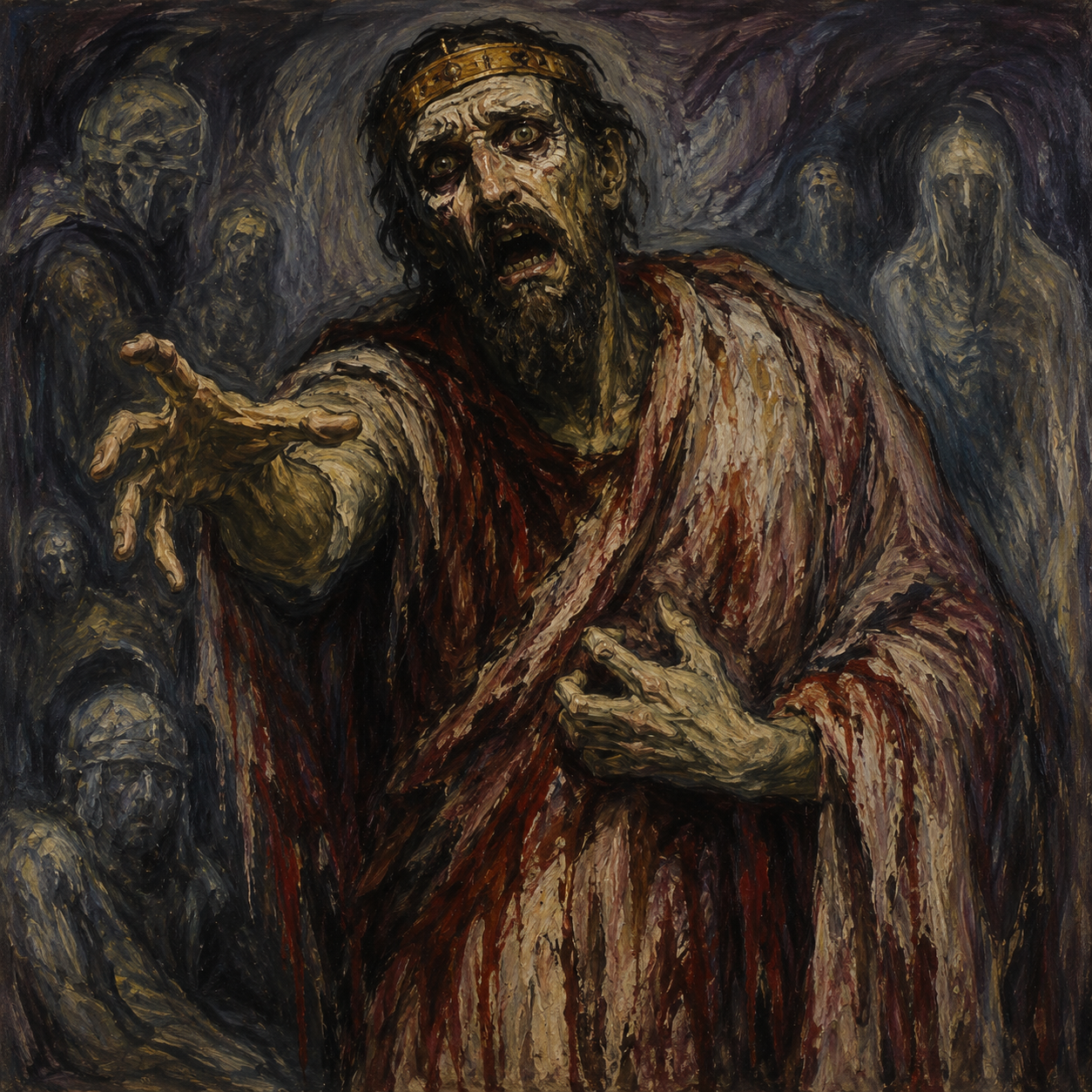
Agamemnon's shade warns Odysseus of treachery at home
His ghost gives Odysseus two pieces of advice. First: do not trust your wife completely. Come home secretly. Test her before you reveal yourself. Second: never tell a woman everything.
This advice is deeply unfair to Penelope, who is nothing like Clytemnestra. But it is exactly what Odysseus does. He returns to Ithaca in disguise. He tests Penelope before revealing himself. He is cautious, careful, suspicious. And part of the reason is this conversation in the underworld, where a murdered king told him that even your own wife might kill you.
Homer is doing something sophisticated here. Agamemnon's story is a narrative foil for the whole poem. His homecoming failed because he walked in openly and trusted the wrong people. Odysseus's homecoming succeeds because he learned from Agamemnon's mistake. The two stories are designed to be read together: one is the tragedy, the other is the version where the hero gets it right.
Achilles: The Speech That Redefines the Poem
And then Achilles comes. The greatest warrior of the Trojan War. The hero who chose a short, glorious life over a long, quiet one. The man whose rage is the subject of the Iliad. He is dead now, and his shade approaches the trench.
Odysseus, trying to comfort him, tells Achilles that he should not grieve about being dead, because he was the most honored of all warriors, and even among the dead he must rule as a king.
Achilles' response is one of the most famous passages in Western literature:
"Do not try to make light of death to me. I would rather be a serf, working for a landless man with nothing to his name, than be king over all the wasted dead." Homer, The Odyssey, Book 11 (Samuel Butler translation, 1900)
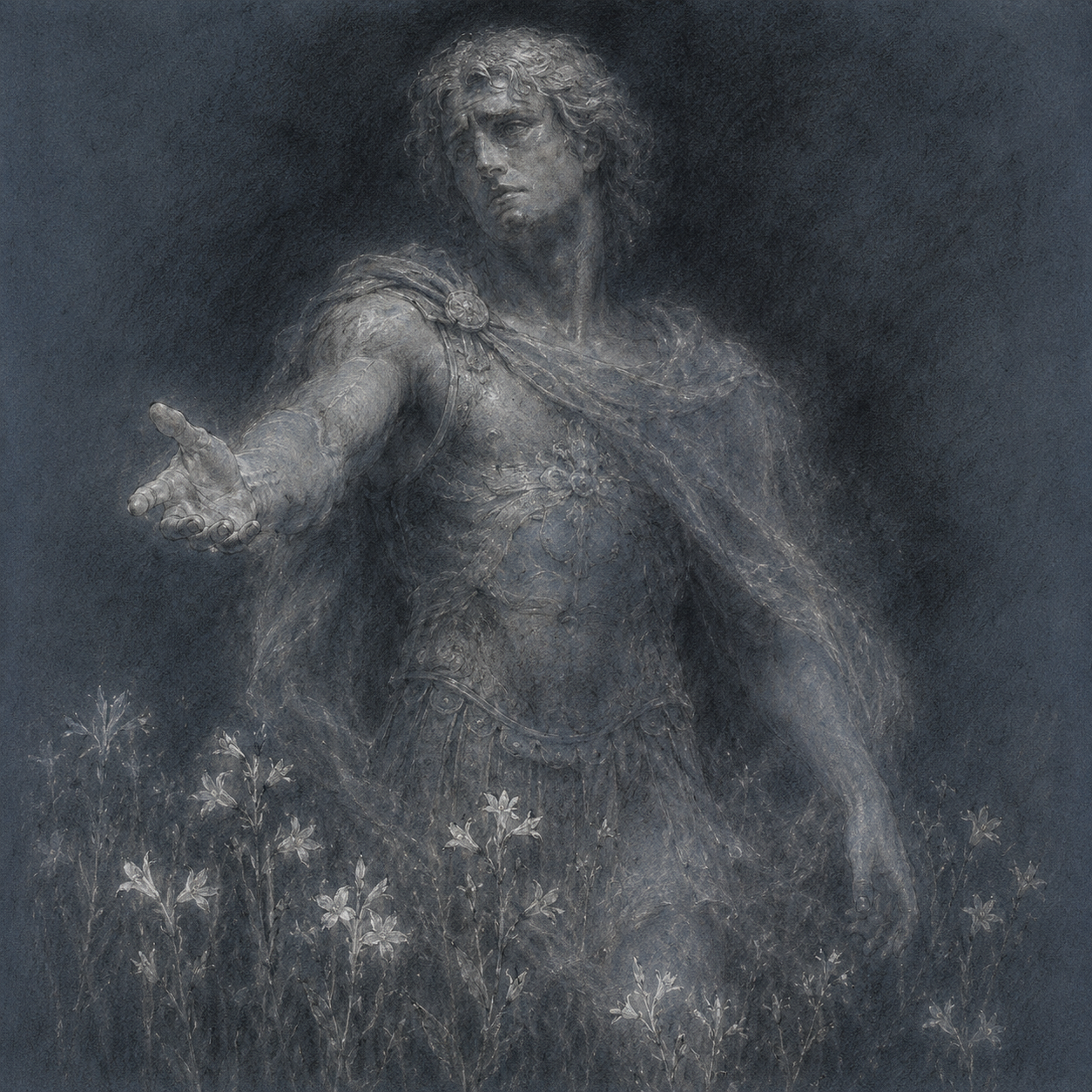
Even great Achilles laments his fate among the dead
The impact of this moment on the Odyssey cannot be overstated. If the Iliad is about the glory of dying well, the Odyssey is about the value of living at all. Achilles' speech is the bridge between the two poems. It takes the Iliad's values and inverts them completely. And it validates everything Odysseus is doing. Odysseus is not seeking glory. He is seeking home. He is not trying to die memorably. He is trying to live. And Achilles, from beyond the grave, tells him that is the right choice.
After his speech, Achilles asks one thing: tell me about my son. And when Odysseus tells him that Neoptolemus has become a great warrior, Achilles' shade walks away across the fields of asphodel with large strides, delighted. Even in death, even after renouncing glory, he is still a father who takes pride in his son. That final detail is perfect. It connects Achilles back to the poem's deepest theme: the ties between parents and children, the need to know that the next generation is going to be all right.
Recommended Reading
As an Amazon Associate, we earn from qualifying purchases.
The Parade of Shades
After the major encounters, Odysseus sees a procession of famous women and men from Greek mythology. He sees Tyro, who loved the river god; Antiope, mother of the founders of Thebes; Alcmene, mother of Heracles; Epicaste (Jocasta), who married her own son Oedipus without knowing it. He sees Ajax, the great warrior who killed himself after losing the contest for Achilles' armor and who still refuses to speak to Odysseus even in death, walking away in bitter silence.
He sees Minos, judge of the dead, sitting on a throne and hearing cases. He sees the giant Orion, still hunting in death as he did in life. He sees Tantalus, tortured by thirst in water that recedes whenever he reaches for it, and hunger beneath fruit that the wind lifts away when he grasps at it. He sees Sisyphus, pushing his boulder up the hill only to have it roll back down, again and again, forever.
Finally, he sees the shade of Heracles (though Homer notes that the real Heracles is on Olympus with the gods, married to Hebe; it is only his phantom that walks the underworld). Heracles recognizes Odysseus as a fellow sufferer, a man forced to complete impossible tasks by the cruelty of fate.
This catalog of the dead serves several purposes. It connects the Odyssey to the broader mythological tradition, reminding the audience that Odysseus's story is part of a much larger web of stories. It provides a who's who of Greek legend. And it deepens the atmosphere of the Nekuia: there are so many dead, so many stories, so many lives ended. The underworld is crowded with the entire history of the Greek world, and all of it has come to this: shadows reaching for blood in the dark.
Why Book 11 Matters
The Nekuia is the Odyssey's philosophical center. Everything else in the poem is action: monsters, battles, tricks, journeys. Book 11 is the place where the poem stops and asks what all of it means.
From Elpenor, we learn that every life matters, even the unremarkable ones. From Teiresias, we learn that the journey does not end where we think it will. From Anticlea, we learn the cost of absence, that the people we leave behind pay a price we may never know about. From Agamemnon, we learn that homecoming can be fatal if you are not careful. And from Achilles, we learn that life itself, messy, painful, temporary, is the greatest thing there is.
Together, these conversations arm Odysseus with the knowledge and the motivation he needs for the second half of the poem. He will return to Ithaca in disguise, as Agamemnon advised. He will avoid the cattle of the Sun, as Teiresias warned (though his men will not). He will value his mortal life and his mortal family over any divine offer of something easier, as Achilles' regret confirmed he should. The homecoming that drives the rest of the poem is forged here, in the darkness, among the dead. The underworld does not just predict the future. It shapes how Odysseus faces it.
There is also something deeply human about the structure of the episode. Odysseus goes to the land of the dead and talks to people he has lost. He hears their stories. He confronts the reality of death. And then he leaves, carrying their words with him, changed by the encounter. That pattern, visiting the dead, listening to them, letting their words change how you live, is not just a feature of ancient epic poetry. It is what grief looks like.
Hear the Dead Speak
Our full-cast narration gives every ghost a distinct voice. Elpenor's quiet shame. Teiresias's authority. Anticlea's unbearable tenderness. Agamemnon's rage. And Achilles, the greatest warrior who ever lived, saying he would trade it all to be alive again. Every word highlighted as it is spoken. Book 11 is one of those passages that changes quality when you hear it out loud. The silence around the voices. The weight of what is being said. This is the Odyssey at its deepest, and it deserves to be heard.
Explore the Underworld
As an Amazon Associate, we earn from qualifying purchases.
Related Pages
Hear Odysseus Descend to the Underworld
All 24 books of the Odyssey, read aloud with a full cast of distinct voices. Hear Teiresias speak his prophecy and the shades of the dead tell their stories.
Listen NowContinue the Journey
Hear the complete Odyssey read aloud with 60+ character voices. Every word highlights as it is spoken.
Book I is completely free. No signup required.
Go Deeper Into the Odyssey Film
Get the free Odyssey Companion Guide: character map, timeline, family tree, and the essential scenes from Homer's poem and the film.
No spam. Unsubscribe anytime.
Lords of the Underworld
Hades and Persephone t-shirts from the Olympian Collection, plus Odyssey designs across five product types.
Shop This DesignUNDERWORLD DESIGNS