Last updated June 2026
Homecoming, Nostos
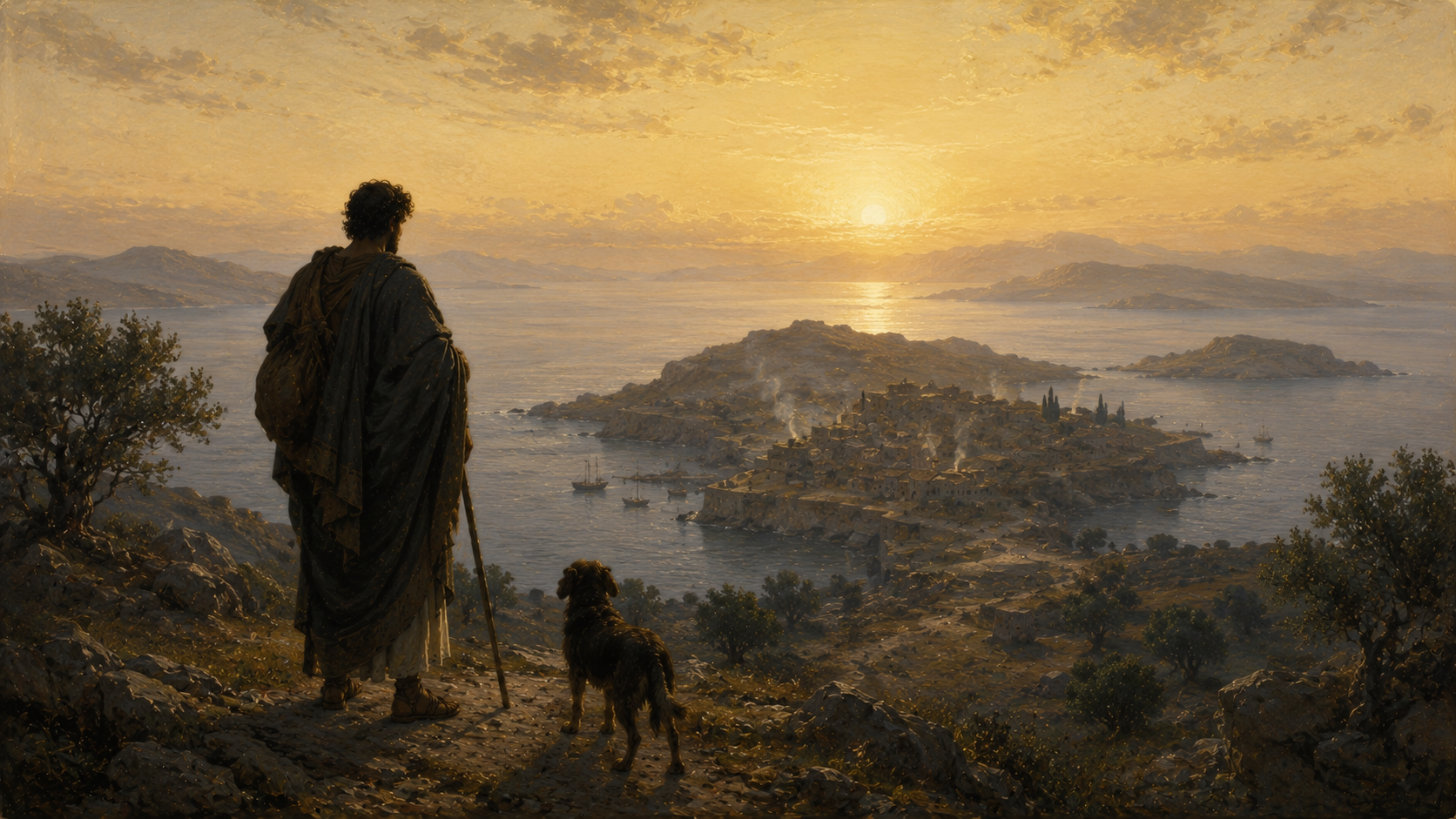
At its most basic level, the Odyssey is a story about going home. The Greek word for this is nostos, the return of the hero from war. It gives us the modern English word "nostalgia," which literally means the pain of homecoming. Every major event in the poem either moves Odysseus closer to Ithaca or pushes him further away.
But Homer complicates the idea right away. We learn that Odysseus's men "perished through their own sheer folly," that the gods are divided on whether he should return, and that the home he left twenty years ago has been taken over by suitors eating his food and courting his wife. Getting home, it turns out, is not just about arriving at a place. It is about recovering a life.
The Hero Who Cannot Stop Traveling
Calypso detains Odysseus for seven years on her island, offering him immortality and eternal youth. That is the opposite of the mortal life waiting for him in Ithaca. Yet he refuses. When Calypso asks why he would choose an aging wife over a goddess, Odysseus gives a painfully honest answer: he admits Penelope cannot compare to an immortal, and still insists on going home. He does not want perfection. He wants what is his: his own hearth, his own wife, his own rocky island.
"Nevertheless, I want to get home, and can think of nothing else. If some god wrecks me when I am on the sea, I will bear it and make the best of it. I have had infinite trouble both by land and sea already, so let this go with the rest." Odysseus to Calypso, Book VHear this theme in Book V →
This refusal to trade authenticity for comfort is what separates Odysseus from the men he loses along the way. The Lotus-Eaters offer forgetfulness, and some of his men accept it gladly. Circe offers pleasure. The Sirens offer knowledge. Each temptation asks the same question: is home worth the suffering it takes to reach it?
The Ithaca He Returns To
When Odysseus finally reaches Ithaca in Book XIII, he does not recognize it. Athena has shrouded the island in mist, and the hero who spent a decade dreaming of home stands on its shore not knowing where he is. The place you have been longing for is never quite the place you remember. The home has changed. The man has changed.
Odysseus then spends ten more books in his own house, disguised as a beggar, watching strangers devour his livelihood, before he can reclaim his identity, his marriage, and his kingdom. The homecoming is not a single triumphant moment. It is a process, patient and painful and deeply human.
Cunning vs. Strength
If the Iliad belongs to Achilles (the strongest warrior, the fastest runner), the Odyssey belongs to the mind. Odysseus is not the strongest Greek at Troy. He is not the bravest, the tallest, or the most beautiful. He is polytropos, the man of many turns, many devices, many strategies. His defining quality is metis, the Greek word for cunning intelligence, and Homer celebrates it above all other virtues.
The Cyclops and the Triumph of Wit
The most famous example of cunning over strength is the encounter with Polyphemus the Cyclops in Book IX. Trapped inside a cave sealed by a boulder no mortal could move, Odysseus cannot fight his way out. Brute force is literally impossible. So he gets the Cyclops drunk, tells him his name is "Noman" (or "Nobody"), blinds him with a heated stake, and escapes by clinging to the underside of the giant's own sheep.
When Polyphemus screams to the other Cyclopes that "Noman is killing me," they dismiss his cries and leave. The pun on "nobody" and "no man" is the hinge on which survival turns. Odysseus does not overpower his enemy. He outwits him. The mind prevails where the sword cannot.
"Cyclops, you ask my name and I will tell it you; give me, therefore, the present you promised me; my name is Noman; this is what my father and mother and my friends have always called me." Odysseus to Polyphemus, Book IXHear this theme in Book IX →
The Bow as a Symbol
In Book XXI, Penelope sets the contest of the bow, and none of the suitors can even string the weapon, let alone shoot through twelve axe-heads. The bow rewards skill, precision, and mastery, the same qualities Odysseus brings to every challenge. When the beggar in rags strings it with effortless grace and sends an arrow singing through the iron rings, it is a vindication of craft over bluster.
Homer shows us again and again that strength alone leads to ruin. The suitors are strong and numerous; they lose everything. Polyphemus is the most powerful creature Odysseus meets; he is blinded and humiliated. Ajax, the strongest Greek after Achilles, loses the contest for Achilles' armor to Odysseus and kills himself. In Homer's world, the man who thinks is worth more than the man who merely hits.
Loyalty and Faithfulness
The Odyssey is populated by two kinds of people: those who stay loyal to Odysseus during his twenty-year absence, and those who betray him. Homer draws this line with total moral clarity. Loyalty is rewarded. Betrayal is punished. And the poem's most moving scenes are the ones where faithful love gets tested, strained, and finally vindicated.
Penelope: The Mind That Matches the Hero
Penelope's faithfulness anchors the entire poem. For twenty years she has waited, resisting the pressure of over a hundred suitors who have occupied her home and eaten through her husband's wealth. Her trick with the loom (weaving a burial shroud by day and unraveling it by night) is as cunning as anything Odysseus himself devises. It bought her three years of delay through pure intelligence.
But Penelope is not just patient. She is cautious to the point of seeming cold. When Odysseus finally reveals himself in Book XXIII, she does not rush into his arms. She tests him, ordering a servant to move the marriage bed, knowing the bed is built around a living olive tree and cannot be moved. Only when Odysseus reacts with indignation, describing the bed he built with his own hands, does she accept him. Her caution is itself a form of loyalty: she will not be deceived, not even by hope.
"Do not be angry with me Odysseus. You, who are the wisest of mankind. We have suffered, both of us. Heaven has denied us the happiness of spending our youth, and of growing old, together." Penelope to Odysseus, Book XXIIIHear this theme in Book XXIII →
Eumaeus, Eurycleia, and the Faithful Servants
The swineherd Eumaeus has tended his master's pigs for twenty years, never stealing from the herd or sucking up to the suitors. When Odysseus arrives at his hut disguised as a beggar, Eumaeus feeds him, shelters him, and speaks of his absent master with grief that has not faded in two decades. Homer gives Eumaeus a distinction no other character in either epic gets: the narrator addresses him as "you," breaking his own distance to speak to the swineherd directly.
Eurycleia, the old nurse, recognizes Odysseus by the scar on his thigh when she washes his feet in Book XIX. Her loyalty is instant and total; she has to be physically restrained from shouting the news to Penelope. And Argos, the hunting dog Odysseus trained as a puppy twenty years before, spots his master from across the courtyard, wags his tail, and dies. Those might be the most heartbreaking four lines in the poem, and Argos is probably the most famous loyal dog in all of literature.
The Cost of Disloyalty
Against these portraits of faithfulness, Homer sets the disloyal: the maidservants who slept with the suitors, the goatherd Melanthius who mocks the disguised Odysseus and serves the suitors' feasts, and the suitors themselves. Their fate is total destruction. Homer does not soften the punishment or invite sympathy. In the Odyssey, loyalty is survival and betrayal is death.
Recommended Reading
As an Amazon Associate, we earn from qualifying purchases.
Hospitality, Xenia
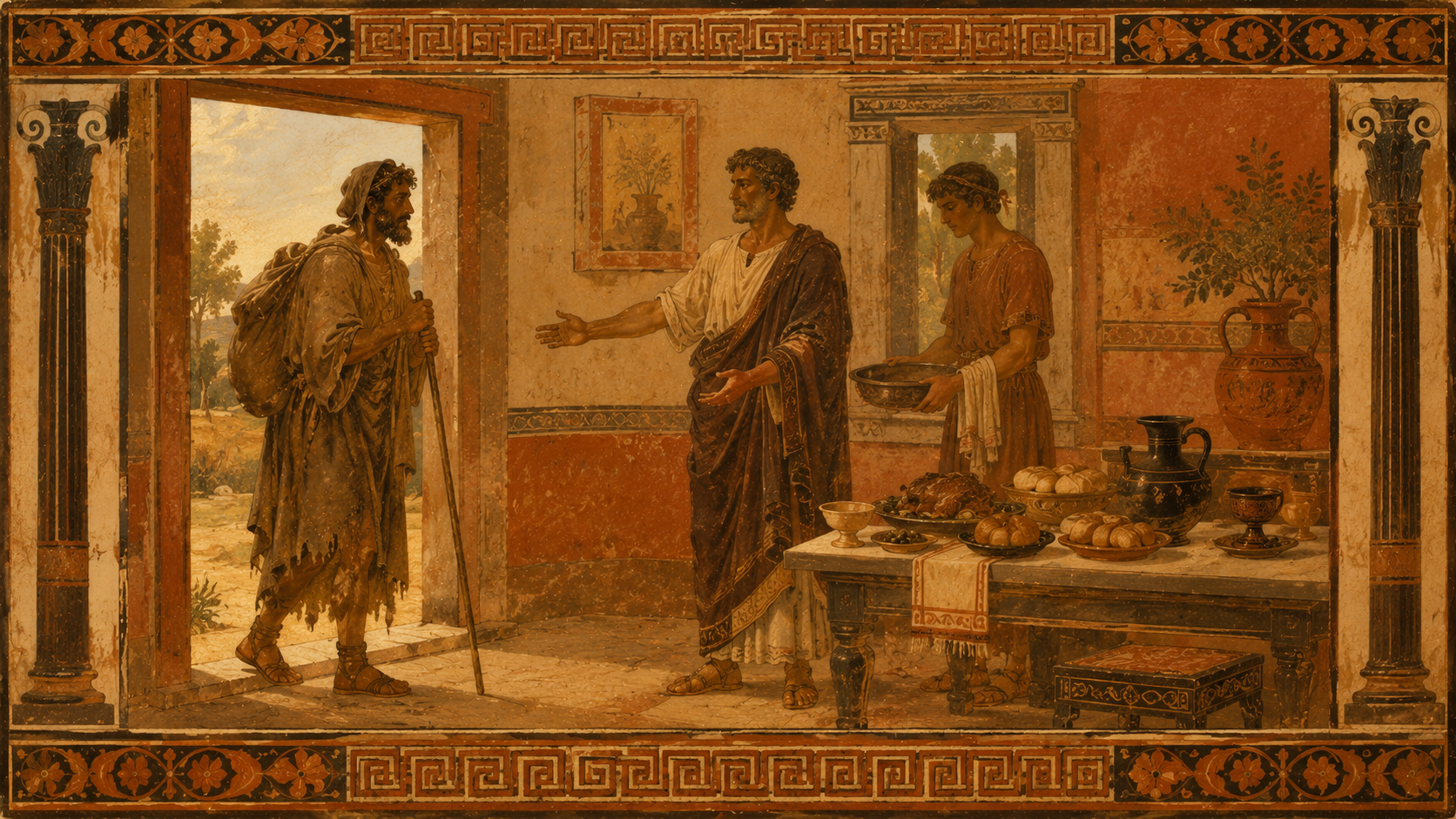
No theme in the Odyssey runs as deep as xenia, the sacred Greek custom of guest-friendship. In the ancient world there were no hotels, no police, and no international law. The relationship between host and guest was protected by Zeus himself, who bore the title Xenios, protector of strangers. Violating xenia meant violating the will of the king of the gods.
Good Hosts, Bad Hosts
The Odyssey is structured as a series of hospitality encounters, and each one is a moral test. Nestor at Pylos and Menelaus at Sparta are models of good hosting: they welcome Telemachus without demanding his name, feed him before questioning him, offer gifts, and provide safe escort.
The Phaeacians take hospitality to its highest level. King Alcinous and Queen Arete welcome the shipwrecked, unnamed stranger, bathe him, clothe him, feast him, and give him a ship and treasure to get home. They do all this before Odysseus even tells them who he is.
At the other extreme, the Cyclops Polyphemus is the worst possible host. When Odysseus invokes the law of hospitality, Polyphemus responds by eating two of his men. He has no civilization, no agriculture, no assemblies, no laws, and therefore no understanding of the sacred obligation between host and guest. His punishment (blindness, isolation, the loss of his flock's leader) is Zeus's justice carried out through Odysseus's cunning.
The Suitors: The Ultimate Violation
The central conflict of the Odyssey is itself a violation of xenia. The suitors came as guests to Odysseus's house and refused to leave. They consume his food, drink his wine, harass his wife, plot to murder his son, and abuse every stranger who comes to the door, including the disguised Odysseus himself. They are guests who have become invaders, and their crime is not just against Odysseus but against Zeus.
When Odysseus slaughters them in Book XXII, he is not just taking personal revenge. He is restoring the cosmic order they violated. Homer makes this clear: Athena fights alongside Odysseus, and Zeus sends a thunderbolt to signal approval. The massacre is brutal, but within the poem's moral framework, it is justice.
"Dogs, did you think that I should not come back from Troy? You have wasted my substance, have forced my women servants to lie with you, and have wooed my wife while I was still living. You have feared neither God nor man, and now you shall die." Odysseus to the suitors, Book XXIIHear this theme in Book XXII →
The Wrath of the Gods
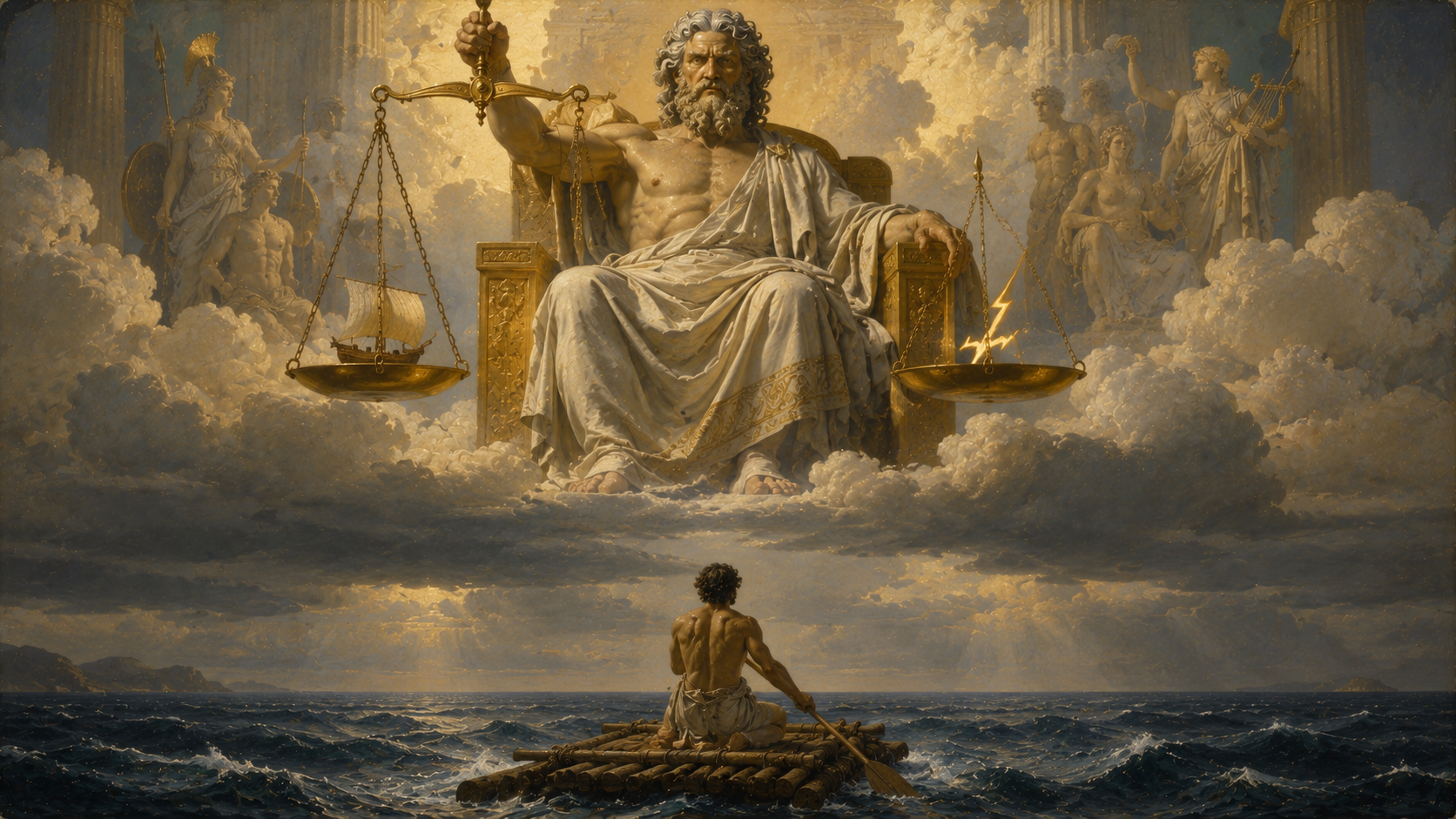
The Odyssey opens in the councils of heaven, and the gods never leave the stage for long. But Homer's gods are not distant or abstract. They are personal, capable of love and grudges, favoritism and spite. The divine machinery of the poem raises questions about fate, free will, and the gap between mortal effort and divine caprice that readers have been wrestling with for three thousand years.
Poseidon's Grudge
The single greatest obstacle to Odysseus getting home is not the sea itself but the god of the sea. Poseidon's anger comes from one act: Odysseus blinded his son Polyphemus. The punishment is wildly out of proportion. Ten years of shipwreck and exile for a single injury committed in self-defense. But Homer does not frame it as unjust. He frames it as the way gods are. Poseidon is not evil; he is a father who loves his son.
Athena's Advocacy
Against Poseidon's wrath stands Athena's love. The grey-eyed goddess champions Odysseus throughout the poem, not because he is pious but because she sees her own qualities in him: craft, intelligence, and resourcefulness. When they meet in Book XIII and she reveals herself, the exchange is warm and playful, two masters of deception admiring each other's skill.
Athena's help raises an uncomfortable question: does Odysseus succeed because of his own abilities, or because a goddess is rigging the game? Homer never fully resolves this, and that is part of the poem's genius. Human effort and divine will are wound together so tightly they cannot be separated.
Zeus and Mortal Folly
The very first divine speech in the Odyssey is Zeus complaining that mortals blame the gods for their own bad choices. It is a startling declaration, and it sets the poem's theological framework: humans have free will. Odysseus's men die because they eat the cattle of the Sun. The suitors die because they refuse to leave another man's house. Aegisthus dies because he ignored a divine warning. In each case, the mortal was told what would happen and chose to ignore it.
That does not mean the gods are fair. Poseidon's wrath, Calypso's detention, the storm that drives Odysseus past Ithaca when he can already see its shores: none of that is his fault. Homer holds both truths at once. The gods are powerful and sometimes arbitrary, and mortals are responsible for their own choices. The drama lives in the space between.
"See now, how men lay blame upon us gods for what is after all nothing but their own folly." Zeus, Book IHear this theme in Book I →
Identity and Disguise
Odysseus is polymetis, the man of many minds, and he is also the man of many faces. Throughout the poem he takes on false identities, tells invented stories about himself, and gets physically disguised by Athena. The question of who Odysseus actually is, beneath the masks and lies, is one of the poem's deepest concerns.
The Man of Many Masks
Among the Phaeacians, Odysseus hides his identity for several books, weeping behind his cloak when the bard Demodocus sings of Troy. On Ithaca, Athena disguises him as an aged beggar, and he keeps that disguise for ten full books, through encounters with his swineherd, his son, his wife, his nurse, and the suitors. Even when Athena tells him he is in Ithaca, his first instinct is to lie. She laughs and calls him incorrigible.
But Homer shows that disguise has a cost. Odysseus sits in his own hall watching the suitors feast on his food and hearing them insult him to his face. He has to endure being struck, mocked, and treated as a worthless vagrant in his own home. The disguise protects him, but it also strips away everything that makes him Odysseus: his name, his authority, his dignity.
The Recognition Scenes
The poem's great emotional climaxes are not battles but recognitions. Telemachus learns his father's identity in Book XVI and weeps. Eurycleia touches the scar in Book XIX and gasps. Argos sees his master from across the yard and dies. Penelope hears the secret of the bed in Book XXIII and finally breaks down. Each recognition peels away another layer of disguise and restores another piece of who Odysseus is.
The recognition between Odysseus and Penelope is the most complex. She has waited twenty years, and when the man who claims to be her husband stands before her, she refuses to believe it. Her test (the immovable bed) is a demand that he prove himself not through appearance or reputation but through private knowledge only the real Odysseus could have. It is the final mask removed, and the emotional release when it falls is one of the most powerful moments in Western literature.
"I am Odysseus son of Laertes, and I am known among all men for the subtlety of my craft. My fame ascends to heaven." Odysseus to the Phaeacians, Book IXHear this theme in Book IX →
Names and Naming
Names carry enormous weight in the Odyssey. When Odysseus tells Polyphemus his name is "Noman," he survives. When he shouts his real name as he sails away, he nearly dies, because Poseidon can now identify him. The act of naming is the act of being known, and being known is both a glory and a danger. His identity is his greatest weapon and his greatest vulnerability.
Temptation and Self-Control
Odysseus's journey home is not just a physical voyage. It is a moral and psychological gauntlet where every stop presents a temptation that could end the journey forever. The Lotus-Eaters offer forgetfulness. Circe offers an enchantress's bed. Calypso offers immortality. The Sirens offer knowledge. In each case the price of giving in is the same: Odysseus would never return home.
The Lotus-Eaters and the Danger of Forgetting
The Lotus-Eaters are the first temptation Odysseus meets after Troy, and in some ways the most dangerous. They do not attack. They simply offer a fruit that makes you forget where you came from and where you are going. Odysseus's men eat it and no longer want to leave; they have to be dragged back to the ships by force. The episode is barely a paragraph long, but it announces a theme that runs through the entire poem: the greatest danger is not violence but comfort, not the enemy who attacks but the host who gives you a reason to stop trying.
Circe, Calypso, and the Temptation of Immortality
Both Circe and Calypso offer Odysseus a life of ease with a beautiful goddess, the kind of existence any mortal might envy. Circe feeds his men and beds him for a year; only his crew's reminder of home stirs him to leave. Calypso holds him for seven years, offering eternal life if he will stay.
Odysseus's refusal of immortality is one of the most defining choices in all of literature. He chooses old age, hardship, and an uncertain future over an eternity of comfort, because that comfort is not his. Calypso's island is beautiful but it is not Ithaca. Her love is real but she is not Penelope. He would rather suffer as himself than live forever as someone else.
The Sirens: Knowledge as Seduction
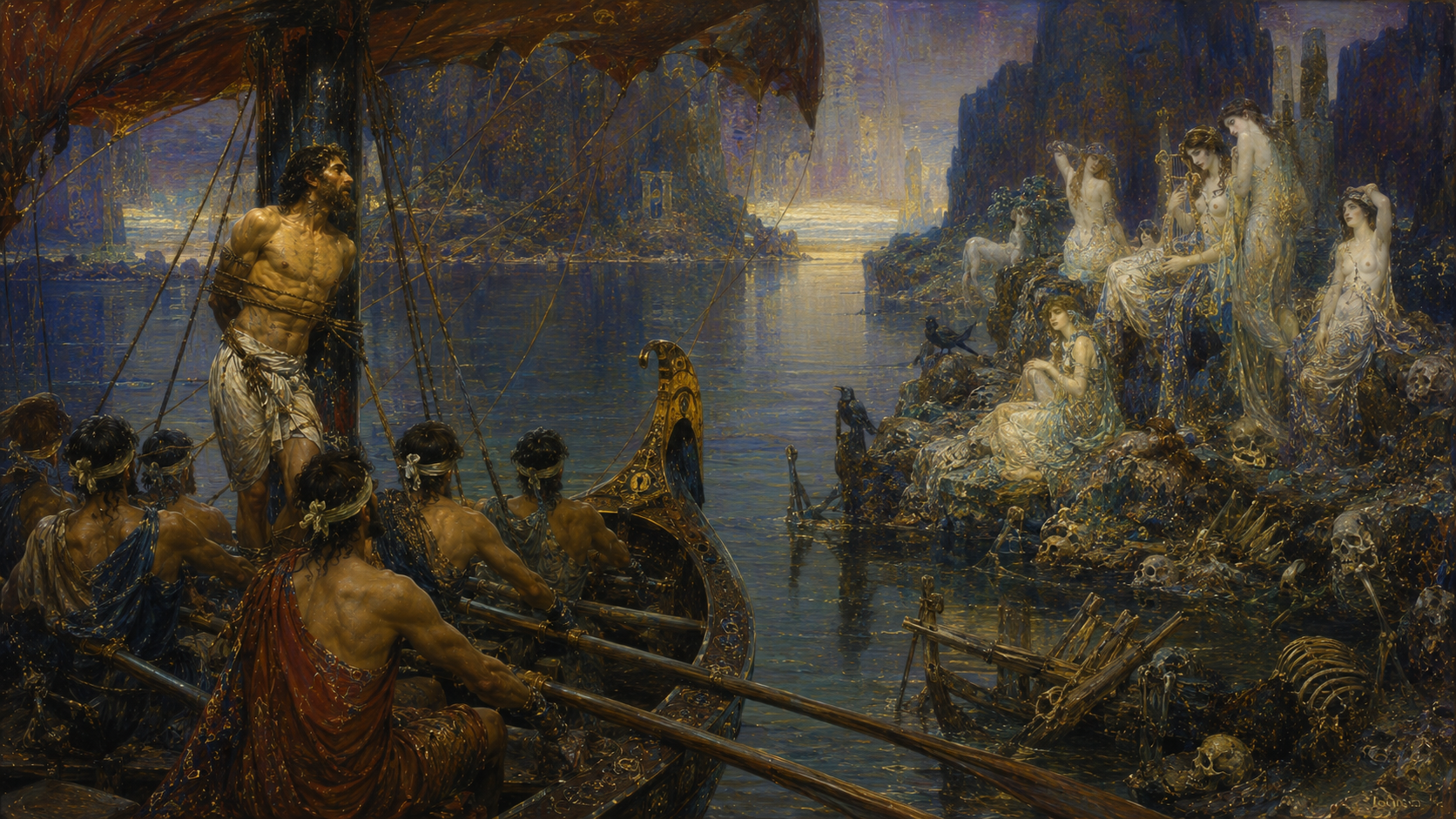
The Sirens are unique among the poem's temptations because Odysseus does not fully resist them. He has his men tie him to the mast so he can listen to their song without being destroyed by it. He wants the experience, the knowledge, the beauty of the song, but he also wants to survive. That is Odysseus in miniature: the man who wants everything and is clever enough to find a way to have it without being consumed.
"Odysseus, noble son of Laertes, so you would start home to your own land at once? Good luck go with you, but if you could only know how much suffering is in store for you before you get back to your own country, you would stay where you are, keep house along with me, and let me make you immortal." Calypso to Odysseus, Book VHear this theme in Book V →
Self-Control in the Hall of the Suitors
The final and longest test of Odysseus's self-control is not supernatural at all. It is domestic. He sits in his own hall for days, enduring insults, dodging thrown stools, watching men court his wife and plot to murder his son. He does not break. Homer compares his restraint to a man holding down a dog that wants to attack. This is not weakness. It is the ultimate expression of the cunning that brought him home. He waits for the right moment, and when it comes, his revenge is total.
Why These Themes Still Resonate
The Odyssey was composed nearly three thousand years ago for an audience of warriors and nobles who saw hospitality as sacred law and measured a man's worth by his reputation and his homestead. We live in a different world. But every theme in the poem still maps onto modern life.
Nostos is the story of every veteran who comes home from war to find that home has changed and so has he. It is the story of every exile, every immigrant, every person who has been away too long and must rebuild from what remains. Cunning versus strength is the story of every underdog who outthinks a bigger opponent, in business, in politics, in life. Loyalty is tested in every marriage and friendship that endures hardship. Xenia, the obligation to the stranger, is the question behind every debate about immigration and refugees.
The wrath of the gods is the question of whether the universe is fair, whether suffering has a cause, whether we are at the mercy of forces we cannot control. Identity and disguise speak to anyone who has felt unseen, who has worn a mask at work and longed to be recognized for who they really are. And temptation, the lure of distraction and easy pleasure, is a fight every person has every day.
Homer did not write timeless themes because he was trying to be universal. He wrote specific scenes about specific people in a specific world, and the truth of his observations was so precise that they became universal on their own. That is what great literature does. Three thousand years later, the Odyssey still has something to say to anyone willing to listen.