The Trick: Weaving by Day, Unraveling by Night
The situation Penelope faces is nearly impossible. Her husband has been gone for twenty years, first to the Trojan War, then lost somewhere on the sea. Over a hundred suitors have invaded her home in Ithaca, eating through the household's wealth and demanding that she choose one of them as her new husband. She has no army, no political allies strong enough to expel them, and no certainty that Odysseus is even alive. What she has is her mind.
Penelope announces that she will choose a husband once she has finished weaving a funeral shroud for Laertes, her aging father-in-law. This is not a random excuse. In ancient Greek culture, preparing burial garments for an elderly family member was a sacred duty, a task so closely tied to piety and family honor that no one could object to it without appearing impious. The suitors accept the condition. They have no choice. To refuse would be to disrespect both Laertes and the gods.
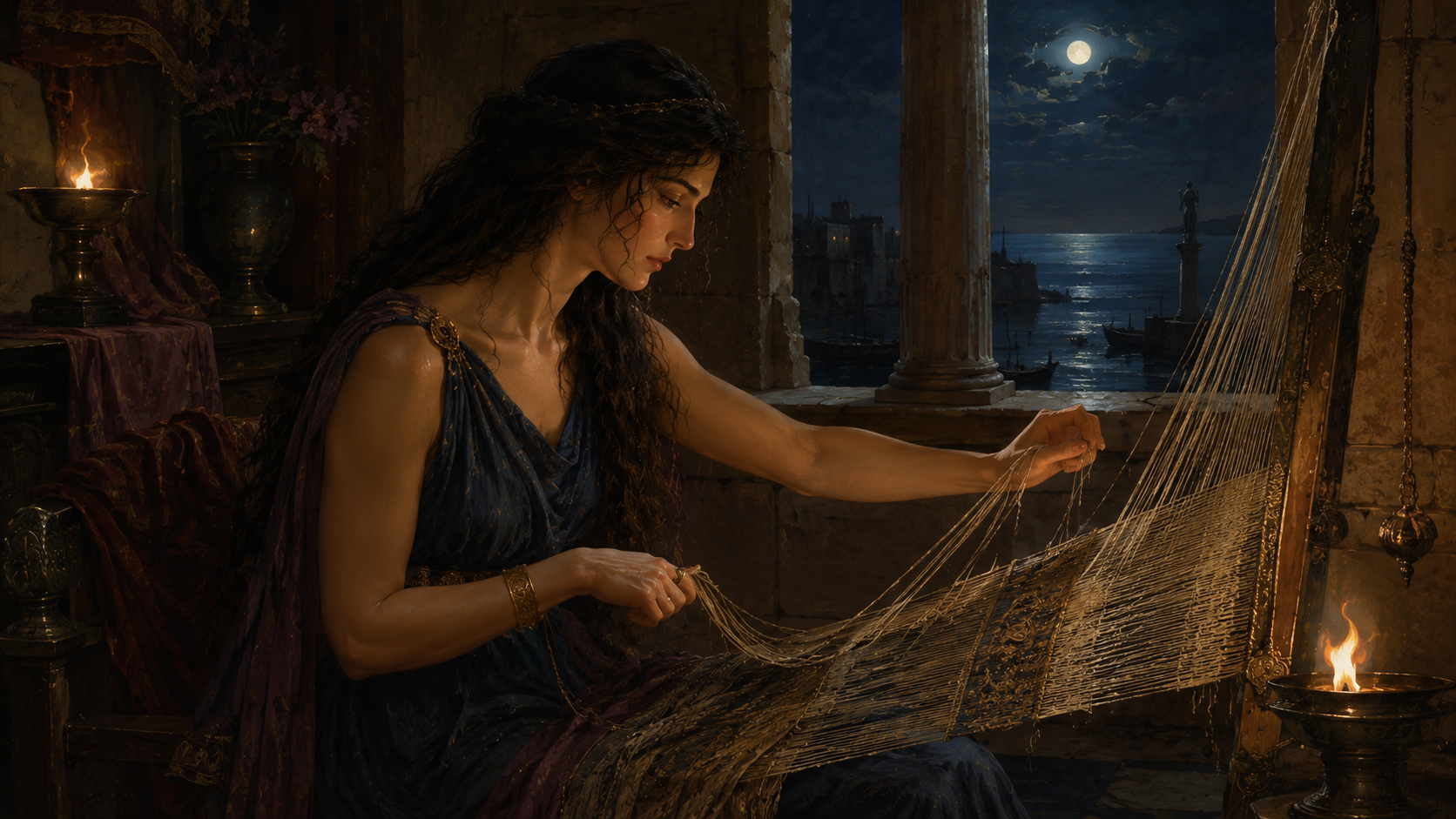
And so Penelope weaves. Every day she sits at her great loom and works on the shroud, visible to the entire household, the picture of a dutiful wife fulfilling her obligations. Every night, after the suitors have retired, she creeps back to the loom by torchlight and carefully unravels the day's work, pulling the threads free one by one. The shroud never gets finished because Penelope never allows it to be finished. The task that appears to move forward each day is secretly reset each night, and the suitors, watching the loom from a distance, see progress that does not exist.
This goes on for three years. Three years of patient, methodical deception, performed with such discipline that neither the suitors nor (apparently) most of the household suspect what she is doing. It is one of the great acts of cunning in all of literature, and Homer clearly intends it to stand alongside the tricks of Odysseus himself.
Why the Shroud Works as a Weapon
Penelope's choice of the shroud is not accidental; it is strategically brilliant. She selects a task that is simultaneously real and deceptive. The shroud is a genuine obligation. Laertes is old and declining. Someone in the household should prepare his burial garments. By choosing this particular task, Penelope wraps her deception in an act of genuine piety, making it almost impossible for the suitors to challenge her without looking cruel or irreligious.
The loom also gives Penelope something Odysseus rarely has during his own journey: control over time. While Odysseus is battered from island to island by forces beyond his control, Penelope has found a way to suspend time within her own household. Each day of weaving moves the clock forward; each night of unweaving rewinds it. She is, in effect, making and unmaking the days, holding the world in a state of suspension that serves her interests. The suitors believe they are waiting for a natural process to conclude. In reality, they are caught in a loop that Penelope controls entirely.
There is also a social dimension to the trick that modern readers sometimes miss. In Homer's world, weaving was the quintessential female activity. A woman at her loom was the image of domestic virtue, of a wife doing exactly what she was supposed to do. Penelope exploits this expectation perfectly. She uses the very symbol of female obedience as a tool of female resistance. The suitors see a compliant wife performing her duties. What they are actually watching is a woman who has turned their own assumptions into a weapon against them.
The Betrayal: A Maid Breaks the Secret
The trick lasts three years, but it does not last forever. Penelope is betrayed by one of her own serving women, who reveals the nightly unweaving to the suitors. The poem mentions this detail several times, most notably through the suitor Antinous in Book 2, who tells the story to the assembly at Ithaca, and again through Penelope herself when she speaks to the disguised Odysseus in Book 19.
"So for three years she deceived the Achaeans; but when the fourth year came, and the seasons began to roll on, one of her maids, who knew what she was doing, told us about it, and we caught her in the act of undoing her work." Homer, The Odyssey, Book 2 (Samuel Butler translation, 1900)
The identity of the specific maid is not given a name in every telling, but the detail is devastating regardless. Penelope's most dangerous enemy is not the suitors themselves but someone inside her own household, someone she trusted. This mirrors a pattern that runs through the entire poem: the greatest threats in the Odyssey come not from external monsters but from betrayals within. The crew who open the bag of winds, the serving women who sleep with the suitors, the goatherd Melanthius who arms the suitors during the final battle: again and again, the poem shows that the people closest to you are the ones with the power to destroy you.
Once the suitors catch Penelope in the act of unweaving, they force her to complete the shroud. The trick is over. But Penelope is not defeated. She simply shifts to new strategies of delay, including the bow contest in Book 21, which functions as another brilliant act of postponement disguised as compliance. The shroud trick may end, but the quality of mind that produced it does not.
What the Shroud Symbolizes
On the surface, the shroud is a piece of cloth. Beneath the surface, it carries some of the richest symbolism in the entire poem.
The most immediate symbolic meaning is loyalty. Penelope is weaving a shroud for Laertes, the father of the husband she refuses to give up on. Every thread she places is an act of devotion to Odysseus's family, and every thread she removes is a refusal to let that family be dissolved by the suitors. The shroud is loyalty made physical, visible, tangible. It is also, paradoxically, loyalty expressed through destruction, because each night Penelope must destroy what she has built in order to preserve what matters.
The shroud also symbolizes time itself, and the way Penelope manipulates it. By weaving and unweaving, she creates a kind of temporal paradox: days pass in the outside world, but within the logic of the shroud, no progress is made. She has found a way to freeze the clock. This makes the shroud a symbol of both power and imprisonment. Penelope controls the pace of events, but she is also trapped inside her own trick. She cannot stop weaving without losing her defense, and she cannot finish weaving without losing her husband. Time is her weapon, but it is also her cage.
For readers interested in the women of the Odyssey, the shroud is one of the poem's strongest statements about female agency. Penelope operates in a world where women have almost no formal power. She cannot command armies, challenge the suitors to combat, or simply order them to leave. She has to work within the constraints her society imposes, and she does so with extraordinary intelligence. The loom, the traditional instrument of female domesticity, becomes in her hands a tool of resistance and subversion. She does not reject her role; she repurposes it. That is a more radical act than simple rebellion, because it proves that intelligence and agency can flourish even within the tightest constraints.
Finally, there is a literary dimension that Homer's original audience would have recognized immediately. In ancient Greek, the word for weaving (hyphainein) was also used to describe the composing of stories and songs. A poet "weaves" a tale; a cunning person "weaves" a plot. Penelope at her loom is, in this sense, a figure for the storyteller: someone who constructs a narrative, controls its pace, decides what to reveal and what to conceal. The shroud is not just cloth. It is a text, and Penelope is its author. This connection between weaving and storytelling runs deep in the Odyssey, a poem that is itself obsessed with who gets to tell stories, how stories shape reality, and what happens when the wrong person controls the narrative.
Metis: How the Shroud Makes Penelope Odysseus's Equal
The Greeks had a specific word for the kind of intelligence Odysseus embodies: metis. It is usually translated as "cunning" or "craft," but it means something richer than either word suggests. Metis is the ability to read a situation, to find the hidden angle, to solve problems through wit rather than force, and to maintain a deception under pressure for as long as necessary. It is the quality that allows Odysseus to tell the Cyclops his name is "Nobody." It is the quality that allows him to disguise himself as a beggar in his own home and endure insults without breaking character.
Penelope's shroud trick is metis in its purest form. She identifies a weakness in her opponents' position (they cannot refuse a pious task), constructs a deception that exploits that weakness, and sustains it under extraordinary pressure for three full years. She does this without any allies, without any divine assistance (Athena does not help with the shroud), and without any guarantee that Odysseus will ever return. It is, by any measure, one of the most impressive feats of cunning in the poem.
Homer draws the parallel between husband and wife deliberately. Both Odysseus and Penelope survive through deception rather than force. Both rely on patience, discipline, and the willingness to play a long game. Both face betrayal from people they should be able to trust. And both, when they are finally reunited in Book 23, recognize each other not by appearance or emotion but by a shared secret: the construction of their marriage bed, built around a living olive tree, a secret that only the two of them know. The bed test is not a test of love. It is a test of metis. Penelope needs to confirm that the man before her possesses the same quality of mind that she possesses, the intelligence to hold a secret and use it at exactly the right moment.
This is why the reunion matters so much. It is not simply a husband coming home to his wife. It is two people of equal cunning recognizing each other across twenty years of separation. The shroud is the proof that Penelope did not merely wait for Odysseus. She matched him, trick for trick, year for year, in a different arena but with the same quality of mind.
Weaving as Storytelling: The Poem's Deeper Pattern
The connection between weaving and storytelling in the Odyssey extends well beyond Penelope's shroud. Throughout the poem, characters who weave are also characters who control narrative. Circe weaves at her loom while singing; Helen weaves a tapestry that depicts the Trojan War; Calypso weaves while Odysseus longs for home. In each case, the act of weaving is linked to the power to shape events, to determine what is remembered and how.
Penelope's shroud fits this pattern but adds a dimension the others lack: she is not just weaving a story but actively un-telling it. Every night she undoes the narrative she has been constructing during the day. She is the author who erases her own chapters, who refuses to let the story reach its conclusion because the conclusion the suitors want is not the one she is willing to accept. In a poem built on the idea that stories determine fate, this is an extraordinary act of power. Penelope is not just delaying the suitors. She is refusing to let their version of events become real.
Homer's audience, steeped in a tradition where poets "wove" their songs aloud at feasts and courts, would have understood this immediately. The Odyssey itself is a woven thing, a poem composed in layers, full of stories within stories, narrators who are unreliable, and truths that are revealed only gradually. Penelope at her loom is a mirror of the poet at work: constructing, revising, concealing, revealing. Her shroud is the poem's most intimate image of its own process, the art of holding an audience in suspense while you decide, thread by thread, how the story will end.
And in the end, of course, the story ends the way Penelope wanted it to. Odysseus comes home. The suitors are destroyed. The shroud was never finished, and it never needed to be, because its true purpose was never burial. Its purpose was time. And Penelope, through patience and intelligence and the willingness to undo her own work night after night, bought enough of it.
The Shroud's Legacy
Penelope's web has become one of the most enduring images in Western literature. The phrase itself has entered common language as a metaphor for any task that is deliberately never completed, any strategy of delay disguised as effort. But the image is richer than its popular use suggests. It is not just about stalling. It is about a woman who found a way to exercise power in a world that denied her any, who turned domestic labor into resistance, and who proved that intelligence can be a match for force when force is not available.
For readers approaching the Odyssey for the first time, the shroud trick is easy to overlook. It occupies relatively few lines compared to the sea voyages and monster encounters. But it is, in many ways, the poem's most important act of cunning, because it demonstrates that the intelligence the poem celebrates is not confined to one gender, one arena, or one kind of adventure. Odysseus fights his way across the sea. Penelope fights her way through time. Both of them win, and Homer wants you to understand that both victories are equal.
Read the Odyssey's exploration of loyalty, perseverance, and cunning as moral virtues, and Penelope's shroud stops looking like a subplot. It starts looking like the poem's quiet thesis: that the greatest trick is not the flashiest one, but the one that holds.
Continue Reading
Hear Penelope's Story Come Alive
Full-cast narration with every word highlighted as it is spoken. Start free with Book I, then unlock all twenty-four books for $6.99.
Start Listening FreeContinue the Journey
Hear the complete Odyssey read aloud with 60+ character voices. Every word highlights as it is spoken.
Book I is completely free. No signup required.
Go Deeper Into the Odyssey Film
Get the free Odyssey Companion Guide: character map, timeline, family tree, and the essential scenes from Homer's poem and the film.
No spam. Unsubscribe anytime.