A Boy Without a Father
Telemachus was an infant when Odysseus left for Troy. He has no memory of his father. Everything he knows about Odysseus comes secondhand, from the stories his mother Penelope tells, from the old servants who remember the household before the war, and from the reputation that precedes the name. He knows his father was clever, brave, and respected. He does not know what his father's voice sounds like, or how he laughs, or what it feels like to have him in the room.
This absence defines Telemachus at the start of the poem. When we first meet him in Book 1, he is sitting in his own hall, surrounded by over a hundred suitors who are consuming his family's wealth, courting his mother, and treating him with open contempt. He is not yet a man. He lacks the authority to expel the suitors, the experience to outmaneuver them, and the confidence to assert himself in his own home. Homer shows us a young man paralyzed by the gap where a father should be. The suitors sense this weakness, and they exploit it. Without Odysseus, the household has no center, and Telemachus has no model for the kind of man he needs to become.
What makes this portrait so powerful is that Homer does not blame Telemachus for his passivity. He understands it. A boy who grows up without a father does not simply lack a parent. He lacks a mirror, someone who shows him what his own strength might look like. That is the hole the poem sets out to fill.
The Telemachy: A Son Finds His Voice
The first four books of the Odyssey, often called the Telemachy, belong entirely to the son. Odysseus does not appear until Book 5. Homer gives Telemachus his own journey first, because the reunion that comes later will mean nothing if Telemachus is still the helpless boy we meet in Book 1.
Athena sets this transformation in motion. Disguised as a family friend named Mentes, she visits Telemachus and speaks to him as an adult for perhaps the first time in his life. She tells him his father may still be alive. She tells him to call an assembly and confront the suitors publicly. She tells him to travel to Pylos and Sparta to seek news of Odysseus from the men who fought beside him at Troy. Most importantly, she tells him it is time to stop being a boy.
Telemachus listens. He calls the assembly, the first one Ithaca has seen since Odysseus left twenty years earlier. His speech is imperfect, emotional, and ultimately unsuccessful at dislodging the suitors, but the act of standing up and speaking is itself a turning point. Then he sails to Pylos, where the old king Nestor receives him with warmth and tells him stories of his father's cunning at Troy. From there he travels to Sparta, where Menelaus and Helen describe Odysseus's bravery and resourcefulness. Telemachus is gathering more than information. He is gathering a picture of his father, assembling the man from other people's memories so that when they finally stand face to face, he will know who he is looking at.
The Telemachy also teaches Telemachus what a functional household looks like. In Pylos, he sees Nestor surrounded by his sons, presiding over sacrifices and feasts with quiet authority. In Sparta, he sees Menelaus and Helen reunited after their own long separation, living in a palace of astonishing wealth. These are the homes of men who came back from Troy. They are the life Telemachus should have had, and their hospitality shows him what his own house has lost.
A Father's Longing
Odysseus thinks about his son constantly. On Calypso's island, where he spends seven years as a captive, he sits on the shore and weeps, staring at the sea, aching for the home and the family he cannot reach. When he descends to the underworld in Book 11, one of his most painful encounters is with the shade of his mother Anticleia, who tells him she died of grief waiting for him. He tries three times to embrace her, and three times she slips through his arms like a shadow. She tells him that Telemachus still holds his estates and that Penelope still waits, but the distance between knowing this and being there is an agony the poem never lets us forget.
What Odysseus fears most is not death at sea or the wrath of the gods. It is arriving too late. He fears that his son will have grown up without him entirely, that the boy will not know him, that the bond between them will be something that existed only in potential and never in fact. This fear gives his journey an urgency that goes beyond survival. Every island he escapes, every monster he outwits, every temptation he resists is not just a step toward Ithaca. It is a step toward the son he has never watched grow up.
The Reunion in Book 16
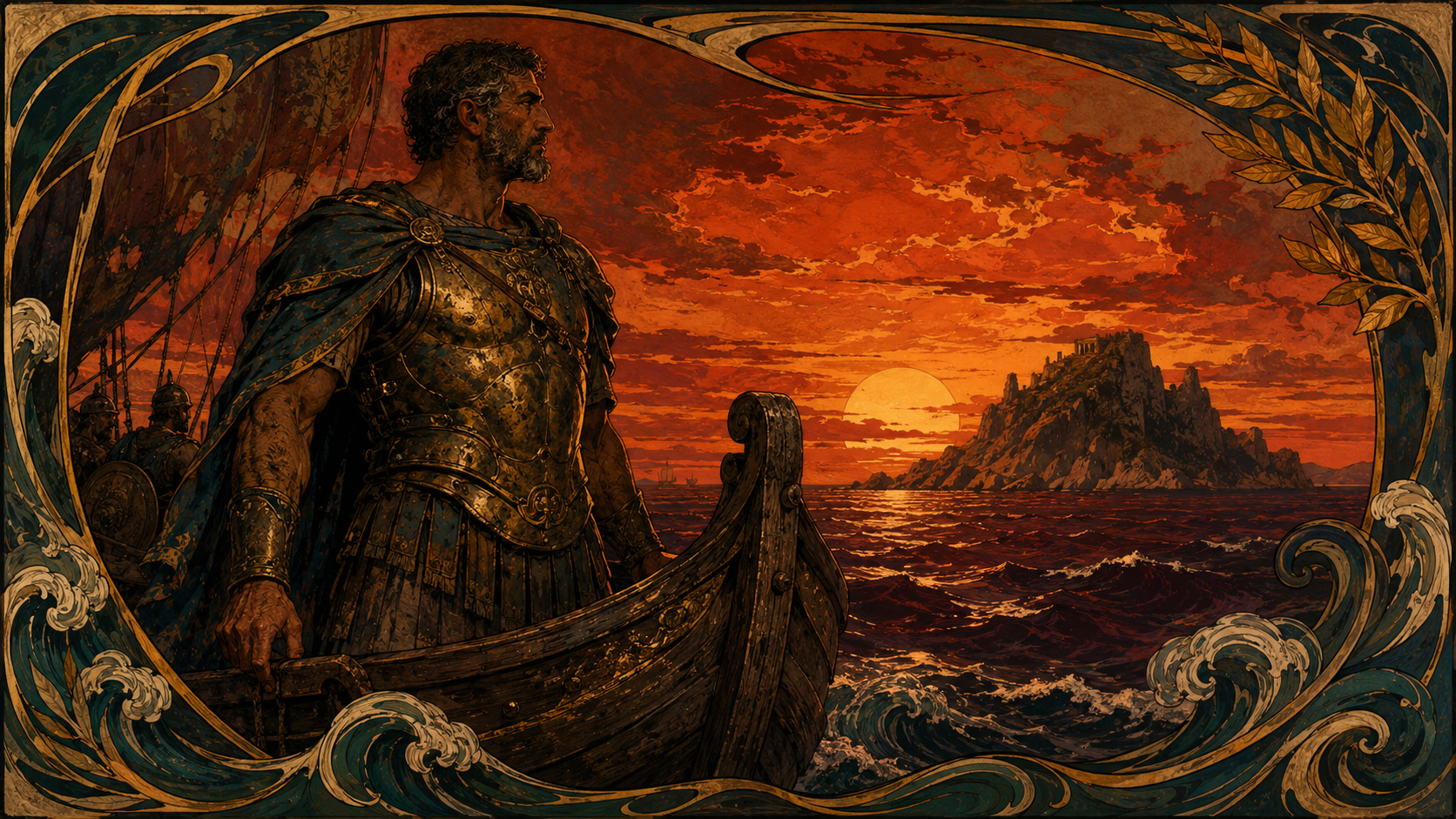
When it finally comes, the reunion between Odysseus and Telemachus is one of the most emotionally devastating scenes in all of Western literature. It happens not in the great hall of Ithaca, surrounded by ceremony and witnesses, but in the humble hut of Eumaeus the swineherd, a man so loyal he has tended his absent master's pigs for twenty years without losing faith.
Odysseus has been in disguise as an old beggar. Athena instructs him to reveal himself to Telemachus, and she restores his appearance: taller, younger, his skin darkened and his rags replaced. Telemachus looks at the transformation and recoils. He thinks a god is playing tricks on him. "You are not my father," he says. No mortal could change like that. Odysseus has to insist, gently: no, it is me, it is really me, I am your father, and I have come home after twenty years.
And then the walls come down.
"As he spoke he sat down, and Telemachus threw his arms about his father and wept. They sat thus weeping and mourning so bitterly that their crying was like that of hawks or eagles whose young have been taken from their nest by country folk before they are fully fledged." Homer, The Odyssey, Book 16 (Samuel Butler translation, 1900)
That simile is extraordinary. Homer compares these two grown men, a warrior king and his nearly adult son, to parent birds crying over stolen young. The image captures everything at once: the predatory fierceness of their bond, the vulnerability beneath it, the sense that something precious was taken and can now, at last, be held again. It is the sound of twenty years of silence breaking.
Homer tells us they would have sat there weeping until sundown if they had not forced themselves to stop and begin planning. And that detail matters, too. The reunion is not an ending. It is a beginning. Father and son must now work together to reclaim their household, and the tenderness of this scene gives way almost immediately to strategy. Odysseus outlines the plan to destroy the suitors, and Telemachus, transformed by his own journey and by the reality of his father's presence, is ready to follow it.
Fighting Side by Side
The slaughter of the suitors in Books 21 and 22 is the Odyssey's great reckoning, and father and son fight it together. Odysseus strings the great bow that no suitor can bend, fires an arrow through twelve axe heads, and then turns the weapon on the men who have devoured his household. But he does not fight alone. Telemachus stands beside him with a sword and spear, and this matters enormously. The boy who could not even speak up in his own hall at the start of the poem is now killing the men who tormented his family.
Homer gives Telemachus a specific, imperfect moment during the battle that deepens the father-son dynamic. Telemachus is the one who accidentally leaves the storeroom door unlocked, allowing the goatherd Melanthius to arm some of the suitors with weapons from the armory. It is a mistake, and Odysseus rebukes him for it. But the rebuke is not devastating. It is the kind of correction a father gives a son who is learning, not a condemnation of failure. Telemachus accepts it and keeps fighting. He is not yet his father's equal, and the poem does not pretend otherwise. But he is there, in the room, with a weapon in his hand and his father at his side. That is the transformation the poem has been building toward since Book 1.
After the battle, father and son stand together in a hall full of the dead. The ending is violent, and the poem does not look away from the cost. But the image of Odysseus and Telemachus together, having reclaimed what was taken from them, is one of the deepest satisfactions the Odyssey offers. The household is restored. The father has returned. The son has proven himself. The absence that shaped everything has, finally, been filled.
The Parallel Fathers and Sons
Homer never tells a story in isolation. The relationship between Odysseus and Telemachus is reflected and refracted through several other father-son pairs, each one casting a different light on the central bond.
The most important parallel is Agamemnon and Orestes. Throughout the poem, the story of Agamemnon's murder by his wife Clytemnestra and her lover Aegisthus is held up as a cautionary tale and a model. Agamemnon came home from Troy and was killed in his own house. His son Orestes, still a boy when it happened, grew up and returned to avenge his father by killing the murderers. This story is told and retold by Nestor, Menelaus, and even Athena herself, always with the same implication: Orestes did what a good son does. Telemachus should follow his example. The comparison is both an inspiration and a pressure. Telemachus must prove he is the kind of son who would avenge his father, even before he knows whether his father needs avenging.
Nestor and his son Pisistratus offer a gentler parallel. When Telemachus arrives at Pylos, Nestor's son greets him warmly and accompanies him on the journey to Sparta. Pisistratus is everything Telemachus could have been if Odysseus had come home: confident, generous, at ease with his place in the world. He is also kind. When the conversation at Sparta turns to the dead, Pisistratus mentions his own brother who died at Troy, and his quiet grief mirrors Telemachus's louder one. This friendship between sons of famous fathers is one of the Telemachy's most touching details.
Then there is Laertes, Odysseus's own father. The old king has retreated to a farm outside the city, wasting away with grief, wearing rags, and sleeping on the ground. He is the mirror image of Telemachus: a father who has lost his son instead of a son who has lost his father. Their reunion in the final book is briefer than the scene in Book 16, but it closes the circle. Three generations of the same family, separated by war and time, are brought together again. Laertes, who was too old and too broken to fight the suitors, picks up a spear when the families of the dead march on the household. Athena fills him with strength, and the old man throws his spear and kills the father of the suitor leader Antinous. It is the last act of violence in the poem, and it belongs to a father defending his son and grandson. The bonds between these three men, Laertes, Odysseus, and Telemachus, are what the suitors violated and what the poem exists to restore.
What Homer Says About Fathers and Sons
The Odyssey does not treat the relationship between fathers and sons as sentimental. It treats it as structural. In Homer's world, a father is not simply a source of affection. He is the person who teaches his son how to be a man, how to lead a household, how to speak in assemblies, how to judge when to fight and when to hold still. Without that teaching, the son is incomplete. Without that son, the father's work has no heir. The bond is not just emotional. It is the mechanism through which civilization passes from one generation to the next.
This is why Telemachus's journey matters as much as Odysseus's. The father must return, yes, but the son must also become someone worth returning to. If Telemachus had remained the passive, overwhelmed boy of Book 1, the reunion would have been hollow. Odysseus would have come home to a son who was not ready for him. Instead, Homer gives Telemachus four books of growth, travel, and learning so that when the moment comes, the son can look his father in the eye as something close to an equal.
The duty runs both ways. Odysseus rejects Calypso's offer of immortality not because he is indifferent to eternal life, but because he cannot abandon his role. He has a wife, a son, a father, a household, a kingdom. These obligations are not burdens the poem asks him to escape. They are the things that make his life meaningful. The choice between immortality and nostos is, at bottom, a choice between a life without responsibility and a life defined by it. Odysseus chooses responsibility, and the poem honors that choice as the highest form of courage.
Nearly three thousand years after Homer composed the Odyssey, the themes of fatherhood and sonship it explores have not faded. The longing of a parent separated from a child, the uncertainty of a child growing up without a guide, the overwhelming relief of reunion, and the difficult, imperfect work of building a relationship out of shared purpose rather than shared history: these experiences belong to every generation. Homer understood that the bond between father and son is not given. It is earned, tested, and, if you are fortunate, restored.
Continue Reading
Hear Father and Son Reunite
Full-cast narration with every word highlighted as it is spoken. Start free with Book I, then unlock all twenty-four books for $6.99.
Start Listening FreeContinue the Journey
Hear the complete Odyssey read aloud with 60+ character voices. Every word highlights as it is spoken.
Book I is completely free. No signup required.
Go Deeper Into the Odyssey Film
Get the free Odyssey Companion Guide: character map, timeline, family tree, and the essential scenes from Homer's poem and the film.
No spam. Unsubscribe anytime.